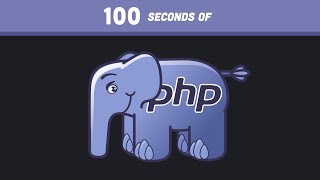

PHP is NOT dead!
45sChallenges the common belief that PHP is dead by listing major platforms that still use it.
▶ Play Clip"The video delivers exactly what the title promises: a concise overview of PHP in 100 seconds."
PHP is a dynamic, interpreted scripting language for server-side web development. Despite criticism, it remains popular, powering CMS like WordPress and sites like Wikipedia. Created in 1994 by Rasmus Lerdorf, it was one of the first languages embedded in HTML, making dynamic web development accessible.
PHP is a dynamic interpreted scripting language for building interactive websites on the server. It powers content management systems like WordPress, top-tier websites like Wikipedia, and frameworks like Laravel and Symfony. Facebook uses it with a custom compiler.
Created in 1994 by Rasmus Lerdorf to manage his personal homepage. Originally stood for 'Personal Home Page', now officially 'PHP: Hypertext Preprocessor'. It predates JavaScript and was one of the first languages embedded directly in HTML.
Create a PHP file with HTML. Use <?php tags to enter PHP mode. Use 'echo' to output values. Variables start with '$'. It's weakly typed. Predefined variables like $_GET, $_POST, $_COOKIE handle HTTP requests.
Supports multiple programming paradigms: first-class functions, anonymous functions, built-in functions for web development, and a complete object model with classes and inheritance.
Current version is PHP 8 with modern features. 78.5% of websites use PHP, making it essential for web developers.
PHP remains a foundational language for web development, powering a majority of websites. Its ease of use and extensive features make it a valuable skill for any web developer.
What does PHP originally stand for?
Personal Home Page
0:24
Who created PHP?
Rasmus Lerdorf
0:24
What is the current major version of PHP?
PHP 8
1:59
What percentage of websites use PHP?
78.5%
2:09
What tag is used to enter PHP mode in an HTML file?
<?php
1:04
How do you output a value in PHP?
Using 'echo'
1:12
What character do variable names start with in PHP?
$
1:17
Is PHP a strongly typed or weakly typed language?
Weakly typed
1:21
Name one predefined variable in PHP for HTTP requests.
$_GET, $_POST, or $_COOKIE
1:26
What year was PHP created?
1994
0:24
PHP's Popularity Despite Haters
Highlights PHP's enduring relevance in web development despite criticism.
0:06Origin of PHP Name
Explains the original and current meaning of the acronym, showing its evolution.
0:24PHP Predates JavaScript
Historical context showing PHP's early role in dynamic web development.
0:41PHP 8 Modern Features
Indicates PHP continues to evolve with modern programming features.
1:5978.5% of Websites Use PHP
Statistical evidence of PHP's dominance in web development.
2:09[00:00] [Music]
[00:00] PHP a dynamic interpreted scripting
[00:03] language for building interactive
[00:04] websites on the server despite the
[00:06] haters pronouncing it dead it remains
[00:08] one of the most popular languages for
[00:10] back-end web development it Powers
[00:11] content Management Systems like
[00:12] WordPress top tier websites like
[00:14] Wikipedia and countless others via
[00:16] Frameworks like LVL and Symphony hell
[00:19] man even Facebook uses it although they
[00:20] built a custom compiler to convert it to
[00:22] machine code on their servers it was
[00:24] created in 1994 by Rasmus lerdorf to
[00:27] manage his personal homepage clever
[00:29] acronym but it sounds lame for a
[00:31] language that powers multi-billion
[00:32] dollar Enterprises so today we practice
[00:34] cognitive dissonance to tell ourselves
[00:36] PHP stands for hypertex pre-processor it
[00:39] has a special place in history because
[00:41] it predates JavaScript and was one of
[00:42] the first languages to be embedded
[00:44] directly in HTML allowing websites to be
[00:46] built dynamically on a server it's open
[00:49] source and was one of the technologies
[00:50] that revolutionized the web by making
[00:52] application development accessible to
[00:54] the average person its interpreter is
[00:56] implemented in C and has a syntax
[00:58] inspired by Pearl to get started create
[01:00] a PHP file and add some basic HTML to it
[01:04] within this file you can go into PHP
[01:06] mode by opening a question mark PHP tag
[01:09] the code Within These tags will be
[01:10] rendered on the server use Echo to
[01:12] Output a value in the location of the
[01:14] tag to declare a variable give it a name
[01:17] that starts with a dollar sign followed
[01:18] by a value it's a weekly type language
[01:21] so no type annotations are necessary it
[01:23] also comes with a large number of
[01:24] predefined variables geared towards web
[01:26] development like git post and cookie
[01:29] which contain information about the
[01:30] incoming HTTP request now when this code
[01:33] is rendered on your server it will
[01:34] output an HTML string with the PHP tags
[01:37] being replaced by whatever you echoed
[01:39] the language also supports multiple
[01:41] programming paradigms you have first
[01:42] class functions which can be assigned to
[01:44] variables or used anonymously as
[01:46] argument and it has tons and tons of
[01:48] built-in functions to do pretty much
[01:50] anything a web developer could ever
[01:51] imagine doing it also has a complete
[01:54] object model where you can Define
[01:55] classes with inheritance to implement
[01:57] objectoriented patterns we're currently
[01:59] on PHP version 8 which has all the
[02:01] features you would expect from a modern
[02:03] pragmatic language every web developer
[02:05] should be familiar with it because
[02:06] statistically there's a 78.5% chance
[02:09] that your client's website is running
[02:11] the personal homepage language this has
[02:12] been PHP in 100 seconds hit the like
[02:15] button if you want to see more short
[02:16] videos like this thanks for watching and
[02:18] I will see you in the next one

⚡ Saved you 0h 02m reading this? Transcribe any YouTube video for free — no signup needed.