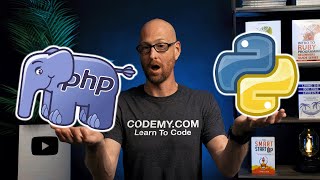

Python vs PHP: Which is Easier to Learn & Code?
56sBeginners crave a clear, syntax-level comparison to pick the right language, making this segment highly shareable and engaging.
▶ Play Clip"The title is accurate; the video thoroughly compares the two languages as promised."
The video compares Python and PHP for new coders across six factors: ease of learning, ease of coding, primary use cases, community and resources, job outlook, and final recommendation. Both languages are beginner-friendly but serve different niches, with Python being more versatile and PHP dominating web development through WordPress.
Both are easy for beginners, with Python slightly easier due to clean syntax.
Python is more readable (pseudo code, indentation), PHP uses more symbols.
Python: data science, ML, web dev, GUI, automation. PHP: server-side web scripting, especially WordPress (43% of websites).
Both have large communities and abundant resources.
Python offers more diverse job opportunities; PHP jobs are plentiful in web/LAMP environments.
Python is better overall for versatility; PHP excels in web. Suggests comparing PHP to JavaScript instead.
How long does it take a complete beginner to learn the basics of Python or PHP?
A few days to a week.
0:42
Which language is known for its readability and simplicity?
Python's syntax is cleaner, more readable, resembles pseudo code, and uses indentation.
0:55
Name three areas where Python excels.
Data science, machine learning, AI, back-end web development, GUI apps, and automation.
1:19
What is PHP primarily used for?
Web page scripting, especially powering WordPress (43% of websites).
1:17
What percentage of websites use WordPress, which runs on PHP?
43% of all websites.
2:06
What does LAMP stand for?
Linux, Apache, MySQL, PHP.
2:23
Why does Python generally have more diverse job opportunities than PHP?
Because PHP is more specialized for web development, while Python is used for many more applications.
3:17
What comparison does the speaker suggest might be more fair than Python vs PHP?
PHP to JavaScript, since both are primarily web page scripting languages.
3:52
Six-point comparison framework
Provides a structured approach for evaluating programming languages.
0:10WordPress market share
43% of websites use WordPress, highlighting PHP's massive real-world usage.
2:06Python's versatility advantage
Python is used for many more applications than PHP, making it the more general-purpose choice.
3:47Fair comparison point
Suggests comparing PHP to JavaScript for a more balanced perspective.
3:52[00:00] Python versus PHP, which is better?
[00:02] Let's talk about it. Hey guys, John
[00:03] Elder here from codemy.com and if you're
[00:05] a brand new coder looking to get
[00:06] started, which programming language
[00:08] should you pick? Python or PHP? Let's
[00:10] break it down to these six things. One,
[00:12] how easy are they to learn? Two, how
[00:14] easy are they to code? Three, what are
[00:16] each good for? Four, how are their
[00:17] communities and resources? Five, what's
[00:19] the job outlook for each? And six,
[00:21] what's my final recommendation? First,
[00:23] how easy are they to learn? And the
[00:25] answer is, pretty easy. If you have any
[00:27] sort of coding background or if you
[00:28] already know some other programming
[00:29] language, you can easily pick up the
[00:31] basics through, I'd say, intermediate
[00:33] levels of both Python and PHP in an
[00:35] afternoon. I've several intro courses
[00:37] for both at codemy.com and I also wrote
[00:39] a best-selling Python book and some PHP
[00:40] books that could help. If you're brand
[00:42] new to coding, you can still pick up
[00:43] either in a few days to, I'd say, a week
[00:45] with no problem at all. Python is
[00:46] probably a little bit easier to learn,
[00:48] but PHP is pretty simple, too. Next, how
[00:50] easy are they to code? Python is
[00:52] definitely the easier of the two to
[00:53] code, but PHP is really not bad at all.
[00:55] Python is known for its readability and
[00:57] simplicity. Its syntax is clean and
[00:59] resembles pseudo code, more natural
[01:01] language-like, and it uses indentation
[01:03] to make things easier to read. PHP, on
[01:05] the other hand, can seem just slightly
[01:06] more complicated. The syntax is a little
[01:08] less readable because it uses lots of
[01:10] weird characters, semicolons, and lots
[01:12] of brackets and things like that. It's
[01:13] just a little harder to look at and
[01:15] easily comprehend. Not super hard, but
[01:17] harder than Python. Third, what are each
[01:19] good for? Python is a great general-use
[01:21] programming language. It excels at data
[01:23] science, machine learning, and AI
[01:24] because of popular libraries like NumPy,
[01:26] Pandas Matplotlib Scikit-learn and
[01:28] PyTorch. We've got tons of videos on all
[01:30] of those here on the channel. Python is
[01:31] also great for back-end web development
[01:33] because of popular frameworks such as
[01:34] Django and Flask. It's also great for
[01:36] graphical user interface apps, GUI apps,
[01:39] using the Tkinter and PyQt libraries.
[01:41] We've got tons of Tkinter, PyQt, Django,
[01:43] and Flask courses here at codemy.com.
[01:45] Python is also great at just
[01:47] general-purpose coding. Have repetitive
[01:49] tasks? Python is great at automating
[01:50] them. PHP, on the other hand, is a great
[01:53] server-side scripting language for web
[01:54] pages. While it can be used on its own
[01:56] or in a PHP framework such as Laravel,
[01:58] Cake, or Symphony, the majority of its
[02:01] use will be in powerhouse content
[02:02] management systems such as WordPress,
[02:04] Drupal, or Joomla. As of 2024, some
[02:06] sources put the number of WordPress
[02:08] websites on the entire internet at 43%.
[02:11] Think about that. 43% of all websites
[02:14] are made with WordPress, and PHP powers
[02:16] WordPress. That gives it a ton of clout.
[02:18] Though, outside of web development,
[02:20] you'll be hard-pressed to find many uses
[02:21] for PHP. You may have heard of the term
[02:23] LAMP, which is a massively popular way
[02:25] to deploy web apps. LAMP stands for
[02:27] Linux machines, Apache web servers,
[02:29] MySQL databases, and PHP. LAMP LAMP is
[02:33] super popular because of its relative
[02:34] ease of use, yet pretty high level of
[02:36] functionality. And PHP is usually always
[02:39] installed by default on most basic web
[02:41] hosting packages. Fourth, community and
[02:43] resources. Both Python and PHP have
[02:45] extensive, massive, fanatic communities
[02:47] with robust resources. If you have a
[02:49] question or a problem with your code
[02:51] along the way, you can always expect to
[02:53] find dozens of answers instantly via
[02:55] Google or Stack Overflow for each.
[02:57] Learning resources for each are endless,
[02:59] as well. There are tons of tutorials,
[03:00] books, online courses, and bootcamps for
[03:02] each of them. Five, what's the job
[03:04] outlook for each? Both Python and PHP
[03:06] are two of the most in-demand
[03:07] programming languages in the world.
[03:09] Neither are going away anytime soon.
[03:11] Just head over to any job listing
[03:12] website like indeed.com and search for
[03:14] jobs in your area for each of them.
[03:15] You'll likely find more diverse job
[03:17] opportunities for Python simply because
[03:19] Python does more stuff than PHP does.
[03:21] But, if you're looking to focus solely
[03:23] on web development, especially in a LAMP
[03:25] or WordPress environment, PHP jobs are
[03:27] plentiful and decent paying. Remember,
[03:29] 43% of all websites on the entire
[03:31] internet use WordPress, which uses PHP.
[03:34] Salaries for each are competitive, and
[03:35] it really just comes down to what sort
[03:37] of work you're interested in doing.
[03:38] Finally, which is better? Which do I
[03:40] recommend? Well, to pick between these
[03:42] two isn't really fair since Python is
[03:43] used for so many more things than PHP is
[03:45] used for. So, in that sense, Python is
[03:47] clearly better. But, for what it does,
[03:49] PHP is no slouch. A better comparison
[03:52] might be PHP to JavaScript since they're
[03:54] both primarily web page scripting
[03:55] languages. If you're interested in that
[03:57] comparison, check out the next video in
[03:58] the playlist which should appear
[03:59] somewhere up there. And as always, you
[04:01] can learn all of these languages and
[04:02] frameworks over at codemy.com where you
[04:04] can get 50% off lifetime membership
[04:06] today using coupon code YouTube50. My
[04:08] name is John Elder from codemy.com and
[04:10] I'll see you in the next video.
⚡ Saved you 0h 04m reading this? Transcribe any YouTube video for free — no signup needed.