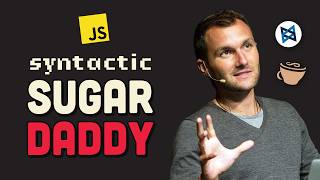

JavaScript Was a Disaster in 2009
45sOpens with a relatable, nostalgic setting and shocking claim about JavaScript's flaws, hooking viewers who remember or want to learn about the language's dark past.
▶ Play Clip"The title accurately reflects the video's content, which discusses Jeremy Ashkenas's contributions to JavaScript."
In 2009, JavaScript was widely considered the worst programming language, lacking standard library, modules, classes, and consistent browser support. Jeremy Ashkenas, a developer at DocumentCloud, set out to transform it by creating underscore.js, CoffeeScript, and Backbone.js. His innovations laid the groundwork for modern JavaScript, many features of which were later adopted into the language itself.
JavaScript in 2009 had no standard library, modules, or classes; every browser interpreted it differently.
Jeremy released underscore.js, a utility belt with ~60 helper functions for arrays/objects.
CoffeeScript created a new language that compiled to JavaScript, fixing bad parts like class syntax and arrow functions.
Backbone.js introduced MVC on the front end with models, collections, views, and an event system.
Many CoffeeScript features (classes, arrow functions, destructuring) were absorbed into modern JavaScript.
Jeremy Ashkenas significantly improved JavaScript through underscore.js, CoffeeScript, and Backbone.js, many features of which were later adopted into the language itself.
In what year was the video set when JavaScript was considered a bad language?
2009
What were three major problems with JavaScript in 2009?
It had no standard library, modules, or classes, and every browser interpreted it differently.
0:31-0:36
Who is credited as the forgotten developer who saved JavaScript?
Jeremy Ashkenas
1:12-1:14
What utility library did Jeremy release to add helper functions to JavaScript?
underscore.js
1:56-2:01
What new language did Jeremy create that compiled to JavaScript?
CoffeeScript
3:10-3:13
What library gave JavaScript developers their first taste of MVC on the front end?
Backbone.js
4:26-4:33
Name at least three JavaScript features that were originally pioneered by CoffeeScript.
Classes, arrow functions, default parameters, spread operator, string interpolation, destructuring
3:52-4:00
JavaScript's Bad Reputation
Sets the historical context for why JavaScript was disliked before improvements.
0:21-0:23Jeremy Ashkenas's Role
Highlights a key individual who drove JavaScript's transformation.
1:12-1:14underscore.js Utility Belt
Shows how a simple library solved the missing standard library problem.
1:56-2:01CoffeeScript Compilation
Demonstrates how compiling a new language to JavaScript led to language improvements.
3:10-3:13Backbone.js and MVC
Illustrates how Backbone.js introduced front-end MVC before modern frameworks.
4:26-4:33[00:00] It's 2009. You're at a Hannah Montana
[00:02] movie and your phone won't stop buzzing
[00:04] with notifications from a new dating app
[00:05] you just downloaded. Your favorite
[00:07] artist is supposed to be releasing a new
[00:09] album next year. Your favorite TV show
[00:11] is currently being made into a movie and
[00:13] you're still riding high from arguing
[00:14] how many days are in a week on the
[00:16] bodybuilding.com forums. Life is good,
[00:18] at least on the weekends, because during
[00:20] the week you have to spend all day using
[00:22] the worst programming language ever
[00:23] invented, a language that was famously
[00:25] designed in 10 days. But after using it,
[00:28] it had you wondering what Brendan did
[00:29] after day two. A language that every
[00:31] browser interpreted differently, had no
[00:33] standard library, modules, or classes.
[00:36] And if your primary job was to write it,
[00:37] I'm told you were a massive loser who
[00:39] didn't deserve to feel loved. At least
[00:41] that's how things were in 2009. But over
[00:43] the next decade, that sentiment changed.
[00:45] JavaScript went from being a language
[00:47] that you'd never touch directly without
[00:49] putting on a jQuery hazmat suit first to
[00:51] arguably the most popular programming
[00:53] language in the world. while JavaScript
[00:55] developers, despite all the stupid
[00:57] stickers on their MacBooks, went from
[00:58] being considered script kitties to real
[01:00] programmers with actual feelings and
[01:02] emotions. So, how exactly did this mass
[01:04] psychosis happen? There's a bunch of
[01:06] different reasons, but in my opinion, I
[01:08] think the most underrated was all led by
[01:10] a single person who has since been
[01:12] forgotten to time, Jeremy Ashkenus. In
[01:15] 2009, Jeremy was a developer at Document
[01:17] Cloud, where he had the unfortunate task
[01:19] of working on a heavy clientside
[01:21] JavaScript application, which was rare
[01:23] at that time. Having a background in
[01:25] Ruby, but being forced to write
[01:26] JavaScript, I assume every morning he'd
[01:28] wake up and think to himself, "Wow,
[01:30] today might be a good day to myself off
[01:32] theing Golden Gate Bridge." But unlike
[01:34] everyone else who had JavaScript
[01:36] Stockholm syndrome, Jeremy had the
[01:38] audacity to think he could fix it. And
[01:40] so he did. His first act was dealing
[01:42] with the fact that JavaScript had no
[01:44] standard library. Again, this was 2009.
[01:46] Although Firefox had shipped support for
[01:48] some array helper methods like map,
[01:50] reduce, and for each, Internet Explorer
[01:52] hadn't yet, which meant you couldn't use
[01:54] them unless you polyfilled them. So, to
[01:56] fix this, Jeremy released underscore.js,
[01:59] a utility belt library that contained
[02:01] about 60 helper functions that made it
[02:03] easier to work with arrays and objects.
[02:05] Now, I know that doesn't sound exciting
[02:07] today, but building for the web was so
[02:09] bad back then that underscore likely did
[02:11] save a few people from throwing
[02:12] themselves off theing Golden Gate
[02:14] Bridge. Underscore got so popular that
[02:16] many of its features were adopted into
[02:18] the JavaScript language itself, which
[02:20] eventually made it obsolete. But
[02:22] underscore was only Jeremy's first act.
[02:24] Next, he decided instead of augmenting
[02:26] fish head JavaScript with a new library,
[02:28] he'd have more freedom if he just
[02:30] created an entirely new language with
[02:32] large cannons. Again, I can't stress
[02:34] this enough. The JavaScript in 2009 was
[02:36] very different than it is today. There
[02:38] were no classes, so inheritance was done
[02:40] through a pattern where you'd manually
[02:42] attach properties to a hidden object
[02:44] called prototype that every function had
[02:46] access to. The only way to declare a
[02:48] variable had bizarre scoping rules that
[02:50] hoisted declarations to the top of a
[02:52] function whether you were aware of it or
[02:54] not. No one really understood or cared
[02:56] about the difference between the
[02:57] equality operator and the identity
[02:59] operator is so you'd have a bunch of
[03:01] type coercion happening without even
[03:03] realizing it. And to define even a
[03:04] simple function, you had to literally
[03:06] type out the word function every single
[03:08] time, which led to some pretty ugly
[03:10] code. But by building a new language
[03:12] that compiled a JavaScript, Jeremy could
[03:14] fix it without having to wait for the
[03:16] standards committee or browser vendors
[03:18] to do it themselves. And even better, he
[03:20] could leave JavaScript the bad parts in
[03:22] that musty room Brendan spent 10 days
[03:24] in. And for a while, Coffecript was
[03:26] huge. The father DHH adopted it almost
[03:28] overnight. And in 2011, it shipped as
[03:31] the default JavaScript prep-processor in
[03:33] Rails 3.1, meaning the front end for
[03:35] every new Rails app in the world was
[03:37] suddenly written in coffecript. A
[03:38] GitHub, Dropbox, and a long list of
[03:41] early 2010 startups adopted it. And for
[03:43] a few years, it was the default choice
[03:45] for anyone who took JavaScript
[03:46] seriously. Today, Coffecript is
[03:48] basically dead after its best features
[03:50] were absorbed into JavaScript itself.
[03:52] But every time your agent writes a
[03:54] class, arrow function, default
[03:56] parameters, a spread operator, does
[03:58] string interpolation or dstructures a
[04:00] value, you can thank coffecript. But
[04:02] Jeremy still wasn't done yet. By 2010,
[04:05] he had given JavaScript a standard
[04:06] library with underscore and a better
[04:08] syntax with coffecript. But there was
[04:10] still one massive problem left. There
[04:12] was no good way to actually structure a
[04:14] JavaScript application. If you wanted to
[04:16] build a large clientsideheavy app, you
[04:18] would still end up with thousands of
[04:20] lines of spaghetti where your data, DOM
[04:22] manipulation, and event handlers were
[04:24] all tangled together. So, in 2010,
[04:26] Jeremy released Backbone.js, a tiny
[04:29] library of less than 2,000 lines of code
[04:31] that gave JavaScript developers their
[04:33] first real taste of MVC on the front
[04:36] end. It introduced models for your data,
[04:38] collections for groups of models, views
[04:40] for rendering, and an event system that
[04:43] let everything stay in sync without the
[04:45] need to wire it up by hand. But for the
[04:47] first time, you could build a serious
[04:49] clientside app without it collapsing
[04:51] under its own weight. And with Jeremy's
[04:52] track record, it quickly caught on,
[04:54] powering the early versions of Trello,
[04:56] Airbnb, Hulu, Pinterest, and basically
[04:59] every other startup that needed a real
[05:01] front end between 2011 and 2014. If you
[05:04] were a JavaScript developer during that
[05:05] window, you almost certainly wrote
[05:07] Backbone and you probably thought it was
[05:09] the future. But as it turns out, it
[05:11] wasn't. Angular, Ember, and eventually
[05:13] React would make Backbone obsolete by
[05:16] taking its core ideas and pushing them
[05:18] further. But Backbone was the library
[05:19] that proved you could actually build
[05:21] clientsideheavy applications. It's easy
[05:23] to forget how bad JavaScript used to be,
[05:25] and even easier to forget the people who
[05:27] fixed it. But the modern web was built
[05:29] on top of ideas that Jeremy Ashken has
[05:31] pioneered, even if no one remembers him.
[05:34] But speaking of things you no longer
[05:35] have to build yourself, O is another one
[05:37] that thanks to Clerk, the sponsor of
[05:39] today's video, they just launched the
[05:41] Clerk CLI, which comes with commands
[05:43] that are even more powerful than the
[05:44] ones I saw at that human dog show. Just
[05:47] run Clerk andit in any directory, and
[05:49] it'll set up endto-end authentication
[05:51] for your entire project with custom
[05:53] middleware, O pages, and environment
[05:55] variables. It even detects if you're
[05:57] migrating from next off or off zero and
[05:59] walks you through the entire process.
[06:01] And since they know you're using agents
[06:03] to do all your dirty work, they also
[06:05] created clerk skills which ships
[06:07] framework specific patterns pinned to
[06:09] the CLI version. They see your coding
[06:10] agent knows exactly how to use it. And
[06:12] the clerk API command lets your agent
[06:15] hit the entire clerk backend API from
[06:17] the terminal without copy and pasting
[06:19] credentials. Try it out for free today
[06:21] at the link below or just run clerk init
[06:23] to get started. the thanks for watching
[06:25] and I will see you in the next one.



⚡ Saved you 0h 06m reading this? Transcribe any YouTube video for free — no signup needed.