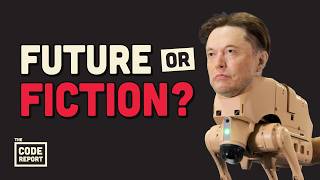

Robot hype is a lie
45sChallenges the viral robot demos and reveals experts say Rosie the maid is 10+ years away, sparking debate.
▶ Play Clip"The title accurately reflects the video's content, which debunks robot hype with expert insights from MIT."
The video discusses the gap between robot hype and reality, highlighting recent demos from Google and 1X, but contrasting them with insights from MIT researchers who say humanoid robots are decades away. It explains the technical challenges, such as dexterity and data, and offers a realistic view of current robot options.
Google's Gemini Robotics 2 and 1X's Neo robot demos show impressive capabilities, but these are designed to generate hype and pump valuations.
MIT researchers say Rosie the robot is decades away, and multi-finger dexterity success rates are only 0-90%, needing above 95% for practical use.
The Moravec Paradox explains why physical tasks are harder for AI: evolution has optimized sensory motor skills for 500 million years, while reasoning is new.
Robots lack a large-scale data source like the internet, so researchers use simulations and synthetic data, but training methods like imitation learning and RL are still not sufficient.
Current robot options include Boston Dynamics Atlas, Unit G1 at $13,500, and Agibot, but most startups don't sell their robots, so real-world performance is unknown.
What is a Vision Language Action (VLA) model?
A vision language action model that takes camera pixels and plain English inputs, then outputs motor commands for a humanoid robot.
02:13
Why are physical tasks harder for AI than reasoning tasks?
Because evolution has had 500 million years to optimize the sensory motor stack, while reasoning is a new beta feature.
03:37
What are the two main training methods for robots?
Imitation learning involves a human teleoperating the robot to clone behavior, while reinforcement learning lets the robot learn through trial and error.
04:54
What are the current success rates for multi-finger dexterity in robots?
Multi-finger dexterity success rates range from 0% to 90%, and need to be above 95% for practical use.
02:42
Why is data a challenge for training robots?
Because there is no large-scale data source like the internet for robots, so researchers use simulations or synthetic data.
04:29
Demos are hype, not reality
Robot demos from companies like Tesla are designed to generate hype and pump valuations, not show true capabilities.
01:48Dexterity success rates are low
Multi-finger dexterity success rates range from 0% to 90%, far below the 95% needed for practical use.
02:42Moravec Paradox explained
Physical tasks are harder for AI because evolution has optimized sensory motor skills for 500 million years, while reasoning is new.
03:37No internet for robots
Unlike LLMs, robots lack a large-scale data source, so researchers rely on simulations and synthetic data.
04:29Trust Me Bro demos
Many robot startups release impressive demos but don't sell the robots, so real-world performance is unknown.
05:20[00:02] Gemini Robotics, too, a crazy new AI model that can control a humanoid robot's entire body. In this demo video, they make robots walk, crouch, tie knots, screw in light bulbs, and even team up with other robots to clean up a
[00:15] room. On top of that, Silicon Valley startup 1X also just released its own crazy new demo of its neo robot playing Xbox and opening funions. And that can only mean one thing. The dream of owning a robot slave is finally upon us. But
[00:28] there's a big problem because as fate would have it, last week I spent a few days at MIT with actual robotics researchers. And I have some bad news. stuff without the incentive to raise money think that a robot that can
[00:41] replace your maid is still 10 plus years away. And that's being hyper optimistic. humanoid robot hype and find out where the true frontier of robotics is. As of today, it is August 11th, 2026, and you're watching the code report. 5 years
[00:56] ago, large language models wrote unusable garbage code and diffusion models produced images like this. But today, after scaling up data and reinforcement learning to a ridiculously massive scale, these same technologies
[01:08] made source code nearly obsolete to the point where Stack Overflow gets less than 1% of its former traffic. While video models can now generate content that's indistinguishable from reality. What will computers be able to do in the
[01:21] future? They'll probably do our homework. robots should be advancing at the same pace. Any day now, we should have robot welders building our Teslas, and robot soldiers in every war, making all
[01:36] bluecollar work obsolete. We may get there someday, but the reality right now is that robots are nowhere close to threatening these jobs. And the demos you see from Tesla and other Silicon Valley startups are designed to generate
[01:48] hype and pump valuations rather than show you the true frontier of robotics. To find the true frontier, let's start by taking a look at Gemini Robotics 2. >> For the robot, [music] dealing with challenges of the actual physical world
[02:00] is borderline impossible. >> The Gemini Robotics 2 system is actually three models with the most important one being a vision language action model or VLA. It takes inputs like camera pixels in plain English, then outputs motor
[02:13] what's special about this one is that it can run the legs, torso, arms, and fingers of a full humanoid robot under a single learned policy. And in Google's demos, we can see it do all kinds of impressive stuff with Appronics Apollo 2
[02:27] humanoids, things like walking and doing back flips are essentially solved problems, while achieving the dexterity of a human hand is very much an unsolved virtually any robot demo, you'll find that multi-finger dexterity success
[02:42] that multi-finger dexterity success rates range anywhere from 0% to 90%. And that's a big problem because nobody wants to buy a Rosie the robot maid who drops your dishes 10% of the time. >> What are you doing? Stop.
[02:58] realistically, these numbers would need to be well above 95% for a robot to make replacement. But why is this still so hard in the age of artificial intelligence? Well, during my recent visit to MIT Seale, I was able to play
[03:11] with all kinds of humanoids and learn how researchers there are also trying to make these robots actually work reliably. When these extremely smart researchers told me that Rosie the robot is decades away from being a reality, it
[03:24] made me think of more of X Paradox. The hard problems are easy, the easy problems are hard. Like AI can easily crush Magnus Carlson at chess, but it comes to stacking blocks. And when you think about it, evolution has had 500
[03:37] million years to optimize your sensory motor stack, while reasoning is just a new beta feature bolted on top. But from a technical standpoint, creating a policy for a robot is a much different problem than regurgitating some text out
[03:49] of an LLM. A large language model can spit out a set of discrete tokens, and generate them, and nobody dies if it's not perfectly accurate. A robot, on the other hand, needs to emit continuous values like joint angles and torqus and
[04:04] to dozens of different motors all working together in unison. If your policy is off by just a little bit, gravity will punish you by making the robot eat the floor. >> It scales across a wide variety of
[04:17] environments. >> What? language models got smart by ingesting the entire internet and every book ever
[04:29] written. But for robots, a data source like that just doesn't exist. And the way researchers are trying to get around this problem is to create simulations or synthetic data. Basically, the idea is you let a robot use a flight simulator.
[04:41] And after a while, it should be able to fly a real plane. But researchers still aren't exactly sure how they should even be training these robots. And currently, versus reinforcement learning. With imitation learning, a human
[04:54] teleaoperates the robot is so the model can clone its behavior. It's a simple idea but very difficult to scale up. The other idea is reinforcement learning where you just let the robot try to do stuff and have it learned through trial
[05:06] when it does something good. This is how unitary robots learn kung fu. But RL is still not good enough for safe general purpose robots. Now, there's a bunch of companies and startups like 1X, Figure, and Tesla who have these crazy Trust Me
[05:20] Bro demo videos, but you can't actually buy these robots, so nobody knows for you're serious about owning your own robot slave today, your options are your hands on the new Boston Dynamics Atlas, although Hyundai and Google
[05:35] to be weightlisted. Or you could get the Chinese Unit G1 with a $13,500 entry point. You've also got Aggiot in China shipping at scale, but the rest of the robotics field is much smaller than the hype actually suggests. And we might
[05:49] even get GTA 6 before we get humanoid robots in the kitchen. And that means there's a huge opportunity for software developers to write the code that makes these robots actually work. That's why you need to know about OmniGenet, the
[06:01] sponsor of today's video. It's an open- source meta harness that gives you one common layer over Claude Code, Codeex, and any agents you build yourself. So instead of being married to just one of them for everything, Omni lets you run
[06:13] multiple agents on the same project and swap them out with a oneline change or from the UI. I used it to resurrect one of my beloved side projects and the orchestrator had Claude Code build the API and codecs make the front end. And
[06:26] them debate each other to figure it out. The agents are governed by a set of policies that dynamically control things like cost, budgets, and model routing. And it all runs in a secure OS level sandbox, so you don't need to give it
[06:39] raw dog access to your actual file system or network. Every run also becomes a live session URL, which lets you share it with a teammate or steer don't have to be chained to your terminal. Omnien is Apache 2.0 licensed,
[06:53] and you can try it out for free right now at the link below. This has been the code report. Thanks for watching, and I will see you in the next one.


⚡ Saved you 0h 07m reading this? Transcribe any YouTube video for free — no signup needed.