
Why delivery robots fail
54sTaps into common frustrations with delivery robots, offering expert insight into their limitations.
▶ Play Clip"Delivers on the promise of answering robot questions with expert insight, though some answers are brief."
In this video, a robotics professor answers a series of questions from the internet about various robotics topics, including humanoid robots, autonomous vehicles, and the future of AI. The professor provides insights into the current state of robotics, the challenges faced, and the potential future developments.
The professor introduces the video and mentions that they will be answering questions from the internet about robots.
The professor discusses food delivery robots, noting that they work in some scenarios but are still first steps in solving the problem of automated package delivery. They can hit things and fall off the road, indicating there is still work to be done.
The professor explains that dancing robots are created by using human motion capture data and training reinforcement learning algorithms to mimic the human dance. The result is a robot that dances like the person.
The professor discusses the probability of AI becoming a threat, stating that if AI is trusted to make decisions, it will make bad decisions. However, AI can be used as a powerful tool, and there is no concern about sentient AI.
Legged robots are beneficial for operating on uneven terrain, while wheeled robots are limited to flat surfaces. Bipeds are the ultimate expression of legged locomotion and can climb ladders or enter small spaces.
Robot dogs have come a long way from research environments, with immense progress in hardware. However, practical use cases are still thin, but they can be used in disastrous scenarios.
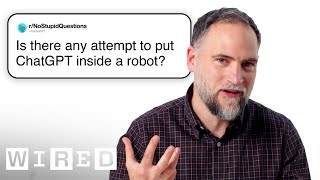
The professor explains that robots have multiple computers, similar to the human body having a brain and spinal cord. An LLM can parse language into code, but reinforcement learning is what actually moves the robot.
Autonomous cars are considered mobile robots, and they are one of the prime examples of advanced robots today, along with mobile warehouse robots like those used by Amazon.
Roomba uses a camera and large neural networks trained on internet images to identify objects in its environment. It checks with the internet to tell you what's going on.
Humanoid robots are suited to do the most things because the world is built for humans. They can navigate doors, stairs, and narrow corridors, and can be dropped into existing factories.
Amazon is the largest owner of robots, and warehouse robots are a large sector. They work synergistically with humans, and the remaining challenge is grabbing objects off shelves, which is more open-ended.
The professor would solve the exoskeleton problem, which could help people with mobility issues.
Some robots have backwards knees for mathematical advantages, such as having light legs to catch yourself as you fall. Birds have this morphology and have robust locomotion.
Curiosity is an incredible engineering feat, with a suspension system and wheels built for robustness on sandy terrain, and electronics that are battery-efficient and can communicate with Earth.
The autonomous car industry has rigorous safety methods, and despite crashes, there is evidence of high safety standards. A decade ago, autonomous cars were demoed, but safety is critical for survival.
LiDAR sends out laser pulses to create a 3D map of the environment, providing precise object identification. It is super effective for safety-critical applications, but Tesla thinks cameras can be made as good as LiDAR.
Surgical robots are better than surgeons at precise small motions and can perform them repeatedly. They provide haptic and tactile feedback while interacting with soft human tissue.
Clothes folding is a big challenge because fabric is deformable and moves. Robots need to interact with the environment in a compliant way, and teleoperation is used to teach robots this task.
The NEO robot was transparent about being teleoperated, which is a tacit acknowledgement that it can't do many tasks on its own. The missing piece is data, and internet-scale humanoid robot data could solve the problem.
The professor doubts that teleoperation data will work for training large models because the amount of data needed is immense. They suggest merging physics with human data to solve the general intelligence problem on humanoid robots.
The professor provides a comprehensive overview of the current state of robotics, highlighting both the remarkable progress and the significant challenges that remain. The key takeaway is that while robots are becoming more capable, there is still a long way to go before they can operate autonomously in complex, unstructured environments.
What is the main challenge with food delivery robots?
They can hit things and fall off the road, indicating there is still work to be done.
00:28
How are dancing robots created?
By using human motion capture data and training reinforcement learning algorithms to mimic the human dance.
01:37
What is the probability of AI becoming a threat?
The professor thinks it's fairly high if AI is trusted to make decisions, but there is no concern about sentient AI.
02:46
What are the benefits of legged robots over wheeled robots?
Legs are beneficial for operating on uneven terrain, while wheeled robots are limited to flat surfaces.
03:53
What is the role of an LLM in a robot?
It can parse language into code, but reinforcement learning is what actually moves the robot.
06:17
How does Roomba identify objects?
It uses a camera and large neural networks trained on internet images to identify objects.
07:47
Why are humanoid robots suited for many tasks?
Because the world is built for humans, so humanoid robots can navigate doors, stairs, and narrow corridors.
08:14
What is the remaining challenge in warehouse automation?
Grabbing objects off shelves, which is open-ended and requires local manipulators with suction cups or soft graspers.
10:37
Why do some robots have backwards knees?
For mathematical advantages, such as having light legs to catch yourself as you fall, like birds.
11:49
What makes the Mars rover Curiosity special?
Its suspension and wheels are built for robustness on sandy terrain, and it is battery-efficient and can communicate with Earth.
12:57
Why is LiDAR considered super effective?
It provides precise object identification and is useful for safety-critical applications like dynamic collision avoidance.
16:03
Why are surgical robots better than surgeons?
They are very good at precise small motions and can perform them repeatedly, with haptic and tactile feedback.
17:24
What is the challenge with clothes folding?
Fabric is deformable and moves, so robots need to interact with the environment in a compliant way.
18:20
What is the missing piece for humanoid robots?
Data. Internet-scale humanoid robot data could solve the problem, but the professor doubts teleoperation data will work.
19:29
AI threat probability
The professor gives a nuanced view on AI risk, distinguishing between decision-making AI and sentient AI.
02:46Legged vs wheeled robots
Explains the fundamental advantage of legs for uneven terrain, a key design consideration.
03:53LLM and reinforcement learning
Clarifies the roles of LLMs and RL in robot control, a common point of confusion.
06:17LiDAR effectiveness
Provides a clear argument for LiDAR in safety-critical applications, countering Tesla's camera-only approach.
16:03Data is the bottleneck
Highlights the central challenge in robotics: the need for massive, high-quality data.
19:29[00:00] I'm here today to answer your questions from the internet. [upbeat music] of these food delivery robots."
[00:15] They obviously work in some scenarios I think the bigger thing they're trying to solve like automated package delivery,
[00:28] A lot of these are first steps which is actually a really hard problem. has taught us a lot about both what works
[00:40] They can hit things, they can fall off the road. And I think that's sort of something to keep in mind that are actually in the field today
[00:54] And it tells you we got a lot of work to do. From Paradise Nights, I thought they were supposed to be our slaves,
[01:09] They're just partying." First and foremost, why are they having robots dance? that's happened in humanoids,
[01:24] I mean really the behaviors we've achieved is in the last year or two has been absolutely remarkable. And the way you do it is you start
[01:37] The reason why the dancing looks so human-like very beautiful and advanced engineering puppetry and the human dances, not me 'cause I'm a very bad dancer,
[01:53] and you get the trajectories from that data, And then you train a reinforcement learning algorithm or copies that human data as much as possible
[02:06] And the end result is it dances like the person meaning the environments like it was But you asked about this,
[02:19] And the answer to that is that we still don't know That's sort of the not-very-secret secret to be truly autonomous and in our homes
[02:32] The next question is from Projectguy111, in a Terminator future?" One is, what's the chance that AI in learning
[02:46] And I think that probability's actually fairly high If you trust AI to be the decision maker, for that AI, it will make bad decisions.
[02:59] you see that it can produce really nice answers sometimes, So we cannot trust AI. but you can use AI as a powerful tool.
[03:13] you get a lot of results back, So I think if we put, like, AI in charge then, you know, bad things will happen.
[03:27] It actually learned to think on its own, So I have no concern of sentient AI. They say AI, artificial intelligence,
[03:41] It has no notion of what it's saying or doing. we've never pattern-matched before. "What benefits do legged robots have over wheeled
[03:53] Legs are inherently beneficial if you wanna operate and more importantly, where things are not flat. as long as there's not uneven terrain.
[04:08] or wheeled someone out around in a wheelchair, Even what you perceive as flat, you realize there's curbs that don't dip enough,
[04:22] They become sort of sticking points to walk more robustly over multiple terrain types. I mean, where your dog or your cat can go on four legs
[04:36] Bipeds, of course, are sort of the ultimate expression So if you need to get into a small space or climb up a ladder, only a biped can do that.
[04:50] Give a ladder to a human, From SamMee514, So we've actually come a long ways in robot dogs,
[05:05] 'cause they have four legs. where we've gone from these robot dogs and research environments
[05:18] The hardware has made immense progress. I think the practical use cases are still a little thin. sending robots ahead in disastrous scenarios, right?
[05:33] The next question is from Leovan21, Yeah, there's lots of attempts. that have that as a layer in their humanoid robots.
[05:48] is that as we're making robots do things, So, imagine your body, you have a brain, So you sort of intrinsically have multiple computers
[06:03] Like, your spinal cord is a computer in its own right So at the highest level, at our cognitive level, So you wanna ask the robot a question
[06:17] So ask the robot, you know, It can use an LLM to parse that language into code, on the table and return based on that an estimate
[06:32] an LLM is not gonna reach for the apple. Or where reinforcement learning will come in, And those are what's actually running on the robot, right?
[06:46] is really what moves your body most of the time "Are autonomous vehicles mobile robots?" what the most advanced robot is today,
[07:01] and mobile warehouse robots like Amazon has. Autonomous cars, I think, are one of the prime examples So yeah, it's absolutely a robot,
[07:16] From Vnightpersona, I think what they're asking is how does the Roomba is the way we would technically phrase this question.
[07:31] that it sees and correctly identifying them. a bunch of examples of pictures on the internet, By teach, what we mean is we can train up
[07:47] basically this big neural network that takes images in And as a result, we can now correctly identify And so what Roomba does is, simply, it has a camera
[08:01] It's checking with the internet based on these large models and using that information to tell you what's going on. "Why make robots humanoid shaped
[08:14] Humanoid robots are the most suited to do the most things, Again, the world is built for us. We've built the robot for something of our shape
[08:29] Doors, stairs, narrow corridors, all these things. where a human can go, you want somebody to start making you sandwiches
[08:43] that can be dropped into an existing factory I wanna say all that as a preface to the fact for, again, a given application.
[08:57] the largest owner of robots is Amazon. one of the largest sector of robotics is warehouse robots. and then move them around warehouses.
[09:12] with the thing you order from Amazon, So the human can just stand there, Now you could theoretically have a humanoid robot do this,
[09:26] Like, these robots are very good to work synergistically with the robot. if you had an application that determined
[09:40] and you find that two arms is not enough and you wanna hold fire extinguisher. A Reddit user asks, "When it comes to automation,
[09:55] if not all, warehouse work with robots?" and then other ones are further away. Amazon is by far the leader in this domain.
[10:11] has been working on warehouse robots, to move pallets around, for, you know, 20-plus years now.
[10:23] so they maximally and efficiently can move packages So the question becomes what remains? which is grabbing these things off the shelf
[10:37] And so this is much more an open-ended work, So for that, you can use things called local manipulators, and maybe you use suction cups or soft graspers
[10:52] And you can do this with varying success levels right now, where you don't need a person present for all objects. all the different geometries and how they feel and look,
[11:08] to automatically and autonomously load all these objects. KaleidoscopeInside asks, with no financial barriers, what would your robot do?"
[11:22] I would try to sort of solve the exoskeleton problem. a billion in my mind could develop something
[11:34] A Reddit user asks, have their knees look backwards?" There's potentially mathematical advantage
[11:49] It's not just that they're inverted, So it turns out the way you control robots on robots is by having very light legs
[12:02] There's lots of mathematical reasons for that, And what that means is as you're walking, to catch yourself as you fall.
[12:14] And in addition, 'Cause birds actually have this type of morphology birds have some of the most robust locomotion out there.
[12:29] and then step up out of the hole And so if you can get that kind of behavior on robots, A Reddit user asks,
[12:43] "What is so special about the Mars rover Curiosity?" Pretty much everything, it was on Mars. are incredible engineering feats.
[12:57] And then the rover itself, they had these amazing engineering sort of gems in them You know, their suspension system is specifically built
[13:11] Their wheels are specifically built so they'll be robust So the entire structure is built to maximally be robust which have to deal with this very sandy
[13:27] where there's dust storms, you know. I mean, the sun doesn't come through at the same intensity. Electronics have to be battery-efficient, right?
[13:41] you have to talk back with Earth at the same time But to build a system like that, is an immense and remarkable engineering feat
[13:55] that sort of just makes me happy as an engineer. "Wait, how do autonomous cars even work? Like, are we trusting robots with our lives now?
[14:09] have gone through some things. there were all these startup companies that formed, And then exactly what you're worried about happened.
[14:25] Despite the fact that they'd already been working and I think that the entire autonomous car industry there was really rigorous safety methods.
[14:38] software, architectures, et cetera, And so in that way, there's a lot of evidence to show have very rigorous safety standards,
[14:52] with the limited number of crashes that they've had. but, you know, after a decade, A decade ago, we could have autonomous cars
[15:04] for, you know, a demo and actually driving around and a kid chases after it, right? meaning if you're not safe,
[15:18] you die, both as a company, but also as a technology. Why does Elon Musk think LiDAR is not a good idea?" but in my mind, LiDAR is awesome.
[15:34] autonomous cars, et cetera. the two most popular things, Now, LiDAR sends out a bunch of laser pulses
[15:48] So it's sort of 3D radar, but now it's using lasers, LiDAR. They can tell you not just how far objects are, but what objects there are
[16:03] the environment and things like that. of precisely identifying everything in the environment so you know exactly where all the objects are,
[16:15] LiDAR is super effective on robots and on autonomous cars It doesn't matter if you're sort of hitting another car
[16:28] You don't wanna hit any of that stuff. to do things like dynamic collision avoidance. And so I imagine that what they're thinking at Tesla,
[16:43] and make them as good as LiDAR, But I think what I found on robots And so for that, for safety critical applications,
[16:57] you want LiDAR in the loop to dynamic changes in the environment that's present in a lot of perception-based representations.
[17:11] "Why is a surgical robot better than a surgeon?" at certain things. They're very, very good at precise small motions
[17:24] repeatedly again and again and again. Basically, any place where you have to interact with the environment in a soft and tactile way.
[17:37] because our skin is soft, our organs are soft, to perform surgery, and sort of compliant interactions with the human body.
[17:51] The surgical robot can do those precise motions and they get all this haptic and tactile feedback while still being able to do what humans do really well,
[18:06] This is from theballisrond, The problem with clothes They move around, there's fabric.
[18:20] So a robot has to interact with something in the environment And so that's why this is a big challenge to try to understand this clothes folding problem.
[18:35] like you teleoperate the robot and then you try to teach the robot that task of the environment itself.
[18:47] that humans generated through teleoperation. "Whatever happened to the NEO robot?" that you could buy like a humanoid robot
[19:00] Now, to give them credit, they completely were transparent about the fact There's even in the app,
[19:14] with a teleoperator. One is it's a tacit, at least, acknowledgement I mean, that's the clear and obvious ramification.
[19:29] meaning it can't do a lot of tasks on its own, very few? is that the only thing that's missing is data. and that's what made LLMs possible.
[19:44] is if we can get sort of internet-scale humanoid robot data, just like ChatGPT solve the problems for language, is not so much that they think
[19:57] but rather this is an amazing way to do data collection. and then people agree to let you teleoperate them and then they're gonna use this data to train a large model
[20:12] If you can get early adopters to sign up for that, to actually train large models is that I don't think it's gonna work.
[20:26] you can collect in this way People tend to confuse LLMs and text with robots, In particular, the amount of data needed to understand
[20:41] think about them as trajectories as the language of robots. all this rich dynamic information. that it makes language seem simple.
[20:57] We developed language in a very small fraction was to do these other basic things, right? That's why they say you only use 10% of your brain.
[21:12] for these very complicated motions that we do, right? is I don't think that data's gonna work. not that it can't be helpful or help to polish things,
[21:26] You need to merge physics with human data the general intelligence problem on humanoid robots, That's it. That's all the questions.
[21:41] [gentle bright music]
⚡ Saved you 0h 21m reading this? Transcribe any YouTube video for free — no signup needed.