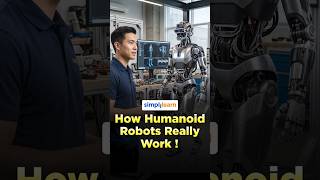

How Humanoid Robots See and Think
54sThis segment breaks down the complex process of how robots perceive and act, which is highly educational and intriguing for viewers.
▶ Play Clip"Title promises an in-depth explanation but delivers a 90-second overview with minimal depth."
This video explains how humanoid robots function, covering their human-like design, the sensors they use to perceive their environment, the AI that processes information, and the complex mechanics of movement and balance. It highlights how advances in AI are enabling these robots to operate in human-designed environments.
Humanoid robots are machines with a human-like body, typically including a head, torso, two arms, and two legs. Having a human-shaped body alone is not sufficient for functionality.
Robots use cameras to see objects and people, and sensors like lidar, depth sensors, and force sensors to understand distance, movement, and physical interaction.
The robot's computers use AI models to recognize objects, understand instructions, and decide what to do next. For example, when told to pick up a bottle, the robot identifies it, calculates its position, and plans arm movement.
Walking requires continuous adjustment of the center of gravity, foot position, and body movement to avoid falling, making it more complex than simple arm movements.
With AI advances, humanoid robots are becoming better at learning tasks, interacting with humans, and operating in environments designed for people, potentially working in factories, warehouses, homes, and other real-world settings.
Humanoid robots combine human-like design with advanced sensors, AI processing, and complex motor control to operate in human environments. As AI improves, these robots are poised to work alongside humans in various real-world applications.
Human-like Design is Just the Start
Clarifies that a human-shaped body alone is insufficient, setting up the need for sensors and AI.
00:02Sensor Suite for Perception
Lists specific sensor types (lidar, depth, force) that enable environmental understanding.
00:16AI Decision Pipeline
Illustrates the step-by-step AI process from object recognition to action planning.
00:29Balance is the Hardest Part
Highlights the continuous adjustments needed for walking, a key engineering challenge.
00:56AI Enables Human Environments
Connects AI progress to the feasibility of robots operating in human-designed spaces.
01:10[00:02] walk, see, talk, and even pick up objects almost like a human? Humanoid robots are machines designed with a human-like body, usually including a head, torso, two arms, and two legs. But, having a human-shaped body isn't
[00:16] enough. [music] The robot needs sensors to understand what is happening around it. Cameras help it see objects and people, while sensors such as lidar, depth sensors, and force sensors help it understand distance, movement, and
[00:29] All this information is processed by the robot's computers, which use AI models to recognize objects, understand instructions, and decide what to do next. For example, [music] if you tell a humanoid robot to pick up a bottle, it
[00:42] first identifies the bottle, calculates where it is, and plans how its arm should move toward it. Then motors and actuators move its joints, while constantly receiving feedback from sensors to maintain balance and control.
[00:56] Walking is even more complicated because the robot has to continuously adjust [music] its center of gravity, foot position, and body movement to avoid falling. With advances in AI, humanoid robots are becoming better at learning
[01:10] tasks, interacting with humans, and operating in environments designed for people. That is why humanoid robots could eventually work alongside humans in factories, [music] warehouses, homes, and other real-world environments.
[01:24] Subscribe to this channel for more such information.




⚡ Saved you 0h 01m reading this? Transcribe any YouTube video for free — no signup needed.