

NASA Chief Shocked by Starship Data
43sThe dramatic timing of the GAO audit and the subsequent flawless flight creates a compelling narrative of defiance and success.
▶ Play Clip"Title promises a shocking discovery, but the video delivers a solid technical breakdown with some hype."
This video analyzes SpaceX's Starship Flight 13 and its implications for the Artemis lunar landing program. It contrasts the GAO audit's concerns with the successful flight, breaking down which data from the test is actually relevant to landing on the Moon, particularly the 14-second Raptor relight and the control demonstrated during the flip maneuver.
One day before Flight 13, the GAO released a 119-page audit listing unsolved problems with Starship HLS. SpaceX flew anyway and succeeded.
Musk countered the audit on X, stating that landing on the Moon is easier than on Earth because there is no wind, simplifying the landing challenge.
Intuitive Machines' lander tipped over due to dead laser rangefinders and a safety switch issue, highlighting the difficulty of lunar landings even for small vehicles.
Ship 40's ascent burn was clean, with all six engines running smoothly, unlike the previous flight where a vacuum Raptor failed shortly after separation.
38 minutes after launch, Ship 40 relit one Raptor for 14 seconds. This is the most directly relevant number for HLS because it demonstrates restart capability in space.
In microgravity, propellant floats and forms blobs. Thrusters gently push the vehicle to settle the liquid near the feed lines, a process called ullage settling, before engine restart.
Relighting one Raptor does not prove SpaceX can transfer hundreds of tons of propellant between two docked Starships. It's a supporting piece, not the finished architecture.
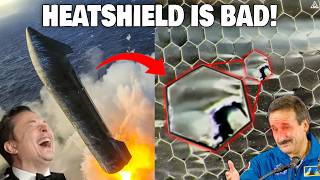
The heat shield, flaps, and belly flop are for Earth return, not lunar landing. HLS has no heat shield, no flaps, and never belly flops.
Ship 40's flip from horizontal to vertical demonstrated precise control over a massive vehicle, which is relevant to HLS's need to rotate and orient itself using engines.
Ship 40 stepped down from three engines to two to one during landing burn to manage thrust as the vehicle became lighter, a technique different from Apollo's single throttleable engine.
HLS will use smaller landing engines mounted higher on the vehicle for final descent, as Raptors may produce too much thrust in lunar gravity.
Musk is right that no wind on the Moon eliminates aerodynamic disturbances, but the engines must do all the braking, making the descent propellant-intensive.
Flight 13 clears one piece: restarting a Raptor in space. It does not prove refueling, long-duration storage, or landing legs, but it replaces an assumption with flight data.
Flight 13's success, particularly the 14-second relight and the control during the flip, provides valuable data that could accelerate the timeline for a lunar landing, but it does not solve all the challenges. The test flight reduces the number of unknowns, bringing the Moon landing closer by validating key assumptions.
What was the duration of the Raptor relight on Ship 40?
14 seconds
02:53
What is ullage settling?
Using thrusters to gently push the vehicle forward to gather liquid propellant near the engine feed lines in microgravity.
04:28
Why is the 14-second relight significant for HLS?
It demonstrates that SpaceX can restart a Raptor in space, a critical capability for lunar missions that require multiple burns.
02:53
What did the GAO audit list?
A list of unsolved problems with Starship HLS.
00:18
What is the difference between Apollo's descent engine and Starship's landing burn?
Apollo used a single deeply throttleable engine, while Starship changes the number of engines during the burn (from three to two to one).
09:21
Why does HLS need smaller landing engines?
Because lunar gravity is 1/6 of Earth's, so Raptors may produce too much thrust, pushing the vehicle upward instead of letting it settle gently.
10:02
What did Chris Hadfield praise about Ship 40?
He praised how well the ship survived, noting it was remarkable that it remained intact and could be inspected afterward.
06:34
What is the historical benchmark for a crewed lunar departure?
Apollo's Saturn 5 third stage using dedicated ullage motors before its translunar burn.
04:44
What does the video say about the heat shield and flaps for HLS?
HLS will not carry tiles or return through Earth's atmosphere, so it does not need a heat shield or flaps.
06:07
What is the first crude lunar landing planned for?
Artemis 4 in 2028.
11:38
GAO Audit Timing
The audit's release just before the flight adds tension and context to the mission's success.
00:1814-Second Relight
This is the most directly relevant data point for HLS, demonstrating restart capability in space.
02:53Ullage Settling Explained
Provides a clear explanation of a complex microgravity challenge that is critical for engine restarts.
04:28Control During Flip
Highlights the engineering challenge of controlling a massive vehicle's attitude, which is transferable to HLS.
07:28Musk's Wind Point
Musk's claim is partially correct but oversimplifies the challenges, making it a valuable point of analysis.
10:28[00:02] celebrating didn't come from SpaceX. It came from the man who runs NASA. Because the data that vehicle sent home may have handed Starship HLS something crucial. A way to reach the moon sooner than anyone expected. So, why is that? And what's in
[00:18] that data that's such a big deal? Before we go deep, you need to know this. One day before flight 13, the Government Accountability Office dropped a 119-page audit on Congress. Tucked into the section on Starship HLS was a list of
[00:33] problems still sitting there unsolved. Think about that timing. Days out from one of the most important test flights this program has ever attempted. And that's the week a congressional watchdog decides to
[00:45] publish. SpaceX would have had that report within hours. They didn't say a word. They just flew. The next day Starship lifted off, and the ship flew its mission just about perfectly. If you were watching, you already know how that
[00:58] felt. Chills, right? And the day after that, Musk went on X and threw a punch. He said, "Landing and remaining stable on any flat surface on the moon is much easier than Earth, as there is no wind on the moon." One sentence answering
[01:12] back everything the auditors had just said about his lander. So, which is it? Because landing on the moon has humbled everyone who's tried it. In February 2024, Intuitive Machines put the first American lander on the surface since
[01:26] Apollo. Its laser rangefinders were dead on arrival. A safety switch nobody flipped before launch. Engineers patched in a backup mid-flight, and the thing still came in with a little sideways drift, caught a foot, and tipped over.
[01:39] That vehicle was about 4 m tall. Now do it with a 52-m one. And Musk wrote that sentence anyway. Knowing all of it. So, what exactly did ship 40 send home that out loud? That's exactly what we're going to break down. So, subscribe to
[01:56] support the channel as we take a closer look at what ship 40 actually did that afternoon and which of those maneuvers really mattered. Ship 40 lifted off from pad B on Friday evening riding booster 20 and 33 Raptor 3 engines. 2 minutes
[02:10] and 21 seconds later the ship lit all six of its own engines and pulled away. All six ran smoothly to shut down. That sounds routine. It was not. On the previous flight a vacuum Raptor failed roughly 40 seconds after separation
[02:24] forcing the remaining engines to burn longer just to protect the trajectory. This time the entire ascent burn stayed clean. Useful data but still not the answer. Ship 40 deployed the Starlinks. Its flaps moved through space like the
[02:38] fins of a giant steel whale. Great footage but neither one directly tells us whether HLS can land on the moon. So what does? 38 minutes after launch ship 40 was coasting through vacuum with its engines cold. Then one Raptor came back
[02:53] to life. 14 seconds. That may be the most directly relevant number from the entire flight. Not because 14 seconds is unusually long but because of everything that had to happen before the engine could produce thrust. To understand that
[03:07] forget the usual image of a rocket firing continuously toward the moon. spacecraft burns its engines at a handful of precise moments. It changes speed, shuts down, and lets gravity carry it across the distance. Apollo
[03:22] worked the same way. The third stage of the Saturn 5 burned for roughly 6 minutes to send the crew toward the moon. Then it shut down and the 239,000
[03:34] miles. 6 minutes of engine, 3 days of falling. The engine does not have to run the whole way. It has to restart exactly when the mission needs it. Leave Earth orbit, slow down near the moon, begin the descent, then lift off the surface
[03:47] and return to Orion. Miss one of those burns and the mission does not simply become delayed. It ends. And that is what makes Ship 40's 14-second relight more important than it first appears. Because turning an engine back on in
[04:01] space is not like restarting a car. The difficult part begins before the ignition command is ever sent. That sounds simple. Turn it back on. In microgravity, propellant doesn't stay neatly at the bottom of the tank. It
[04:15] floats, breaks into blobs, and drifts around like water inside a bag. But a turbopump needs liquid. If gas enters the feed line instead, the pump can cavitate and lose the conditions required for a clean ignition. So,
[04:28] thrusters gently push the vehicle forward, gathering the liquid near the engine feed lines. Engineers call that ullage settling. Apollo's Saturn 5 third stage used dedicated ullage motors before its translunar burn. It sat in
[04:44] Earth orbit, settled its propellant, and restarted on command. That remains the historical benchmark for a crewed lunar departure. And this is where Ship 40's 14-second burn connects to the GAO audit. Orbital refueling will require
[04:58] SpaceX to control enormous amounts of liquid methane and oxygen in microgravity. The company will have to keep the propellant cold, manage slosh and gas, control pressure, and place the liquid where the transfer system needs
[05:12] it. Relighting one Raptor does not prove SpaceX can move hundreds of tons of propellant between two docked Starships. And that distinction matters. Flight 13 showed that SpaceX could prepare cryogenic propellant for ignition in
[05:26] space. It did not show that two docked vehicles could control their tanks, manage pressure, and move that propellant from one ship into the other. One supporting piece, not the finished architecture. And the remaining gap is
[05:39] still enormous. Ship 40 restarted after 38 minutes. A lunar Starship will need to manage propellant across mission time scales measured in days, potentially scales measured in days, potentially much longer. 38 minutes is progress. It
[05:52] is not a lunar mission, which brings us to everything else flight 13 produced. The heat shield? Not directly. HLS will not carry tiles or return through Earth's atmosphere. Neither will it use flaps or perform a belly flop. So, what
[06:07] could ship 40's final 20 seconds possibly teach SpaceX about landing on the moon? The answer is simpler than it sounds. Not the belly flop itself, but what happened immediately after it, the flip. The precise stop in the upright
[06:21] position and the landing burn stepping down from three engines to two and finally one. Ship 40 reached the Indian Ocean gently enough to remain intact. It leaned onto its side and floated there, cameras still running. Chris Hadfield
[06:34] saw those images and said it was remarkable how well the ship survived. A test pilot, a former commander of the International Space Station, a man who spent his career deciding whether machines were safe to fly. When he says
[06:47] a vehicle held up, that carries weight. But listen to what he was actually praising. He was talking about survival, about being able to walk up and inspect the thing afterward. And that's where I have to take something away from you.
[07:00] The lunar Starship has no heat shield, no tiles, no flaps. It never flies through an atmosphere, so it never belly flops. And it does not touch down on its Raptors. All that gorgeous reentry data, the tiles Hadfield praised, the flip,
[07:16] the belly, that's about coming back to Earth and flying again. It is not about landing on another world, but two things in those final seconds do carry toward the moon. And they are not the tiles or the flaps.
[07:28] The first is control. Ship 40 went from falling sideways to standing upright in only a few seconds. That is difficult not simply because Starship is long, but because so much mass sits far from its center of
[07:41] rotation. The farther that mass is spread from the axis, the more torque it takes to start the motion. And the more precisely the vehicle has to counter that torque to stop it. The Apollo lunar module was compact, light, and built for
[07:55] one environment. Starship is a 52-m steel cylinder arriving sideways. The flaps helped place ship 40 in the right attitude, but the engines finished the maneuver by gimballing their nozzles. They pushed the thrust off-center,
[08:08] rotated the vehicle upright, and then arrested that rotation before it went too far. Starting the flip is only half the job. Stopping it cleanly is the hard The maneuver itself does not transfer directly to HLS. The lunar version will
[08:23] have no atmosphere, no belly flop, and no flaps. But the underlying control problem does. HLS will still have to rotate, hold its attitude, cancel unwanted motion, and keep an enormous vehicle precisely oriented using engines
[08:39] Flight 13 showed that SpaceX could throw a vehicle of this scale through a violent attitude change and stop it exactly where it wanted. That is useful moon data. But why did ship 40 step down from three engines to two, and finally
[08:54] lighter every second it burns propellant. While its engines can only throttle so far, eventually even their lowest stable setting can produce more thrust than the vehicle needs. So, SpaceX uses two controls at once. Engine
[09:08] count is the coarse adjustment. Throttle is the fine adjustment. Three engines burn away the remaining velocity immediately after the flip, then two, then one as the ship slows and becomes lighter. Apollo solved the same problem
[09:21] with a deeply throttleable descent engine built specifically for the lunar module. One vehicle relied on a specialized engine. Starship changes the number of engines during the burn. Different hardware, same problem. But
[09:33] this is where the comparison with HLS reaches its limit. Ship 40 used sea level Raptors for its landing burn. HLS will operate in vacuum where the large their intended environment. Those engines can remove most of the vehicle's
[09:48] velocity high above the surface. The final touchdown is another matter. Lunar gravity is only 1/6 of Earth's, which means HLS needs far less thrust to remain suspended above the ground. Even a deeply throttled Raptor could produce
[10:02] more force than the vehicle needs, pushing it upward instead of letting it settle gently. So, what handles the final descent? In the public HLS design, SpaceX uses smaller landing engines mounted higher on the vehicle. The
[10:15] Raptors do the heavy braking. The smaller engines take over for the delicate work near the surface. The control logic transfers. The final hardware does not. And that brings us back to Musk's point about wind. During
[10:28] the belly flop, Starship deliberately exposes its broadside to the atmosphere. That drag removes most of its speed, but it also gives the air an enormous surface to push against. Gusts, shear, and changes in air flow all become
[10:42] disturbances the flaps and flight computer have to correct. Then the ship flips and has only seconds to erase whatever motion remains. On the moon, that entire category of uncertainty disappears. There is no wind, no shear,
[10:55] no atmosphere, and no moving drone ship underneath the vehicle after touchdown. The descent becomes cleaner and more predictable, but not easier in every way. Earth's atmosphere does much of the braking for free. On the moon, there is
[11:08] nothing to slow Starship down. Every foot per second has to be removed with propellant. So, Musk is right about one side of the equation. No atmosphere means no aerodynamic surprises. The price is that the engines have to do
[11:22] everything. So, does any of this actually bring a moon landing closer? Yes, but not because flight 13 rehearsed the landing. It didn't. The first crude landing is Artemis 4 in 2028. Before that, Artemis 3 has to prove in 2027
[11:38] that Orion and a lander can meet and dock in Earth orbit. SpaceX can't get there until Starship starts flying real orbital missions. Flight 13 cleared one piece of that. 38 minutes after launch, ship 40 restarted a Raptor in space.
[11:53] That proves nothing about refueling, long-duration storage, landing legs, regolith, or the HLS landing engines, but it replaces an assumption with flight data. Engineers can now hold their ignition models and tank pressure
[12:06] predictions against what a real Starship actually did. If the numbers match, that piece of the design firms up. If they don't, SpaceX finds the error now, not later, with two ships docked and hundreds of tons of cryogenic propellant
[12:20] between them. That's how a test flight makes the moon arrive sooner, not by skipping steps, by cutting the number of failures it takes to reach the next one.



⚡ Saved you 0h 12m reading this? Transcribe any YouTube video for free — no signup needed.