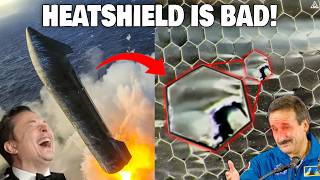

NASA Vets Call Starship Heat Shield a Dead End
44sThe shocking verdict from NASA veterans contradicts the celebration of Starship's successful flight, creating immediate controversy.
▶ Play Clip"The title promises a dramatic reaction but delivers a balanced analysis; still, it's informative and mostly delivers on the premise."
The video discusses the controversy surrounding SpaceX's Starship heat shield after a successful test flight, where three former NASA veterans declared the current thermal protection system a 'dead end' for rapid reusability. It contrasts the experts' concerns about operational turnaround with SpaceX's iterative approach and Elon Musk's goal of reducing launch costs to under $100 per kilogram.
Ship 40 survived re-entry at over 2,600°F, a first for Starship, with ceramic tiles intact, marking a major milestone.
Three former NASA veterans, including Dan Rasky, published an analysis declaring the current heat shield technology a 'dead end' for rapid reusability.
Elon Musk did not fire back but reiterated his long-term goal: Starship must achieve immediate and complete reusability to drop launch costs below $100 per kilogram.
Footage shows missing, cracked, and chipped tiles, raising questions about inspection and repair turnaround times, which are critical for rapid reuse.
SpaceX views the damage as a map for improvement, while the veterans see a physical limit. Historical Falcon 9 booster reuse improved over time, but reentry heating differs.
NASA's Space Shuttle had ~24,000 tiles and required extensive processing, with a record turnaround of 55 days, illustrating the operational burden of tile-based heat shields.
Starship uses standardized hexagonal tiles on pins over stainless steel, offering more thermal margin, but steel does not make the heat shield optional.
The veterans judge the ceiling of the current tile system; Musk bets on continuous improvement. Neither side has enough evidence yet.
The veterans argue NASA has underfunded next-generation heat shield research, leaving SpaceX to rely on imperfect technology.
Even if tiles are a dead end for Mars, they may be sufficient for Starlink and limited reuse, enabling cheaper access to orbit and funding future innovation.
The video concludes that while the NASA veterans' criticism is valid for the ultimate goal of rapid reusability, SpaceX's iterative approach may still achieve significant cost reductions. The heat shield debate highlights the tension between operational practicality and long-term innovation.
What was the temperature Starship's heat shield endured during re-entry?
Over 2,600°F
00:28
Who co-invented PICA, the heat shield material on Crew Dragon?
Dan Rasky
01:52
What is Elon Musk's target cost per kilogram for Starship launches?
Under $100 per kilogram
04:00
How many ceramic tiles does Starship have?
18,000
04:29
What was the record turnaround time for the Space Shuttle?
55 days
08:25
What is the main argument of the NASA veterans regarding Starship's heat shield?
The current thermal protection system is a dead end for rapid reusability.
02:19
How does Starship's tile mounting differ from the Shuttle's?
Starship uses standardized hexagonal tiles mounted on pins over stainless steel, while Shuttle tiles were custom-shaped and bonded to aluminum.
09:21
NASA Veterans' Verdict
Direct quote from Dan Rasky declaring the heat shield a 'dead end' for rapid reusability, setting the central conflict.
02:19Cost Goal
Musk's target of under $100 per kilogram contrasts sharply with SLS's $58,000 per kilogram, highlighting the economic stakes.
04:00Shuttle's Ghost
The Shuttle's operational burden serves as a cautionary tale for tile-based heat shields, emphasizing the importance of turnaround time.
07:58Core Disagreement
The video frames the debate as a wall versus a rough road, capturing the fundamental disagreement between the veterans and Musk.
10:31[00:02] SpaceX spent years relentlessly upgrading Starship's heat shield. It looked like a massive breakthrough. Then three respected NASA veterans stepped in and wiped away the celebration with one brutal verdict. Starship's current heat
[00:16] shield is a dead end for rapid reusability. So why are they so convinced SpaceX has reached a wall? And how did Elon Musk react to that how did Elon Musk react to that devastating claim? Let's dive in. So far
[00:28] Ship 40's survival still stands as one of the most remarkable thing SpaceX has ever pulled off. It hit the atmosphere at over 2,600° F, hot enough to melt steel, hot enough to turn almost any machine humanity has
[00:42] ever built into a shooting star. But it didn't burn. It flipped. It lit its engines. It set down on the Indian Ocean in the softest splashdown this program has ever flown. And then it just sat there.
[00:57] Floating. Whole. The ceramic tiles still on its belly. No Starship prototype had ever done that before. Musk's reaction was a full victory lap. The test worked. They got all the heat shield data they
[01:10] needed, he said, and then some. This was the moment SpaceX had been chasing for 6 years. And the credit goes to the one thing that dragged Ship 40 out of death's hands, the heat shield. But the very thing that just saved the ship is
[01:24] the thing that made three former NASA veterans shake their heads. In their eyes, this heat shield is still a dead end. And they didn't just say it in passing. They published a detailed analysis on LinkedIn, and a video from
[01:37] us here at Alpha Tech was cited in it as source material. Why? Listen to the man who delivered the verdict. Dan Rasky spent nearly 40 years at NASA's Ames Research Center studying exactly one problem, how to keep a spacecraft from
[01:52] burning up on the way down. He co-invented PICA. That's the material on the bottom of Crew Dragon, the shield standing between astronauts and the fire every time SpaceX brings a crew home. He helped put that technology in SpaceX's
[02:05] hands. And after reviewing flight 13, here is what he said, word for word. "Based on the data from the recent Starship VI 13 flight, we assert that the current thermal protection systems technologies are a dead end and cannot
[02:19] get to Mach 25 full and rapid reusability." Read that again. The man successful heat shield looked at their newest one and used the words dead end. He wasn't alone. Signing alongside him
[02:34] were Charles Camarda, a former NASA astronaut, and Charles Miller, who ran the NASA transition team for the current White House. Three veterans, real credentials, one brutal verdict four days after the best flight in the
[02:48] program's history. So, this is where you expect Elon Musk to fire back, call them expect Elon Musk to fire back, call them dinosaurs, something. He didn't. Because Musk has never denied the heat shield is Starship's hardest problem. He's been
[03:01] saying it for years, louder than the critics ever have. Yes, ship 40 survived, but in Musk's own long game, surviving once means almost nothing. The ship has to fly again, a third time, a
[03:15] fifth, a tenth. At that bar right now, the veterans are correct. It's not enough yet. But, look at what not enough yet is measured against. An upper stage flew into the fire and came back whole, something almost no rocket on Earth was
[03:30] ever built to do. Most rockets fly once and drop into the ocean as scrap. The most expensive example of that old way is NASA's own SLS, the rocket carrying Artemis astronauts to the moon. It costs $4.1 billion per launch, roughly $58,000
[03:47] for every kilogram it puts in orbit. And not one piece of it comes home. Every launch, NASA burns down an office building full of cash and throws the building into the Atlantic. Hold that number. $58,000
[04:00] a kilogram, used once, because the target Starship is aiming at is under $100 a kilogram. And that number came straight from Musk. His answer to the whole dead end argument was a single line. The cost would drop well below
[04:14] $100 to orbit for Starship if it achieves immediate and complete reusability. With local production of liquid CH4 and O2. No insult. No dinosaur jokes. Just a man still swinging, still trying to prove his heat
[04:29] shield isn't a dead end. And standing in the middle of that gap are 18,000 ceramic tiles. So now, the experts' case. Why do three people with that much experience look at the best Starship heat shield SpaceX has ever flown and
[04:44] still see a wall? Start with what the footage shows. A handful of tiles appear missing while many more look cracked, chipped, or damaged around their edges. Pale streaking runs across parts of the belly, much of it near tile boundaries,
[04:57] but some white areas were deliberate test articles and exterior video cannot protection underneath. None of that killed ship 40, but destruction was never the standard. Before SpaceX flies that ship again, it has to answer harder
[05:13] questions. Is a chipped tile still good for another re-entry? Has an intact-looking tile loosened on its pins? Did heat reach the layer beneath it? And can those answers come in hours, not weeks? That does not mean a
[05:26] technician must touch all 18,000 tiles by hand. SpaceX can use cameras, drones, sensors, and automated image comparison. Flight 13 already moved that way. Six
[05:38] Starlink satellites watched the shield during re-entry while sensors measured what the tiles were experiencing. Automation only changes who or what performs the inspection. The system must still find hidden damage, decide what is
[05:52] safe, and clear the vehicle to go back through Mach 25. That is the wall the experts are pointing at. A tile does not have to fall off to create work. A cracked edge may require analysis. A damaged seam may need repair. Multiply
[06:07] shield that survives can still destroy the turnaround schedule. On that point, the experts have stronger evidence. Ship 40 proved survival. It did not prove reflight, but is dead end still too strong? Flight 13 was not SpaceX
[06:23] presenting a finished shield. It was an instrumented test. SpaceX has repeatedly changed the tiles, mounting system, gap protection, and material beneath them. This mission sent cameras alongside the ship precisely to find where the design
[06:38] still failed. To the NASA veterans, the damage shows the weakness of mechanically attached ceramic tiles. To SpaceX, it is a map for the next vehicle. SpaceX has followed that path before. Early recovered Falcon 9
[06:51] boosters needed far more work than today's fleet. That burden fell flight by flight until boosters began flying dozens of missions. That does not prove Starship's tiles will do the same. Reentry heating is different and tile
[07:04] damage can threaten the vehicle itself, but it explains why SpaceX sees iteration where the experts see a physical limit. And this is where Musk's under $100 per kilogram number enters the argument, not as a rebuttal, as a
[07:18] dependency. The claim only works if Starship becomes immediately and completely reusable. The hardware must fly often enough to spread its manufacturing cost across many launches, while inspection, repairs, propellant,
[07:31] and operations remain cheap enough not to erase the savings. That is what divide the rocket cost by 100 flights misses. A vehicle does not become cheap because it survives. It becomes cheap when the next flight costs far less than
[07:45] replacing it. The shield does not need to keep every original tile for 100 flights. Tiles can be replaced. Repairs can be automated. Even a handful of re-flights might transform launch economics. The decisive measurement is
[07:58] not whether all 18,000 tiles remain untouched. It is how many labor hours, replacement parts, inspections, and days are required before the ship can safely fly again. That is where NASA's ghost enters the story. The shuttle carried
[08:13] roughly 24,000 thermal protection tiles and blankets, many shaped and bonded for specific locations. NASA's original plan called for a 14-day turnaround. In 1984,
[08:25] Challenger returned to flight 55 days after its previous landing, a record at the time. Another government estimate put the full shuttle processing flow at about 1.2 million procedures. The tiles did not cause everyone. Engines,
[08:39] boosters, payloads, software, and the rest of the vehicle also demanded work. But the fragile shield became the clearest symbol of a spacecraft reusable in hardware and exhausting in operation. That is what Dead End warns about. Not a
[08:54] ship that burns up, but one that survives and then disappears into processing until reuse stops saving money. So, when three NASA veterans look at Starship's tiles, they remember the scaffolding, scanners, repairs, and
[09:08] thousands of people needed to send a reusable spacecraft back into orbit. And honestly, somebody should remember that. But Starship is not wearing the shuttle's exact shield. Shuttle tiles were largely custom shaped and bonded to
[09:21] an aluminum orbiter. Starship uses more standardized hexagonal tiles mounted on pins over stainless steel, with SpaceX continually revising the gaps and protection beneath them. That does not make replacement as easy as LEGO, but it
[09:35] does mean the two systems are not condemned to share the same operational story simply because both use ceramic tiles. Then there is what sits beneath the tiles and that changes the comparison. The shuttle was built
[09:48] largely from aluminum. A breach in the wrong place could expose a structure heating. Columbia proved how catastrophic that could become. Starship carries more thermal margin and may survive localized damage that would have
[10:03] been far more dangerous on the shuttle. But this is where SpaceX fans have to be honest. Steel does not make the heat shield optional. Musk has said it himself. We are not resilient to loss of a single tile in most places. The steel
[10:17] buys margin, not immunity. That is why Starship should not be dismissed as shuttle 2.0. Its structure, tiles, mounting system, and manufacturing philosophy are different. But those differences do not automatically solve
[10:31] rapid reuse. They only give SpaceX a better chance of solving it. So put both sides face to face. The NASA veterans are judging the ultimate ceiling of the current tile system. Musk is betting that SpaceX can keep improving the
[10:45] system until the operational burden becomes cheap enough to preserve the economics of reuse. They agree on the problem. The heat shield is the hardest part of bringing the upper stage back. What they disagree on is whether the
[10:58] current architecture is a wall or simply the roughest section of the road. And right now neither side has enough evidence to claim victory. Ship 40 survived one re-entry. It has never flown a second time. Same day
[11:11] turnaround, dozens of reuses, and launch costs below $100 per kilogram remain projections. An intact ship floating in the Indian Ocean proves survivability.
[11:23] It does not prove reusability. Their deeper criticism is not aimed only at SpaceX. They argue that NASA has allowed the basic research pipeline for truly next-generation orbital heat shields to weaken over several decades. NASA never
[11:37] stopped working on thermal protection, but according to these veterans, it stopped investing aggressively enough in the kind of high-risk research that might replace tiles entirely. So, SpaceX is being criticized for relying on an
[11:50] imperfect technology while the institution that pioneered that technology has yet to produce a clearly superior replacement. Meanwhile, SpaceX is doing what NASA's alumni say must be done, flying full-scale hardware,
[12:04] collecting real reentry data, exposing weaknesses, and changing the next vehicle. That still does not make the veterans wrong. They may be right that today's tiles will never support thousands of rapid flights for passenger
[12:16] transport or cities on Mars. But, they also acknowledge that the same shield may be good enough for Starlink, limited upper stage reuse, and dramatically cheaper access to orbit. That distinction decides the verdict. If
[12:29] these tiles can fly Starship several times, lower launch costs, and fund the development of something better, then they are not a dead end for SpaceX.



⚡ Saved you 0h 12m reading this? Transcribe any YouTube video for free — no signup needed.