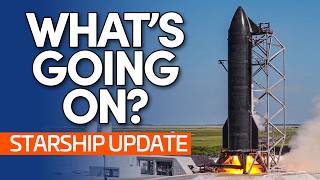

Why is SpaceX playing hot potato with Starship?
45sThe mystery of why SpaceX swapped ships between pads sparks curiosity and engagement.
▶ Play Clip"Title promises an 'unexpected turn' but delivers a routine update; still, content is solid and informative."
This video provides a comprehensive update on SpaceX's Starship development, covering recent testing activities, construction progress at various launch sites, and hardware movements. Key highlights include the completion of Ship 40's static fire testing, the stacking of Booster 22, and significant progress on the LC-39A and SLC-37 pads.
Booster 21 is fully stacked in Megabay 1, preparing for cryogenic testing. Booster 22's stacking has begun, with its LOX tank progressing rapidly, making it the fastest Block 3 booster to stack, taking just 28 days.
Ship 42's nosecone has arrived at Megabay 2 for stacking. The ship currently consists of its nosecone, pest dispenser, payload base section, and other components.
Ship 40 and Ship 41 swapped places multiple times at Massey's. Ship 40 completed a single engine static fire, while Ship 41 underwent cryogenic tests. This was likely due to an issue preventing a six-engine static fire, which was later resolved.
Ship 40 completed the long-awaited 60-second six-engine static fire after resolving the issue. It was then rolled back for final pre-flight preparations ahead of Flight 13.
The super crusher had its cap and skirt section removed, indicating that this configuration has completed testing. The future of B18.3 is uncertain, but it may test grid fin motors.
At Roberts Road, the gigabay's structural steel is complete, with cladding and roofing on the north side. The penthouse level does not cover the entire footprint, and its purpose is unknown. Work stands are beginning to take shape.
Construction of the SLC-37A launch mount is underway with all eight first-level sections in place. This design has taken about six months to reach this stage. At least three of four top deck deluge sections are spotted.
LC-39A resumed work in February 2025 and is on the home stretch. Deluge testing has begun, with additional gas generators added to each subsystem. The chopsticks are finally reeved, and the service structure appears complete.
At SLC-37A, the LR 13000 crane has stacked four of nine tower modules. The flame trench is excavated, and rebar installation is underway. Other components like the ship quick disconnect arm and chopsticks are being prepared.
Pad 2 conducted four deluge tests, including catch simulations. The system was fired to protect against launch and then again for a returning booster. Chopsticks also performed simulated catches and landing rail movements.
A new record-breaking Raptor 3 sea level engine (serial 188) and a vacuum Raptor were observed. Eight engines in total were seen, including two vacuum Raptors.
SpaceX is making significant progress across multiple Starship pads, with Ship 40 ready for Flight 13 and construction advancing at LC-39A and SLC-37. The company is also conducting extensive testing and simulations to prepare for future booster and ship catches.
How long did it take to stack Booster 22's LOX tank?
28 days
00:56
What milestone did Ship 40 complete?
A 60-second six-engine static fire
03:34
What is the purpose of the IP proofing structural test and alignment tool?
To load test and align all 20 hold down arms and clamps on the launch mount
09:28
How many gas generators does the LC-39A deluge system have for the buckets, ridge cap, and top deck?
Five for buckets, three for ridge cap, and four for top deck
08:48
What is the name of the crawler crane used at SLC-37A?
LR 13000
13:02
Ship 40 Six-Engine Static Fire
This milestone clears Ship 40 for Flight 13, a critical step in the Starship test campaign.
03:34LC-39A Nearing Operational
The pad is close to becoming operational, which would give SpaceX a second launch site for Starship.
08:08Pad 2 Catch Simulations
Testing catch simulations indicates SpaceX is preparing for booster and ship catches, a key milestone for reusability.
14:58[00:02] been treating the Massey's test site like a hot potato. What's up with that? We've also got a bunch of hardware to discuss at SpaceX's Roberts Road launch complex station on A and even space launch complex 37. And if you're thirsty
[00:16] for more, pad two performed more deluge testing including catch simulations as SpaceX prepares to bring the booster back to the launch site. From Florida Space Coast to South Texas, we have all of that and more coming up in this
[00:28] of that and more coming up in this Starship update.
[00:43] at the production site where booster 21 has now been fully stacked inside mega bay one and is being prepared for its cryogenic testing campaign. However, the turntable inside mega bay one did not remain empty for long as stacking has
[00:56] already begun on booster 22. With booster 22's liquid oxygen tank already is progressing through stacking much fastest block three booster to be stacked so far taking just 28 days to
[01:11] complete the process. But booster 22 is not the only vehicle being stacked over at mega bay two. Ship 42's nosecone has rolled in ready for stacking. Ship 42 currently consists of its nosecone, pest dispenser, payload base section and
[01:24] the boosters, SpaceX is wasting no time how you shouldn't waste any time with pressing that subscribe button. Vehicles production site. Construction of the final level of the gigabay is continuing
[01:38] while the tower cranes are also being extended for the final time as this will build. Just as we have seen over at Roberts Road, a crawler crane will be used to both dismantle the tower cranes and to complete the roof. After all, the
[01:51] roof while they are still sticking through it. Two turntable pieces likely destined for the Gigabay, have also arrived from Huddleston, SpaceX's storage facility just down the road. Just like the Megabase, the Gigabay will
[02:04] together during vehicle stacking. Looking inside the Star factory, the possible test nosecone we were very interested in last week has received six smaller flanges beneath the large flange. These smaller flanges could
[02:17] allow additional actuators to push or pull on hardware inside the nosecone. However, that's only speculation, so we'll have to keep watching for further Over at Massey's, SpaceX was playing a
[02:29] game of musical chairs with its ships this week as Ship 40 and Ship 41 swapped places more than once. Ship 41 rolled out to Massey's last week after Ship 40 unexpectedly returned to the production site having completed only a single
[02:42] engine static fire test. But, if that was not strange enough, Ship 41 only carried out two cryogenic tests on the same night before SpaceX decided it had spent enough time at the truss structure for the moment. It was then rolled back
[02:55] to the production site so that Ship 40 could return to Massey's and complete its static fire testing campaign. One possible explanation is that SpaceX identified an issue that prevented a six-engine static fire, but did not stop
[03:07] them from carrying out a single engine test. With Ship 40 already at Massey's advantage of the opportunity and completed that single engine static fire last week. During Ship 40's return to the production site, SpaceX appears to
[03:21] have resolved whatever was preventing the six-engine static fire while Ship 41 began the first stage of its cryogenic testing campaign. Once the two ships had with cryogenic propellants and even carried out both forward and aft flap
[03:34] tests. That finally cleared the way for the long-awaited 60-second six-engine static fire. With that milestone complete, Ship 40 was rolled back to the production site for its final pre-flight preparations ahead of Flight 13. With
[03:47] this data in mind, when do you think Flight 13 will take place? Let us know the production site, it was then ship 41's turn to return to Massey's and complete the rest of its cryogenic testing campaign. One thing is for
[04:00] certain, the rollout teams got plenty of experience this week. Now that ship 40 has finally completed its static fire testing campaign, it can put its feet up final days of the summer sale at
[04:12] shop.nasaspaceflight.com, where you can save 10 to 20% on the it eventually splashes down in the Indian Ocean to join the Super Heavy its heat shield with the Starship heat shield grill apron after getting
[04:26] thoroughly cooked by the plasma of re-entry. For ship 41, however, the tail continues as it has since returned to the production site and other than some flat movement, it completed no visible testing whatsoever. But it could have
[04:39] done ambient testing. After all, an ambient test can uncover issues with a vehicle. Just ask Booster 18. As ship 41 is now sitting inside Mega Bay 2 on the engine installation stand, the next time it
[04:51] rolls out, it should be for a static fire test. Last week we saw that the super crusher had its cap removed indicating that this configuration has now completed testing. This week we also saw the ship's skirt section removed as
[05:03] well. This section previously had the cap installed on top of it and was used against the integrated hot stage ring during all phases of flight. The future of B18.3 is somewhat uncertain, but it is possible that SpaceX will go on to
[05:17] test the grid fin motors. At present, only the sockets where the grid fins are testing, not the motors that actually rotate the grid fins themselves. Understanding how these motors perform will help SpaceX determine how quickly
[05:30] adjustments during re-entry, improving its ability to steer through the noticed, we carried out a flyover of Cape Canaveral this past week, which Starship components currently under construction. This includes Roberts
[05:45] Road, Launch Complex 39A, and Space launch complex 37, all of which are at various stages of development. First off, the gigabay Roberts Road began construction around March 2025 when the foundation work started with continuous
[05:57] flight auger piles. Since then, crews have made significant progress. As of July 2026, the structural steel is complete with cladding and roofing now on the north side of the building have been installed with work now progressing
[06:11] on the two large doors on the south side through which completed vehicles will eventually roll out. The penthouse section of the gigabay, which is the final floor below the roof, does not appear to cover the entire footprint.
[06:23] look down into the aisles below and observe vehicles being worked on. At present, it is not yet known what SpaceX will install on this level. It is launch control facility for Cape Canaveral given the eastern side
[06:38] pads. Work stands for the gigabay are also beginning to take shape next to different design from those currently Starbase. It will become clearer how they function once similar units are
[06:52] built at Starbase, but the potential booster work stand currently appears to have six arms rather than 10 as seen in megabay one. Another interesting piece of hardware spotted in this area is a possible jig being assembled under a
[07:04] transitioning boosters between horizontal and vertical orientations. Roberts Road with construction of the slick 37A launch mount now underway and
[07:16] all eight first level sections in place. This design, which has already been completed twice, has so far taken crews around six months to reach this stage before being rolled out to the pad. At least three of the four top deck deluge
[07:29] sections have also been spotted. Nearby, two manifolds required to supply water to the top deck are also visible. Other equipment seen around Roberts Road includes valve skids and the arms for for chopstick carriage. The valve skids
[07:41] could be intended for either the liquid oxygen system at 39A or for slick 37 once construction reaches that stage. Finally, a pair of new buildings is under construction at Roberts Road. One is Hanger X3 while the other remains
[07:54] unnamed. It is not yet clear what these will be used for, whether warehouses or fabrication facilities. Moving on to LC-39A which resumed work in February 2025, progress on the launch pad is now on the home stretch with it likely only
[08:08] operational. For perspective, this build has neither been significantly faster nor slower than pad two at Starbase. While crews already had a tower and chopsticks at LC-39A, both were effectively empty shells. Whereas at
[08:22] Starbase pad two, crews already had the required propellant storage tanks in place. A major indication that the pad is nearing operational status is that ridge cap and bucket deluge testing has now begun. So far, only a few tests have
[08:35] been observed, but this is a positive sign as SpaceX still needs to refine the new configuration compared to pad two. At LC-39A, SpaceX has added additional gas generators to each water deluge subsystem. This means the deflector
[08:48] buckets now have five generators, the ridge cap has three, and the top deck has four. For reference, pad two currently has four for the buckets, two for the ridge cap, and three for the top deck. This is an upgrade that pad two at
[09:00] Starbase will likely receive later on once there is sufficient downtime. While pad one is likely to receive the upgrade more immediately. Another improvement to the deluge system at LC-39A is that slightly beyond the flame trench exits,
[09:13] there are dips in the concrete with drainage at the base designed to help recapture as much unused deluge water as possible. SpaceX does not have the room Starbase, but it could potentially be installed at both planned slick 37 pads.
[09:28] Another major test was also completed recently. The IP proofing structural test and alignment tool was used on the launch mount. This piece of equipment was built at Starbase to help load test and align all 20 hold down arms and
[09:40] clamps. The tooling may remain at Cape Canaveral for use on slick 37A or return to Starbase for pad one. Although both uses are still at least 12 months away. Moving on, the service structure now appears to have most if not all of its
[09:53] necessarily mean the interior is significant finishing work ongoing inside. The final remaining items to be quick disconnect door, rear hoods for both BQDs, the full connection of both
[10:08] BQDs, and final integrated testing. Another major milestone is that the chopsticks are finally reeved, meaning they can now move up and down the tower. The chopstick carriage was installed on the LC-39A tower in January 2023, 3
[10:22] months before Starship flight one launched, meaning it has largely been sitting idle on the tower for several years. It does raise questions about how rusted the bearing skates may have become after such a long period in the
[10:34] Florida weather. Looking more closely at one of the chopsticks, we can see that installed. It's likely the other chopstick has these installed as well. The tower itself, which has been stacked since September 2022, has recently begun
[10:48] major milestone in construction progress. The drawworks housing at the rear of the tower base has also been modified to include a sloped protective roof, similar to what is seen on the Starbase pad two tower base. One of the
[11:02] final pieces of the tower will be the installation of the new cladded roof, which still requires final Federal Aviation Administration approval. Unlike pad two or even pad one at Starbase, this roof is planned to include a 10-ft
[11:14] lighting tower on top, which is far more necessary in Florida than South Texas. wall constructed to protect the tank It is worth noting that more of this blast wall still needs to be built so it
[11:28] extends all the way to the far end of the methane side of the tank farm. Speaking of the tank farm, two additional liquid oxygen storage tanks bringing the total to six. There are still empty positions for further
[11:41] and liquid methane sides of the tank farm, as well as additional liquid nitrogen storage tanks on both sides. However, SpaceX likely already has sufficient capacity for a full stack plus reserves for a scrub, meaning they
[11:54] should be able to launch with the current configuration if necessary. Additional storage can then be added over time. SpaceX is also storing many additional parts near LC-39A, including several vaporizers and three smaller
[12:07] subcoolers, which could very well end up being installed on the methane side of the LC-39A tank farm. Just inside LC-39A, there are also three transport Starbase, consisting of two ship transport stands and one booster
[12:21] transport stand, currently located in front of the horizontal integration milestones remaining for the 39A Starship pad, including launch mount top deck water deluge testing, full launch rehearsal retracts, vehicle tanking
[12:34] tests, and a booster static fire, among others. Just recently, booster 22 and respective megabays. If everything proceeds smoothly on flights 13 and 14, these two vehicles could be destined for the Cape and stacked on LC-39A's launch
[12:49] mounts, potentially [music] by the end of the year. Moving over to SpaceX's second Starship launch complex at the Cape, located at Slick 37, construction is continuing to make steady progress. So far at 37A, the LR 13,000 crane has
[13:02] stacked four out of nine modules for the tower. Each of these tower modules has been fitted with more hardware ahead of stacking than the other three towers SpaceX has assembled so far, thanks to the LR 13,000 crawler crane being the
[13:14] most powerful crawler crane in the world. The flame trench for this pad has now been fully excavated and rebar installation for the three sections of the trench floor is currently underway. Meanwhile, the other major components of
[13:26] Slick 37A, the ship quick disconnect arm, chopsticks, and carriage are all being worked on off to the side. The carriage and chopstick arms were assembled months ago at Roberts Road and then transported to Slick 37. It is
[13:38] worth noting, however, that they arrived in a fairly bare state, so there is to complete on them at this site before they can be installed on the tower. coolers have also arrived and are now awaiting installation in their
[13:52] respective positions within the launch complex. Pedestals for all of the tanks suspected deluge farm location, and pedestals for storage tanks on one side of the suspected tank farm area have also been installed. SpaceX is likely
[14:06] cryogenic storage tanks to arrive over the next few years. There is also considerable groundwork taking place near the Slick 37A tower modules that are still due to be stacked. This area is believed to be the future location of
[14:19] Slick 37B, the second Starship pad at this launch complex. In addition, new electrical work is underway along one side of the suspected tank farm. We will likely see much more of this across the rest of Slick 37 as SpaceX continues
[14:33] developing the site for its two planned Starship launch pads. It will likely be a few years before even one of these pads is fully operational, mainly due to lead times for cryogenic storage tanks and other key hardware. But, that's not
[14:45] everything. In fact, after I ever covers more companies than just SpaceX, Relativity, and of course, NASA's operations. To see those, make sure to check out our next Space Coast update. Taking a look at the only Starship pad
[14:58] that is currently online, pad two saw a total of four deluge tests this week. flame bucket, ridge cap, and even the top deck. The remaining test involved did not use the bucket itself. This is the first time since flight 12 that the
[15:13] system has been activated. Amongst these, SpaceX also did some catch simulations, first firing the deluge system to protect the pad against launch, and then firing it again a few minutes later to protect the pad against
[15:25] the exhaust of a returning Super Heavy Booster. We can tell that the second run is for a landing, not only because of the timing, but also because the different to launch. With the scaffolding now removed from the launch
[15:38] to the launch site soon as the launch course, the booster itself still needs to be fully prepared as well. Even the chopsticks got some rehearsal time this week as we saw them simulating a booster
[15:51] lift onto the mount. On top of that, the chopsticks also performed three high-speed simulated vehicle catches and landing rail movements. With SpaceX chopsticks and carried out work on the landing rails a few weeks ago, these
[16:04] small tests appear to be aimed at confirming that nothing major arises before they are put into action during an actual booster or ship lift. While neither Booster 20 nor Ship 40 will be caught at the launch site, it is
[16:16] encouraging to see SpaceX looking ahead and using this down time to carry out this work to minimize gaps between launches in preparation for when they eventually do a booster catch or ship catch, possibly even on flight 14 with
[16:28] Booster 21. The ship quick disconnect arm also appears to be receiving scaffolding around the shoulder of the arm where the engine chill line is to cool the engines while they are running by flowing cryogenic propellant
[16:43] cryogenic prop through the engine bell must be ramped up gradually in order to avoid thermal shock as the cold cryogenic fluid would otherwise expand difference between the propellants and the engine hardware. The pressure
[16:57] change could become severe enough to damage the engine. Gradually increasing slowly and keeps pressures within operational limits. It's time for a McGregor minute where we saw as usual a new record-breaking Raptor 3 serial
[17:11] number pass by our 24/7 McGregor Live cameras. The Raptor serial number in question was 188. Being a sea level Raptor engine, it could be destined for either a future booster or a ship. However, we also saw a vacuum Raptor
[17:24] engine roll by this week with an unknown serial number. That engine was not the as a total of eight engines were observed in all, two of which were Raptor vacuum engines. With flight 13 getting closer and closer and ship 40
[17:37] testing now complete, the launch site is getting ready for a static fire campaign. Hopefully, we'll see booster [music] 20 rolling out soon. But for now, I've been Ryan Keaton for NSF. Thanks for watching and goodbye.




⚡ Saved you 0h 17m reading this? Transcribe any YouTube video for free — no signup needed.