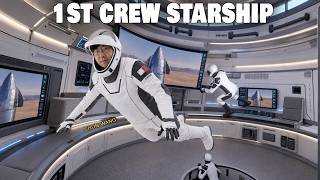

First Human to Fly to Mars Announced!
60sThe shocking reveal of the first crewed Mars mission passenger sparks immediate curiosity and debate.
▶ Play Clip"Title overpromises a 'shock' to NASA and China, but the video is a solid, informative breakdown of Starship's first crew and the refueling challenge."
SpaceX has announced that Chun Wang, a Chinese-born cryptocurrency investor, will be the first person to fly aboard Starship on its first crewed interplanetary mission to Mars, with a lunar flyby planned beforehand. The video explores Wang's background, the ambitious missions, and the critical technical hurdle of orbital refueling that must be solved before any deep-space crewed flight is possible.
An astronaut expressed emotional words after a Starship flight test, highlighting excitement about becoming a multi-planetary species.
SpaceX officially announced that Chun Wang will be the first person to take an interplanetary journey aboard Starship.
SpaceX's official X account emphasizes daily work on perfecting Starship to return to the Moon and eventually reach Mars.
Fram 2's mission commander, Sato Fichi (Chun Wang), is set to fly on Starship's first interplanetary human spaceflight mission to Mars, and will also join a commercial flight around the Moon.
Chun Wang is a Chinese-born cryptocurrency investor and space enthusiast. He founded F2 Pool and Stakefish, with a net worth around $300 million. He became a Maltese citizen in 2023.
Wang led a privately-funded mission that sent him and three others into polar orbit in a SpaceX Dragon capsule for 3.5 days.
Wang intends to join Dennis Tito and his wife on a Starship trip around the Moon, a week-long mission coming within 200 km of the lunar surface.
Tito was the first American space tourist in 2001 and proposed a Mars mission in 2013, but NASA declined. He announced his lunar flyby plan in 2022.
Yusaku Maezawa canceled his 2018 Starship lunar mission in 2024 due to delays in SpaceX's timeline.
A 2022 study found SpaceX's approach was roughly 10 times cheaper and twice as fast as NASA's traditional model. NASA's Artemis 2 costs $4.1 billion.
Starship must be refueled in orbit for any crewed mission beyond low Earth orbit. Without it, deep space missions are technically impossible.
Multiple tanker Starships will launch to transfer propellant to a depot in low Earth orbit, then a crewed Starship docks to refuel before departing.
A lunar landing requires about 10 tanker launches of propellant; a Mars mission would demand considerably more.
SpaceX transferred at least 10 metric tons of liquid oxygen between tanks within a single Starship upper stage in space, a successful NASA-backed demonstration.
Flight 12 validated the docking port and quick disconnect hardware for future ship-to-ship transfer, but was not a refueling test.
Engineers are working on leakage and transfer rates under operational conditions. Analysts believe SpaceX has underestimated the timeline, with some arguing refueling won't be achieved until late 2020s.
Orbital refueling success affects Wang's lunar flyby, Mars ambition, and NASA's Artemis timeline. SpaceX advertises lunar cargo in 2028 and Martian cargo in 2030.
Elon Musk puts the probability of meeting the late 2026 deadline for uncrewed Mars missions at roughly 50%.
Wang's missions are waiting for orbital refueling at scale to be invented, tested, and validated. Flight 12 was a small step, but the distance to Mars is measured in solving unprecedented problems.
SpaceX's ambitious plans for Starship, including Chun Wang's lunar and Mars flybys, hinge on mastering orbital refueling—a complex, unprecedented capability. While progress is being made, significant technical and scheduling uncertainties remain, making the timeline for crewed deep-space missions far from certain.
Who is the first person announced to fly aboard Starship on an interplanetary mission?
Chun Wang, a Chinese-born cryptocurrency investor.
01:40
What was Chun Wang's net worth as of last year?
Around $300 million.
04:19
What is the critical capability Starship must have for crewed missions beyond low Earth orbit?
Orbital refueling.
07:22
How many tanker launches are required for a lunar landing mission?
Approximately 10 tanker launches worth of propellant.
08:28
What did SpaceX successfully demonstrate in March 2025?
Transfer of at least 10 metric tons of liquid oxygen between tanks within a single Starship upper stage in space.
08:43
What did Flight 12 validate?
The docking port and quick disconnect hardware for future ship-to-ship transfer.
09:12
According to a 2022 study, how much cheaper and faster is SpaceX's approach compared to NASA's?
Roughly 10 times cheaper and twice as fast.
06:27
What is the dry mass of Starship?
275 metric tons.
07:49
What is the probability Elon Musk gives for meeting the late 2026 deadline for uncrewed Mars missions?
Roughly 50%.
10:53
First interplanetary passenger announced
This is a historic announcement naming the first person slated for a Starship interplanetary mission.
01:40SpaceX vs NASA cost comparison
Highlights the dramatic cost and speed differences between private and government space programs.
06:27Orbital refueling as the critical bottleneck
Identifies the often-overlooked technical challenge that gates all deep-space crewed missions.
07:22Successful propellant transfer test
Demonstrates tangible progress on orbital refueling, a key milestone.
08:43Musk's 50% confidence on Mars deadline
Reveals internal uncertainty about the schedule, tempering expectations.
10:53[00:04] multi-planetary. Those were the emotional words of an astronaut after Starship flight test ended. A clear sign of just how excited people are about the future of becoming a multi-planetary species. In fact, he
[00:18] sounded so thrilled that it almost felt like he was already sitting comfortably inside Starship, ready to travel across the universe. What do you think? That's is this is no dream. Because recently,
[00:32] SpaceX officially announced that he will become the very first person to take an interplanetary journey aboard Starship. So, who exactly is this astronaut? And what critical problems does SpaceX still need to solve before Starship can carry
[00:47] its first human crew? Let's find out on today's episode of Alpha Tech. Although Starship has not yet officially entered full operational service, its future toward the moon and eventually Mars
[00:59] already feels inevitable. "I want to enable anyone to go to the moon or Mars so that we secure the future of consciousness." Elon Musk made this statement in one of his replies on X. And of course, it's not just him.
[01:12] SpaceX's official X account constantly reminds all of us that the company is working every single day to perfect Starship and turn humanity's historic dream into reality. Returning to the moon and eventually reaching Mars. Most
[01:27] recently, SpaceX posted an announcement about the first astronaut who is expected to fly aboard Starship on its first crewed interplanetary mission to Mars. Fram 2's mission commander, Sato Fichi,
[01:40] is set to fly aboard Starship's first interplanetary human space flight interplanetary human space flight mission. And yes, that man is Chun Wang. But even more impressively, he will also join Starship's first commercial space
[01:52] flight around the moon. Honestly, amazing and inspiring are probably the first words I would say if I ever met him. Don't you think Chun Wong's future experiences sound absolutely dream-like? If you do, type yes in the comments so I
[02:06] can feel everyone's excitement about this incredible future. So, who exactly is Chun Wong and what made an ordinary man place his faith in SpaceX's Starship? Chun Wong is a Chinese-born cryptocurrency investor who has become
[02:20] the latest wealthy space enthusiast aiming to take part in a future journey around Mars. But, before that, he wants to fly around the moon aboard SpaceX's Starship. And SpaceX appears more than willing to work with him. Wong shared
[02:33] his ambition during a SpaceX webcast focusing on the first attempt to launch a next-generation Starship V3 rocket from SpaceX's Starbase in Texas for a test flight. Wong already qualifies as a space traveler. Last year, he headed up
[02:48] a privately-funded mission that sent him and three other crew members into polar orbit in a SpaceX Dragon capsule for 3 and 1/2 days. SpaceX launch commentator line to take on >> You are going to be on the first
[03:03] interplanetary mission on a Starship. >> Even though the rocket is still in testing mode and hasn't yet made a single orbit around Earth. >> So, it's going to be a flyby mission of
[03:15] The uh A lot of people are talking about the uh uh Mars will be like uh uh they're going to fly to Mars, they're going to land on Mars, they're going to build cities on Mars. But, uh
[03:30] let's get it started with uh with a flyby. It uh it's going to light the fire. It will ignite the imagine imagination.
[03:51] myself of pilot. I can stare at the uh uh uh uh the Melbourne uh our airplane uh all the way uh from uh uh takeoff to landing. So, I think I'm going to enjoy the trip.
[04:04] >> Wang was born in China in 1982, but became a citizen of Malta in 2023. He played a role in founding two cryptocurrency ventures, F2 Pool and Stakefish, and his net worth was said to be somewhere around $300 million as of
[04:19] last year. As a warm-up for the Mars flyby, Wang said he intends to join California engineer investor Dennis Tito and his wife Akiko Tito on a Starship trip around the moon. SpaceX says that week-long mission would come within 200
[04:34] km, 120 mi of the lunar surface, and advance the development of Starship systems for deep space long-duration missions. uh it's a test of flyby, it's uh it's a try a lot of things that never
[04:48] been attempted before. >> Dennis Tito, 85, announced his plan for the trip to the moon and back in 2022, but there hasn't been much word since then about preparations for the mission. Back in 2001, Tito became the first
[05:01] American space tourist when he rode a Russian Soyuz craft into orbit for a 6-day stay on the International Space Station. In 2013, Tito proposed a 501 day mission that would send a man and a woman around Mars. At first, he
[05:16] at least part of the mission, but a couple of months later, he said that what he called a philanthropic partnership with government. NASA demurred. The next billionaire to look into leading a space mission beyond
[05:30] Earth orbit was Yusaku Maezawa, who made his fortune after founding Zozotown, Japan's largest online fashion mall. Maezawa teamed up with SpaceX in 2018 on a plan that would involve sending the billionaire and a crew of artists and
[05:45] performers around the moon on Starship. As part of the deal, Maezawa committed to paying SpaceX an undisclosed amount to support Starship's development, but he canceled his plans in 2024, citing delays in SpaceX's timeline. "It's a
[06:00] developmental project, so it is what it is, but it is still uncertain as to when Starship can launch," Maezawa said at the time. "I can't plan my future in this situation, and I feel terrible making the crew members wait longer,
[06:13] hence the difficult decision to cancel." Since then, NASA has prepared to send four astronauts around the moon on the Artemis 2 mission, a mission reportedly costing $4.1 billion, a number so enormous that even hardcore
[06:27] space enthusiasts can't help but be stunned by how expensive it is. A 2022 study comparing NASA and SpaceX found that SpaceX's approach was roughly 10 times cheaper and twice as fast as NASA's traditional project model. Now,
[06:42] these numbers do not necessarily prove that private companies are inherently superior. They reflect very different mission goals, risk tolerances, and accountability structures, but they do raise a sharp and uncomfortable
[06:55] question. If a private individual with $300 million can potentially buy a seat on a Mars flyby mission, then what exactly is the government model purchasing at 100 times the cost? That's a question not everyone knows the answer
[07:09] to, but if you do, don't hesitate to share your thoughts in the comments below. Before anyone boards the Starship for the moon, let alone Mars, SpaceX must first solve a problem that receives far less attention than rocket engines
[07:22] or heat shields, but is arguably more consequential than either. Starship must be refueled in orbit. Without that capability, every crewed mission beyond low Earth orbit remains technically impossible,
[07:34] regardless of how powerful the rocket is or how ambitious the passenger. The physics are unforgiving. Given Starship's dry mass of 275 metric tons, the vehicle must be refueled in orbit to perform the translunar injection or Mars
[07:49] injection burns required for deep space missions. In simpler terms, even a fully fueled Starship leaving Earth carries enough propellant to reach orbit, but not enough to go meaningfully further. The rocket that Wong intends to ride to
[08:03] Mars must be topped off while already in space by another Starship sent up for that sole purpose. Multiple Starship tanker vehicles will launch in succession, transferring their propellant to a dedicated depot vehicle
[08:15] waiting in low Earth orbit. A crewed or cargo Starship then docks with the depot to refuel before departing for its destination. For a lunar landing mission alone, the Starship human landing system requires approximately 10 tanker
[08:28] launches worth of propellant to reach the lunar surface. A Mars mission would demand considerably more. Where does SpaceX actually stand on this today? During a test flight in March 2025, SpaceX successfully transferred at least
[08:43] 10 metric tons of liquid oxygen between tanks within a single Starship upper stage while in space. A demonstration conducted under a NASA tipping point contract and confirmed as successful by NASA officials. It was a meaningful
[08:57] simplest possible version of the problem, moving fluid between two tanks on the same vehicle, not between two separate spacecraft traveling at orbital velocity. The genuinely hard part, docking two distinct Starship vehicles
[09:12] in orbit and transferring propellant from one to the other. Flight 12, the debut of Starship V3, validated the docking port and quick disconnect hardware that enables future ship-to-ship transfer, but it was not a
[09:26] refueling test. No second Starship was in orbit at the time. The hardware simply needed to survive launch, operate in a vacuum, and return data that clears the architecture for the actual propellant transfer demonstration NASA
[09:40] requires before any lunar mission can proceed. The engineering challenges embedded in that demonstration are not trivial. Engineers are still working to and leakage, as well as how much
[09:53] transferred under operational conditions. Independent analysts have not been gentle in their assessments. A consensus among aerospace analysts holds that SpaceX has underestimated of this chain, with a minority position
[10:07] arguing that Starship will not achieve useful on-orbit refueling before the late 2020s. If SpaceX nails orbital refueling, everything else becomes easier to schedule. If it slips, every downstream plan moves with it. That
[10:22] dependency runs straight through Wang's lunar flyby, his Mars ambition, and NASA's own Artemis lunar landing timeline simultaneously. The stakes are also institutional. SpaceX has advertised lunar cargo delivery starting
[10:36] in 2028, and Martian cargo starting in 2030, at a stated rate of $100 million per metric ton of delivered surface cargo. Timelines that depend entirely on orbital refueling working reliably. Meanwhile, Elon Musk himself has put the
[10:53] probability of meeting the late 2026 deadline for uncrewed Mars missions at roughly 50%. A candidate mission that even SpaceX's internal confidence in its own schedule is far from certain. What this means for Wang's plans is worth
[11:07] stating plainly. The lunar flyby he envisions with Dennis Tito, and the Mars flyby he is committed to beyond that, are not simply waiting for a rocket to be built. They are waiting for an entirely new mode of space operations,
[11:20] orbital refueling at scale, executed reliably and repeatedly, to be invented, tested, and validated. Starship flight 12 was the first small step toward that. The distance between that step and a two-year crude journey to Mars is not
[11:35] measured in months. It is measured in the successful resolution of problems that have never been solved before under conditions that have never been tested before with human lives depending on the answer. That is not a reason to dismiss
[11:48] understand exactly what it will take to realize it.

⚡ Saved you 0h 11m reading this? Transcribe any YouTube video for free — no signup needed.