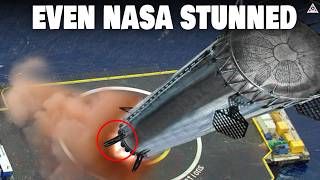

SpaceX's Drone Ship Retires for Starship
45sThis segment reveals a major shift in SpaceX's operations, sparking curiosity about Starship's future.
▶ Play Clip"Title accurately reflects the video's focus on Starship landing legs and drone ship operations, though it slightly overpromises by implying a confirmed design."
SpaceX has officially retired the drone ship 'Just Read the Instructions' (JRTI) from Falcon 9 duties after 156 landings, dedicating it to Starship operations. This video explores the implications for Starship landing methods, the challenges of landing on a drone ship, and JRTI's new role in transporting Starship components from Texas to Florida.
SpaceX's drone ship 'Just Read the Instructions' (JRTI) has been retired from Falcon 9 landings after 156 successful landings. It will now be dedicated to Starship operations.
Falcon 9 operations will shift entirely to SLC-40, with the drone ship 'A Shortfall of Gravitas' (ASOG) handling all landings from that pad, supporting a launch cadence of roughly one every 4 days.
The FAA's approval for LC-39A permits up to 44 Starship launches per year with 88 landings, explicitly allowing drone ship landings in the Atlantic Ocean, not just tower catches.
Starship lacks landing legs; developing them for drone ship landings would require a robust system to support ~150 tons of dry mass, with stainless steel construction, 4-6 legs, and a damping system to handle wave motion.
Starship's three Raptor engines produce up to 840 tons of thrust, far exceeding Falcon 9's single Merlin. JRTI's 16mm steel deck and cooling system would need significant upgrades to withstand the heat and pressure.
Kiko Dontchev confirmed JRTI will no longer be a landing platform. Instead, it will team up with the transport barge 'You'll Thank Me Later' to move Starship and Superheavy from Starbase to Cape Canaveral.
SpaceX's primary plan is to catch the booster with the Mechazilla tower, which eliminates the weight of landing legs and allows for rapid reuse. The catch success rate has reached 75% by Flight 8.
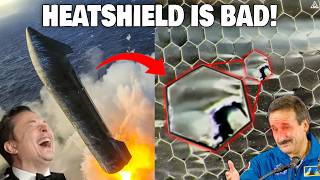
Booster 19 (Block 3) had three grid fins instead of four and a new hot staging truss. The asymmetric grid fin layout and plume interaction caused a 90° roll, fuel sloshing, and engine failures, leading to loss of control.
NASA funded both SpaceX's Starship HLS and Blue Origin's Blue Moon to ensure redundancy. The New Glenn explosion has delayed Blue Origin, leaving SpaceX as the sole provider for critical Artemis missions in 2027-2028.
Amazon's Project Kuiper, initially avoiding SpaceX, now relies on Falcon 9 launches after New Glenn's delay. SpaceX has launched over 300 Kuiper satellites, highlighting the irony of Bezos's company depending on Musk's rockets.
On June 5, 2026, a leak in the Russian Zvezda module's PRK compartment forced the US crew to evacuate to Crew Dragon Freedom. Cosmonauts sealed one leak site, but a second remains under evaluation.
SpaceX's Starfall is a disc-shaped, uncrewed re-entry vehicle for microgravity manufacturing. It can carry 1,000 kg of payload, re-enters at Mach 28, and splashes down in the Pacific. It is designed for mass production and routine cargo return.
SpaceX is strategically reallocating resources to support Starship's development, with JRTI transitioning from a landing platform to a transport vessel. The challenges of drone ship landings and the shift to tower catching highlight SpaceX's iterative approach, while the company's growing role in NASA's Artemis program and commercial satellite deployment underscores its central position in the space industry.
Just Read the Instructions (JRTI)
tool
A Shortfall of Gravitas (ASOG)
tool
You'll Thank Me Later (transport barge)
tool
Mechazilla (tower catch system)
tool
Crew Dragon Freedom
tool
Starfall (re-entry vehicle)
tool
Kiko Dontchev
person
Elon Musk
person
Jared Isaacman
person
Sergey Kudzkov
person
Sergey Mikyf
person
Jessica Mir
person
SpaceX
service
Blue Origin
service
NASA
service
Amazon Project Kuiper
service
Starlink
service
FAA Environmental Assessment for Starfall
link
How many successful Falcon 9 landings did JRTI complete before retirement?
156
What is the dry mass of Starship on landing?
100 to 160 tons
06:30
What material is recommended for Starship landing legs?
Stainless steel 304L or 30X
04:00
How many grid fins did Booster 19 have?
Three
12:00
What caused the asymmetric torque on Booster 19?
One grid fin was hit by the ship's exhaust plume due to the open hot staging truss and asymmetric fin layout.
12:00
What is the name of the transport barge that will move Starship components?
You'll Thank Me Later
08:15
What is the maximum payload capacity of Starfall?
1,000 kg
23:00
What is the re-entry speed of Starfall?
Mach 28 (over 34,000 km/h)
23:00
What is the estimated cost per Starfall capsule in mass production?
1 to 3 million USD
23:00
What is the name of the compound used to seal cracks on the ISS?
Germatl 1
20:00
JRTI's Last Landing
The 156th and final Falcon 9 landing on JRTI marks the end of an era for the drone ship that served for 11 years.
Booster 19's Asymmetric Failure
The detailed breakdown of how three grid fins and a new hot staging truss led to a catastrophic roll and loss of control is a technical revelation.
12:00Amazon's Irony
Amazon, which deliberately excluded SpaceX from launch contracts, now relies on Falcon 9 to save Project Kuiper after New Glenn's explosion.
18:00[00:00] Unbelievable. SpaceX has just officially delivered a dedicated drone ship to support all Starship operations in Florida. Does this mean they now have an additional landing method for their biggest spacecraft? Or is there something else they're still hiding? Let's find out right away. Can you believe that a single routine Falcon 9 launch could actually shape the entire future of Starship in Florida? Just recently, SpaceX successfully launched the GPS 3-8 satellite for the US Space Force. Booster B10
[00:33] 95.7 came screaming back through the sky and nailed a perfect landing on the drone ship. Just read the instructions, better known as JRT. But this wasn't just any landing. It was the 156th successful Falcon 9 landing on JRT. And it was also the last. SpaceX has now officially announced that after 156 landings, just read the instructions, we'll be fully dedicated to Starship operations from now on. For 11 years, this drone ship has been right there with
[01:06] Falcon 9, traveling across the vast ocean on hundreds of missions. It stopped being just a barge a long time ago. It became a true member of the Falcon family. So, why is SpaceX retiring JRTI from Falcon 9 duties right now? The answer lies in their bigger plan, launch complex. 39A is transforming fast. It's becoming the main pad for Falcon Heavy and very soon, Starship. That means all regular Falcon 9 operations will shift entirely to SLC 40.
[01:39] SpaceX realized they no longer need two drone ships running fulltime on the East Coast. Their other veteran ship, a shortfall of gravitas, or ASOG, is more than capable of handling every single landing from SLC40. It can easily support the current pace of roughly one launch every 4 days while still backing up ground landings whenever needed. But the big question is, will JRT i actually become a floating landing pad for Starship? Think about it. LC39 A currently
[02:12] has only one launch tower. SpaceX will likely want to use it to catch the Superheavy booster. That leaves the Starship itself landing on a drone ship. And it actually makes perfect sense. Back in early 2026, the FAA's approval for LC 39A allows SpaceX up to 44 Starship launches per year along with 88 landings, 44 for the booster and 44 for the ship. Importantly, the document explicitly permits drone ship landings in the Atlantic Ocean, not just tower
[02:45] catches on land. This isn't some wild idea. It's already written into the official environmental plan. And this is the smart part. Starship is an absolute monster. Every time it lands on solid ground, it creates a storm of noise, shock waves, and pressure on Florida residents. Landing offshore changes everything. The sound disappears into the vast ocean. Sonic booms stay far from the coast and the risk of endless lawsuits drops dramatically. Falcon 9 has already proven this approach
[03:18] works beautifully, quiet, safe, and routine. But here's the biggest challenge. Starship doesn't have landing legs. It was born to be caught by Makeazilla in midair. Only the hls version for Artemis has legs and those are specially designed for the moon's dusty surface, not for rocking waves. If SpaceX really wants to land Starship on JRT, I they'll need to build an entirely new set of landing legs, a beast of a system strong enough to support roughly 150
[03:51] tons of dry steel while the ship sways with the ocean. Remember JRT? I was built for Falcon 9 boosters that weigh just 25 to 30 tons on landing. Starship is many times heavier and must handle constant wave motion. Even a slightly off touchdown could shake the entire vehicle if the legs aren't designed perfectly. So, what would these legs look like? First, the material has to be stainless steel 304 L or 30X, the same grade used on
[04:24] Starship's body. It's incredibly tough, heatresistant, and immune to saltwater corrosion. Falcon 9's carbon fiber simply isn't strong enough here. As for the number and shape, SpaceX could go with four to six legs. Blue Origin's new Glenn uses six legs for better stability at sea, and Starship will need that, too. These legs would deploy outward during descent, creating a footprint of at least 15 to 18 m to prevent tipping when waves hit the drone ship. The mechanism
[04:57] must be clever legs that fold or telescope during flight to stay aerodynamic. Then powerful electric or hydraulic actuators push them out and automatically adjust the angle to match the ship's rocking motion. And the most critical part, the damping system has to absorb the massive impact energy of hundreds of tons of steel. It will likely combine giant pneumatic and hydraulic absorbers. Right after touchdown, an instant locking system is essential. Possibly something like New Glenn's energetic welding, where
[05:30] pyrochnic pins fire to temporarily weld the legs to the deck and keep the beast from toppling in heavy seas. But there's an even bigger problem. Starship's raw landing thrust. This isn't Falcon 9. When Starship or Superheavy prepares to touch down, it has to fire three Raptor sea level engines at the same time. Three, not just one Merlin like Falcon. Each Raptor 3 delivers around 280 tons of thrust at sea level. That means a combined total of
[06:03] nearly 840 tons if running at full power. Of course, SpaceX will throttle them way down for a soft landing. But even at minimum power, the exhaust from three Raptors is many times more powerful than a single Merlin 1D, which only puts out about 86 tons during landing. Just picture it. When Falcon 9 touches down on the drone ship, it's a single gentle pillar of flame like a soft footstep. Starship 3. Massive columns of fire blasting at
[06:36] once, delivering extreme heat and pressure straight onto the deck. JRT I was built for Falcon 9. Its steel deck is only 16 mm thick, and its cooling system has never faced anything this brutal. On top of that, Starship's dry mass is already 100 to 160 tons, 4 to six times heavier than a Falcon booster on landing. So, if SpaceX really wants to use JRTI for Starship, they won't just need those monster landing legs we talked about
[07:09] earlier, they'll have to completely upgrade the entire drone ship, thicker reinforced steel deck, a much more powerful water cooling system, and possibly special locking mechanisms to stop the ship from sliding in heavy waves. With all these challenges and drawbacks, a drone ship clearly isn't the perfect landing solution right now. So, what is JRTI actually for? Kiko Danchev, SpaceX's vice president of launch, gave a very straightforward answer. JRT, I isn't going to be a landing drone ship
[07:42] anymore. Instead, it will team up with the massive transport ship. You'll thank me later to move Starship and Superheavy from Starbase in Texas to Cape Canaveral in Florida. Here's the picture. Starship and Superheavy are still built primarily at Starbase in Bokhica, Texas, where the Meabay Star factory and experienced teams assemble those 120 m tall stainless steel beasts. Meanwhile, Florida is racing to finish the giant Gigabay at Robert's Road near Kennedy Space Center for local integration. But
[08:15] Gigabay won't be fully ready until mid or late 2026. Until then, the only practical way to get Starship to launch complex 39A, which is becoming the main pad for both Falcon Heavy and Starship, is by sea. Road transport is nearly impossible for these giants, and flying them is out of the question. That's exactly why, you'll thank me later, was created. This huge transport barge based on the Marmarmac 31 platform is big enough to carry a full
[08:48] superheavy booster or a Starship lying horizontally across the Gulf of Mexico. Elon named it in classic Space X humor inspired by the Culture series novels and now it makes perfect sense. You'll thank me later. Kiko Donv confirmed it. Clearly JRTI will join this ship. The two will work together as a logistics team. JRTI is no longer needed for Falcon 9 landings. Instead, it will support transport carrying extra hardware tanks or even parts of the stages on
[09:20] long journeys. With pad 39A now focused on Starship and Falcon Heavy Space, Gus only needs one drone ship ASOG for regular Falcon operations. That frees JRTI to help with the bigger Starship dream. This move perfectly reflects SpaceX's long-term strategy. Right now, everything still depends on Starbase for stainless steel, skilled welders, and hard-earned flight experience. They're ramping up contractors, sea logistics, and extra crew for these shipments. But once Gigabay in Florida is complete production, we'll gradually shift
[09:53] there. Sea transports will become much less frequent because Starship can be built and launched directly from Florida. And that's when people start wondering, could you'll thank me later. Later be repurposed as a Starship landing drone ship if needed. Although for now, SpaceX's main plan is still to catch the booster with the Mechazilla tower. And this approach has some clear advantages. If they added landing legs like Falcon 9, the booster would have to carry a heavy complex
[10:26] set of legs complete with hydraulic systems, reinforced structures, and extra propellant for fine adjustments. All of that would cut payload significantly, possibly by dozens of tons, and add serious mechanical risk during touchdown, where reflected exhaust could damage engines or cause violent shaking. Mechazilla eliminates all that weight by catching the booster in midair using the hard points already built into the interstage. The result, a lighter rocket that can carry more payload and land with such precision that
[10:59] it can be stacked again almost immediately. From flight 5 in 2024, the first successful booster catch to flight 8 in March. 2025, SpaceX has already pushed the catch success rate up to 75% in just a few attempts. Each flight improved the guidance software grid fins and engine relight performance. It's clear proof tower catching isn't just possible. It's becoming reliable faster than any leg system could for a vehicle this massive. But the deeper story is why SpaceX
[11:32] was willing to take that high initial risk in exchange for full reusability on both stages. With Falcon 9, they already proved that booster reuse could slash the cost per kilogram to orbit from over $10,000 down to around $2,500 and even as low as $600 per kg after dozens of flights. Starship takes that logic to the extreme. If only the booster is reusable while the ship is expendable, you'd still need to build hundreds of new Starships for
[12:05] big missions like Mars or Starlink Gen 2. True full reusability for both booster and ship is what turns Starship into a real space truck. A vehicle that can fly multiple times a day with costs dominated by cheap propellant. The break even point comes very quickly. After just a few flights, the huge development costs are paid off and every launch after that is basically just fuel money. Technically, the challenges with Superheavy are enormous. Its massive weight demands
[12:38] precise landing thrust. Starship's re-entry temperatures exceed 1,600° C and need a perfect heat shield, and the flip maneuver requires incredibly sophisticated software. Choosing tower catch over legs was a smart trade-off. They accepted lower reliability at the start and more testing time in exchange for a simpler design, higher payload, and much faster turnaround. We've always known SpaceX builds Starship the hard way, spending hundreds of millions per flight learning by doing. Because, as Elon himself put it on
[13:11] X, there is obviously no degree you can get from a university that actually teaches you how to make an orbital rocket. None of the professors know how to do it. And he's right. Not even NASA or Rosscosmos could teach him because nothing like Starship has ever existed before. And yet in just a few years, what they've pulled off is remarkable. Starship flying stable suborbital trajectories. Superheavy sticking three chopstick catches a 200 ton metal cylinder falling from
[13:44] the sky, snatched out of the air without a scratch. Something so surreal that people watching it live genuinely teared up. So, you'd think all that hard one data would make version 3 better, smoother, more reliable. Instead, the newest Superheavy lost control and slammed into the ocean with the most powerful Raptor engines ever built with flight software refined over a dozen missions. Look at the three boosters that were successfully caught. Then look at booster 19. Spot the
[14:17] difference. The other three have four grid fins. Those giant waffle iron paddles mounted near the top. Booster 19 only has three. On top of that, the hot staging ring looks completely different, too. Those precise modifications are what started the chain reaction that brought it down. Here's why. SpaceX first added the hot staging ring during Starship flight 2. From flight 2 to flight 11, they constantly tweaked that ring. They added internal shielding to direct the exhaust gases
[14:50] and adjusted the vents to reduce back pressure on the ship engines. By flight 9, they even tried using the ship exhaust pressure to generate guided torque, helping the booster start its flip in the right direction after separation. Clever, but Flight 9 still ended with booster 14 exploding over the Indian Ocean for other reasons. And that was when SpaceX decided to completely scrap the traditional ring. Block 3 introduced a hot staging truss similar to the Soviet N1
[15:23] rocket, a structure much more open than the old ring. Instead of having a dedicated surface to catch the ship exhaust, the plume now blasts directly against the booster forward dome, which is protected by an extra steel plate. On paper, this was a brilliant move. But when you change a component, you change what it does. The old ring performed one crucial job that the open truss cannot controlling the direction and intensity of the exhaust plume hitting the
[15:56] booster during separation. With the trellis style truss, the gas rushes through the gaps in much more complex vectors no longer boxed in a predictable way. This meant that the pressure and forces acting on the booster body and on the three grid fins below now depended on a much larger set of variables than before. A set of variables that could only be measured during actual flight. Now let us break down the grid fins. Previously, four fins were
[16:29] placed symmetrically like a plus sign. Any axis you drew through the center of the booster would always line up with exactly two fins on opposite sides, creating a perfectly balanced pair of forces. Want to pitch down the two opposite fins tilted in reverse directions, creating a clean rotation along one exact axis. Want to yaw right the two side fins coordinated symmetrically. The control software was simple, straightforward, and proven over dozens of flights. The grid fins on
[17:02] Superheavy version 3 were reduced from four to three, with each fin being 50% larger and significantly stronger. Positioned lower on the booster body to reduce thermal exposure during hot staging. Three fins in a T-shape mean there are no symmetrical pairs, none at all. Any force you want to generate in one direction requires all three fins to move in complex proportional combinations with each fin contributing a bit of pitch, a bit of yaw, and a bit of
[17:35] roll at the same time. The control software has to solve that math equation every single millisecond of flight. And the third fin acting as a rudder fin tends to create unwanted pitching forces if not specially designed. So SpaceX had to adjust the angle of the internal grid to keep the airflow moving in the right direction. That is exactly what SpaceX changed. Now let us connect the dots. In block 3, SpaceX changed not just the hardware but
[18:08] also the booster flip mechanics. In previous flights, the booster flip relied mostly on aerodynamics and a bit of thruster force. With version three, they designed a new, more aggressive hot staging sequence. The ship ignites three Arvac engines first to create initial separation thrust, then lights one seale raptor in an off-center position to create asymmetric thrust, an intentional offbalance push to kickstart the booster flip in the exact desired direction, straight down in the vertical plane. In other
[18:41] words, SpaceX did not let the booster flip on inertia and aerodynamics like before. They used the ship thrust to literally kick the booster in the right direction from the very beginning. The idea was clever and more precise if it worked as designed. But that day it did not work. When the ship fired three Arvacs and then that one seale raptor in sequence, the exhaust plume escaped through the open hot staging truss, not through the old ring
[19:14] with its controlled vents. And in the 909180° layout of the three grid fins, there is never perfect symmetry. One fin is always located closer to the ship exhaust plume than the other two. As the massive gas cloud from that ignition sequence escaped through the truss and expanded around the booster body, one grid fin got slammed by the ship plume, creating a sudden asymmetric torque completely different from what the control software was programmed to handle. Instead of
[19:47] flipping downward in a straight vertical plane as intended, the booster rolled about 90° sideways, spinning much faster than expected. Frame by frame analysis from the independent community shows this movement was amplified by the exact grid fin hit by the plume and the entire engine plumbing optimized for a standard flip would not work well when tilted at such a severe angle. And then came an equally painful feedback loop. The lost RVAC engine on the ship was highly
[20:20] likely caused by its own plume reflecting off the booster grid fin creating unusual acoustic and pressure effects that kept the engine from running stably. The two stages were destroying each other at the exact same moment the booster lost control because of the ship plume and the ship lost an arvac because its own plume bounced back from the booster fins. Once the flip veered 90° off course, everything that followed was an inevitable consequence of physics. Booster 19
[20:53] contained about 3,400 tons of liquid methane and liquid oxygen, two extremely cold, heavy fluids moving on inertia. When the booster rolled sideways at an angular velocity higher than design limits, that mass of liquid could not keep up with the movement. It sloshed and surged, creating voids and gas bubbles right at the turbo pump inlets. A phenomenon known as fuel slloshing. Think of it like holding a full bucket of water and spinning it. Suddenly, the water no
[21:26] longer sits flat at the bottom, but splashes wildly in all directions. Only this bucket weighed thousands of tons and was 70 km high. Booster 19 then tried to perform its boost back burn planning to light almost all 33 Raptor 3 engines, but many failed to relight and the rest began shutting down. Worse yet, among the engines trying to ignite under severe fuel sloshing conditions, at least one outer ring engine suffered a RUD, meaning it exploded violently,
[21:59] or rapid unscheduled disassembly in polite SpaceX terms. and the energy from that explosion triggered a chain reaction into neighboring engines. As a result, instead of a powerful boost back burn with dozens of engines, booster 19 was left with only a few engines running for a brief couple of seconds before the burn ended prematurely. The booster lost total control before all engines went dark, tumbling until it slammed into the thicker parts of the atmosphere, where the grid
[22:32] fins finally regained some aerodynamic control. The booster drifted down its path, attempting a final landing burn, and only one of the 13 expected engines managed to catch fire. Booster 19 crashed into the Gulf of America. This is the point where many people misunderstand when looking at the booster 19 anomaly. SpaceX did not just blindly miss the fact that the interaction between the new truss, the new ignition sequence, and the three new fins could cause problems. They
[23:05] knew. And that is why they spent months running CFD gas flow simulations and fluid dynamics modeling for the fuel inside the tanks. Stage separation is already one of the most dangerous phases of any multi-stage flight because plume impingement from the upper stage engines not only creates mechanical forces but also causes flow reversal where the gas flow gets reflected backward making the separation trajectory incredibly complex. With block three, that unknown variable was larger than ever because all
[23:38] three things, the truss, the fins, and the ignition sequence were completely new and had never flown together. But there is a hard limit that no simulation can ever cross. When you combine three new systems that have never flown together in real atmospheric conditions with real pressure and temperature under the blast of six Raptors pumping out thousands of tons of thrust, there is always a portion of that behavior that only reality can reveal. And SpaceX chose to
[24:11] let reality reveal it with a real flying rocket instead of wasting another year and a half running simulations in a closed room. And this will make the next version three flight a much greater success. Do you think so too? If you do, please comment go SpaceX down in the comment section below. A decade ago, when SpaceX lost a Falcon 9 on the pad at SLC 40, rocket gone, satellite gone, infrastructure badly damaged, NASA said nothing. No
[24:44] experts dispatched, no formal support offered. That was understandable. SLC40 was SpaceX's pad, SpaceX's problem. But after the New Glenn explosion at LC36, NASA administrator Jared Isaacman personally visited the site. He posted on X, "NASA is committed to helping the Blue Team recover, continue to advance their lunar lander, and get New Glenn back to launching as soon as safely possible." Think about what that actually means. NASA, the agency whose entire lunar program just took a serious hit
[25:17] because of this explosion, is now rushing to help the company that caused the problem. Not out of goodwill, because they can't afford not to. And that's the most unsettling part of this whole story. Not the explosion itself, but the moment you realize how much is now riding on one company that didn't lose anything that night, SpaceX, and whether they're truly ready to carry it. That's what I want to dig into today. But before we get into
[25:50] what happens next, you need to understand where Blue Origin actually stood in this picture. Because a lot of people looked at this explosion and thought, "SpaceX is still there, so what's the big deal? That's not the whole story. NASA didn't fund two competing lunar landers out of generosity." They did it because history taught them the hard way what happens when you don't. For decades, NASA operated with a single system, a handful of primary contractors, and no
[26:23] real backup. Then, Challenger exploded in 1986. Then, Colombia broke apart on re-entry in 2003. Each time the program froze, astronauts died. Recovery took years and cost billions. And each time there was no Plan B sitting ready on the shelf. That history is why NASA signed SpaceX and Blue Origin. Two landers, two contractors, two ways to the moon, so that if one stumbles, the other keeps going. SpaceX is the first pillar and the biggest. Starship HLS can
[26:56] potentially carry over 100 metric tons to the lunar surface. It's fully reusable, designed to build a permanent moon base at a scale and speed that's never been attempted before. There has never been a vehicle like it in the history of human space flight. NASA chose it as the primary. Blue Origin is the second pillar. In 2023, NASA awarded them a $3.4 billion contract to develop Blue Moon Mark 2, a crude lander for astronauts up to 30
[27:28] days on the surface designed to operate alongside Starship from Artemis 5 onward. smaller, less dependent on the complex orbital refueling that Starship requires and technically more conventional. That's exactly why NASA wanted it a complimentary system, a lower risk parallel path. But before Mark 2, there was a step that most people don't know about, and it matters more than it looks. Blue Moon. Mark 1 also called Endurance, an uncrrewed cargo lander capable of delivering around 3 tons
[28:01] to the lunar surface. On paper, not that impressive compared to Starship. But Mark 1 was never really about delivery. It was a data machine. Real precision landing on actual lunar terrain. How modern engines interact with moon dust. The same dust that tore apart Apollo equipment. Autonomous guidance under real conditions. Cryogenic propulsion on the actual surface. All of that feeds directly into Mark 2's development. Mark 1 was scheduled to launch in the fall of 2026. That plan
[28:34] is now dead. And without Mark 1's data, Mark 2 loses its foundation. The lander that was quietly on track to be ready, possibly even ahead of Starship HLS for the first crude lunar landing of this century is now on indefinite hold. There's one more thing most people gloss over. Blue Origin has one launchpad, a single facility at Cape Canaveral with no backup. SpaceX operates five pads across Florida and Texas. If one goes down, they move to
[29:07] another. Just like Kiko Donv, vice president of launch at Space X, recently confirmed on X that Starship launchpad at LC39A is about to become operational. Blue Origin doesn't have that option. When LC36 Blue, everything stopped, all of it at once. And this is where the story gets genuinely complicated because the pressure from this chain of delays doesn't just fall on Blue Origin. It lands on SpaceX 2. Artemis 3 currently targeted for late 2027 is the mission
[29:40] where Orion was supposed to rendevu and dock with both lunar landers Starship HLS and Blue Moon Mark 2 in Earth orbit. A critical dress rehearsal before anyone sets foot on the moon. But with New Glenn grounded and Mark 1 indefinitely delayed, Blue Origin almost certainly won't be ready in time, that leaves SpaceX to run most of the docking scenarios alone. No counterpart to compare against no technical backup if something goes wrong. Then comes Artemis 4, the
[30:13] first crude lunar landing targeted for some time in 2028, the first time humans will return to the moon since Apollo 17 in 1972. The original plan had both HLS providers working in parallel. Mark1 flying cargo missions, first collecting surface data, delivering rovers, and scientific payloads to prepare the landing site. Now, with Mark 1 significantly delayed, Starship HLS doesn't just have to land. It has to absorb the cargo and logistics work that Blue Moon was supposed to
[30:46] handle. One vehicle doing the job of two. But the challenge that gets the least attention and matters the most is orbital refueling. For Starship HLS to reach the lunar surface, it needs to be fueled in orbit. That means a propellant depot, a fleet of tanker spacecraft, and a complex docking sequence that has never been executed end to end at this scale. This is the makeorb breakak milestone that SpaceX has no choice but to nail on schedule.
[31:19] When there were two providers, NASA had room to maneuver. If Starship runs behind on refueling shift some missions to Blue Moon, that flexibility is now essentially gone for the critical 2027 to 2028 window. Space X becomes the only option and NASA loses its leverage. Not just technically, but at the negotiating table on timelines on cost. History shows that when a single contractor becomes too big to fail, the shift in power rarely works in the government's favor.
[31:52] So, what does NASA actually do? Now, wait for Blue Origin or go allin on SpaceX. There are three realistic scenarios. And when you look at the timeline, the budget, and the geopolitical stakes, the answer becomes clearer than most people want to admit. The first option is to wait, delay Artemis 3 and Artemis 4 until LC36 is rebuilt. Mark 1 flies successfully and Blue Origin is back on track. On paper, it's the most technically cautious path. In
[32:25] practice, it's nearly impossible to justify. China is targeting a crude lunar landing in 2030 and has publicly committed to building the International Lunar Research Station at the South Pole somewhere between 2030 and 2035. The Shackleton Crater region, where water ice sits in permanently shadowed areas, is not just scientifically valuable, it's strategically valuable. Whoever gets there first and puts infrastructure in the ground holds a long-term advantage that's very difficult to reverse. On top of that, explaining to
[32:58] Congress why a multi-billion dollar program is on hold because of a contractor's static fire test is a conversation nobody in Washington wants to have. This scenario was effectively off the table the moment the smoke cleared. The second option is to go allin on SpaceX. Push forward as fast as possible. Starship HLS carries Artemis 3's docking test in late 2027, then carries the first crude landing in 2028. The upside is speed. The risk is significant. Orbital refueling
[33:31] propellant depot, multiple tanker flights, cryogenic docking end to end has never been executed at the scale Starship requires. If anything fails at any point in that chain, the entire Aremis program stalls with no short-term safety net. No Mark 2 to fill the gap, no backup, just a very expensive pause. The third scenario, and the most likely one, is a hybrid approach. NASA moves forward on schedule with SpaceX as the primary provider for 2027 and 2028 without
[34:04] waiting for Blue Origin. Artemis 3 and Aremis 4 run on Starship HLS. At the same time, NASA continues funding. Blue Origin keeps the contract alive and shifts their timeline to Artemis 5 and beyond when a permanent moon base actually needs the redundancy and cargo capacity that two providers can offer. The logic isn't complicated. NASA needs to keep a dual provider structure intact for the long term because a sustainable lunar presence can't depend on a single contractor
[34:37] indefinitely. Keeping Blue Origin in the program also preserves political cover. It's harder to accuse NASA of handing one company a monopoly on the moon when there's technically still a second player developing in the background. But here's what the hybrid scenario actually means in practice for the most critical window in the entire Aremis program. 2027 to 2028, SpaceX will be alone on the stage. No direct competitor. No technical backup. No one else can absorb the pressure if
[35:10] something goes wrong. That's not just an engineering challenge. It's a fundamental shift in how power is structured across the most expensive space program NASA has run in half a century. So, which scenario do you think actually plays out? Drop your take in the comments and subscribe if you're into topics like this. And now SpaceX isn't just carrying extra weight for NASA's Aremis program. They're quietly becoming the lifeline for something that was never supposed to depend on
[35:43] them at all. Amazon Leo, Jeff Bezos's satellite internet network and Starlink's most direct competitor. The backstory matters here. When Amazon was building out its launch contracts for Project Kyper, SpaceX wasn't just passed over. They were never seriously considered in the first place. According to a shareholder lawsuit filed in 2023, Amazon's board spent less than 40 minutes approving billions of dollars in launch agreements with Blue Origin, ULA, and Aryan Space without SpaceX ever being formally presented as
[36:16] an option. The lawsuit alleged that Bezos's personal rivalry with Musk drove the decision. Amazon denied it, but the outcome was clear. SpaceX was out. Then reality hit. Amazon faced a hard FCC deadline. At least half of its planned 3,232 satellite constellation had to be operational by July 30th, 2026. New Glenn was supposed to be a core part of that cadence, carrying 48 satellites per flight. That option is now gone. Vulcan is grounded with its own engine
[36:49] issues. And with the clock running, Amazon had nowhere else to turn. They came back to SpaceX. first a contract for three Falcon 9 launches, then 10 more. By early 2026, Amazon Leo had completed 11 missions and put over 300 satellites into orbit, a significant portion of them on the rocket they spent years trying to avoid. Just days after the New Glenn explosion, ULA managed to get an Atlas 5 off the ground carrying 29 Amazon satellites, a
[37:22] temporary fix. But with New Glenn on indefinite hold and Vulcan still grounded, Falcon 9 is now the most reliable path Amazon has left to stay anywhere near its deployment schedule. The irony is almost too much. The company that deliberately shut SpaceX out that had its own shareholders sue over that decision that built its entire launch strategy around not depending on Elon Musk is now signing contract after contract with him just to keep its constellation alive. And
[37:55] Musk, who Starlink competes directly with Amazon Leo for the exact same customers, is taking every single one of those contracts. Is this Goodwill? No. It's business. Cold, unscentimental, and completely predictable once you see how the dominoes fell. One explosion changed the math. And suddenly, the rival you spent years avoiding is the only one with enough rockets to save you. Imagine you're floating 400 km above the Earth's surface inside the most expensive engineering achievement in human history.
[38:28] And every breath you and your fellow astronauts take depends on one thing oxygen. Now imagine that somewhere invisible and silent, a leak is steadily pulling that oxygen out into the frozen vacuum of space. This isn't a movie. This was a real emergency. aboard the International Space Station on Friday, June 5th, 2026. To understand why that day felt so desperate, you have to go back 7 years. In 2019, Roscosmos engineers first detected air leaking from a section
[39:01] called the PRK, a narrow transfer compartment at the rear of Russia's Zvezda module, connecting the aft docking port to the rest of the station. This is where Russian Progress cargo ships regularly come and go, delivering fuel and supplies. And this is where microscopic cracks had been quietly eating away at the station's structural integrity. Four causes were converging at once. First, mechanical stress from Progress resupply vehicles. The Russian probe and drove docking system is not the smooth,
[39:34] gentle affair you see with NASA's docking system on the Dragon capsule. Every docking is a controlled collision, hard mechanical impact, compressive force, cyclic vibration as the hooks engage and the seals lock. Over years of repeated dock and undock cycles that cumulative stress leads to metal fatigue and fatigue leads to cracks, particularly near the welds in the PRK region. Second thermal cycling. The ISS completes 16 orbits every single day, which means 16 sunrises and 16 sunsets and
[40:07] 16 brutal swings between scorching heat and absolute cold. Imagine stepping out of a room set to 61° F into 104° Fahrenheit outdoor heat over and over again. Your blood vessels would constrict and dilate so violently that doctors would warn you of stroke risk. Now take that same stress and multiply it by 10. In low Earth orbit, the station swings between roughly -250° F in shadow and plus 250° F in direct sunlight. The difference is nearly 500°
[40:40] F, cycling 16 times a day, every day with no pause. What makes this particularly punishing for Zvezda is its aluminum alloy construction, a material chosen for its strengthtoe ratio, but one with a relatively high coefficient of thermal expansion. Every orbit the metal breathes expanding in sunlight, contracting in shadow. Over 25 years, those breaths add up. Third, micro vibrations from life support pumps and control moment gyroscopes running continuously through the station's frame. Fourth, manufacturing tolerances from the
[41:13] late 1990s that may have left subtle imperfections in the metal from the very beginning. Zvezda launched in July 2000. 25 years in orbit, not a single day off. Now, fast forward to the present. Under normal operations, Roscosmos keeps the PRK compartment at a lower pressure than the rest of the station, an isolation measure designed to contain any leakage before it can spread into the crew's living quarters. Only when access is needed for inspections, repairs, or transferring
[41:46] cargo from a docked Progress ship do they repressurize the PRK to match the rest of the station and open the hatch. And it was during exactly that repressurization process on Friday morning that the system detected a new leak. This time worse than before. Rosscosmos recorded a leak rate that had climbed to nearly 2 pounds, close to 1 kilogram of air lost every single day. New suspected leak sites had also been identified. The decision was made. Surface
[42:19] patching was no longer enough. A deeper intervention was needed. Sergey Kudzkov and Sergey Mikyf prepared to cut through a sealed section inside the PRK with a saw to reach the cracks directly. NASA assessed the operation as carrying enough risk to activate a protocol nobody ever wants to use. At 9:00 a.m. Eastern time, the call from Houston came through the comm system. All USOS crew members need to execute emergency procedure. 3.4 Crew Dragon establish safe haven. If
[42:52] we need you to suit up, we will do that once we're inside the Dragon. The four members of crew 12, Jessica Mir, Jack Hathaway, Sophie Adenaut, and Andre Fidy, along with astronaut Chris Williams immediately moved into Crew Dragon Freedom. Pressure suits on. Hatchsealed, independent life support activated. At that moment, the Dragon was no longer just a ride home. It was the only lifeboat on the station, ready to undock within minutes if things went beyond anyone's control.
[43:25] Meanwhile, at the other end of the station, more than 60 meters away, Kudkov and Miky were still working in protective suits. During their inspection of the PRK, the two cosmonauts identified two potential leak sites. The first was addressed immediately sealed with an initial layer of a two component compound called germatl 1. The second located on the conicle section of the PRK was still being prepared for ceiling. Then Roscosmos made a call stop. Rather than proceeding with
[43:58] further structural intervention, they shifted to pressure measurements and data collection. About 90 minutes after the evacuation order, Houston came back over the comm to the crew sitting inside Dragon. Our Russian colleagues have elected to perform measurements only today. So with that, we are comfortable backing out of the safe haven configuration. and Jessica Mir, commander of crew 12, asked a single short question that said everything. We don't have help from our counterparts. Mission control confirmed affirm. Her
[44:31] two Russian colleagues were still working at the far end of the station. There was nothing more to be done. The crew climbed out of Dragon and returned to normal operations. A breath of relief, but only a temporary one. The first leak site has been sealed. The second on the conicle section of the PRK is still being evaluated, not yet fully addressed. Roscosmos has stated that the current situation poses no immediate danger to the crew or the
[45:03] station systems. Overall air pressure remains stable, maintained through periodic repressurization. But temporarily stable is not the same as problem solved. The ISS is currently planned to operate through at least 2030 with a possible extension to 2032 depending on partner agreements and fatigue cracks in the PRK will not heal on their own. Under the continued stress of docking cycles, micro vibrations, and thermal expansion, they are more likely to grow than to stay still. As for next steps,
[45:36] Russosmos has paused deep structural repair efforts, including the bracket cutting approach in order to gather more measurement data and complete a thorough risk assessment. NASA has supported that decision and expressed its commitment to continued collaboration. Although the PRK belongs to the Russian segment, NASA has been closely monitoring the situation, sharing data, and providing technical consultation as it has throughout the station's history. Finding a permanent solution for a module as old as VZDA flying since the year
[46:09] 2000 is genuinely difficult. The options on the table range from the manageable to the drastic. The most optimistic path involves multiple layers of specialized sealant combined with composite patching, essentially building a permanent seal from the outside in. Alongside that, continuous sensor monitoring and regular inspection would become the new normal. But in a worst case scenario, mission planners may have to consider permanently closing the PRK hatch and abandoning the aft docking port altogether. A decision that would
[46:42] directly impact Progress resupply operations and reshape how the Russian segment functions for the remainder of the station's life. Roscosmos has not yet announced a specific repair plan. Any future structural intervention carries real risk, will require careful preparation, and will almost certainly mean another evacuation order, another moment where the crew has to seal themselves inside a crew dragon and wait. And that perhaps is what Friday's events quietly revealed, that the most expensive structure humanity has ever built
[47:15] after 25 years in the harshest environment imaginable. now depends on a commercial spacecraft. One built by a private company less than two decades ago as its last line of defense. Not as a backup plan, as the plan. If this is where we are in 2026, emergency evacuations, saws cutting into aging metal, cosmonauts patching cracks with sealant while astronauts sit suited up in a lifeboat. What does 2030 look like? What happens when Zvezda is 30 years old,
[47:48] still cycling through 16 thermal shocks a day, still absorbing every docking impact, still holding together through nothing but maintenance and determination? The answer increasingly is that we shouldn't have to find out. And that realization is exactly what's been pushing the current administration hard toward commercial space stations. Most people assume SP X is laser focused on one thing right now. Starship, the biggest rocket ever built, the one that's supposed to take humanity to Mars. And with that
[48:21] on the table, who would have time for anything else? Turns out Space X does. Because while the world was watching Starship, they were quietly building something else entirely, something smaller, something that doesn't carry crew, doesn't land on Mars, and won't make headlines at a launch event. And yet, it might end up being one of the most commercially important vehicles SpaceX has ever made. It's called Starfall. You won't find it on SpaceX's website. Elon hasn't tweeted about
[48:54] it. There's been no announcement, no press conference, no renders dropped on social media. The only reason we know it exists at all is because of a single 174page government document, a Federal Aviation Administration environmental assessment quietly approved on May 15th, 2026, buried in regulatory paperwork that most people would never bother to read. We read it so you don't have to. In return, I'd really appreciate it if you could support us by, say, subscribing to the channel.
[49:27] Thank you so much. And trust me, after digging through it all, what's inside is genuinely fascinating. First, this Starfall vehicle can be called a re-entry vehicle, a capsule, or an uncrrewed spacecraft. Personally, I prefer just calling it Starfall. It sounds way cooler. But here's what makes it interesting. Starfall is not a flashy crude spaceship like Dragon. It's a pure uncrrewed cargo machine designed for high-speed re-entry. It has a distinctive discshaped design. Because there aren't many official
[50:00] images yet, you'll see some concept art that makes it look like a mini UFO or even a giant flying hockey puck. No matter how you picture it, the dimensions are surprising. It's only 0.75 m tall, about hip height if you stand next to it. But its diameter reaches 3.1 m, which is almost as wide as a Falcon 9 rocket. Wide, flat, and deceptively compact for something designed to fall from space. Inside the cargo bay measures 2.5x
[50:33] 1.5x 0.5 m, roughly 1.87, 5 cubic meters of usable space capable of carrying up to 1,000 kg of payload. One full metric ton in something that looks like it belongs on a loading dock, not in orbit. Of course, no one's letting you climb in because its entire purpose is to bring cargo from hundreds of kilometers up back down to Earth safely. and at speeds that would make your head spin. As for carrying people, well, nobody knows
[51:06] yet. So, with these seemingly limited capabilities, why didn't SpaceX just use the Dragon capsule instead of building a whole new vehicle? Of course, it's not that simple, because Starfall was created for a completely different purpose than Dragon. Here's something most people don't realize. Certain materials can only reach their full potential in the absence of gravity. On Earth, gravity constantly pulls molecules downward as they form, causing uneven settling microscopic impurities, structural inconsistencies that no amount of engineering
[51:39] can fully eliminate. In microgravity, that interference disappears. Pharmaceutical crystals grow more uniformly. Semiconductor structures form with fewer defects. Proteins fold in ways that are simply impossible at the bottom of a gravity well. The science has been proven on the ISS for decades. The problem was never whether it works. The problem was always getting the products back down. The ISS costs roughly 3 to4 billion dollar a year to operate. was never designed for commercial manufacturing and gives
[52:12] researchers access to microgravity and small windows squeezed between crew schedules and maintenance demands. Dragon is capable, but it's built around astronauts expensive complex and completely overkill for routine cargo return. The result is that an industry with genuine commercial potential has been stuck in slow motion, limited by infrastructure that was never meant to scale. Take something like a promising cancer drug synthesized in orbit. The compound exists. The research works. But getting it back to Earth fast enough
[52:45] for clinical trials with current systems is slow, expensive, and dependent on launch schedules that have nothing to do with your timeline. That's the gap Starfall was built to fill. Not a spacecraft for exploration, not a capsule for astronauts. A dedicated return vehicle compact, reusable, and designed from the ground up to be mass-produced like an industrial component. So, how does it actually work in practice? Because of its flat compact form factor, Starfall can be launched on either
[53:18] Falcon 9 or Starship, depending on the scale of the mission. With Falcon 9's payload capacity to low Earth orbit sitting around 22 metric tons and each Starfall capsule weighing in at 2,100 kg, plus up to 1,000 kg of cargo, a single Falcon 9 mission could theoretically carry around four to six of them at once. Starship, on the other hand, with its 9 meter wide cargo bay stretching 18 meters deep, could push that number anywhere from 15
[53:51] to 30 capsules per launch. This is where the economics start making sense. Not launching them one at a time, but deploying an entire fleet in a single flight. Once in orbit, each Starfall operates completely on its own. There's no combustion engine on board. Instead, the attitude control system runs on cold compressed nitrogen gas from a 151 L COPV tank, making small, precise adjustments to keep the capsule stable throughout its time in orbit. Simple, lightweight, and exactly
[54:24] enough to do the job. And that's when the real work begins. Picture dozens of these capsules drifting silently above Earth. Each one a self-contained processing unit, quietly doing what no groundbased facility ever could. When the process is complete, each capsule carries up to 1,000 kg of finished product back home. No waiting on NASA's schedule. No standing in line. When the market needs it, it comes home. And this is where Starfall truly shows what sets it apart
[54:57] from every cargo vehicle that came before it. Once released onto a pre-programmed re-entry trajectory, Starfall begins its plunge back to Earth with gravity as its only engine. Nothing controls the speed, just physics. By the time it hits the dense layers of the atmosphere at around 72,000 ft, it's already traveling at Mach 28 over 34,000 km hour, nearly 30 times the speed of sound. The air compressed in front of it heats to the point of igniting into
[55:30] plasma, wrapping the entire structure in a brilliant shroud of fire. From the ground, it looks exactly like a shooting star. What stands between that heat and the 1,00 kg of cargo inside is a carbon thermal shield held at precisely the right angle by the same cold nitrogen thruster system used in orbit. The re-entry is violent enough to generate a sonic shock wave measured at 0.71 lb per square foot. at ocean level, a figure the FAA actually
[56:03] had to address in a dedicated environmental assessment. Then at exactly the right moment, the heat shield separates. A multi-stage parachute system deploys from the 1,400 kg aluminum top plate, a drogue chute, first followed by a stabilizing chute, and finally the main canopy woven from Kevlar and nylon blossoming open against the sky. In a matter of seconds, what was a fireball screaming at Mach 28 becomes a slow, steady descent, ending with a gentle splash down in international
[56:36] waters, roughly 700 nautical miles off the California coast. And waiting there already, SpaceX's dedicated recovery fleet. That's the hardware. That's the physics. But the more interesting question is, who actually needs this and why? For NASA, Starfall is the missing piece of a puzzle they've been staring at for years. With the ISS heading toward retirement by 2030, the agency risks losing its primary platform for microgravity research, not just for science, but for an emerging industrial opportunity that
[57:09] nobody wants to walk away from. Starfall changes that equation. Instead of isolated experiments squeezed into spare crew time on an aging space station, NASA gets a dedicated ondemand supply chain for microgravity manufacturing, ultra pure pharmaceuticals, advanced materials, next generation compounds at a fraction of the cost of keeping the ISS alive. It doesn't just give scientists access to space. It gives them a logistics network. But NASA isn't the only one paying attention. The US military has been
[57:42] quietly interested in exactly this kind of capability for years. A rapid response transporter that doesn't need airspace clearance, can't be shot down by conventional air defense, and can reach any coordinate on Earth within 30 to 60 minutes. Picture a unit cut off in a conflict zone, running low on medical supplies in terrain where conventional cargo aircraft would never make it through. At Mach 28 and with a radar signature too small to intercept in time, Starfall doesn't
[58:15] ask for permission. A mission like that could cost upward of $50 million, but that's the price of speed and reach that nothing else flying today can match. Two completely different customers. two completely different use cases and the same vehicle serves both. That's not a coincidence. That's the design. Of course, SpaceX didn't build Starfall out of goodwill. The end goal is profit. And the economics behind this thing are actually pretty fascinating once you run the numbers. SpaceX
[58:48] hasn't released any official cost figures. The project is still in prototype and testing phase. But based on the capsule's dimensions, materials, and engineering complexity, industry analysts estimate the initial manufacturing cost of a single Starfall somewhere between 5 and $15 million. That's the prototype price. Once SpaceX shifts into mass production, and this is genuinely one of their core competitive advantages, that number could fall to just 1 to 3 million per unit. This isn't wishful thinking. SpaceX did
[59:21] exactly this with the Merlin engine, then with Falcon 9, and they're doing it again right now with the Raptor on Starship. Cost reduction through scale is basically their signature move. But here's the thing, manufacturing cost is almost beside the point. Because SpaceX isn't selling capsules, they're selling a service. The entire pipeline from the moment a payload leaves the ground through its time in orbit all the way to recovery in the Pacific is one endto-end package. For
[59:54] a typical Falcon 9 mission covering launch capsule operations and ocean recovery total operating costs are estimated at around $3 to$10 million. When Starship enters stable operations and starts flying dozens of capsules per launch, that marginal cost per capsule drops below $2 million. Now look at the other side of the ledger. Pharmaceutical companies, semiconductor manufacturers, advanced materials firms, and the Department of Defense are willing to pay anywhere from 15 to 50 million for 1,000 kg of product
[1:00:27] processed in microgravity. Because these aren't luxury goods, these are materials that physically cannot be produced at the same quality on Earth. The market isn't paying for the ride. It's
⚡ Saved you 1h 00m reading this? Transcribe any YouTube video for free — no signup needed.