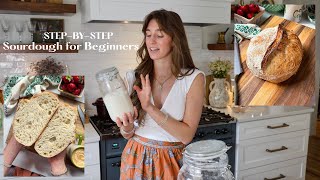

Sourdough Secrets: You Can Make It!
42sThe creator builds curiosity and confidence by promising that sourdough is easy and unlocks unlimited recipes, which hooks viewers seeking simplicity in a trendy topic.
▶ Play Clip"The title accurately describes the content: a step-by-step beginner's guide to making sourdough starter and bread."
This video provides a step-by-step guide for beginners to make a sourdough starter and bake their first loaf of sourdough bread. The creator demystifies the process, emphasizing that sourdough is easier than it seems and that mastering the starter opens up a world of possibilities.
Sourdough starter is a wild culture of bacteria created by fermenting equal parts flour and water. It acts as a natural leaven, replacing commercial yeast.
Use a glass jar, feed once daily with equal parts (by weight) starter, flour, and water. Discard all but 50g each feeding. The jar should not be washed with soap.
It takes about 7 days for a starter to become properly fermented. Feed every 24 hours, and after 7 days it should be bubbly and active.
For the bread: 100g active starter, 300g warm water, 10g salt, 450g flour. Mix with hands, then let rest 30 minutes before performing lift and fold sets (every 30 min, 3-4 times total).
After folding, shape the dough and place in a floured banneton. Let it proof on the counter for another hour, then refrigerate overnight (cold ferment).
Preheat oven to 500°F (or highest) with Dutch oven inside. Bake dough inside covered for 20 minutes, then remove lid and bake at 400°F for another 15+ minutes until golden.
Let the bread cool for at least 40 minutes to an hour before slicing. The crust will be crisp and the inside chewy.
What are the only two ingredients needed to make a sourdough starter?
Flour and water.
00:52
How many days does it take to create a properly fermented sourdough starter from scratch?
79 days.
02:02
How often should you feed a sourdough starter during the initial 7-day process?
Once a day (every 24 hours).
02:08
What is the ratio for feeding a sourdough starter?
Equal parts by weight: sourdough starter, flour, and water.
01:33
Should you wash the sourdough starter jar with soap?
No, you should never wash the jar with soap because it can kill the good bacteria and make the starter taste like soap.
02:32
What are the four ingredients for sourdough bread?
Sourdough starter, lukewarm water, flour, and fine baking salt.
04:13
What are the exact ingredient amounts for the sourdough bread recipe in the video?
100 grams of active sourdough starter, 300 grams of warm water, 10 grams of salt, and 450 grams of flour.
04:25
How often do you perform the 'lift and fold' process for the dough?
Every 30 minutes for a total of 3 to 4 times.
06:14
What is the purpose of the lift and fold process?
To create beautiful air bubbles in the dough.
06:26
How long should you wait before slicing into the baked sourdough bread?
At least 40 minutes to an hour.
11:00
What is the baking time and temperature schedule for the Dutch oven method?
20 minutes with the lid on, then another 15+ minutes with the lid off at 400°F.
09:13
Sourdough is easy
Demystifies the process for beginners, emphasizing that once mastered, many other recipes become possible.
Starter is a wild bacteria culture
Explains that starter is created by fermenting flour and water, acting as a natural leaven.
00:52Equal parts by weight
The key principle for feeding a starter: equal weights of starter, flour, and water.
01:33No soap for starter jar
A critical tip: washing with soap can kill beneficial bacteria and affect taste.
02:32Lift and fold to incorporate air
Describes the folding technique that creates air pockets for a light, open crumb.
06:26[00:00] Today I'm going to show y'all how to make sourdough starter and sourdough bread for beginners, step by step. Sourdough is one of those things where it seems really complicated, but it's actually one of the easiest things. And once you master, like, sourdough starter, not only sourdough bread, but sourdough starter, like, you are unstoppable.
[00:17] You can make biscuits, pancakes, focaccia. Focaccia is one of the easiest bread. Honestly, even easier than, like, a bread loaf. I'm going to show you how easy a bread loaf is. You're going to be, like, your mind's going to be blown. You can make like, baklava focaccia, s'mores focaccia, um, loonan blueberry focaccia, cinnamon roll focaccia, all the crips, these are on my blog by the way.
[00:38] Um, I don't know what, English muffins? Like, literally, the possibilities are endless. So, let's just go ahead and get into it. First things first, we need to make some sourdough starter. Sourdough starter, for those that don't know, is this wide culture of bacteria.
[00:52] It's the bacteria that is created by fermenting flour and water. so those are the only two ingredients you need and it's basically a natural leaven. It basically helps your bread rise naturally without using like commercial yeast.
[01:07] You can still have that and it's great when you're in a pinch. But we're going to start off with a glass jar. I highly recommend a glass jar. This one is I think 800 milliliters big. You can use one smaller.
[01:21] I also, this is like a recycled jar, so you can drip jars, you can recycle them from like when you buy like pickles at the grocery store.
[01:33] Just wash it out, make sure it doesn't smell like pickles. We're going to put our glass jar on our scale, and we're going to hit the power button to cancel it out so that it zeroes out. You're always going to want to use equal parts water, equal parts flour, and equal parts sourdough starter.
[01:46] Now we currently don't have a firewood starter, so we're going to start off with 50 grams of water And we're going to hit the tar gun into zero now. So I went over 4 and it's 53 grams So we're going to do 53 grams of flour. And now that we have equal parts flour and equal parts water
[02:02] We're just going to mix this together. We're going to add the lid and we're going to let this sit for 24 hours The process of creating your own firewood starter from scratch is going to take about seven days total for it to become properly fermented So every day we're going to feed it once a day.
[02:20] So let's pretend it's day two. Take 50 grams of our major fresh dough disbarter. Then disbar the remaining sourdough in the jar. And then I like to swirl around warm water until the jars are clean.
[02:32] The thing is you never want to wash it out with soap as that will interrupt the fermentation process and it's not really good for the bacteria. and it's not really different bacteria. And it might taste like soap, so don't do it.
[02:47] Also, tip is to get this sourdough starter out of your sink immediately, because this stuff whole hearted my heart right now. Just as with day one, we're gonna add equal grams of water, so we get 52 same ratio for flour so we gonna do day that you always want that flour fully absorbed when you mixing
[03:07] I'm just gonna add a bathroom team and rinse the jar. You're gonna repeat that process for 7 days total and you gotta feed it every day, every 24 hours because it is now a living breathing organism.
[03:19] Maybe not breathing, but living. It's a living organism. So you're going to feed it the same type ratio of sourdough starter, flour, and water. So if you decide to keep 50 grams or even 100 grams of sourdough starter,
[03:32] you're going to do 100 grams of sourdough starter, 100 grams of flour, 100 grams of water. To be. Tomatoes, tomatoes. I don't really know how to read this that well. But if you want to save yourself some time, you can also just always ask your friends for a bit of their sourdough starter.
[03:46] I give my friends so much sourdough starter, and I love it. because basically you give them your dip drum, they can eat it in a day and it's perfect or you can go ahead and feed it for them and they just start the process the next day.
[03:58] All types of work, the longer it's firmness, the better it tastes. But this bag is bubbly and ready. I'll actually show you yesterday when it was like overflowing bubbly and ready, so let's make some sourdough bread. So we just made four ingredients. Our sourdough starter that's active and bubbly,
[04:13] our flour, some lukewarm water, and some fine baking salt. My sourdough starter I usually feed about like 8am and then I'll start making bread about like 1pm. I even push it to 2pm sometimes.
[04:25] You can be really relaxed with yourself. I don't care that much about those certain times. But just to give you kind of an idea of my time schedule. I'm going to put up 300 grams of warm water. Then we're going to add 100 grams of your active sourdough starter.
[04:39] And then 10 grams of salt. Lastly we're going to add 450 grams of flour. I'm just using all-purpose flour, but you could use fresh flour, totally up to you. Okay. Your hands are your best kitchen tools.
[04:53] So you're just gonna mix this. You could also use like one of those regular kneading tools. But I just mix it with my hands until all the flour has kind of stored. It also takes like less than 30 seconds, so we're not gonna waste this kitchen tool.
[05:08] There's flour everywhere. You've done your hard work, you've made your sourdough dough, we're going to cover it with either- Okay, I like to cover it two different ways. Don't hate me for the first time. Saran wrap, I know, plastic.
[05:20] But I just, like, trap in the moisture, and that's what we want. We want it to get, like, we want it to get, like, warm in the air. Because, okay, summertime is the best time to make tarragon bread, in my opinion,
[05:34] because it rises so much quicker, and it's so much more bubbling in the summertime because it's nice and warm. You know how you want your dough to rise in a warm environment? same here, same situation here, the segway which I really don't appreciate, is I'll wet
[05:48] this under like really hot water and then I'll wring it out so it's nice and it's just damp. And then I cover it. Right now we're using a dry. We're going to set it aside for 30 minutes After 30 minutes we going to complete our first lift and fold process So imagine the bowl is divided into four different corners So we going to lift up each corner from the center and the bottom and then we going to fold it into the center
[06:14] So lift it up, fold. Rotate out an hour and a half to ZonBuy because every 30 minutes for a total of three to four times, you're lifting and folding those four corners into the center.
[06:26] we tap in all of this beautiful air, all this air, to create those beautiful air bubbles. That's what I meant. And then we have the final folding process. So this, we're going to stretch out our dough as much as possible,
[06:41] kind of shaking it underneath because we don't want to break the dough. We don't want to tear the dough. We don't want to flatten it or knead it. We want to keep all those air bubbles in it. And then you're just going to gently roll it up and then kind of push it towards you to roll tightly and we're going to put it in our floured
[06:57] bread basket and leave it on the counter for another hour and then we're going to put it away in the fridge. Also I left it basically out on the counter until it's on the bed which will be like 11 or 10 o'clock sometimes and I feel like the more rice I bring to the fridge the more it grows
[07:13] so I think that's totally fine. I've never had a problem with it but I wouldn't put it in your because any earlier than like 8 p.m. And then you can bake it at like 8 p.m., 9 a.m., even up to like 2 p.m. the next day.
[07:29] Now that our breads are fresh, it's time to bake. And I only have one set of them, so we're baking one bread at a time. Since I made two yesterday, so we can bake them together. Okay, so this one is a cinnamon swirl,
[07:43] no, cinnamon sugar chocolate chip swirl sourdough loaf. I'm so excited for it. If you have a 3-2-5, this is gonna be your girl. Basically how I made it was I made my regular firewood oven that I just showed y'all,
[07:55] and then half way through the lifting fold, I added in chocolate chips so that they'd be evenly distributed. And then right before the final fold, I sprinkled it with some cinnamon sprinkles, and then I just put it in the bread basket to rest overnight, or do a small fermentation overnight.
[08:10] So now, it's time to bake. So to bake our firewood oven, we want to set our oven to the highest temperature. Mine goes to 500. I would recommend you go more than 500 if you're gross. More than 500. You could also do 475, 460.
[08:23] And I like to preheat it for at least 30 minutes so it's going to get really hot. And then I also like to put the base of my Dutch oven in the oven while it's preheating so that it gets super hot.
[08:35] And now we need parchment. Crinkle your parchment paper and pour your bread on your parchment paper prior to adding it to the bedside. Make it like a little easier. Pour your bread directly on your parchment.
[08:50] Ooh, this is a little sticky over my face. If that happens, don't worry, you can wash it. And you can discuss it with a little bit of flour. When you go to store your bread you want it to be like quick and do split Oh and I say that but these chocolate chips are stopping me I gonna do a little cross Sometimes you can if one of those edges is a little rough you can
[09:13] kind of scoop them up a little bit and this will help them rise better when baking. Now that our bread is in the oven we're going to bake it about 20 minutes at like 475 to 500.
[09:29] this is going to help take steam within the duck oven and that is going to help your bread rise and like get nice and thick. So when you take the cover off you're going to notice your bread is like
[09:41] basically the size it's going to be. When I first started making sourdough I'd look at the cover and it would be flat and be like this is the most heartbreaking thing to see but after 20 minutes
[09:54] of baking with the cover. We're going to remove the cover to bake another like 15 and some minutes at 400 degrees Fahrenheit. I would tell you the calculations is Celsius, but my brain isn't going
[10:07] to do that this morning, unfortunately. Maybe I'll put them right here so you all know. And yeah, and then basically when you take the cover off to bake, that's when it's going to get super cold and brown and crisp on top. And I would just keep an eye on it after about 15 minutes,
[10:22] because every oven is different. It's got to be like gas, electric, stuff. You can get one on a last cooker or a last load. You might have to go a little more.
[10:34] Get the swirl. This smells like fresh bread. It smells amazing. But this is like, this smells like vodka, a chocolate chip cookie, and like a cinnamon swirl pretzel all hand-made with our inner bread.
[10:48] That's what it smells like. You can see the seams. Okay.
[11:00] Now, the hardest part about baking bread is the waiting after you've done all the hard work to make it. That's so hot. Oh, my gosh. Okay. You want to wait at least 40 minutes to an hour before slicing into it because it's still baking, guys.
[11:14] Like, that's why it's piping hot. It needs to cool down. It needs to stop baking. And I promise you, it is worth the wait. I'm so excited.
[11:33] Mmm. Mmm. It's so chewy. The outside is crisp.
[11:49] I also cut my finger. We're going to be a chocolate trip, love. Okay, any of the video on my phone, but if you guys have any sourdough questions, please let me know in the comments. I am here to help. I'll also have full details written on my blog.
[12:03] Is that Instagram? Or you can start with a blog. Love you guys.
⚡ Saved you 0h 12m reading this? Transcribe any YouTube video for free — no signup needed.