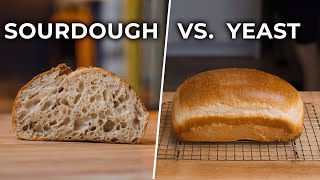

All bread was sourdough until 100 years ago
35sThis historical fact surprises viewers and challenges common assumptions about bread.
▶ Play Clip"The title accurately reflects the content, which clearly explains the difference between sourdough and commercial bread."
The video explores the difference between sourdough and commercial bread, explaining that sourdough is defined by its natural fermentation method using wild yeast rather than a sour taste. It covers the history of sourdough, the rise of commercial yeast for convenience, and the superior flavor and nutritional benefits of sourdough. The video advises how to identify genuine sourdough and encourages home baking.
Until about 100 years ago, all bread was sourdough. The term 'sourdough' refers to the method, not the flavor.
Sourdough originated around 10,000 years ago in ancient Egypt when people let flour and water sit, allowing wild yeast to bubble and create light bread.
Commercial yeast is strong and convenient, allowing bread to rise quickly, but it produces less flavorful and nutritious bread.
Sourdough starters contain yeast and healthy bacteria that break down wheat, making bread easier to digest and more nutritious with complex flavors.
Store-bought 'sourdough' often uses commercial yeast and chemicals to mimic sourness. Real sourdough should have only flour, water, and salt (or natural enrichments).
The speaker encourages making sourdough at home for fun, satisfaction, and better taste, even with a busy schedule.
What defines a bread as sourdough?
The method of making bread using naturally cultivated yeast rather than commercial yeast.
00:49
What type of yeast causes sourdough to rise?
Wild yeast naturally present in flour and water, which grows and multiplies under the right conditions.
00:35
Where and when was sourdough first discovered?
It was in ancient Egypt, about 10,000 years ago.
00:16
What are the benefits of the bacteria present in a sourdough starter?
They help break down the wheat, create complex acids, make the bread easier to digest, and more nutritious.
02:41
What are two major problems with using commercial yeast for bread?
It rises quickly, which doesn't allow enough time for the wheat to break down properly, and lacks biodiversity.
02:11
What are the only ingredients that should be in a genuine sourdough bread?
Flour, water, and salt (for a basic loaf); enriched breads may also include sugar, butter, eggs, and milk.
03:22
What is required to maintain a sourdough starter?
It needs to be fed with new flour and water on a regular basis to keep the yeast and bacteria alive.
01:47
What is used to leaven sourdough bread instead of commercial yeast?
A sourdough starter that has been fermenting for weeks, months, or even years.
02:26
Why does sourdough bread have a more complex flavor than commercially yeasted bread?
Because the starter contains both yeast and healthy bacteria, leading to complex flavors, better digestion, and more nutrition.
02:54
How can you tell if a store-bought bread labeled as sourdough is genuine?
Check that the ingredients list contains no added yeast and preferably only flour, water, and salt.
03:51
Origin of Sourdough
Provides historical context showing sourdough's ancient roots and that it predates commercial yeast by thousands of years.
00:16Definition of Sourdough
Clarifies a common misconception—sourdough is defined by its natural fermentation method, not its sour taste.
00:49Disadvantages of Commercial Yeast
Explains how fast fermentation leads to incomplete breakdown of wheat and less flavor development.
02:11Benefits of Sourdough Bacteria
Highlights the nutritional and digestive advantages of sourdough over commercial bread through natural bacteria.
02:41How to Identify True Sourdough
Gives practical advice for consumers to avoid fake sourdough products in stores.
03:51[00:00] When most people think of sourdough, they think of that tangy, rustic bread that you can only really get at fancy artisan bakeries. But it hasn't always been that way. In fact, until about 100 years ago, all bread was sourdough. Because contrary to popular belief, the term sourdough doesn't actually have anything to do with the flavor of the bread.
[00:16] But instead, it has to do with the way that it's made. You see, about 10,000 years ago in ancient Egypt, people discovered that if they let a mixture of flour and water sit out for an extended period of time, it would start to bubble and rise. And if they then cooked that mixture, it would result in a light and airy final product that was much tastier than the non-leavened flatbreads that they were making up until that point.
[00:35] So whether or not they realized it, it was yeast that was creating those bubbles. But of course, they hadn't added any yeast to the bread. It was just the yeast that was naturally present in their flour and water, which when provided with the right conditions could grow and multiply, causing the bread to rise.
[00:49] So the use of this naturally cultivated yeast, rather than a commercial yeast like the kind you see in packets at your local grocery store, is what actually defines a bread as sourdough. And that's the only requirement. So sourdough bread doesn't need to taste sour, although it does tend to be sour due to the naturally occurring bacteria that forms alongside the yeast.
[01:06] So we'll talk more about that in a bit. So for thousands of years, the only type of bread that existed was sourdough. But today, the large majority of breads that you'll find at your local grocery store are 11 with commercial yeast. And genuine sourdough bread is really only made by artists and bakeries and some more adventurous home cooks.
[01:22] But as we'll discuss in this video, I and many others believe that sourdough is the far superior type of bread. So the real question is, why did commercial yeast take over as the more popular option? And why do I think that you should be making sourdough bread if you're not already?
[01:35] Well, let's talk about that. So the main reason commercial yeast became popular is because it's a very strong and concentrated yeast. So it helps the bread to rise much faster than it otherwise would. And on top of that, it's just far more convenient than sourdough.
[01:47] Because when you make sourdough bread, you first have to make a sourdough starter, which is that mix of fermented flour and water that we discussed earlier. And then you have to feed that starter with new flour and water on a regular basis in order to keep it alive.
[01:59] So by using commercial yeast instead of that sourdough starter, commercial bakeries are able to churn out loaf after loaf very quickly. But that also leads to a few major problems. Basically, when you add commercial yeast to your dough, it rises quickly.
[02:11] But since that fermentation process is so quick, it doesn't allow enough time for the wheat to break down properly. And on top of that, the commercial yeast doesn't have the same biodiversity that a sourdough starter does. So in other words, when you make a yeasted bread, you're literally just mixing flour, water, and yeast.
[02:26] So sure, it creates an edible and airy final product. That is technically bread, but it will basically just taste like cooked flour with a very slight fermenting flavor from the yeast. Whereas with sourdough bread, we're using a sourdough starter, which has already been fermenting for weeks, months, or even years.
[02:41] So it not only contains a healthy culture of yeast, but it also contains lots of healthy bacteria. Which, when added to your dough, will work to break down the wheat, converting it into tasty complex acids, while also making the bread easier to digest, and more nutritious.
[02:54] So in simple terms, you could think of sourdough as undergoing a complete breakdown during fermentation. Whereas yeasted dough, while it does rise during fermentation, it doesn't have a chance to fully break down. So as a result, sourdough bread ends up with a much more aromatic and complex flavor,
[03:09] as the nuances really come to the forefront, like the calmly earthy notes of whole wheat flour or the subtle sweetness of dairy. And while the sourdough bread making process isn't always simple, as you definitely know if you've ever made it, the ingredients themselves are very simple.
[03:22] In fact, a basic sourdough bread can be made with just flour, water, and salt. And there's just something so satisfying about making a delicious loaf of bread with such simple ingredients. Now, the other thing to know is that you have to be careful when you see sourdough bread at the grocery store,
[03:35] because often these commercially produced breads that are labeled as sourdough are not actually sourdough. You see, in a lot of cases, these sourdough breads are actually just traditional yeasted breads with chemicals added to make them taste hangy. Not to mention a ton of preservatives, added sugars, and other things that you just don't need in your bread.
[03:51] So really, the only way to know for sure that a bread is sourdough is by looking at the ingredients and verifying that there was no additional yeast added to it. And preferably, the only ingredients should be flour, water, and salt. Or in the case of an enriched bread like brioche, it'll also include things like sugar, butter, eggs, and milk.
[04:07] But there certainly shouldn't be any preservatives or chemicals, or just generally any ingredients that you don't recognize. But of course, even better than that would be to make the bread yourself, or at least buy from your local artisan bakery, who you know is using high-quality ingredients and making bread the proper way.
[04:21] But of course, I think that you should just always make it yourself, because it's just so fun, so satisfying, and generally more tasty than any other alternative. And even if you have a busy schedule, there's always a way you can fit in at least one baking session per week once you learn how to manipulate your bread making process.
[04:35] And if you want to learn how to make your first sourdough starter, be sure to check out my full tutorial right here as well. Thanks a lot for watching, and I'll talk to you in the next one.
⚡ Saved you 0h 04m reading this? Transcribe any YouTube video for free — no signup needed.