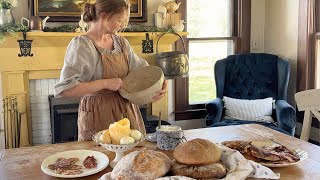

We've Overcomplicated Sourdough!
41sChallenges the modern obsession with precision, offering a relatable and liberating perspective.
▶ Play Clip"The video delivers exactly what the title promises: making sourdough without modern tools using historical techniques."
The video explores historical sourdough methods from 200 years ago, discarding modern precision tools like scales and measuring cups. The creator attempts to replicate pioneer techniques, including storing leaven in salt or flour, and baking by feel.
Sourdough was originally called leaven, an old piece of fermented dough.
Store leaven in a container covered with whole wheat flour for short-term use.
For long-term storage, keep leaven in a canister covered with salt, which forms a crust and dries it out.
Pioneer women dehydrated leaven and ground it into powder to carry on journeys.
To restore salt-stored leaven, soak in water for 2-4 hours until soft, then add flour.
Women kept sourdough in a pouch around their waist to keep it warm.
The creator mixes dough by feel, using about 3-4 cups flour, half cup leaven, warm water, and salt.
Reference to 1823 book 'The American Domestic Cookery' by Maria Rundle, stressing kneading.
1869 recipe: 1 coffee cup flour, 2 coffee cups gram flour, 1 coffee cup warm water, half cup yeast, molasses, salt, soda. Rise overnight, bake 1 hour.
Bake at 350°F for 45 minutes after 8-hour fermentation at 65-70°F.
Pinch a piece of dough from the bread to store for the next bake, as Maria Rundle advised.
Main takeaway: keep bread simple, focus on feeding family, not perfect crumb.
What was sourdough called 200 years ago?
Leaven
01:05
How did pioneer women store leaven for long journeys?
Dehydrated and ground into powder
03:04
What temperature and time did the creator bake the bread at?
350°F for 45 minutes
11:02
How long did the dough ferment in the kitchen?
About 8 hours at 65-70°F
10:48
What book from 1823 did the creator reference?
The American Domestic Cookery by Maria Rundle
06:16
How did pioneer women store leaven for long periods without refrigeration?
In a canister covered with salt
02:39
How do you restore salt-stored leaven to make bread?
Soak it in water for 2-4 hours until soft
03:36
Overcomplication of sourdough
Challenges modern precision baking and advocates for simplicity.
00:51Salt storage method
Shows a historical preservation technique that creates a crust around the leaven.
02:39Dehydrated starter powder
Reveals that pioneer women ground dried starter into powder for long journeys.
03:04Feeding family over perfection
Summarizes the core philosophy: bread is about nourishment, not aesthetics.
17:09[00:00] Music
[00:24] Sourdough, as we know it today, is a lot different than what it used to be 200 years ago, and even earlier than that. I have learned to make sourdough bread by counting every gram of flour and every drop of water.
[00:41] And wondering where I went wrong when my bread doesn't quite turn out even though I followed a recipe precisely? Well, I think that maybe we've overcomplicated this sourdough thing. Maybe we are overthinking all of this.
[00:56] And so today I'm throwing caution to the wind. I'm throwing out the measuring cups, the recipes, the scale, and I've done some research. And I'm going to be using some 200-year-old sourdough bread baking methods.
[01:10] First of all, what we now call sourdough used to be called leaven, which simply refers to an old piece of dough that has been sitting and souring and has gone through a fermentation process.
[01:25] So I've milled some fresh flour, and I've prepared some sourdough bread the way I normally would, but I have taken a piece of my sourdough bread, and I'm going to be storing it in the ancient way.
[01:38] And that is by taking a piece of my sourdough, my leaven, and storing it in a container and covering it with some whole wheat flour. Today I actually am going to be mostly using freshly ground whole wheat flour.
[01:52] This is how they would store their sourdough bread for a short period of time. They would probably be using this on a daily basis, or maybe every other day, is how long it would be able to keep in a canister, or even a pouch that they would carry on them if they were walking across the prairies.
[02:13] Although they didn't have the science that we do today, these women were smart, and they understood the power of fermentation, and they knew that heat was important for their bread to rise. And so, even though they didn't have refrigerators, they knew that their leaven needed to stay warm if they wanted to make some bread, and it needed to stay cool if they wanted to store it.
[02:35] If they wanted to store it for a long period of time without refrigeration or an ice box, they would keep it in a canister covered in salt. And what would happen is this salt would create a crust around their sourdough ball of dough, and it would dry it out inside an homeless, kind of a petrified way of storing the sourdough.
[02:59] I also read that these pioneer women would dehydrate their sourdough starters and grind it into powder and take it with them on their long journeys, especially if these women were coming across the Atlantic Ocean, making their ways west, they had to figure out a way to store their leaven for long periods of time.
[03:17] And this is what my leaven looked like after five days of sitting in my salt canister on the counter. It had formed a hard crust around the dough, and inside was a petrified piece of leaven.
[03:31] And so I scraped all the crusty edges off and pulled out the inner parts, and to restore it to make bread, you just put it in a bowl of water and let that sit for maybe two to four hours until it's nice and soft.
[03:48] And then you can go ahead and throw in the flour and continue to make bread as normal, and that's how you could store your leaven for a long period of time. But for today, we're going to go with the short period of storing our leaven by just using my lump of dough that I had put in our flour canister.
[04:08] Speaking of these brave pioneer women who came west, they often would keep their sourdough in a pouch around their waist to keep it warm in a little pouch of flour.
[04:23] From an old pioneer woman who wrote in her journal, probably around the time of 1848, as she was traveling west across the American frontier, she wrote, when we camped, I made rising and set on a warm ground. It would be up about midnight. I'd get up and put it to a sponge in the morning first thing.
[04:42] I would mix the dough and put in the reflector oven with good hot coals, the breads or cakes for a hearty breakfast or ready by the time the men rounded up the teams. These women traveling west would indeed make bread along the way. They would keep their lump of sourdough in a pouch covered with flour wrapped around their side, and they would carry it with them,
[05:06] or they would even keep it in a canister and set it in the sun on the wagon to let it rise. While everyone was setting up camp, they would mix their sourdough 11 with some flour and water, and they would set it to rise on the warm ground.
[05:23] And at midnight, this woman recalls she would mix the dough and then it would ferment throughout the night and she would bake it in the morning for breakfast. So I'm going to mix together my bread in a similar way. I'm just going off of what feels right.
[05:40] I've put together about three to four cups of flour just using a bowl and a big wooden spoon. I put about a half a cup of lemon and poured some warm filtered water in there.
[05:54] I've also added a bit of salt and I'm just eyeballing everything. I think I've made enough bread that I can understand what it's supposed to feel like. I'm mixing my dough together until there's no more dry clumps in it.
[06:10] I took a lot of notes from an old book from 1823 called The American Domestic Cookery by a lady that's literally what it's called. It was written by Maria Rundle, and she really stressed the importance of kneading the dough.
[06:27] In these early pioneer American cookbooks and journals, no stretch and fold methods were ever mentioned, although the importance of actually kneading your dough thoroughly was mentioned quite a bit.
[06:40] Next, I'm going to mix together a sandwich loaf that is actually from 1869. This recipe is one coffee cup of flour, two coffee cups gram flour, one coffee cup warm water, half coffee cup yeast, a little molasses, a teaspoon of salt, half teaspoon soda dissolved in the water, make as stiff as it can be stirred with a spoon.
[07:07] Let it rise overnight and bake about an hour in moderate oven. This quantity makes one loaf. You'll also notice that I'm mixing my bread dough and baking it in the exact same pan, which is a nod to maungles who also did this, and she also baked sourdough, by the way, in the 1800s.
[08:45] On the prairie, no food would have ever gone to waste, so with the rest of our leaven, we're going to mix together some pancakes or some flat jacks, as they might have called them.
[09:10] And I mix together some corn flour and some whole wheat flour and some milk, and we are going to let this ferment with the rest of our doughs overnight. I'm also going to incorporate a little bit of kneading on the rest of my doughs to get that gluten going.
[09:29] And I would love to hear if you have any recipes passed down by your families or any history on bread making, anything you want to share down in the comments below, I would love to hear what you guys have to say on the subject of ancient bread making.
[09:59] You
[10:29] So our bread has been fermenting here for about eight hours, and it's probably about 65 to 70 degrees in my kitchen.
[10:57] You can see that this has risen a little bit, and I didn't shape it. I just gave it a little cut on top, and I'm baking it at 350 for about 45 minutes, and then we'll check on it. In the meantime, I'm going to pull out our other loaf. I think I'm going to call this our pioneer loaf. This is based off of a rough schedule from one of our pioneer women, and just roughly made by eye.
[11:23] We're going to give it a quick stretch and a shape and get this ready to go in the oven. I'm going to let it sit here on the counter for about an hour while we're waiting for the other loaf to finish baking because I'm going to bake them at a considerably different temperature.
[11:39] We know that people have been making bread for centuries, and that also makes sense that there would be so many different recipes for making a sourdough starter. And so it kind of blew my mind all the different methods and ways to make a sourdough starter other than the typical way that you would find on the internet today.
[12:00] Today we started starter by putting flour and water together, discarding that amount and feeding it a new amount of flour and water every day for about a week. I was surprised to find that back in the day you could just mix your flour and water into a lump of dough and leave it on the counter for about 12 days, and that would be your sour 11.
[12:22] So are there some things that I would keep and there's some things that I would not keep that I've learned this week. One thing I thought was also very interesting was that they would use the same dishes for mixing their doughs.
[12:36] They really did understand fermentation and the importance of keeping those bacteria around and not washing them away. So I don't think I could really stand to have a bunch of dirty dishes in the kitchen, but I think I can stick with one sourdough mixing bowl that I don't wash
[12:56] and keep that for mixing my sourdough in. And that just makes sense to keep all those live cultures in your bowl alive and not sanitizing things all the time.
[13:09] And just like Maria said from her 1823 book, I am pinching a piece of my sourdough off of the bread that I'm about to bake and I'm going to store it for later. And this is how they would keep their sourdough 11 going for the next bake.
[13:49] So that's how they would keep their sourdough.
[14:49] So that's how they would keep their sourdough.
[15:19] So that's how they would keep their sourdough.
[15:49] Thank you very much.
[16:19] So what is the takeaway?
[16:31] What did I really learn through these past few days of researching old sourdough methods?
[16:43] Well, like I always say on this channel, I think we need to keep things simple. I think we're overthinking this whole bread thing.
[16:57] It's not just for looks, it's not about making them perfect sourdough loaf and having the perfect crumb. I don't really think that mattered at all back then.
[17:09] What really mattered was feeding your family and feeding them good food. So what I'm really trying to do is restore home and family and spirit through tried and true home making skills. And I feel that is exactly what we did this week.
[17:23] We simplified things. We brought it back to the way that they were intended to be made. It's just bread.
[17:37] Maybe it's time for you to put those recipe books aside and just make some bread. Enjoy the process of making bread with your own hands and seeing how it turns out.
[17:49] Thank you so much for joining me here today. I can't wait to hear from you all in the comments down below. Share your recipes and your thoughts. I do have lots more videos on baking, bread making, and so much more in my playlist that will be down in the description box below.
[18:05] Make sure to watch that. And I will see you guys all next week for a more restoring home family and spirit through tried and true home making skills. Love you lots!
⚡ Saved you 0h 18m reading this? Transcribe any YouTube video for free — no signup needed.