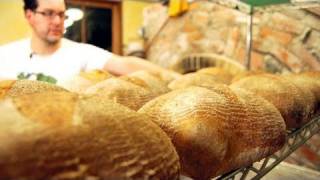

Why Most Sourdough is Fake
43sReveals a common misconception about fake sourdough, sparking controversy and curiosity.
▶ Play Clip"The title accurately reflects the video's content, which combines the craft of sourdough baking with scientific explanations of fermentation and microbiology, though it slightly overpromises 'secrets' when the content is more of an introductory overview."
This video explores the science and craft behind authentic sourdough bread. Eduardo Morral, founder of Morral's Bread, explains what truly defines sourdough, contrasting it with commercial imitations that use added acids instead of natural fermentation. The video also features insights from a scientist studying the beneficial bacteria, particularly lactobacillus, that create sourdough's unique flavor.
Eduardo Morral explains that many breads labeled 'sourdough' are not authentic; they may use added acid rather than natural fermentation. Real sourdough is produced anywhere via natural bacteria and yeast in a starter, resulting in a mild, complex flavor, not just tanginess.
Eduardo developed an interest in the science of sourdough culture, aiming to return to traditional bread making. A starter is a medium of flour and water where airborne colonize microorganisms, including bacteria and yeast that consume starch and produce gas for rising.
Fermentation is a microbial process that makes food more nutritious and digestible. The video highlights lactic acid bacteria, essential for fermented foods like yogurt, cheese, olives, and sourdough bread, which can contain living, beneficial bacteria.
Sourdough relies on a symbiotic marriage between yeast and bacteria. Unlike baker's yeast (Saccharomyces cerevisiae), sourdough yeast (Candida milleri) works with lactobacillus bacteria (e.g., Lactobacillus sanfranciscensis) to produce acetic acid, giving the bread its sour taste.
Eduardo describes his 15-16 hour baking day as a fusion of physics, biology, and chemistry. He uses wood, flour, water, and salt, and his mixer emulates hand-kneading. The process involves mixing, shaping (about 3 hours), proofing, and baking (3.5 hours).
Eduardo notes that his background in English and science led him to see baking as both creative and scientific. He believes the two disciplines are not mutually exclusive, and he finds beauty in the scientific aspects of bread making.
Real sourdough is a product of natural fermentation, blending science and craft for a complex flavor. The video shows that authentic sourdough is not merely sour but offers a multidimensional taste.
What distinguishes real sourdough from common imitations in the market?
Real sourdough relies on natural fermentation by bacteria and yeast, not added acids to create a tangy taste.
00:43
What is the recommended method to create a sourdough starter?
Mix flour and water to create a medium where airborne microorganisms (yeast and bacteria) can colonize.
01:41
What type of bacteria is essential for sourdough fermentation?
Lactic acid bacteria, particularly Lactobacillus species, are essential.
02:28
What is the scientific name of the yeast commonly used in sourdough?
Candida milleri.
03:32
How does the yeast in sourdough differ from typical baker's yeast?
Sourdough yeast (Candida milleri) depends on lactobacillus bacteria to consume sugars and produce byproducts that allow yeast growth, whereas baker's yeast (Saccharomyces cerevisiae) consumes sugars directly.
03:32
What is the function of lactobacillus bacteria in sourdough?
It produces organic acids, specifically acetic acid (vinegar), which gives the bread a sour taste.
04:03
What are the four raw materials Eduardo uses to make bread?
Wood, flour, water, and salt.
04:54
How does Eduardo describe the process of baking from a scientific perspective?
He describes it as a combination of physics, biology, and chemistry, transforming raw materials into the final product.
04:43
Sourdough is Not Just Sour
Highlighting the common misconception that sourdough is inherently sour, whereas real sourdough has a mild, complex flavor depending on fermentation.
00:43Fermentation Increases Nutrition
A factual point explaining that fermentation makes food more nutritious and digestible, which is a key principle of fermented foods.
02:10The Symbiotic Yeast-Bacteria Partnership
Reveals the unique biological relationship between yeast and bacteria in sourdough, which is distinct from commercial bread.
03:16Lactobacillus sanfranciscensis and Acetic Acid
A specific scientific detail about how a particular lactobacillus species produces the sour taste in San Francisco sourdough.
04:03Science and Creativity are Intertwined
A principle expressed by the baker that creativity and science are not mutually exclusive, reflecting the holistic nature of artisan baking.
06:32[00:00] My name is Eduardo Morral and I'm the founder and owner of
[00:30] Morral's Bread. I started Morral's Bread back in 2001 along with the with the assistance of my wife who actually was in the bakery with me for the first few years of the business until my daughter was born and it's been 10 years now
[00:43] that I've been running the business. The idea of sourdough in general can be a little bit confusing to so many people because there are so many breads out there that are labeled sourdough which actually aren't sourdough at all. For a
[00:58] long time the idea of San Francisco sourdough was just this really sour tasting bread. They didn't have anything to do with natural fermentation. All they were doing was adding some kind of acid to make it this tangy product that
[01:12] people associated with San Francisco sourdough. The reality of it is that sourdough can be produced anywhere in the world with the bacteria and the yeast and stuff in the sourdough starters and sometimes the natural lemon bread isn't
[01:26] specifically all that sour. It's a much more mild flavor depending on how much you're fermenting it. I started to develop this interest in the science of a sourdough culture. It was all trying to get back to what bread making has been
[01:41] for thousands of years. I think that sourdough starters was just the way to do bread up until yeast became commercialized. What starter means to me and what starter is you just take flour and water and you're creating a medium for
[01:57] these microorganisms that are in the air that we're breathing right now to colonize. They could take a little piece of that dough, mix that into a new dough and that dough would start rising. The bacteria and yeast are doing their job
[02:10] consuming the starch producing gas for the bread to rise and this is fermentation. It is a form of making food more nutritious and more digestible.
[02:28] My lab is interested in the beneficial bacteria you find in foods and in our gastrointestinal tracks and a particular we're interested in group of organisms called lactic acid bacteria which are essential for many fermented
[02:44] plants and dairy foods. Fermented food is actually the result of extensive microbial growth. When you eat yogurt, you're actually eating product made by bacteria in which probably still contains a high amount of living bacteria which
[03:00] are perfectly harmless and sometimes even helpful. Fermented foods include sausage, salami, cheese, and fermented plant foods like olives and sourdough breads.
[03:16] Sourdough is really fascinating because it's a marriage between a yeast and a bacteria. There's a difference between the yeast you find in typical supermarket bread and the yeast you find in sourdough bread and supermarket bread just
[03:32] typically made using baker's yeast or saccharomyces or VCA is able to consume the sugars in the dough for growth. That's different from the yeast you find in sourdough bread, the yeast being Canada, Millerite, and it's dependent on the bacteria you
[03:48] find in the bread, lactobacillus, sand fans, the senses, or San Francisco for short. To consume the sugar, it's a bit part of it back out and that's what allows the yeast to grow. This lactobacillus species is really only found in
[04:03] sourdoughs, nowhere else. Like other lactobacillus bacteria produces organic acids as a result of its growth. This particular organism produces a lot of acetic acid, which is vinegar acid. That acid gives the bread a very sour taste.
[04:25] So my day varies anywhere between 15 to 16 hours. I usually come in the bakery the first thing I do, I start the fire in the oven. And fortunately with the efficiency of these ovens in terms of heat retention, once the fire starts it
[04:40] goes. I do feel like a scientist sometimes when I bake. I think cooking is you know science to a certain extent. It's taking raw materials. My raw materials being
[04:54] wood, flour, water, and salt, and you know exerting a force on them. And I start with those things. In 16 hours later I have a complete product, which I can you know then take to the farmer's market and sell to someone. So it's a little bit of
[05:07] physics, it's a little bit of biology, and that's a little bit of chemistry. It's all rolled into one, no pun intended, with the bread. There's a lot of dough to mix. It'll work that I used to do by hand. I was able to
[05:23] find the kind of this diving arm mixer that really emulates the way in which bread is hand-needed.
[05:40] By the time I'm finished mixing and kneading very last dough, the first dough I mixed and kneaded is ready to be shaped. We go through this process of shaping for about three hours.
[05:59] All the dough is cut and shaped and then I put into the proof box if it's cold in the kitchen. That keeps it warm or not.
[06:11] As soon as the last doughs are cut and shaped, then the first doughs are ready to go into the oven. Then it's all baking for the next three and a half hours.
[06:32] I've always been fascinated by science. Both my parents' positions, my brothers you know, as a scientist, and I took science, lots of science classes when I was in college. I was an English major taking all these science classes because I just was
[06:44] fascinated by that. So it's really interesting that what I do now is both creative and scientific. I don't think that the two are mutually exclusive. I don't think that creativity and science are, you know, these two separate disciplines. I think
[06:58] they're very much intertwined and I do find the beauty and the creativity and science.
[07:14] When you taste a bread, it is truly natural that I have a bread. You're like, wow, you know, this isn't just a one-dimensional thing. It's this really round and more kind of
[07:32] dimensional flavor as opposed to just being sour. A lot of people who say, no, I don't like sour dough. They try my bread and they're just eating it happily and then like, this is sour dough. I'm like, absolutely. This is truly sour dough, real sour dough bread, naturally lemon bread.
⚡ Saved you 0h 08m reading this? Transcribe any YouTube video for free — no signup needed.