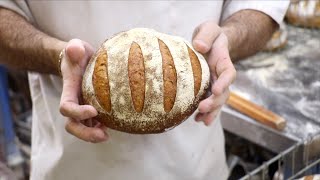

Wild Yeast vs Baker's Yeast
45sExplains the fundamental difference between sourdough and commercial bread in a clear, visually compelling way.
▶ Play Clip"The title 'The science of sourdough bread' perfectly matches the transcript, which explains the biological and chemical processes behind sourdough."
Sourdough bread uses a wild starter instead of commercial baker's yeast, which introduces diverse yeast strains and lactobacillus bacteria that create unique flavors and textures. The process involves growing a culture from wild yeast, feeding it daily, and using a large proportion of it in the dough to achieve a slow fermentation that enhances digestibility, flavor, and structure.
Sourdough uses a wild starter instead of a single strain of mass-produced baker's yeast, leading to diverse yeast types and flavors.
Wild yeast settles on grain berries; when flour is mixed with water, the yeast feeds on sugars, producing alcohol and CO2 gas. Bubbles appear after about five days, indicating yeast growth.
Lactobacillus bacteria grow alongside yeast, producing lactic acid that gives sourdough its tangy flavor and name.
A small portion of the starter is fed daily with fresh flour and water to keep it active indefinitely.
30% of the dough is the culture, mixed with fresh flour and water. Mixing develops proteins that trap gas, creating a chewy texture.
The dough proves until doubled in size, which takes longer than commercial bread. Gentle shaping preserves gas pockets, and the dough is placed in floured baskets to form the crust.
The long production time makes sourdough more digestible, flavorful, and textured, with a better crust and ability to spring back when squashed.
Sourdough's unique flavor, texture, and digestibility come from its slow fermentation using a wild starter, which requires daily care and patience but yields superior bread.
What is the main difference between sourdough and normal bread?
Sourdough uses a wild starter instead of a single strain of baker's yeast.
How long does it take for bubbles to appear in a wild yeast culture?
About five days.
0:53
What bacteria gives sourdough its name and flavor?
Lactobacillus, which produces lactic acid.
0:58
What percentage of sourdough dough is made up of the culture?
30%.
1:34
Why does sourdough take longer to prove than normal bread?
Because the wild yeast is being grown during the process, unlike commercial yeast which is already grown.
1:55
What is the role of proteins in sourdough dough?
They trap the gas produced by yeast, creating a chewy texture and large holes.
1:45
How should sourdough dough be shaped to preserve gas pockets?
Gently, to avoid knocking out the gas.
2:04
What are two benefits of the long production time in sourdough?
It makes the bread more digestible and gives it more flavor.
2:37
Sourdough vs. Baker's Yeast
Explains the fundamental difference in yeast sources, which drives the entire sourdough process.
Wild Yeast Cultivation
Describes how wild yeast is naturally present on grain and can be cultivated at home.
0:33Lactobacillus and Flavor
Highlights the symbiotic relationship between yeast and bacteria that creates sourdough's signature tang.
0:58High Culture Proportion
Reveals that 30% of the dough is starter, much more than commercial bread, affecting flavor and fermentation.
1:34Time as an Ingredient
Emphasizes that the long fermentation time is key to sourdough's digestibility, flavor, and texture.
2:37[00:00] Sourdough differs from normal bread, as you
[00:06] wild starter instead of baker's yeast. So baker's
[00:13] mass-produced, to create this milky substance
[00:18] and that's trillions of cells which means you
[00:22] of developing that dough and growing
[00:26] With a sourdough you don't know what type
[00:30] so you get lots of different
[00:33] What you do with the wild yeast is you grow it
[00:38] outside of a grain berry, as soon as that's
[00:42] it begins to feed on the sugars. When it feeds on
[00:47] the gas being CO2. In five days time you'll start
[00:53] Those bubbles are the first sign that the yeast is
[00:58] is basically a good bacteria that grows alongside
[01:02] It creates lactic acid, it gets sharper and
[01:07] very important thing that the two grow together.
[01:11] smells more like a brewery because of all the
[01:15] We then take a little bit of that, feed it with
[01:19] bubbling away like mad and that is your culture.
[01:24] to keep feeding it every day, keep a little bit
[01:29] as long as you remember to feed it every day. 30%
[01:34] a small amount of yeast you would add to bread.
[01:39] and water to make the dough. The dough is then
[01:45] The proteins are what trap the gas. So you've got
[01:49] chewy gum-like texture to the dough that trap the
[01:55] double its size. This takes quite a long time when
[02:00] So once the dough's developed or
[02:04] marshmallow of dough so we're then gently
[02:08] all those pockets of gas. It's taking a long
[02:12] we don't want to knock it out. So we gently shape
[02:16] floured into baskets. That helps to create
[02:21] holding it together and it allows it to
[02:25] The proteins are trapping the gas and create
[02:31] then turn it out onto wooden peels, score it, and
[02:37] Sourdough has something in it that normal
[02:40] in its production, which makes it more
[02:44] more texture, you can squash it flat, it will
[02:49] Flavour is the biggest thing though, it
⚡ Saved you 0h 02m reading this? Transcribe any YouTube video for free — no signup needed.