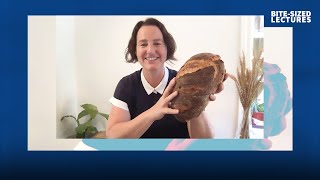

Sourdough's Secret Science
39sReveals the hidden microbiology behind a common food, sparking curiosity.
▶ Play Clip"The title accurately reflects the content, which delves deeply into the science and microbiology of sourdough."
Sourdough bread, while simple in ingredients (flour, salt, water), involves complex science and microbiology. Yeast and bacteria form a stable community in the starter culture, fermenting to produce gas and acids that give the bread its rise and tangy flavor.
Sourdough bread is simple in ingredients but backed by science and microbiology.
Flour, salt, water, plus yeast and bacteria from fermentation form the starter culture.
Commercial yeast (Saccharomyces cerevisiae) ferments quickly with limited flavors; sourdough starters often contain Kazakhstania yeast, which forms stable associations with bacteria.
Yeast produces gas for rising; bacteria (lactobacilli) produce acids for sour taste and tangy flavors.
Microbes may come from grain, hands, containers, or insects (e.g., fruit flies). An experiment with wild grain showed fermentation within a day.
A 120-year-old Alaskan starter, when fed with Australian flour, showed different microbial diversity, suggesting adaptation to local conditions.
Farmer bakers (closed system) have distinct microbial diversity compared to industrial processes, highlighting the impact of environment on starter cultures.
Sourdough's microbial community is dynamic and influenced by ingredients, environment, and handling, offering a rich area for scientific exploration.
What are the three basic ingredients of sourdough bread?
Flour, salt, and water.
00:23
What is the fourth ingredient that forms in sourdough starter?
Yeast and bacteria that ferment the starter.
00:23
What type of yeast is commonly found in supermarket yeast?
Saccharomyces cerevisiae.
00:55
What genus of yeast predominates in artisanal sourdough starters from Victoria and East Coast Australia?
Kazakhstania yeast.
01:09
What role do yeast play in sourdough fermentation?
Yeast produce gas (bubbles) that help the bread rise.
01:38
What role do bacteria play in sourdough fermentation?
Bacteria produce acids that give the bread its sour taste and tangy flavors.
01:51
Name one possible source of microbes in a sourdough starter.
Grain, hands, container, or passing insects (e.g., fruit flies).
02:49
How long did it take for the wild grain starter to show fermentation (bubbles)?
By the end of the first day.
02:34
What happened to the microbial diversity of the Alaskan starter when fed with Australian flour?
The microbial diversity changed and became different from its original Alaskan composition.
04:02
What is the difference in microbial diversity between farmer bakers and industrial bakers in France?
Farmer bakers (closed system) have distinct microbial diversity compared to industrial processes.
04:46
Simple ingredients, complex science
Highlights the contrast between the simplicity of ingredients and the complexity of the microbial science behind sourdough.
00:23Yeast diversity
Reveals that commercial yeast (S cerevisiae) differs from the Kazakhstania yeast found in artisanal starters, affecting flavor and fermentation.
00:55Origin of microbes experiment
Demonstrates a practical experiment to explore where microbes come from, showing fermentation from wild grain within a day.
02:07Microbial adaptation over time
Illustrates how a starter's microbial community can change when moved to a new environment (e.g., Alaska to Australia).
03:48Closed vs industrial systems
Compares farmer bakers' closed ecological systems to industrial processes, showing distinct microbial diversity.
04:33[00:00] sourdough bread, smells delicious and tastes delicious, but for something that's quite deceptively simple and is on our plate sometimes every day, there's a lot of science and a lot of microbiology that sits behind this lovely loaf of delicious spread.
[00:23] Bread in its very simplest form is three ingredients, flour, salt and water, and when the flour and the water are together over a long period of time you get a fourth really important ingredient in sourdough bread and that's the yeast and the bacteria that start to ferment
[00:39] in that starter culture. These yeast are really interesting if you're a microbiologist because they form this stable community with the bacteria that have found it and so our lab has been looking at what those yeast and the bacteria are and how they interact with one another.
[00:55] So we know that if the yeast that you can buy off the shelf in the supermarket is saccharomyces cerevisiae it's the the workhorse of the yeast world it does everything you know it's a strong fermenter but it tends to ferment very quickly and without a wide range of interesting flavours.
[01:09] When we look at sourdough starters from artisanal bakeries at across Victoria and the East Coast of Australia we've been finding that Kazakhstania yeast predominate in these sourdough bakeries
[01:21] and Kazakhstania yeast are a different genre altogether and they have a wide range of different characteristics and they're really interesting because they form very stable associations with the bacteria in the starter. Now these bacteria are lactocacid bacteria and particularly lactobacillate
[01:38] and they work together to ferment so the yeast tend to produce gas which are these bubbles that you see and they help live in the bread so it rises and you get this lovely big complote. The bacteria are working
[01:51] also with the yeast they take nutrients from the yeast to grow but then they they tend to produce acids and these acids give a sour note to the bread which is of course why we call it sourdough some of these acids have got really distinctive tangy flavours.
[02:07] When we consider where the yeast and the bacteria are in the sourdough the next question for scientists is where do they come from and so I've been thinking about this a lot and reading lots of papers and then when I was on holiday in the Western history it's a Victoria I was like okay cool it can finally do
[02:22] an experiment on this. I was driving on the road and saw a pile of grain on the side. Great collected some up, milled it and added a wall showing took it back to the campsite and left it out
[02:34] in the container and after just I think by the end of that day it started to finish. You can see there were bubbles on the top of the culture which means that there was microbial activity it started to take place. Now we don't know what yeast and bacteria were there at the moment but we can start to speculate
[02:49] where they might come from there might be on the grain that we found might be something in our hands it could be in the container it could be from passing insects actually and we know that some
[03:01] insects such as soft lids they carry a big community of yeast and bacteria and the same genres and species are found in sourdough starter so that could also be a way that they're introduced. So by the end of this first day it was smelling not very pleasant a little bit rank
[03:16] but after a while we were feeding it every single day with flour and water and tipping a little bit out feeding it with some flour and water and it started to settle into a nice routine when you could see it rise over the day it would then collapse a little bit and then we'd feed it again
[03:32] and it would start to do that as well and then it started to produce a pretty nice aroma and it was ready to make some lovely loads of green and with some very distinct flavours and aromas that I hope we could perhaps one day think back to the Western districts of Victoria where I took the grain
[03:48] from originally. So we started looking at the microbial diversity of sourdough starters and we were given a starter from a baker friend which originated in Alaska when we looked at this in the lab we found
[04:02] a really interesting assembly to use in bacteria and we started wondering well this is the same starter that would have come from Alaska all of these years ago I think the tradition of this particular starter was it was a hundred and twenty years old with no good way of telling and we would suspect that
[04:17] over time moving from baker's hand to baker's hand and different baker's moving continents and then being fed with Australian flour with me that the microbial diversity is quite different to what it would have been when it was started in Alaska all those years ago. Now we've got some evidence I guess
[04:33] that would support that because my collaborator in France, Delfine Cicare, is really interested in yeast diversity in French baker's now we know that the French have a very strong tradition of bread
[04:46] and she's been investigating the diversity of yeast and bacteria and sourdough starters in these farmer bakers which are a very closed ecological system they grow their own wheat they mill it they make the bread and they sell it and comparing that to a more industrialised bread making system.
[05:02] Now the farmer bakers and this closed system have a very distinct microbial diversity then that's quite different to what you'll find in the more industrialised process so this is an emerging story. Now I'm really excited to think about what we might discover about Australian yeast.
⚡ Saved you 0h 05m reading this? Transcribe any YouTube video for free — no signup needed.