
Why saffron only blooms in water
51sThe visual demonstration of water-soluble crocin shows a surprising kitchen science fact that people love to see.
▶ Play Clip"The title matches the content—the video thoroughly tests saffron's worth, confirming it is expensive but not always necessary to buy the priciest grade."
This video explores the most expensive spice in the world, saffron, focusing on three key questions: its flavor and culinary role, differences between cheap and expensive saffron, and how to maximize its use in cooking. Through experiments and taste tests, the presenter investigates whether price and preparation methods matter.
The video sets out to answer three questions: the flavor and use of saffron, differences between cheap and expensive saffron, and how to get the most out of it when cooking.
Saffron is bloomed in water, milk, and oil at 150°F to test extraction of flavor compounds.
Saffron's primary impact is aroma (safranal) and color (crocin), not taste. It is slightly bitter from picrocrocin but used in small amounts.
Crocin is water-soluble, so blooming in water-based liquids is key for color. Oil does not extract color.
Saffron’s luxury association influences perception, adding a cultural bias to its flavor experience.
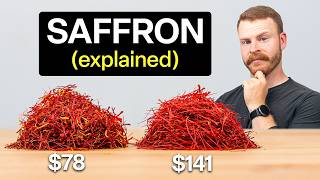
Two saffron grades ($79/oz vs $141/oz) are used in saffron rice. Blind taste test reveals no clear flavor or color difference in the dish.
Risotto with 0.05g, 0.1g, 0.2g, and 0.4g saffron. The 0.1g portion is preferred; higher amounts add bitterness without proportional aroma.
Grinding saffron produces darker color and slightly more bitterness. It allows using less saffron for similar color.
A little saffron goes a long way; cheaper whole-thread options are sufficient for most home cooks, and grinding maximizes extraction.
What is the primary aroma compound in saffron?
Safranal
[4:10]
What compound gives saffron its golden yellow color?
Crocin
[5:20]
Why should saffron not be bloomed in oil?
Because crocin is water-soluble, not fat-soluble, so oil does not extract the color.
[7:22]
In the cheap vs. expensive saffron test, what was the price per ounce for each?
Cheap: $79/oz, expensive: $141/oz.
[11:01]
According to the ISO grading, what determines saffron quality?
Coloring strength, aroma, and flavor compounds.
[12:55]
In the risotto quantity test, which amount of saffron was preferred?
0.1g per 150g risotto.
[21:00]
What happens when too much saffron is used?
It becomes bitter due to picrocrocin.
[23:05]
How does grinding saffron affect extraction compared to whole threads?
Grinding increases surface area, leading to faster and more complete extraction of color and flavor compounds.
[25:58]
What percentage of the world's saffron comes from Iran?
About 90%.
[12:37]
Aroma Over Taste
Clarifies that saffron's value is primarily aroma and color, not taste, which is a common misconception.
[3:40]Water Solubility of Crocin
Explains why blooming in water is essential for color extraction, a practical cooking tip.
[5:00]Price vs. Performance
Shows that expensive saffron may not yield better results in dishes, saving money for home cooks.
[17:49]Grinding Increases Extraction
Demonstrates a simple method to use less saffron while achieving stronger color, a cost-effective tip.
[25:58]Little Goes a Long Way
Emphasizes that saffron is potent and a small amount suffices, debunking the need for large quantities.
[29:15][00:00] In this video, we are doing a deep dive
[00:01] into saffron, which I think a lot of us
[00:04] know is by far the most expensive spice
[00:07] in the world. But beyond that, I have a
[00:09] lot of other questions I want the answer
[00:12] to. First, what is the flavor of
[00:14] saffron? For example, what types of
[00:15] dishes is it used in? And what does it
[00:17] actually contribute to those dishes? Is
[00:20] it mainly the color or is there
[00:21] something special about the aroma or
[00:23] taste as well? Then my second big
[00:25] question is there a flavor difference
[00:26] between cheap and expensive saffron? So
[00:30] I bought two different tins at very
[00:32] different price points and I want to
[00:33] know whether spending more money on what
[00:35] is already the most expensive spice
[00:38] actually makes a difference. And finally
[00:40] my last big question is how do you get
[00:43] the most out of your saffron when
[00:45] cooking? And really what I want to know
[00:47] is how much do you need to add before it
[00:49] becomes overpowering? and also what is
[00:51] the best way to extract the flavor
[00:54] whether keeping them as whole threads or
[00:55] grinding them up first. So in this video
[00:58] we're going to answer those three
[00:59] questions through a series of
[01:01] experiments and taste test. And by the
[01:03] end I don't know if we'll quite have a
[01:04] PhD in saffron but we will definitely
[01:07] have our master's degree. Now before we
[01:09] hop into the first test I need to tell
[01:11] you about the Cookwell app that my team
[01:13] and I have been building based on the
[01:15] past eight years of experience and
[01:17] listening to all of you. And really,
[01:19] there are four key things we've built so
[01:21] far. And first is simple recipes that
[01:24] don't suck to use. There are no ads, no
[01:27] stories. You can save, organize, and
[01:29] edit them. Add ingredients directly to
[01:31] grocery list, and use our Let's Cook
[01:33] mode, which lets you swipe left and
[01:34] right between steps instead of doom
[01:36] scrolling up and down between the
[01:37] ingredients and instructions. Then the
[01:39] second piece are frameworks. And this is
[01:41] where it gets a lot more exciting for
[01:43] me. If you followed the channel for a
[01:45] while, you know I'm a huge believer in
[01:47] framework-based cooking because they're
[01:49] designed to help you cook with what you
[01:50] already have. For example, in this
[01:52] canned curry framework, you can choose
[01:54] the curry paste, aromatics, protein, and
[01:55] vegetables you already have on hand,
[01:57] then save this version to your profile
[01:59] to cook from. Then the third piece are
[02:01] guides, which helps you learn about
[02:03] specific ingredients, techniques, and
[02:05] cooking concepts. Alongside this video,
[02:07] for example, we're publishing a saffron
[02:09] guide that covers what we learned here,
[02:11] plus a few additional recipes and
[02:13] frameworks you can try yourself. And
[02:15] finally, all of this lives inside a
[02:17] complete home cooking system. You can
[02:20] plan meals, build grocery lists, log
[02:22] what you've cooked, and just keep
[02:23] everything organized in one place. And
[02:27] our goal here is simple. We just want to
[02:29] build the tools that help you cook and
[02:31] create more at home. So, you can check
[02:33] out the Cookwell app using the link
[02:34] below and save 30% off the yearly plan.
[02:38] But now, let's get back to saffron and
[02:40] dive into our first test. So, for our
[02:43] first test, we're going to be blooming
[02:45] saffron in three different liquids:
[02:47] water, milk, and oil that I've heated to
[02:50] 150° F. And the reason is that many
[02:52] recipes will call for blooming saffron
[02:55] before you use it, but they don't always
[02:57] explain the food science behind it. And
[02:59] it turns out that saffron contains a
[03:01] variety of compounds that contribute to
[03:03] its flavor. However, some of these
[03:05] compounds are thought to dissolve more
[03:06] readily in water, while others may be
[03:09] extracted differently in the presence of
[03:11] fat. And milk is interesting because
[03:14] it's essentially a combination of both.
[03:17] So, I'm going to get these liquids
[03:18] heated up and then weigh out the exact
[03:20] same amount of saffron for each one. And
[03:23] while I let them steep, I want to break
[03:25] down the flavor properties of saffron so
[03:27] we can start to learn how it's actually
[03:28] used in cooking. And then I'll meet you
[03:30] back here for the taste test because I'm
[03:33] kind of curious to see if there are any
[03:35] noticeable differences in kind of the
[03:36] color or aromatic intensity.
[03:40] Starting with taste, saffron isn't a
[03:43] strong tasting ingredient. Technically,
[03:45] if you steeped a bunch of saffron into
[03:47] some plain water, you could detect a
[03:48] slight bitterness from a compound called
[03:50] picroin. However, because saffron is
[03:53] typically used in very small amounts and
[03:55] alongside other strong tasting and
[03:57] smelling ingredients like salt, sugar,
[03:59] aromatics, and fats, taste is not what
[04:02] makes saffron special. Like many other
[04:04] herbs and spices, it's the unique aroma.
[04:07] The primary aroma compound in saffron is
[04:10] saffronol, and this develops during the
[04:11] drying process. Now, while saffronol is
[04:14] considered the primary aroma compound,
[04:16] it's not working alone. Researchers have
[04:18] identified more than 100 volatile
[04:20] compounds including tarpen, fennel
[04:22] propenoids, benzonoids, and other aroma
[04:25] active molecules that contribute to
[04:27] saffron's unique aroma profile. And this
[04:30] is one reason why the smell of saffron
[04:32] can be difficult to describe. Unlike
[04:34] vanilla, for example, which is heavily
[04:36] dominated by a single compound called
[04:37] vanoline, saffron's aroma comes from a
[04:40] collection of compounds working
[04:41] together. And the aroma of saffron is
[04:43] often described as floral, honeylike,
[04:45] earthy, grassy, or even slightly
[04:48] medicinal. Now, whether those aroma
[04:50] compounds are extractively different in
[04:52] water versus milk or oil is something
[04:54] we'll see in just a second. But there is
[04:56] another flavor property where we have a
[04:58] much clearer answer. The next flavor
[05:00] property is sight. And this is a
[05:02] reminder that we eat with our eyes
[05:03] first. And when it comes to saffron, the
[05:06] color it provides is arguably just as
[05:08] important as its aroma. Saffron gives
[05:11] foods that signature golden yellow color
[05:13] you'll see in dishes like paella,
[05:15] biryani, and risoto melanise. And this
[05:18] color comes naturally from compounds
[05:20] called croins, which belong to a family
[05:22] of pigments called the keratenoids. And
[05:23] this is the same class of compounds
[05:25] responsible for the orange color in
[05:27] foods like carrots. Now, what's unique
[05:29] about croin is that it's highly water
[05:32] soluble, which is important because the
[05:34] croin in saffron needs to be extracted
[05:37] from the threads before they can color a
[05:39] dish. And this is why many recipes that
[05:42] use saffron will tell you to bloom it in
[05:44] a small amount of water, milk stock, or
[05:46] another liquid before using it. Now, if
[05:49] croen is mainly water- soluble and not
[05:51] fat soluble, we should expect to see a
[05:53] clear difference in this first test. But
[05:56] before we check in on those, let's
[05:57] briefly touch on the last three flavor
[06:00] properties. Fourth is texture. And as
[06:02] you can guess, saffron doesn't really
[06:04] contribute much here. It's typically
[06:06] steeped and will soften before being
[06:08] dispersed throughout a dish. And it's
[06:09] used in such small quantities that
[06:11] texture isn't a meaningful part of the
[06:13] experience. Next are physical sensation.
[06:16] And this would include things like the
[06:17] heat from chili peppers, the cooling
[06:19] sensation of mint, or the aringency of a
[06:21] strong tea. And saffron doesn't really
[06:23] contribute much in this category either.
[06:25] Its impact primarily comes from the
[06:27] aroma and color. And finally, we have
[06:30] the human element. And this is the idea
[06:32] that flavor isn't just determined by
[06:35] what's happening on our tongue or in our
[06:36] nose. It's also influenced by culture,
[06:39] nostalgia, expectations, and the stories
[06:41] we attach to food. And saffron is one of
[06:44] the best examples of this because it's
[06:46] rare and very expensive. It's often
[06:49] associated with things like luxury,
[06:51] celebration, and special occasion. So
[06:53] whether it's a paella, biryani, Persian
[06:55] rice dishes, or risoto melanise, saffron
[06:58] tends to show up in foods that people
[06:59] really care about. Now, this doesn't
[07:01] actually change the chemistry of
[07:03] saffron, but it can absolutely change
[07:05] the way we experience it. So, this is
[07:07] one bias worth keeping in mind as we go
[07:10] through our tests. Okay, so visually, we
[07:14] can all see a difference. And to me,
[07:16] this is just really cool when the theory
[07:17] matches up with what you actually see in
[07:20] practice. And right away, I mean, the
[07:22] oil didn't change color at all because
[07:24] as we just talked about, you know, the
[07:25] croin is water soluble. And as soon as I
[07:29] dropped in the saffron to the water,
[07:31] this started changing color right away.
[07:33] You could see it start leaking out and
[07:34] and getting into that water. And I think
[07:36] what's interesting to me here is I can
[07:39] still see um the milk starting to seep
[07:42] away, but it's going much much slower
[07:44] compared to just the pure water.
[07:46] Obviously, there's some opakqueness
[07:47] there, too, that I'm able to see. But to
[07:49] me, this really goes to show that in a
[07:51] dish where the color of saffron is very
[07:53] important, you have to make sure that
[07:55] there is a water component in there, you
[07:57] know, you wouldn't want to bloom your
[07:59] saffron in oil like you do in a lot of
[08:01] other Indian dishes. You know, the
[08:03] spices, you have to do it in some kind
[08:05] of water-based solution. Now, so
[08:07] visually, very cool difference to see,
[08:09] but I'm kind of interested to see what
[08:11] these kind of what it smells like when I
[08:12] give them a sip because I really only
[08:14] cooked with saffron a few times and
[08:16] never in isolation. So, Let's see.
[08:21] Right away, you get that kind of floral
[08:25] quality.
[08:29] It really is such a unique aroma that it
[08:32] has. It is kind of floral and like a
[08:35] little medicinal. It feels right as a
[08:37] tea. Like this this tastes very normal
[08:39] and and is very enjoyable. Like I could
[08:41] totally just sit down and and have that
[08:43] on like a nice, I don't know, rainy
[08:45] afternoon. Um, but it is a it is a very
[08:48] distinct um aroma that it has and I'm
[08:52] I'm curious to see how it's going to
[08:53] show up in the cooking. Um, but let's go
[08:55] through and at least taste the milk and
[08:57] the oil as well.
[09:02] So, the milky aromomas and also there's
[09:04] sugar and milk as well is definitely
[09:06] kind of competing with the flavor a
[09:08] little bit. It is still very delicious
[09:10] and you can clearly tell there's saffron
[09:12] in it, but with just the plain water,
[09:14] it's way more obvious than the milk
[09:16] because again, we're starting to compete
[09:18] because there's sugars, there's our own
[09:20] molecules in the milk. So, saffron, it's
[09:22] fairly subtle. Um, it it's very obvious
[09:25] in just the water, but when you get to
[09:26] the milk, it is pretty subtle. And
[09:28] lastly, um, let's see if we really get
[09:30] anything from just the oil. Obviously,
[09:33] no color, but there should be some
[09:35] aroma. This feels weird sipping oil, but
[09:38] it is what it is.
[09:42] Way less aroma in this one. It's And I I
[09:46] wonder too if a lot of the aroma
[09:47] molecules that make up uh saffron are
[09:50] also water soluble. The aroma and flavor
[09:53] you get from just the water is feels way
[09:56] stronger than the oil. Just the oil
[09:59] alone, it it really it it's like there's
[10:01] like a hint of it in there, but this
[10:03] almost feels like it might be five times
[10:05] as strong in terms of aroma.
[10:09] Yeah, that's super interesting.
[10:12] So, this first taste test absolutely
[10:14] fascinating. And I think the big
[10:15] takeaway is the importance of water
[10:17] solubility when it comes to both the
[10:19] color and aroma that you get in saffron.
[10:22] And this is going to be really important
[10:24] as we move throughout the video and kind
[10:25] of talk about different grades of
[10:27] saffron and also start using it in some
[10:30] different cooking applications. So let's
[10:32] break it down. So now that we understand
[10:34] the general flavor properties of
[10:36] saffron, I think it's time to start
[10:38] cooking with it in an actual dish and
[10:40] let's tackle that second big question.
[10:43] Because what I want to know is there a
[10:45] flavor difference between cheap and
[10:47] expensive saffron. Because while saffron
[10:50] is already the most expensive spice in
[10:52] the world, there are still significant
[10:54] differences in price and grading within
[10:56] the category itself. So for this next
[10:58] test, I bought two saffron tins at very
[11:01] different price point. One cost about
[11:03] $79 per ounce, while the other cost
[11:05] about $141
[11:07] per ounce, and I'm going to use the
[11:09] exact same amount of saffron to make two
[11:11] batches of saffron rice, then put them
[11:13] through a blind taste test to see if
[11:15] that higher price is actually worth it.
[11:18] So, we can clearly see there's a
[11:20] difference in the color of the saffron
[11:21] threads in the budget versus the more
[11:23] expensive option. But I have no idea if
[11:26] this is actually going to show up once
[11:28] we cook them in the rice. So, while I
[11:30] get this going, let me quickly explain
[11:32] how saffron is grown, how it's harvested
[11:33] and graded, and why some saffron can end
[11:36] up looking different from one another.
[11:38] and then I'll meet you back here and
[11:39] we'll find out whether those color
[11:41] differences actually make a difference
[11:43] in some saffron rice which I am very
[11:46] excited to eat. To understand why
[11:48] saffron is so expensive, we first need
[11:51] to understand what it is. And saffron
[11:53] comes from the red stigmas of the crocus
[11:55] sativis flower. And these are the thin
[11:57] red threads that grow from the center of
[11:59] the flower. And they're what eventually
[12:00] get harvested, dried, and sold as
[12:03] saffron. Now the challenge isn't growing
[12:05] the flower. As Kevin from Epic Gardening
[12:07] has shown us, you can grow it at home if
[12:09] you really want to. The challenge is
[12:11] harvesting those threads. Each flower
[12:14] only produces three stigmas, and all of
[12:16] them have to be harvested by hand. On
[12:18] top of that, the harvest season is
[12:19] relatively short, which means growers
[12:21] have a limited window to pick thousands
[12:22] of flowers before they begin to
[12:24] deteriorate. And that's really the main
[12:26] reason why saffron is so expensive. It's
[12:29] not necessarily rare or limited in the
[12:31] same way something like truffles are.
[12:33] It's more driven by the cost of
[12:35] production. And today around 90% of the
[12:37] world's saffron comes from Iran with
[12:39] smaller amounts produced in Kashmir,
[12:40] India Afghanistan Morocco Greece and
[12:43] Spain among others. Now, this got me to
[12:46] wondering if saffron is so expensive, is
[12:48] there actually a difference between the
[12:49] cheaper and more expensive options. And
[12:52] the answer is yes, at least on paper.
[12:55] There's an international ISO grading
[12:57] system that evaluates saffron quality
[12:59] based on things like its coloring
[13:01] strength, aroma, and flavor compounds,
[13:03] but you rarely see those grades listed
[13:06] on the consumer packaging. Instead,
[13:08] you'll typically see names like Super
[13:09] Neggan, Negan, Coupe, Mcha, Grade 1,
[13:12] among others. And in general, higher
[13:14] grade saffron is going to contain more
[13:16] of the deep red stigma and less of the
[13:19] yellow style, which is the lower value
[13:21] portion of the flower. And you could
[13:23] actually see this difference clearly in
[13:25] the two saffron I bought. The first one
[13:28] is a grade one premium saffron from
[13:30] Afghanistan that cost $141 per ounce.
[13:33] And the second one was packaged and
[13:35] exported from Spain which cost just $78
[13:38] per ounce. And visually you can see the
[13:41] cheaper saffron contains noticeably more
[13:43] yellow mixed in with those dark red
[13:46] threads from the more expensive option.
[13:49] And according to the grading standards,
[13:51] the higher grade saffron should in
[13:52] theory produce a stronger color and
[13:54] potentially a more intense aroma. But
[13:57] the real question is whether any of that
[13:59] actually shows up in a finished dish.
[14:02] And this is why I thought saffron rice
[14:05] would be a perfect test. So to test
[14:07] this, I made two identical batches of
[14:10] saffron rice. For each batch, I weighed
[14:12] out the exact same amount of basmati
[14:14] rice and vegetable stock. then added 0.5
[14:17] grams of either the Afghan and Spanish
[14:19] saffron. And everything went into
[14:21] identical rice cookers. So the only
[14:23] variable here was the saffron itself.
[14:26] And once they finished cooking and
[14:27] steaming, I opened them up and stirred
[14:29] in about 10 g of butter just to make
[14:31] everything nice and glossy. So let's
[14:33] give these a taste and see if there are
[14:35] any differences. Okay, so I have all the
[14:38] saffron rice samples ready. And the
[14:40] first thing I got to say, smells
[14:42] absolutely incredible. If you've never
[14:44] had saffron rice, you got to try it.
[14:46] I've got some chicken in the fridge. I
[14:48] think I'm going to cook up, make a
[14:48] little spicy, and pair it with this with
[14:50] a little maybe ranch style sauce. Um,
[14:52] but right away, let's cover the color
[14:54] first. So, you guys can let me know. But
[14:57] I think when I first opened up the rice,
[14:59] the one did look a little bit paler.
[15:01] However, after I added the butter and
[15:03] kind of stirred everything together, I'm
[15:05] not really seeing much of any color
[15:08] difference here. I think it probably
[15:09] matters just the total amount you use
[15:11] rather than if you're using the same
[15:13] amount. And I used a good bit in these.
[15:15] There's just not a big color difference.
[15:17] But let's blindfold up and see if
[15:19] there's any kind of aroma and flavor
[15:21] difference when I get into these.
[15:24] Pallet cleanser ready.
[15:29] All right. Man, this is going to be a
[15:31] delicious taste test. One,
[15:35] two,
[15:37] and three. And one,
[15:41] two,
[15:44] three.
[15:47] Okay, let's do saffron rice number one.
[15:53] Oh,
[15:56] the aroma is just h so good.
[16:01] Butter, rice, saffron. O.
[16:10] clear the nostrils with the root beer.
[16:15] Let's go to number two.
[16:19] Feel like I'm getting rice everywhere.
[16:24] I don't know if that was just a bite,
[16:26] but I felt maybe a little less strong.
[16:30] Still phenomenal, man. I'm not sure if
[16:33] there's a difference between one and
[16:34] two.
[16:41] All right,
[16:45] man. This is just
[16:49] so good.
[16:52] Let me go back through one more time.
[16:54] Two.
[17:01] Okay, so all three were delicious. And I
[17:04] could be off base here. One to me tasted
[17:06] the best. Two tasted a little bit less
[17:09] strong. And then three, I think, may be
[17:11] the same as one. So, I'm going to guess
[17:14] one and three are the same and two is
[17:15] different. But let's see.
[17:20] Nope. Okay, never mind. I I don't know.
[17:23] Maybe it was just I got a stronger bite
[17:25] with like some extra saffron threads in.
[17:28] So, one and two are the same and three
[17:30] is different. So, I was wrong. All three
[17:32] absolutely delicious.
[17:38] Yeah, maybe that first bite I got just
[17:40] had like a couple extra threads in it
[17:41] and it made me think there was more kind
[17:44] of aroma to it.
[17:46] Okay, so I wasn't able to tell a clear
[17:49] difference between these, at least in
[17:50] this particular test. So, if you did
[17:51] want to save some money, you know,
[17:53] looking for a budget saffron that's
[17:54] whole thread might be a good way to go.
[17:57] And now I want to switch gears for the
[17:59] last part of the video because what I'm
[18:01] curious in now is what happens when I
[18:03] use different amounts of saffron in a
[18:05] dish and also if I use the same amount
[18:08] but keep some as whole threads and some
[18:10] as grounds. And that's exactly what
[18:12] we're going to get into in part three.
[18:17] Also, I'll say it again. You got to make
[18:19] some saffron rice. So, after testing
[18:22] this, while there may be some minor
[18:23] visual differences, I just don't think
[18:25] the more expensive saffron is going to
[18:27] be worth the upgrade for most people.
[18:29] And this brings us to what I think is
[18:31] the most important question of the
[18:33] video. How do you get the most out of
[18:35] the saffron you buy when you're cooking
[18:38] with it? And really, there are two
[18:40] questions I want to test here. First is,
[18:42] how much saffron do you actually need to
[18:44] use? Because recommendations are all
[18:46] over the place. And since saffron is
[18:48] sold by the gram, even using a little
[18:50] too much can get expensive quickly. And
[18:53] secondly, what's the best way to extract
[18:55] the flavor? Does grinding the saffron
[18:57] before cooking make a difference? Or can
[18:59] you simply throw the threads directly
[19:00] into the dish and get the same result?
[19:03] So to find out, we're going to use one
[19:04] of the most famous saffron dishes as our
[19:07] test subject. Risoto Milan. So I started
[19:11] by making a large batch of plain risoto.
[19:14] So, I measured out some arboro rice,
[19:15] heated up my chicken stock, poured out a
[19:17] little white wine for acidity, and
[19:18] finally diced a shallot for some nice
[19:20] background aromatics. Then, I just set a
[19:23] pan over medium heat on the stove, added
[19:25] some butter, and started sweating down
[19:26] the shallots. Now, I'm not looking for
[19:28] any color here. I just want those
[19:29] softer, sweeter kind of shallot
[19:31] aromomas. The saffron is really going to
[19:33] be the star of this dish, so I want
[19:34] everything else to stay in the
[19:36] background. And after about three to
[19:38] four minutes, I added in the arboria
[19:39] rice and toasted that briefly before
[19:41] pouring in the white wine and cooking it
[19:43] until it was mostly evaporated. Then I
[19:46] just start adding the stock and cooking
[19:47] the risoto in the classic way. Add some
[19:50] stock, stir it, let it absorb, then
[19:52] repeat. And while I was continuing to
[19:54] cook the risoto for about 20 to 30
[19:56] minutes, I got the saffron samples ready
[19:58] and essentially doubled it each time. So
[20:01] after weighing out the saffron, I
[20:02] grabbed out four shot glasses and added
[20:04] hot water to each of them before
[20:05] dropping in the saffron. 05 g in the
[20:08] first one, followed by.1 g,2 g, and
[20:12] finally all the way up to 04 g of
[20:14] saffron, which is obviously a ton in
[20:17] that last glass. And I'm just going to
[20:19] let these bloom for about 20 minutes
[20:21] while I continue to cook the risoto. So
[20:24] after that stock had fully absorbed and
[20:26] the rice had softened nicely to finish
[20:27] the risoto I tossed in a little more
[20:29] butter and freshly grated parm and
[20:31] emulsified that all together before
[20:33] portioning them into four identical 150
[20:36] g servings of risoto. So from there I
[20:39] added in the entire saffron infusion to
[20:42] each bowl and stirred everything
[20:43] together. Now this isn't exactly how you
[20:46] would make traditional risoto melanise.
[20:48] Normally, the saffron would be infused
[20:49] into the cooking liquid itself, but for
[20:51] testing purposes, this approach lets us
[20:53] isolate the effect of the saffron much
[20:56] more clearly. And once I line them up
[20:58] side by side, the first thing that
[21:00] really jumped out was the color
[21:02] difference. There's this very obvious
[21:03] progression from one bowl to the next,
[21:05] which is kind of satisfying to see. But
[21:07] let's see which one tastes the best.
[21:11] Okay, so I've got all the risotos ready.
[21:13] Let's dive in. And again, visually very
[21:16] clear um difference in in here as you
[21:18] would expect. I mean, I I literally used
[21:21] more. I kind of just doubled it each
[21:22] time. And to me, I would say the first
[21:24] one, this looks a little pale for my
[21:27] liking. Um again, this is just like
[21:29] colors preference. The fourth one looks
[21:31] striking. It's like very dark and deep,
[21:34] but honestly for me, I think visually
[21:37] number two looks quite good. It It looks
[21:40] Yeah. Yeah, I mean it's a little less
[21:41] dark than three, obviously, but I think
[21:44] two is where I'd like to be color-wise.
[21:46] The first one looks a little little too
[21:48] pale. But let's see how these actually
[21:50] taste. And these up here should be way
[21:53] too much uh saffron most likely because
[21:56] I find you learn the most when you go to
[21:58] kind of the opposite ends of the
[21:59] extreme. And normally the happy medium,
[22:01] the Goldilock zone is somewhere in the
[22:03] middle. But let's just give these a
[22:04] taste and kind of see what the
[22:05] differences are. All right, number one.
[22:13] Man, I've not had risoto in a long time.
[22:15] It's good.
[22:18] Just a very simple
[22:21] nice aroma to it. Not overpowering at
[22:23] all. Nice balance of the salt, butter. I
[22:26] mean, it's good. Yeah, I I definitely
[22:29] think I mean, number two just visually
[22:32] looks way better. Like if I was served
[22:33] number two, I'd be like, "Yeah,
[22:36] definitely smells a little stronger."
[22:38] Um, let's see.
[22:41] I definitely like this one better than
[22:43] number one. Just feels a little bit more
[22:46] richer and aromatic. And then obviously
[22:48] just looking at it.
[22:51] Now, let's move on. And this might start
[22:54] being a little overpowering, but we'll
[22:56] see. Man, the color on this just looks
[22:58] so cool.
[23:01] It's still good, but I do think I am
[23:04] getting a little bit of that bitterness
[23:05] because if you remember from the first
[23:07] part of the video, it does have bitter
[23:10] in the pico croen if you use enough of
[23:12] it. And this is a pretty high amount
[23:14] here. So, I'm thinking this last one's
[23:15] probably going to be pretty bitter, but
[23:17] this one's still good.
[23:20] If you made this one, you would probably
[23:22] want to add maybe a little more acidity
[23:23] and a little more salt to it can help
[23:24] balance out um the the bitterness,
[23:28] but still quite delicious. And then the
[23:31] last one, which you can see there's just
[23:33] threads everywhere. Man, the visuals are
[23:36] just so cool for this dish.
[23:40] Let's get it.
[23:46] way too much saffron in that because and
[23:48] this is something I've talked about in a
[23:50] spice video before, but our perception
[23:52] of aroma kind of like has a diminishing
[23:56] returns where it kind of tapers off. And
[23:57] even though I think this is four times
[23:59] the amount of saffron as this this one,
[24:03] it doesn't smell four times as strong,
[24:05] but it definitely tastes kind of four
[24:07] times as strong because taste, at least
[24:10] for our perception, tends to work a
[24:11] little bit more linearly. And yeah, this
[24:14] is just it's it's it's not the aroma
[24:16] that's making it bad. It's it's
[24:18] definitely kind of the bitter taste. So,
[24:19] of these, again, very interesting test.
[24:22] I think number two is definitely my
[24:24] clear favorite of these. There's enough
[24:26] where it visually looks very nice
[24:28] compared to the first one, but it
[24:30] doesn't have so much saffron in it that
[24:32] it starts getting a little bit of
[24:33] bitterness. It's still very nicely
[24:34] balanced. And then this one, I would
[24:36] probably want to add a little salt or
[24:38] acidity to it to just help balance it
[24:39] out. But the color, I think, looks a
[24:41] little deeper, obviously. So all in all,
[24:43] very interesting test and just goes to
[24:45] show you don't really need to use that
[24:47] much saffron, which is great because it
[24:49] is really expensive. So you don't need
[24:50] to use a lot to get kind of the effect
[24:53] of the color and aroma. But now we have
[24:55] one last test to do and I want to see
[24:58] different extraction methods if we use
[25:00] the same amount of saffron but just
[25:03] change how we're extracting it whether
[25:05] it's ground up or as whole threads. So,
[25:08] for the final test of this video, I
[25:10] decided to compare whole saffron threads
[25:12] against saffron that have been ground
[25:13] into a fine powder. And the reason I'm
[25:16] testing this is pretty simple. If
[25:17] grinding can help extract the flavor and
[25:19] color compounds more efficiently, then
[25:21] we might be able to get a similar result
[25:23] while using less saffron, which means
[25:26] the saffron you buy will last a lot
[25:28] longer. And the theory is similar to
[25:30] brewing coffee. The more surface area
[25:32] you expose, the easier it is for
[25:34] compounds to move from the ingredient
[25:35] into the liquid. So, by grinding the
[25:38] saffron into a finer powder, we should
[25:40] be able to release those compounds
[25:42] faster and potentially more completely
[25:44] than leaving the threads whole. So, to
[25:46] test this, I poured the same amount of
[25:48] hot water into two shot glasses and
[25:50] added.1 g of saffron to each. One left
[25:54] as whole threads and then one grind into
[25:55] a powder. And right away, you can see a
[25:58] difference. As soon as that ground
[26:00] saffron hits the water, the color starts
[26:02] spreading almost immediately while the
[26:05] whole threads are releasing their color
[26:06] much more gradually. And that's really
[26:09] the power of that added surface area.
[26:12] And after about 15 minutes of steeping,
[26:14] the difference becomes even more
[26:16] obvious. Both samples have released
[26:18] plenty of color, but the ground saffron
[26:20] produces a noticeably darker and more
[26:22] intensely colored infusions. Then just
[26:24] like in the prior test, I poured each
[26:26] saffron infusion over identical portions
[26:28] of risoto and mixed them in. And we can
[26:30] again see there is a clear visual
[26:32] difference between the two. But what I
[26:34] want to know is there an actual
[26:36] difference in the flavor as well. So
[26:38] it's time for one final blind taste
[26:41] test. Okay, so again, visual difference,
[26:44] but now I'm really interested to see if
[26:45] I blindfold up if we're going to taste
[26:47] the difference. Because remember in the
[26:49] prior test, it was a little bit more
[26:50] bitter. So, I'm kind of curious if
[26:52] that's also going to hold up here and if
[26:54] I can actually tell a difference between
[26:56] them. So, let's give these a taste.
[27:03] One two three
[27:09] three.
[27:11] Okay, number one.
[27:16] First one's good. Maybe a touch more
[27:18] bitterness in that one. And I'm just
[27:19] remembering from the prior test. Let's
[27:22] go to number two. Also, another thing
[27:24] I'll note, even when I was pouring out
[27:25] the color, I think the threads were
[27:27] still giving off color even though it
[27:29] had been, you know, 15 minutes, but they
[27:30] kind of sat while I was getting stuff
[27:32] set up. Number two,
[27:37] a little le I think a little less
[27:38] bitter. I'm going to need to go to the
[27:41] third one, but I think one and two
[27:44] are different. And it's mainly the
[27:47] aftertaste that I'm picking up on.
[27:53] I think that's the same as number two.
[27:57] The aroma is there, but I I think it I
[27:59] think I'm just getting a little bit more
[28:00] bitterness in number one.
[28:05] Mhm. Okay. I definitely think one is
[28:09] different. Two and three are the same.
[28:11] And I'm going to assume that one is the
[28:13] ground up saffron as well. But let's
[28:15] see. Yeah. Okay. So, this was really
[28:19] cool to see kind of the effect of
[28:21] grinding versus threads. And I think the
[28:24] big takeaway that I'm getting is it you
[28:26] need to if you're going to grind it or
[28:27] keep them as whole threads. It kind of
[28:29] influences how you're going to balance
[28:30] the rest of the dish. So, I probably
[28:32] could have ground up this and used half
[28:34] the amount and gotten a deeper color
[28:36] than this one. Or additionally, what I
[28:39] could do to kind of balance that extra
[28:40] little bitterness I'm getting is just
[28:41] add some more salt, add some more
[28:43] vinegar or acidity to it, and that
[28:45] should help it balance nicely. And I
[28:47] think for a lot of dishes, the best of
[28:49] both worlds might be grinding a small
[28:51] amount and incorporating it into the
[28:53] dish and then maybe adding a couple
[28:55] threads as a garnish just to give you
[28:56] that nice little visual appeal. Um, but
[28:59] overall, this was a very, very
[29:00] fascinating and satisfying test. Um, and
[29:03] overall, this video has been too. So, to
[29:06] round out this video, let's do a quick
[29:08] summary of everything we've learned. So,
[29:10] if you do go out and get some saffron,
[29:12] you'll know exactly what to do with it.
[29:15] So, in conclusion, while saffron is
[29:17] still the most expensive spice in the
[29:20] world, the one thing that I've learned
[29:21] throughout this video is that a little
[29:23] really can go quite a long way. And I do
[29:26] think that picking up 5 to 10 grams
[29:28] worth of a reasonably priced whole
[29:30] thread saffron is worth it if you're
[29:32] curious and want to experiment in your
[29:35] own kitchen. And as a quick recap,
[29:37] saffron is primarily valued for its
[29:39] unique aroma and that golden yellow
[29:41] color it can bring to dishes, but it can
[29:43] also contribute some bitterness if used
[29:45] in larger amounts. Now, when it comes to
[29:48] cheaper versus more expensive saffron,
[29:50] there are visually some differences that
[29:53] might matter in like a garnish. But for
[29:55] most home cooks looking to just flavor
[29:57] and color a dish, I think the lowerc
[29:59] cost whole thread options is a great
[30:01] place to start. And if you want to get
[30:03] the most out of your saffron when
[30:04] cooking, grinding the threads before
[30:06] using them is one of the simplest way to
[30:08] improve extraction and make every gram
[30:11] go just a little bit further. And now is
[30:14] where I would love to hear from you.
[30:16] Have you ever used saffron? Or if you
[30:18] have, what are your favorite ways to use
[30:19] it? Is it paella, biryani? Is it just
[30:22] tea? Something like that? Because I've
[30:24] certainly got a lot of saffron. I don't
[30:26] think I'll literally ever need to buy
[30:28] any more for the next several years at
[30:30] least. So, I would love to know down in
[30:32] the comments what surprised you or what
[30:34] ways you like to use saffron at home.
[30:37] But anyway, that is going to wrap it up
[30:39] for me in this video. Just a reminder,
[30:42] if you guys do want to check out the
[30:43] Cookwell app, we're going to have that
[30:44] saffron guide on there as well at the
[30:46] end of this video. But that's going to
[30:47] wrap it up for me in this one. I
[30:49] hopefully you have all enjoyed. I know I
[30:51] have. So, that's going to wrap it up for
[30:52] me in this one. I'll catch you all in
[30:53] the next one. Peace y'all.


⚡ Saved you 0h 30m reading this? Transcribe any YouTube video for free — no signup needed.