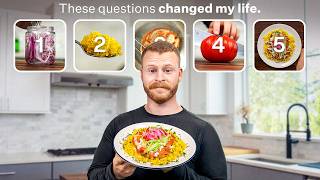

5 Questions That Make You a Better Cook
45sDirectly addresses a common frustration (recipes not working) with a promise of underlying principles, creating high curiosity and engagement.
▶ Play Clip"The title accurately promises five actionable questions that genuinely improve cooking skills, backed by science and demonstration."
The video presents five science-based questions to improve cooking skills by focusing on underlying principles rather than rote recipes. The host explains each question with food science and demonstrates their application while making a chicken and rice bowl.
Every dish is built on five tastes: sweet, salty, sour, bitter, umami. Salt is the most important. An exercise using 0%, 0.5%, 1%, and 2% salt by weight on 100g portions helps calibrate palate and intuition.
Cooking is water management. Ingredients are mostly water. Browning requires surface drying; juiciness requires moisture retention. Butterflying chicken increases surface area for browning while reducing cooking time to retain moisture.
Consider pan temperature, oil temperature, surface temperature, and internal temperature. Recipes give estimates; food responds to temperature. For chicken, aim for 155°F internal and pan over 450°F for Maillard reaction.
Texture is key. Contrast makes food interesting: crispy, crunchy, creamy, juicy, tender. Each ingredient in the bowl contributes a different texture.
After the first bite, ask what flavor property is missing (taste, aroma, texture, sight, physical, human element). This turns every meal into feedback for improvement.
By asking these five questions—taste, water, temperature, texture, and missing elements—cooking becomes about understanding principles rather than following recipes, enabling improvisation and consistent improvement.
What are the five basic tastes that form the foundation of flavor?
Sweet, salty, sour, bitter, and umami.
02:32
What is the most important taste in cooking according to the video?
Salt.
03:14
What is the recommended salt percentage by weight for a baseline seasoning?
About 1% salt by weight.
06:49
What three things does the salt calibration exercise connect?
How much salt you added, what that amount tastes like, and what it feels like when you pinch it with your fingers.
04:35
What is the approximate water content of most proteins?
Around 70% water.
08:29
What is the target internal temperature for chicken to be juicy and safe?
Around 155°F.
13:11
What pan temperature is recommended for browning chicken?
Over 450°F.
13:26
What is the water-to-rice ratio mentioned for stove-top cooking?
One part rice to 1.25 parts water.
10:14
What is the purpose of butterflying a chicken breast?
To increase surface area for browning while reducing cooking time to retain moisture.
09:35
What question should you ask after the first bite to improve a dish?
What flavor property is this dish missing?
17:00
Salt is the single most important ingredient
Establishes salt as the foundation of flavor, a core principle for all cooking.
03:14Salt calibration exercise
Provides a practical 20-minute method to develop salt intuition, a skill most home cooks lack.
04:35Cooking is water management
Reframes cooking as controlling water, explaining many common cooking problems.
08:14Think about temperatures, not time
Shifts focus from recipe times to temperature goals, enabling adaptation to different kitchens.
11:08Every meal is feedback
Encourages continuous improvement by analyzing what a dish is missing after tasting.
16:17[00:01] science-based questions I ask myself every time I cook something. It doesn't vegetables, or a simple grilled chicken and rice, the questions are always the same and they have genuinely made me better at cooking. Because after making
[00:17] well over 500 cooking videos in the past 8 years, I've come to realize that the way we teach people how to think when cooking at home is completely backwards. technique, and tip by tip. And
[00:31] answers to follow. But what we don't teach are the underlying principles that explain why those recipes work, why those techniques matter, or why we use certain ingredients in some situations and not in others. And these five
[00:45] questions I'm going to show you today are all built on those principles. So, for each one, I'm going to explain what it is, the food science behind why it works, and then show you exactly how I apply it while I'm making a simple
[00:57] weeknight chicken and rice bowl. And all of the cookware you're going to see me use throughout this video came from today's sponsor, Made In. cookware, if I could recommend just one piece, it would be this carbon steel
[01:11] griddle. It is by far my most used piece of cookware because it can handle so many different jobs. I'll use it for smash burgers, protein prep, or most often, it's just for quick lunches. And as we'll talk about later in this video,
[01:24] its ability to retain heat, which makes it easier to get consistent results. But most importantly, it just reduces friction for me when I'm in the kitchen. leave it on my stovetop, then I'll cook whatever I need, eat my meal, give it a
[01:39] if it needs it, then leave it right there ready for the next meal day after day, week after week. And I just think this is honestly a lot of fun to cook on as well. So, if you'd like to check out Made In's carbon steel griddle and press
[01:52] or any of their other amazing cookware, you can head to the link in my description. But now, let's get back to my questions. So, let's start with the first and probably most important question I ask myself, which is what
[02:04] question I ask myself, which is what should this dish taste like? and even though you swear you followed exactly what the recipe said, when you finally take a bite, you kind of think to yourself, "Well, it's okay, but it
[02:18] would have thought." And we've all had this experience before, and it's one of the biggest problems with how we teach cooking. Because we never teach you how to fix the dish when it just doesn't taste right. And at the end of the day,
[02:32] every dish is built around the same five tastes: sweet, salty, sour, bitter, and umami. And these five tastes form the foundation of flavor. Now, on top of everything else that makes food exciting. Aromas from herbs and spices,
[02:47] contrasting textures, the heat from chili peppers, rich sauces, fresh garnishes, and so on. If the five tastes aren't balanced, the dish will almost no matter how many other herbs and spices you add, or how pretty it may
[03:00] look on Instagram. And the obvious question then becomes is, how do you actually learn to balance the five tastes? And the easiest way to do this is to start with the most important of them all, salt. Salt is the single
[03:14] in the kitchen. And if you get the salty to be pretty good. You can always fine-tune it later with acid, sweetness, the salt wrong, it's incredibly difficult for the rest of the dish to
[03:28] make up for it. And the thing is, we never really teach home cooks how to properly season with salt, and because of this, most home cooks are missing two things. First, they don't have a clear reference for what under-salted,
[03:41] properly salted, and over-salted food taste like. And then secondly, they never develop an intuition for how much salt they're adding when they grab out a pinch. So, I want to share you the simplest exercise I know, and it's going
[03:54] to calibrate both of those things at the same time, and this experiment will literally put you ahead of 99% of home cooks. For this experiment, you only need three things. About 400 g of a protein or
[04:06] a kitchen scale that measures to at least a tenth of a gram. This one was leave a few options if you don't already have one. And I know buying a scale just excessive, but what you're about to learn here isn't a recipe. It's a skill
[04:23] you'll use for the rest of your life. If you're trying to improve at golf, lifting weights, or even video games, you need some way to measure what you're doing, and cooking isn't any different. And this scale is going to let you
[04:35] connect three things that almost nobody intentionally connects. First is how much salt you added, second is what that amount tastes like, and third is what it feels like when you pinch it with your fingers, and this feedback loop is
[04:49] what's going to develop your intuition. And most people eventually develop this through years of trial and error, but this exercise is going to compress that learning into just 20 minutes and give you a reference point you'll use every
[05:01] time you cook from now on. So, here's how to do it. Take about 400 g of your protein or vegetable and divide it into four equal portions. Mine are just 100 g each, and then season each one differently. We're going to do 0% salt
[05:15] as a control, then 0.5% salt, 1% salt, and 2% salt. And we're measuring by weight here because different salts have different crystal sizes, but a gram is experiment will work no matter what type of salt you're using. So, weigh the salt
[05:30] it up with your fingers and sprinkle it on the food just like you normally would, and this is how you're going to build that physical calibration. Ask yourself, what do the different amounts of salt pinches feel like on your hand?
[05:43] much as you're going to teach your palate. So, after you make sure the salt is evenly distributed across the food, then cook all four portions exactly the same and taste them side by side, and this is where you're going to build the
[05:57] sensory calibration. Ask yourself, which salt percentage do I actually prefer? What does under-salted taste like? And then at what point does it become over-salted? You might decide you like 0.5% you might prefer 1% chances are
[06:11] 0.5% you might prefer 1% chances are you'll probably think 2% is too salty. And if that 2% sample is too salty, don't throw it away. You can fix it by mixing it with a 0% sample to dilute the salt level. And then as a bonus
[06:23] experiment, try adding a squeeze of lemon or another source of acidity to a bite and notice how adding sour taste influences your perception of the salt. It's a great reminder that these five tastes don't exist in isolation, they
[06:36] all interact with each other. So, now that I have this experiment done, let me show you how I answer this first question of what should this dish taste like for my chicken and rice bowl. For me, the answer almost always starts with
[06:49] a simple baseline of about 1% salt by weight. So, this chicken breast I'm so I'm going to season it with roughly 2 and 1/2 g of salt. And if I'm ever unsure, I can always use my scale, but after doing this thousands of times, I
[07:04] don't really need it anymore because I built an intuition for what the amounts feel like in my fingers and what I actually like when I taste it. And this gives me a solid foundation to then build everything else on.
[07:16] And from there, I start thinking about the rest of the dish. I want my yellow to add a little chicken bouillon, which has salt in it, but then I also want going to balance it by using some pickled onions. And each component in
[07:30] slightly different, but they're all supporting that same goal of a well-seasoned dish built on the foundation of the five taste. So, if following a recipe at home, and something just doesn't quite taste
[07:44] right, ask yourself, what should this dish taste like? And once you know the answer, the fix usually becomes really obvious. Sometimes it's just a little bit of salt, other times it might be a little bit of acidity to brighten it up,
[07:58] bitterness, or umami to bring everything into balance, but it all starts by knowing what you're aiming for. And this brings me to the second question I ask myself every time I cook, which is what do I want the water to do? And this
[08:14] might sound a little abstract, but it's genuinely one of the biggest realizations I've had in the past 8 years. Cooking is mostly water management, and the reason is pretty simple. Almost every ingredient we cook
[08:29] is made of mostly water. Chicken, steak, and other proteins are typically around and other proteins are typically around 70% water, most vegetables are 80 to 95% water, rice and pasta spend most of the cooking process absorbing water, and
[08:41] nearly everything we cook with is either holding onto water, releasing water, or taking on more of it. And even the salt we just talked about only works because it's water-soluble. Once the salt dissolves, it can move
[08:54] throughout water-based food and eventually reach the taste receptors on at cooking through this lens of water management, so many things start to make ever been following a recipe and wondered things like, why are my
[09:09] potatoes not browning? Why did my chicken come out dry? Why is the texture of the sauce not right? Or why are my vegetables soggy instead of crisp? And almost every one of those questions come back to water. So, let me show you
[09:23] exactly what I mean with this chicken and rice bowl. So, before I even added the salt to the chicken, many of you might have noticed that I butterflied the chicken breast. And the reason I did that had everything
[09:35] to do with water. So, on one hand, I want the inside of the chicken to stay juicy, which means I need to retain as much water as possible. On the other hand, though, I want the surface to dry out so I can get deeply brown bits in a
[09:48] hot pan, and butterflying the chicken helps me do both. The thinner chicken less time over the heat and loses less moisture, and at the same time, the extra surface area gives me more
[10:01] browning space. And the rice is the same idea, but just in reverse. Instead of trying to remove water from the surface, I'm trying to get the grains to absorb the right amount. And this is why I'm using about one part rice to 1.25 parts
[10:14] water. And if the rice is still hard, it usually means it didn't absorb enough water, and if it's mushy, it usually means it absorbed too much water or too little evaporated during cooking. But in my case, the rice cooker is handling all
[10:26] the effort, but if you're doing it on the stove, this is important. And once cooking, you're going to see it everywhere. A sauce reducing is water probably means there's too much water sitting on the surface, fried chicken
[10:40] bubbling in oil is the water escaping as steam, or potatoes that won't crisp probably also contain too much surface moisture, and that's why this question is so useful. So, whenever you're following a recipe and something isn't
[10:53] working, stop and ask yourself, what is not, the answer to that question will point you towards the solution, and this brings us to the third question I ask myself every time I cook, which is what
[11:08] temperatures do I need? When most people hear the word about the internal temperature of the food, but this is only one of the cooking. I'm also thinking about the
[11:21] temperature of the pan, the temperature of the oil, the temperature on the surface area of the food, and then yes, eventually the temperature at the temperatures are going to influence the final result. And this is why if you've
[11:34] cook the chicken for 8 minutes only for you to cut it open and find it still raw, or you baked a loaf of bread for 20 minutes, but it's still not browning, it's likely because of temperature. And the problem is every recipe is written
[11:48] in a kitchen that is slightly different than yours with slightly different burner, a different oven, a different pan, a different thickness of food, or literally just a different room temperature in the case of bread dough.
[12:01] And recipes can give you times, but you have to realize they're really just estimates. Food responds to temperatures, and that's what's going to as many of us know, heat is just the energy we use to move food from one
[12:15] temperature to another. And ultimately, the amount of time something takes to cook is mostly just a consequence of how quickly it reaches those temperatures. So, every time I cook, I'm almost never
[12:28] thinking about time. I'm thinking about the temperatures I'm trying to create. this chicken to be so it stays juicy, to be on the surface so I can make sure it browns? And then how quickly do I
[12:42] want it to get from one to another? And every cooking technique we use is really those temperatures to create the physical and chemical changes we want. rice bowl, and let me show you how I'm paying attention to my temperatures. So,
[12:59] different temperature goals happening at the same time. First, I want the center to reach around 155° F, so it's juicy and safe to eat, but I also want the
[13:11] Maillard reaction to happen so it can develop a deep brown crust. So, to make that happen, I start with my burner on high and let the pan get really hot. And thermometer and waiting until the pan is over 450° before adding the chicken
[13:26] because I know cold chicken is immediately going to pull heat out of the pan. So, starting hotter helps keep the surface in that browning zone. The rice is then the same idea. I'm using a rice cooker here, so it's doing most of
[13:39] on a stove, I first bring it to a boil so the starches can begin to gelatinize, then I'd lower the heat because I don't want the water evaporating faster than the rice can absorb. And then I'm also thinking about one more temperature when
[13:52] I go to plate this, and that is what temperature do I want each component to be when I actually go to eat? So, the chicken and rice should be hot, the dill the refrigerator, the lettuce is going to be cold, and then the tomatoes can be
[14:06] room temperature. And this contrast isn't an accident. Just like taste and texture, temperature is another tool that you can use to make a dish more enjoyable. So, the next time something isn't turning out the way you expected,
[14:19] maybe something's not browning, it's cooking unevenly, or the texture isn't right, think about the temperatures you're creating. Recipes can't account for every different pan, burner, oven, or kitchen, but if you understand these
[14:31] different temperatures, you can find the solution. And this brings me to the fourth question I always ask myself every time I cook, and it's one of my favorite things to think about, which is what do I want this dish to feel like
[14:44] when I eat it? Or put another way, what type of textures do I want to create? wondered why it calls for a certain ingredient, a specific way of cutting
[14:56] something, or a particular cooking method, part of the answer is often texture. And great dishes aren't just designed around taste and aroma, they're also designed around how it feels to eat. Iceberg lettuce, for example, isn't
[15:09] exciting because it tastes good, it's there because it's fresh and crisp. Or maybe you slice onions thin because you want a gentle bite, not a huge crunchy chunk. You fry chicken because you want that crisp exterior, or you make a sauce
[15:21] because you want something creamy that coats every bite. And there are dozens of textures you can think about: crispy, crunchy, creamy, juicy, tender, chewy, memorize all of them, and there aren't really any hard rules for which textures
[15:35] belong together, but in general, what makes food interesting is contrast. So, let's go back to our chicken and rice bowl and take a look at some of the textures. The chicken is juicy on the inside with a nice browned interior, the
[15:49] lettuce is cold and crisp, the tomatoes are kind of juicy, the pickled onions sauce is cool and creamy, and then the rice ties everything together with a fluffy, tender base. Each ingredient is there because it contributes a different
[16:03] texture to the final bite. And this brings me to the fifth and final question I ask myself. And unlike the first four, which actively happen while I'm cooking, this question happens after everything is plated, I sit down, and I
[16:17] take the first bite. And the final question I always ask myself, is this dish missing anything? And if you've worked through the first four questions, there's a good chance what you made is going to taste pretty good. But this is
[16:33] take a bite, decide it's good enough, and move on. But for me, this is where my continued learning happens. And there are really two outcomes. Either I can make a quick adjustment right now, maybe
[16:46] some Aleppo pepper, fresh herbs, or if it's too late, I can make a mental note so next time I make this, it's even better. And the important shift is how I figure this out. I don't ask myself what ingredient am I missing? I ask myself
[17:00] what flavor property am I missing? Then I mentally run through that same framework: taste, aroma, texture, sight, physical, and the human element. So, take this chicken and rice bowl. After
[17:13] the first bite, it tasted pretty good, but I thought it needed a little missing a little bit of heat and freshness. So, I finish with some Aleppo pepper and fresh parsley, and that brought everything together. So, the
[17:27] next time you're making something that feels a little flat, don't just throw random ingredients at it. Instead, ask yourself, "What flavor property is this dish missing?" And then, you can figure out what ingredient you need. And this
[17:41] way, every meal becomes feedback. Sometimes, the answer to this question will be nothing. It's exactly what I wanted. Other times, you can discover one small change that make the dish dramatically better.
[17:53] And that's really what these five questions are all about. I promise, if questions when you're cooking, you're going to get better at problem-solving, ingredients you have, you're going to be able to substitute and improvise, you're
[18:08] things are not going right. And that to me is when cooking becomes the most fun. It's not about just following recipes and doing what everyone else says. It's about going on your own journey. So anyway, that is going to wrap it up for
[18:22] me in this video. Thank you again to Made In for sponsoring this video. cookware for five, six, I don't even know how many years at this point. Um then additionally, if you guys want to check out our CookWell app for home
[18:35] cooks, a lot of the same learnings that you see in these videos here is exactly lot of you guys will like it. But anyway, that is going to wrap it up for the next one. Peace, y'all.
⚡ Saved you 0h 18m reading this? Transcribe any YouTube video for free — no signup needed.