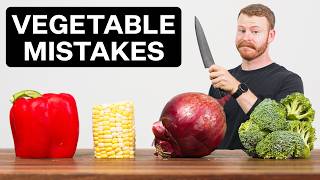

Why Your Vegetable Prep is Wrong
52sChallenges common cooking assumptions with a food science perspective, sparking curiosity and debate.
▶ Play Clip"The title promises to change the way you cook vegetables, and the video delivers a comprehensive food science breakdown with practical experiments, closely matching the claim."
This video breaks down common vegetable cooking mistakes through a food science lens, exploring how cutting, cooking methods, and flavor properties (taste, aroma, texture, physical sensation, sight, and human element) transform vegetables. The creator demonstrates that cooking vegetables is about understanding flavor outcomes rather than following rigid rules, encouraging experimentation at home.
The video promises to break down five common vegetable cooking mistakes from a food science perspective, ordered to build on each other.
The creator introduces their long-term sponsor Made In and a carbon steel griddle they've used for years, emphasizing its utility for home cooking.
The first mistake is thinking vegetable prep is about skill when it's really about setup. A good setup involves the three S's: sturdiness (cutting board doesn't slide), space (dedicated spot, large board), and sharpness (sharp knife, maintained with a whetstone).
The second mistake is not knowing what flavors vegetables provide. The video breaks down flavor into six properties: taste, aroma, texture, physical element, sight, and human element.
Taste includes sweet, sour, salty, bitter, and umami. Sweetness in vegetables (e.g., carrots, sweet potatoes) becomes more noticeable through cooking due to evaporation, structure breakdown, chemical conversion, and reducing masking flavors.
Aroma is more complex than taste, with categories like sulfurous (onions, garlic), green/grassy (celery, spinach), earthy (potatoes, mushrooms), sweet/nutty (peas, corn), fruity/floral (tomatoes), and herbaceous (parsley, basil).
Texture (crunchy, crispy, tender) and physical elements (temperature, pungency, astringency, spiciness) are key to vegetable enjoyment. Contrast in textures makes dishes like lo mein work.
Sight (color, shape) and human element (emotions, memories, culture) influence how we perceive vegetables before tasting. Bad childhood experiences can affect preferences.
Cutting affects flavor by breaking cells, increasing surface area, and changing shape. The video tests three onion cuts (whole, large dice, grated) in tomato sauce and shows clear differences in sweetness, aroma, and texture.
Cooking techniques control reactions (e.g., Maillard, caramelization, pyrolysis) by affecting what, how much, where, and how fast they happen. Nine potato cubes (three cuts x three methods: boil, sauté, fry) demonstrate different outcomes.
The final mistake is being afraid to experiment. With 40+ vegetables, 8 cuts, and 15 cooking methods, there are 4,800 possible outcomes. The creator encourages buying unfamiliar vegetables, trying unconventional cuts, and experimenting with cooking methods.
Cooking vegetables is about exploration and understanding flavor science, not rigid recipes. By mastering setup, flavor properties, cutting, and cooking techniques, home cooks can create thousands of unique dishes and discover new favorites.
What are the three S's for a good vegetable chopping setup?
Sturdiness (board doesn't slide), space (dedicated spot, large board), and sharpness (sharp knife).
[3:48]
What are the six flavor properties of vegetables as described in the video?
Taste, aroma, texture, physical element, sight, and human element.
[6:09]
Name four mechanisms that make vegetables taste sweeter when cooked.
Evaporation of water, structure breakdown releasing sugars, chemical conversion (e.g., starches to maltose), and reducing masking flavors.
[7:57]
What are the five core tastes that the human tongue registers?
Sweet, sour, salty, bitter, and umami.
[6:18]
According to the video, what provides most of the flavor we perceive?
Aroma, which comes from volatile compounds.
[11:41]
List the six aroma categories for vegetables mentioned in the video.
Sulfurous/allium, green/grassy/fresh, earthy, sweet/nutty, fruity/floral, and herbaceous.
[12:58]
What are the four physical elements that affect how we experience vegetables?
Temperature, pungency (e.g., raw onions), astringency (e.g., leafy greens), and spiciness (capsaicin).
[16:17]
Why does a grated onion in tomato sauce taste sweeter than a whole onion?
Grating breaks open cells, releasing sugars evenly throughout the sauce, while whole onion retains sugars inside the piece.
[24:24]
What are the four things cooking techniques control according to the video?
What types of reactions can happen, how much those reactions happen, where they happen, and how fast they happen.
[27:19]
What is the total number of possible flavor outcomes from 40 vegetables, 8 cuts, and 15 cooking techniques?
4,800 possible outcomes.
[29:56]
The Three S's of Setup
Provides a simple, actionable framework for improving vegetable prep.
[3:48]Six Flavor Properties
Introduces a comprehensive model for understanding vegetable flavor.
[6:09]Onion Cutting Experiment Results
Demonstrates the dramatic impact of cutting on flavor with a clear, testable example.
[24:24]Embrace Experimentation
Encourages home cooks to break free from recipe rigidity and explore.
[29:32][00:00] Chopping and cooking with vegetables is
[00:02] something we do almost every time we
[00:04] cook. But the way we're taught about
[00:06] them is completely backwards because no
[00:09] one ever tells you what vegetables are
[00:11] actually doing in a dish. Seriously,
[00:14] have you ever wondered why does an onion
[00:15] taste different from a carrot, a potato,
[00:17] a bell pepper, or leafy greens? And then
[00:20] beyond that, what's the point of all
[00:21] these different cuts? Why would you
[00:23] finally mince something versus dicing it
[00:25] versus just leaving it whole? And why
[00:27] can the same vegetable taste completely
[00:29] different all depending on how you cook
[00:32] it? Well, in this video, we're going to
[00:34] break down the five mistakes that most
[00:36] people make when it comes to vegetables,
[00:38] but we're going to do it from a food
[00:40] science perspective. And I specifically
[00:42] order the mistakes in this way because
[00:44] each one builds on the prior one. And by
[00:47] the end of this video, I promise you'll
[00:49] never look at vegetables the same way
[00:52] again.
[00:54] Now, before we get too deep into the
[00:55] food science and some of the other
[00:57] experiments we're going to do in this
[00:58] video, I need to tell you about my
[01:00] history with this carbon steel griddle
[01:02] that is about to turn four years old.
[01:04] And it comes from today's sponsor, Made
[01:06] In. This exact carbon steel griddle
[01:08] first appeared in a kebab video of mine
[01:10] on June 24th, 2022. And ever since then,
[01:14] it's become a recurring character on the
[01:16] channel. Whether that's breaking down
[01:18] burger science, learning about why you
[01:20] need to cook frozen meat, running spice
[01:22] experiments, or most recently cheese
[01:24] steaks along with about 20 to 30 other
[01:26] videos on my second channel in the past
[01:28] year. And the reason I keep using this
[01:30] is simple. It just makes cooking at home
[01:33] a lot easier. The griddle spans two
[01:35] burners, so you've got tons of space to
[01:37] cook multiple things at once without
[01:39] overcrowding. So if I'm testing
[01:40] different versions of something or just
[01:42] cooking a lot of food at once, it solves
[01:44] that problem immediately. And the best
[01:46] thing I can say about it is I just keep
[01:48] reaching for it day after day, week
[01:50] after week, and truly year over year.
[01:53] So, you can check out the Carbon Steel
[01:55] griddle and my other favorite cookware
[01:56] from Maiden by using the link in my
[01:58] description to save on your order. And
[02:01] thank you again to Maiden for sponsoring
[02:02] this video and being a longtime
[02:04] supporter of the channel. And I think
[02:06] what we both do well is just making
[02:07] cooking easier and more approachable.
[02:09] And this is exactly what we're going to
[02:11] get into with mistake number one when it
[02:13] comes to chopping vegetables. So, let's
[02:16] break it down. The first mistake we need
[02:18] to fix is thinking vegetable prep is
[02:20] about skill when it's really about
[02:22] setup. And when most people try to learn
[02:24] how to chop vegetables, they think being
[02:25] able to chop really fast, having perfect
[02:27] technique, or mastering a bunch of
[02:29] different cuts is what's important. But
[02:31] for a home cook, what actually matters
[02:33] is much simpler. It just shouldn't be
[02:36] miserable to chop your vegetables on a
[02:38] daily basis when you need to cook. And
[02:41] if you don't like chopping vegetables or
[02:43] think it takes way too much time, you
[02:45] probably just have a bad setup. At home,
[02:48] my vegetable prep usually takes three to
[02:50] six minutes depending on the dish. And I
[02:51] have a second channel with over 50
[02:53] real-time videos where you can see that
[02:55] I'm not rushing, just talking to the
[02:57] camera. And when I have a good setup,
[02:59] chopping vegetables is generally one of
[03:00] the parts of cooking that I enjoy.
[03:03] However, there is one situation where I
[03:06] am forced to cut vegetables very slow
[03:07] and it's an absolutely miserable
[03:09] experience and that is when I go to an
[03:12] Airbnb because every time it's the same
[03:15] story. There's typically two tiny
[03:16] cutting boards in a drawer, a knife that
[03:18] hasn't been sharpened in 8 years, and
[03:19] suddenly I'm chopping very slowly,
[03:21] frustrated, and wondering if I'm about
[03:23] to slice my finger open. And this is not
[03:26] a skill issue. This is a setup issue.
[03:29] So, the two questions you probably have
[03:31] are, what are the fundamentals of a good
[03:33] setup? And secondly, do I need to spend
[03:35] a lot of money? Well, the answer to the
[03:37] second question is no. Because if every
[03:40] Airbnb had this $40 cutting board, this
[03:42] $20 knife, and a way to keep it sharp
[03:44] like a wet stone, I would be perfectly
[03:46] happy. Because a good setup comes down
[03:48] to the three S's: sturdiness, space, and
[03:52] sharpness. If you have these three,
[03:54] chopping vegetables becomes faster,
[03:55] easier, and way more enjoyable.
[03:59] Sturdiness means your cutting board
[04:00] shouldn't move. Use a drawer liner or a
[04:02] damp towel. Just lock it in place so
[04:04] you're not fighting it. Space is
[04:06] twofold. First, you should have a
[04:08] dedicated spot for your cutting board so
[04:10] you're not constantly needing to set it
[04:12] up and put it away. It's more important
[04:14] than any other appliance on your
[04:16] counter. And secondly, you need enough
[04:18] room on your cutting board to be able to
[04:20] work with multiple ingredients. And I
[04:22] believe that a 24-in or 60cm wide board
[04:25] is the optimal size for most home cooks
[04:27] because most counters in the US and
[04:29] Europe at least are 25 in or 63 cm deep.
[04:33] So even if you're in a small kitchen,
[04:35] you can rotate it vertically and still
[04:36] have plenty of space to work. And
[04:38] lastly, we have sharpness. Your knife
[04:41] should be sharp and you need a way to
[04:43] keep it that way with something like a
[04:45] wet stone. This is what's going to make
[04:46] chopping actually feel good instead of
[04:49] frustrating. And that's it. If you get
[04:51] the three S's right, chopping your
[04:53] vegetables each night won't feel like a
[04:54] miserable chore. Instead, it's something
[04:57] you can experiment with. And this
[04:59] mistake is a really important one to fix
[05:01] in your kitchen because if you hate
[05:03] chopping vegetables, you're never going
[05:05] to want to learn what they actually
[05:06] taste like in mistake number two. And
[05:09] this is a shame because personally, I
[05:10] think this is where things get a lot
[05:12] more interesting and a lot more fun.
[05:17] This might seem like a dumb question,
[05:19] but if somebody asked you, "What flavors
[05:21] do vegetables actually provide?" Could
[05:24] you explain it? And this is where things
[05:26] are going to start to break down because
[05:27] what seems like a simple question is
[05:29] fairly complex. For example, a carrot we
[05:32] would typically say is orange, it's
[05:34] crunchy, has kind of a fresh smell, and
[05:36] maybe it's a bit sweet, but if you then
[05:37] roast that same carrot, it's going to
[05:40] have a completely different flavor. The
[05:42] first thing you'll notice is it's now
[05:44] soft instead of crunchy. But it's also
[05:46] much sweeter on your tongue and has
[05:48] deeply brown caramelized aromomas that
[05:50] we can smell. And the problem is if you
[05:52] don't know what flavor vegetables
[05:54] actually have, you also can't control
[05:56] them. So instead of being able to feel
[05:58] confident experimenting with new
[06:00] vegetables at the farmers market or
[06:02] using what you already have in the
[06:03] fridge to substitute them, this kind of
[06:04] leaves you stuck following recipes for
[06:07] the rest of your life. So to fix that,
[06:09] we're going to break down the flavor of
[06:10] vegetables into six properties. Taste,
[06:13] aroma, texture, sight, physical, and the
[06:16] human element. So let's start with
[06:18] taste. Our tongue registers five core
[06:21] tastes. Sweet, sour, salty, bitter, and
[06:23] umami. Now overall, vegetables are
[06:26] fairly mild in terms of pure taste,
[06:28] which is why we often add things like
[06:30] salt, citrus juice, MSG, and sugar sweet
[06:33] sauces while we're cooking. However,
[06:35] depending on the vegetable you are
[06:37] using, one of the five tastes could play
[06:39] a big role in the dish you are making.
[06:42] And the question that I always had is
[06:44] where do these tastes come from? Like
[06:45] what signals in our brain that makes a
[06:47] sweet potato sweet or arugula taste
[06:49] bitter? And as it turns out, the taste
[06:51] we experience are tied to specific types
[06:54] of molecules. And vegetables, like all
[06:56] food, are just made up of molecules. At
[06:59] a basic level, most raw vegetables are
[07:01] 80 to 95% water, 3 to 15% carbohydrates,
[07:05] which includes things like sugars,
[07:07] starches, and fibers, 1 to 5% proteins,
[07:09] 0 to 1% fats, and about 1 to 3% other
[07:13] vitamins and minerals. So, let's take a
[07:15] look at what vegetables actually taste
[07:18] like. Starting with sweetness. Sweetness
[07:21] usually comes from sugars like fructose,
[07:23] sucrose, glucose, and maltose. And both
[07:25] the amount of and type of sugar matter.
[07:28] And you might be surprised to learn that
[07:30] in the United States around 55% of sugar
[07:33] production actually comes from a
[07:35] vegetable, sugar beets, because they are
[07:37] high in sucrose. However, in order to
[07:40] extract that sucrose, they are first
[07:41] cooked with hot water before being
[07:43] evaporated and concentrated down into
[07:45] table sugar. And that's because when
[07:47] raw, most vegetables don't taste
[07:49] especially sweet. However, when we cook
[07:51] with them, that sweetness can become
[07:54] much more noticeable. And if you've ever
[07:55] wondered why, there are usually four
[07:57] mechanisms at play. First is
[08:00] evaporation. As the water cooks off,
[08:02] everything else will become more
[08:03] concentrated, including the sugars. So
[08:05] even though the total sugar doesn't
[08:07] change, it tastes sweeter because
[08:08] there's less water diluting it. Second
[08:10] is structure breakdown. When vegetables
[08:12] cook, their cell walls start to soften
[08:14] and break apart. And this is going to
[08:16] release sugars that were trapped inside
[08:18] and make them easier for your tongue to
[08:20] detect. Third is chemical conversion.
[08:22] And this is a big one for certain
[08:23] vegetables. For example, in sweet
[08:25] potatoes, heat activates enzymes that
[08:27] break the starches down into simpler
[08:29] sugars like malttose. So, we are
[08:31] literally creating more sugars during
[08:33] cooking. And then fourth is reducing
[08:35] masking flavors. A lot of vegetables
[08:37] will have sugars but also have bitter
[08:39] sulfurous and other harsh compounds that
[08:41] can mask their sweetness. However, when
[08:44] we cook with them, a lot of those
[08:45] harsher compounds will mellow out,
[08:47] making the sweetness easier to detect.
[08:49] And one of the things that surprised me
[08:51] in the onion deep dive I did a few
[08:53] months ago is that sweated onions are
[08:55] actually perceived to be sweeter than
[08:56] caramelized ones because there are no
[08:59] masking flavors. So sweetness can
[09:02] definitely play a role depending on the
[09:04] vegetable and how we cook them. But what
[09:06] about the other for taste? And in
[09:08] general these tend to play a smaller
[09:10] more supporting role in the grand scheme
[09:12] of things. Sour taste comes from organic
[09:15] acid things like citric malic and oxylic
[09:18] acid. And when we think of sour
[09:19] vegetables, usually tomatoes or
[09:21] toatillos may come to mind, but those
[09:23] are technically fruits, which raises the
[09:25] question, are there any true vegetables
[09:28] that taste sour? Well, there are a few.
[09:30] And one of the best examples is rhubarb.
[09:32] It kind of looks like red celery, but if
[09:35] you take a bite, it has a distinctly
[09:37] tart flavor due to a mix of oxylic and
[09:39] malic acids. And that combination gives
[09:41] it that slightly rich sourness, which is
[09:44] why it's commonly used in things like
[09:46] pies. That said, sourness just isn't
[09:48] very common across vegetables, which is
[09:50] why when we're cooking, we often need to
[09:52] add it ourselves in the form of vinegar
[09:54] or citrus juices. Bitterness, on the
[09:57] other hand, is a completely different
[09:59] story and one that you need to be
[10:01] careful with while you're cooking. A
[10:03] bitter taste in vegetables often comes
[10:05] from a wide range of defensive
[10:06] compounds, and these are chemicals that
[10:08] plants produce to protect themselves
[10:10] from being eaten. And these are very
[10:12] common in vegetables, especially leafy
[10:14] greens and things in the brasica family.
[10:17] You'll find bitterness in kale, arugula,
[10:19] broccoli, Brussels sprouts, cabbage,
[10:21] mustard greens, and ridiculio. But the
[10:24] intensity can vary quite a bit. And this
[10:26] is something you need to be aware of
[10:27] because most humans generally do not
[10:30] prefer dishes that are overly bitter.
[10:33] Cooking can help mellow out the
[10:34] bitterness, but many times we'll also
[10:36] balance it by pairing bitter vegetables
[10:38] with things that are salty or sour to
[10:40] help mask that taste and make it more
[10:42] enjoyable. And this brings us to our
[10:45] next taste, salty. Saltiness primarily
[10:48] comes from sodium, which is why we use
[10:50] salt all the time when we're cooking.
[10:52] However, vegetables themselves naturally
[10:55] are very low in sodium. While they can
[10:57] technically absorb some trace minerals
[10:59] from the soil, the amounts are usually
[11:01] pretty minimal. So, they're not going to
[11:03] get much saltiness from them naturally.
[11:05] And this brings us to our final taste,
[11:07] umami. Umami comes from compounds like
[11:09] glutamates and nucleotides, which can
[11:11] create that deep savory flavor. And some
[11:14] vegetables that are naturally higher in
[11:15] these molecules include things like
[11:17] seaweed tomatoes mushrooms corn and
[11:19] spinach. However, similar to sweetness,
[11:21] you usually won't notice much umami in
[11:23] vegetables until they're cooked down or
[11:26] combined with other ingredients, which
[11:27] is why MSG is a popular seasoning added
[11:30] to so many different dishes. So, really
[11:33] what we're doing when cooking with
[11:34] vegetables is trying to balance these
[11:36] five tastes in different ways, but taste
[11:38] is just one piece of the puzzle here.
[11:41] What actually makes vegetables quite
[11:43] distinct from one another is their
[11:44] aroma. And as Harold McGee points out in
[11:46] on food and cooking, most of what we
[11:49] experience as flavor is actually the
[11:51] odor or aroma. So let's talk about the
[11:55] second flavor property of vegetables. At
[11:58] a high level, aroma comes from volatile
[12:00] compounds. And these are small
[12:01] lightweight molecules that can easily
[12:03] evaporate and become airborne, which is
[12:04] how they travel from the food up into
[12:06] our noses. And unlike taste, which is
[12:08] limited to just a few core categories,
[12:10] aroma is incredibly complex. There are
[12:13] hundreds and even thousands of different
[12:15] aroma compounds, and this is where most
[12:17] of the unique flavors in our food
[12:19] actually come from. Now, we could spend
[12:21] 10 hours going through what every single
[12:22] vegetable smells like and how it changes
[12:24] when we cut and cook with them. But for
[12:26] purposes of this video, it's helpful to
[12:28] think about the aroma of vegetables into
[12:29] broad categories. Because once you start
[12:32] seeing these categories, you're going to
[12:33] notice two things. First, many of the
[12:35] dishes we cook are often a combinations
[12:37] of two or three broad aroma types that
[12:39] complement or contrast each other. And
[12:41] second, it makes substitutions a lot
[12:44] easier. For example, instead of needing
[12:46] to run to the store for an onion, you
[12:47] can ask yourself, do I have something
[12:49] that plays the same role as an onion in
[12:51] this dish? And maybe reach for some
[12:53] shallots or leaks instead. So, let's
[12:56] quickly walk through these categories.
[12:58] First are sulfurous and alien based
[12:59] vegetables, which includes things like
[13:01] onions garlic leaks scallions and
[13:03] shallots. Second are green grassy and
[13:05] fresh aromomas which includes things
[13:07] like celery, spinach, green beans,
[13:09] zucchini, snap peas, and green bell
[13:11] peppers. Third are kind of earthy
[13:13] vegetables. Think of potatoes, mushroom,
[13:15] beets, parsnips, or sweet potato. Fourth
[13:17] are sweet and nutty aromomas, which
[13:18] includes peas, corn, squash, and
[13:20] carrots. Fifth is fruity and floral,
[13:22] which includes tomatoes and certain red
[13:24] and orange chili peppers. And then the
[13:26] last group is what I'd call the
[13:27] herbaceious category, which includes
[13:29] things like parsley, cilantro, basil,
[13:31] dill, and fennel. And herbs aren't
[13:33] technically vegetables, but they are
[13:34] plant leaves that we use in very similar
[13:36] ways to provide aroma to many dishes.
[13:39] And if you want to see a practical
[13:40] example of me swapping in a ton of
[13:43] different aromomas into a dish, the low
[13:45] main video I just made is a great
[13:47] example. I made three different versions
[13:49] where I swapped out the aromatics using
[13:51] only garlic in one, garlic and ginger in
[13:54] another, then adding Thai chilies to a
[13:56] third, while also changing up the bulk
[13:58] of the vegetables. And each version
[14:00] tastes and smells quite different
[14:03] because of the vegetables I use. But all
[14:05] of them work because I'm maintaining a
[14:08] similar balance of the aroma. Now, there
[14:10] is another reason why that dish works so
[14:13] well. And that is also because I'm
[14:15] balancing the textures. And this is our
[14:18] next flavor property and one that's very
[14:20] often overlooked. And a great example of
[14:22] this when it comes to vegetables is
[14:24] iceberg lettuce. Because iceberg lettuce
[14:27] barely has any taste or aroma. But we
[14:29] still use it all the time in salads,
[14:31] sandwiches, tacos, and more because of
[14:33] that crispy, refreshing crunch that it
[14:35] brings to a dish. So, let's talk about
[14:39] texture. At a basic level, texture is
[14:41] how food feels when it touches your
[14:42] lips, tongue, and teeth. And one of the
[14:45] great things about vegetables is that
[14:46] they have a really wide range of
[14:48] textures. You can think about categories
[14:50] like crunchy, crispy, snappy, tender,
[14:54] soft, creamy, fibrous, juicy, and chewy.
[14:56] Though there are definitely more. And
[14:58] when it comes to texture, there are two
[15:00] big things to keep in mind. First, many
[15:02] vegetables actually have multiple
[15:04] textures at once. For example, a
[15:05] cucumber is both crunchy and juicy, and
[15:08] a roasted vegetable might be crispy on
[15:09] the outside, but soft in the middle. And
[15:12] secondly, these textures will change a
[15:14] lot depending on the ripeness and how
[15:15] you cook them. And a big part of what
[15:17] makes food enjoyable is the contrast
[15:20] between the textures, which is why lain
[15:22] works so well. The protein is tender,
[15:24] the noodles are chewy, so you balance it
[15:26] out with vegetables that bring crunch
[15:28] and crispness.
[15:30] Now, what if I told you there was a
[15:31] vegetable in one of those lain dishes
[15:34] that I didn't choose for its taste,
[15:36] aroma, or texture, but for how it
[15:38] physically feels when I eat it. And
[15:41] those were the Thai chilis. I chose Thai
[15:44] chilis because they are spicy and wanted
[15:46] to feel a little bit of pain while I was
[15:48] eating it. And this brings us to our
[15:51] next flavor property, the physical
[15:53] element. Now, the physical element is a
[15:55] little bit different because it's not
[15:57] technically a taste. Think about it. Why
[15:59] do raw onions or garlic make your nose
[16:01] sting? And why do chili peppers feel
[16:03] like they're burning your mouth? These
[16:05] aren't tastes like sweet or salty, and
[16:07] they're not aromomas either. They're
[16:09] sensations. Your body is literally
[16:11] reacting to the food. And when it comes
[16:13] to vegetables, there are kind of four
[16:15] main physical elements to think about.
[16:17] First is temperature, which is pretty
[16:19] straightforward. It's literally just the
[16:20] temperature of the ingredient. Pairing
[16:23] something like a chilled cucumber salad
[16:25] next to hot salmon creates contrast
[16:27] that's way more enjoyable than if those
[16:29] cucumbers were also warm. Next is
[16:32] pungency. This is that sharp stinging
[16:34] sensation you get from things like raw
[16:35] onions, garlic, radishes, or mustard
[16:38] greens. And these foods create reactive
[16:40] compounds that irritate our eyes and
[16:42] nose. Third is aringy, which is that
[16:44] dry, slightly rough, puckery feeling in
[16:46] your mouth. It's most commonly
[16:47] associated with wine, but you'll also
[16:49] find it in some vegetables, especially
[16:51] leafy greens. And finally, we have
[16:53] spiciness. My favorite. This sensation
[16:55] comes from capsation, which activates
[16:56] your pain receptors and creates that
[16:58] burning feeling. And it's exactly why I
[17:00] like that spicy beef lomain so much.
[17:04] Okay, so I'm going to pause here for
[17:06] just a second because we've covered a
[17:08] lot of information so far as it relates
[17:10] to the taste, aroma, texture, and
[17:12] physical element of vegetables. And let
[17:15] me know if some of this is starting to
[17:16] click down in the comments below. Maybe
[17:19] something is making a bit more sense
[17:21] now, like why certain vegetables get
[17:23] sweeter when you cook them, why carrots,
[17:25] onion, and celery are often used
[17:27] together, or why you prefer certain
[17:29] vegetables because of their texture or
[17:30] spicy elements. And while you're
[17:32] thinking about that, I'm going to
[17:33] quickly walk through our remaining two
[17:36] flavor properties, sight and the human
[17:38] element. And these are interesting
[17:40] because they shape how we experience
[17:43] food before we even take a bite. The
[17:46] fifth flavor property is sight. And
[17:48] vegetables play a large role here
[17:51] because they bring a wide range of
[17:53] colors, shapes, and visual contrast we
[17:56] can see with our eyes. Think of bright
[17:58] pink pickled onions, adding scallions to
[18:00] braze meat, or choosing a number of
[18:02] different colored vegetables, which all
[18:04] will shape our perception of a dish
[18:06] without needing to take a bite. And our
[18:08] final flavor property is the human
[18:11] element. We experience food through our
[18:13] emotions, memories, and cultural
[18:15] associations. And this is why the same
[18:17] vegetable can feel completely different
[18:19] from one person to another. For example,
[18:22] if you had a bad experience with a
[18:24] certain vegetable as a kid, you might
[18:26] still avoid it to this day, no matter
[18:28] how it's prepared. And on the flip side,
[18:30] certain flavors can feel incredibly
[18:32] comforting because they're tied to
[18:34] something familiar or nostalgic. So, now
[18:37] that we've gone through these six
[18:38] properties, you should start to see that
[18:40] flavor really has so many different
[18:42] layers to it, and every vegetable is
[18:44] going to contribute to those in slightly
[18:45] different ways based on the molecules
[18:48] they are made up of. However, as I've
[18:50] been hinting at, these molecules don't
[18:53] stay the same. They are going to change
[18:55] based on how we cut the vegetable and
[18:57] how we cook them. Which brings us to
[18:59] mistake three. Because if you've ever
[19:01] wondered why cutting changes the flavor
[19:04] of vegetables, it's quite simple. The
[19:06] more we change the structure of the
[19:07] vegetable through cutting, the more we
[19:09] change how these flavor properties are
[19:11] going to show up. And to test this,
[19:13] we're going to run a simple experiment.
[19:15] So, I took 3/4 of an onion. One I left
[19:18] whole. The second I cut into a large
[19:20] dice. And the last one I grated so it
[19:22] would completely disperse into a tomato
[19:24] sauce. And the question we are asking
[19:26] here is how much does the onion flavor
[19:29] actually change when we use the same
[19:31] cooking method but cut it in three
[19:34] different ways? So I'm going to let
[19:36] these sauces cool down just a bit and
[19:38] then get them set up for our taste test.
[19:40] So while I do that, let's break down
[19:41] exactly how cutting changes the flavor
[19:44] of vegetables.
[19:48] There are a lot of different ways that
[19:50] you can cut a vegetable. For example, in
[19:52] The Professional Chef on page 622, they
[19:55] list eight standard vegetable cuts and
[19:56] then there are five more on the next
[19:58] page. However, even if you memorized and
[20:00] knew how to perfectly execute all 13 of
[20:03] them, the real question still remains.
[20:06] How does the flavor actually change? And
[20:08] how do I decide which of these cuts to
[20:10] use at home? And as it turns out, all of
[20:13] these fancy knife cuts are really just
[20:14] changing three things that can influence
[20:16] the flavor. First is how many cells
[20:18] you're breaking open. When we cut or
[20:20] slice a vegetable, it ruptures the cell
[20:22] walls, which will then release the
[20:23] water, sugars, aroma compounds, and all
[20:26] the different molecules that we talked
[20:27] about where they can then change and
[20:29] react during cooking. Second is how much
[20:31] surface area is created. So, the more
[20:33] surface area will change how quickly
[20:35] something cooks, generally meaning more
[20:37] evaporation, faster browning, more
[20:39] caramelization, and also more places for
[20:41] sauces, fats, and seasonings to stick
[20:44] to. And then third is the overall shape
[20:46] and structure of the vegetable. This is
[20:48] going to change the texture, the visual
[20:50] appeal, and how it feels when you
[20:52] actually eat it. And really, all these
[20:54] cuts are just slight differences in the
[20:56] flavor outcome. And this is why when
[20:58] you're deciding how to cut your
[20:59] vegetable at home, the question you
[21:00] should not ask is what is the right cut
[21:03] to use, but instead a more useful one is
[21:06] what flavor outcome am I trying to
[21:08] create? Because sometimes it's not going
[21:11] to matter all that much. For example, if
[21:13] a recipe calls for a medium dice and you
[21:15] go for a larger dice, the difference is
[21:17] going to be fairly small. But what I do
[21:19] want to do is show you three different
[21:20] examples that make a difference in how I
[21:22] decide to cut my vegetables at home. not
[21:24] because it's the correct way to do it,
[21:26] but to explain my thought process behind
[21:28] them. And the first one is cutting
[21:30] vegetables to match the size of the
[21:32] other ingredients. And a good example of
[21:35] this concept was a cucumber salad I made
[21:37] on the Cookwell channel a few weeks ago.
[21:39] And when I cut up the cucumber, I chose
[21:41] these larger kind of cube-like pieces.
[21:43] So, why did I do this? Well, I wanted a
[21:45] shape that would let me scoop up the
[21:47] salmon and cucumber together with a
[21:49] spoon and get everything in one bite.
[21:52] And this is the same exact thought
[21:54] process that I use for these tomatoes in
[21:55] the pesto pasta, the vegetables I
[21:57] chopped for my fried rice, or finally
[21:59] mincing the red onion and tomato to
[22:01] match the size of the corn in this
[22:02] roasted salsa. This cucumber salad and
[22:05] salmon still would have tasted fine if I
[22:07] finally minced the cucumber or sliced
[22:09] them into thin coins, but I wanted to
[22:11] ultimately match the size of the salmon.
[22:13] And additionally, this shape holds its
[22:15] crunch for a few extra days in the
[22:17] fridge rather than getting soft and wet
[22:19] with really thin slices. Now, the second
[22:22] example is cutting vegetables for big
[22:24] texture contrast. And a great example of
[22:26] this is the tomato in this breakfast
[22:29] sandwich I made. So, I cut the tomato
[22:31] slice very thick and a lot of people
[22:33] were trying to flame me in the comments
[22:35] for this. But hey, it's my kitchen and
[22:37] there was a very intentional flavor
[22:38] outcome that I wanted to create because
[22:40] I'm trying to layer in the textures. So,
[22:43] on the bottom, I've got the chewy
[22:44] English muffin, then the creamy cream
[22:46] cheese, thin, salty, and crunchy bacon
[22:48] underneath. Then on top of that, I
[22:50] wanted that beautiful summer tomato to
[22:52] be a big, juicy, substantial bite,
[22:54] almost imagining that I'm biting into a
[22:57] big burger patty. And when I bite into
[22:59] this sandwich, my tongue hits those
[23:01] layers in order. The bread, the
[23:03] creaminess, the salty crunch of the
[23:04] bacon, and then that tomato really comes
[23:06] through with its juicy, sweet, and sour
[23:08] bite that balances everything together.
[23:11] Could I have sliced it thinner?
[23:13] Absolutely. But would it have been as
[23:14] memorable? Definitely not. Then the
[23:18] third example is cutting aromatics based
[23:19] on whether you want their flavor to stay
[23:21] concentrated or spread throughout the
[23:24] dish. And this is exactly what we're
[23:26] testing with our onion experiment. So on
[23:28] one end, I left the onion in one large
[23:30] piece. We broken the fewest amount of
[23:32] cells, released the least amount of
[23:34] aroma, and the onion flavor is going to
[23:36] stay concentrated in that individual
[23:38] piece. Then on the complete other end of
[23:40] the spectrum, I've grated the onion into
[23:42] a pulp. We've broken open the most
[23:44] cells, release way more aroma compounds,
[23:46] and that onion flavor is going to be
[23:48] spread evenly throughout the entire
[23:50] sauce. So, instead of having one big
[23:52] sweet onion, the whole dish will kind of
[23:54] start tasting like that more intense
[23:56] onion flavor. But let's see how big of a
[23:59] difference this really makes. Okay, so I
[24:02] have the three different sauces. Let's
[24:03] give them a taste and see how different
[24:06] the flavor really is.
[24:10] Good. pallet cleanser,
[24:14] man. Started with the grated and then
[24:16] what I like to do is go to the opposite
[24:17] ends first. So, we'll do a normal just a
[24:21] spoonful of sauce first.
[24:24] That is so cool.
[24:26] I'll tell you why in a second.
[24:30] Man, this is truly a test I think you
[24:32] all should recreate at home because it
[24:34] totally drives home all of what we've
[24:37] talked about so far. So, right away, the
[24:40] sweetest sauce here is going to be the
[24:42] grated one. Why? Well, it makes a lot of
[24:44] sense. Onions, again, we talked about
[24:46] water and sugar. So, all of that
[24:48] sweetness is evenly dispersed in this
[24:51] first sauce. So, right away, you can
[24:53] tell when you get down to here, when
[24:54] it's in the big onion pieces, that the
[24:56] sauce on the end is much more sour. A
[25:00] lot of sugar is still in these big onion
[25:02] pieces, which helps perfume the sauce,
[25:04] but it doesn't actually disperse the
[25:05] sugars that are inside them. So you can
[25:07] take these out, blend them up, or just
[25:09] eat them as a snack.
[25:11] So obviously there's a clear difference
[25:13] in terms of the pure taste, but
[25:15] additionally there's big differences in
[25:17] terms of aroma and the texture. So in
[25:20] the grated onions, remember we crushed
[25:22] up all of those cells. None of that ever
[25:25] happened in the big onion pieces. So we
[25:27] get those really nice kind of mellow
[25:29] onion aromomas all throughout every bite
[25:31] of this first sauce. compared to the
[25:34] whole onion. It kind of tastes lightly
[25:36] perfumed of onion, but it's definitely
[25:39] not as kind of onion forward, if you
[25:41] will. And then from a texture
[25:43] perspective, too, obviously, you know,
[25:45] the the grated onion is kind of
[25:47] integrated within the sauce. The middle,
[25:49] there are these big chunks that you can
[25:50] kind of still feel, and then you have
[25:51] the bigger onions on the end. And all of
[25:53] this ultimately is just down to
[25:55] preference. But it just goes to show
[25:56] that how you cut your vegetables really
[25:58] does matter. And ultimately what you're
[26:00] trying to do is control the flavor
[26:02] outcome. Okay, so we've seen a clear
[26:04] example here of what happens when you
[26:06] keep the vegetable and the cooking
[26:07] method the same, but change how it's
[26:09] cut. So the next natural question is how
[26:12] much does the flavor change when we keep
[26:14] the vegetable the same, change how it's
[26:16] cut, and also change the cooking method?
[26:19] And that's exactly what we're going to
[26:21] test with nine different cubes of
[26:23] potatoes. And this brings us to mistake
[26:25] four. So let's break it down.
[26:30] There are so many different ways you can
[26:32] cook a vegetable. And here are 15 quick
[26:34] examples. Bake, blanch, boil, char, deep
[26:37] fry pickle poach sauté sear shallow
[26:39] fry, smoke, steam, stir fry, and roast.
[26:42] And looking at this list, it seems like
[26:44] all of them are completely different.
[26:47] However, what if I told you they have
[26:48] way more in common than you think?
[26:51] Because every cooking technique is just
[26:53] triggering different physical and
[26:55] chemical reactions. things like cell
[26:57] wall breakdown, evaporation,
[26:59] dehydration, gilation, the mayor
[27:02] reaction, caramelization, and pyrolysis.
[27:05] And most people completely ignore these
[27:06] or don't even realize they're happening.
[27:08] But it's these reactions that are
[27:10] actually driving the changes in the
[27:12] flavor of the vegetables when we cook
[27:14] them. And when we switch cooking
[27:16] techniques, we're really just
[27:17] controlling four things. First is what
[27:19] types of reactions can happen. For
[27:21] example, if you boil a vegetable, it's
[27:23] never going to get hotter than the
[27:24] boiling point of water at 212°. So, no
[27:28] mayar reaction or browning is able to
[27:30] occur. Second is how much those
[27:32] reactions happen. So, if you only sear
[27:34] or char a vegetable on one side, this
[27:37] means you're only getting the mayar
[27:38] reaction and pyrolysis on that single
[27:40] side. Third is where they happen. So, if
[27:43] you roast a vegetable, the outside can
[27:45] brown and develop flavor, but the inside
[27:47] is going to stay soft and relatively
[27:49] unchanged. And then fourth is how fast
[27:51] the reactions happen. If you sauté a
[27:54] potato on low heat, it's going to
[27:55] evaporate slower compared to dropping it
[27:57] into hot oil. And if you want a more
[28:00] detailed and specific example of this, I
[28:02] actually broke this down in an onion
[28:04] video of mine a few months ago where I
[28:06] took onions through six different levels
[28:08] of cooking. So in that I compared things
[28:10] like evaporation, cell wall breakdown,
[28:13] aroma development, the mayor reaction,
[28:15] caramelization, and even pyrolysis,
[28:17] showing how each one of these changes as
[28:19] you cook them in different ways.
[28:21] However, for today, I thought it would
[28:23] be kind of fun to do a little test with
[28:25] nine cubes of potato. So I have nine
[28:28] equal-sized potato cubes, and I'm going
[28:30] to cut them in three different ways.
[28:32] First, I'm going to leave three as a
[28:34] cube. Second, I'm going to cut three of
[28:35] them into thicker, evensized planks. And
[28:38] the last one I'm going to cut very thin,
[28:40] almost like square potato chips. Then I
[28:42] took those three cuts through three
[28:45] different cooking methods. First, I
[28:47] boiled them. Then I sauteed them. And
[28:49] lastly, I fried them to create this
[28:51] matrix of different flavor outcomes. All
[28:54] by changing the cutting and cooking
[28:57] method. So, let's take a look at what
[28:59] these taste like. So, we can clearly see
[29:02] how changing the cut, but also the
[29:04] cooking method will dictate how these
[29:06] potatoes are going to be used in
[29:07] different dishes. For example, we've got
[29:09] kind of our potato chips down here.
[29:11] We've got French fries. The sauteed
[29:14] potatoes you can maybe use for kind of
[29:15] like a breakfast potato. And then the
[29:18] boiled ones you can kind of mash them up
[29:20] for mashed potatoes. And the big picture
[29:22] takeaway throughout this entire video is
[29:23] that there are so many different ways
[29:25] you can experiment with vegetables. And
[29:27] this brings us to mistake five.
[29:32] So, we covered a lot of information in
[29:35] this video. However, everything we
[29:37] learned can really be summarized into a
[29:40] single sentence. When you're cooking at
[29:42] home, there are three main decisions you
[29:43] need to make. First, what vegetable you
[29:46] choose, second, how you cut that
[29:48] vegetable, and third, how you cook it.
[29:51] And as we've seen, those three things
[29:52] are what can create thousands of
[29:54] different flavor outcomes. Think about
[29:56] it. If a typical grocery store carries
[29:58] at least 40 different vegetables year
[30:00] round and you have eight different ways
[30:02] to cut them and 15 different cooking
[30:04] techniques, that's 4,800 possible
[30:07] outcomes. And that's before you even
[30:08] start adding sauces, spices, fats, or
[30:11] different proteins, which can feel a bit
[30:14] overwhelming. However, I think the
[30:16] bigger issue for a lot of home cooks is
[30:18] being afraid to experiment. A lot of us
[30:20] may think that there are right or
[30:22] correct ways to cook something and just
[30:24] always want to follow what the recipe
[30:26] says. However, cooking isn't something
[30:28] you can truly master. It's something
[30:30] that needs to be explored. So, the next
[30:33] time you're at the grocery store or
[30:35] farmers market and see a vegetable
[30:36] you've never used, buy it. If you want
[30:38] to cut something in a way that feels a
[30:40] little unconventional, do it. If you
[30:43] want to try a cooking method that sounds
[30:44] weird for the vegetable you chose, go
[30:47] for it. Worst case, it's a little off.
[30:49] And best case, you might discover
[30:50] something you really like. And you can
[30:53] tell other people about it. And this is
[30:56] where I would love to hear from you down
[30:58] in the comments. Let me know some
[31:00] vegetables that I should try. Let me try
[31:02] some weird ways you've cut things or
[31:04] cooked things because that is what
[31:05] cooking is all about. So, that's going
[31:08] to wrap it up for me in this video.
[31:10] Thank you again to Made in for
[31:12] sponsoring this video. Seriously, if
[31:14] you're ever looking for any cookware out
[31:15] there, the griddle I use all the time,
[31:17] but I've got a bunch of their other
[31:18] stuff, stainless, it's all great. So,
[31:20] that'll be linked down below. And then
[31:21] the very last thing is our Cookwell app,
[31:24] which we launched a few months ago and
[31:26] recently did a new feature that we're
[31:28] calling guides. So, there's a meal plan
[31:30] on top. There's also some dedicated
[31:33] ingredient guides that you can kind of
[31:34] learn about the ingredient and then a
[31:36] few different recipes to try out if you
[31:38] want to go that route. So, that'll be
[31:40] linked down below as well. But
[31:41] seriously, thank you guys for watching
[31:42] these videos. They're really fun to
[31:43] make. I love going for these big
[31:45] overarching topics and just yeah, I
[31:48] mean, cooking is so cool. There's so
[31:49] much to be explored. So, that's going to
[31:51] wrap it up for me in this one. I'll
[31:53] catch you all in the next one. Peace
[31:55] y'all.


⚡ Saved you 0h 31m reading this? Transcribe any YouTube video for free — no signup needed.