
Why Raw Onions Burn Your Eyes
45sExplains the science behind onion tears with a surprising fact about chemical reactions, making viewers curious.
▶ Play Clip"The title promises a mindset shift about onions, and the video delivers deep scientific and practical insights, making it highly accurate."
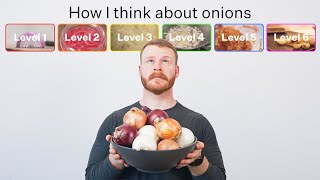
This video explores the six distinct levels of onion preparation—from raw to charred—and explains the science behind how each transforms the flavor, texture, and aroma. The host breaks down the chemical reactions and physical changes that occur, then demonstrates the differences through two side-by-side taste tests.
Raw onions can be used intentionally with different varieties, cut sizes, and timing to balance their pungency.
The aroma of raw onions comes from sulfoxides reacting with the alliinase enzyme, producing volatile thiols and thiol sulfonates.
Intensity depends on onion type, cut size, and time after cutting; the first 10 minutes are most pungent, then it mellow over 30–60 minutes.
Raw onions have a firm crunch and juicy bite, and they maintain their natural color, providing visual contrast.
Pickling lowers pH, making the onions sour and less pungent; aroma becomes cleaner and reflects the brine.
Pickled onions are softer, cold, and have a vibrant pink color when using red onions.
Evaporation of water concentrates natural sugars, which is the main reason caramelized onions taste sweet.
Cell wall breakdown (pectin and hemicellulose) between 80–95°C makes onions soft and tender.
Maillard reaction (amino acids + sugars) at 140–165°C gives browning and savory aroma; caramelization (sugar alone) at 160–180°C adds nutty, buttery notes.
Pyrolysis (burning) adds smoky, bitter notes in charred onions; it's a controlled technique.
Taste tests show raw onion adds crunch and pungency, pickled adds sourness, charred adds smoke and sweetness; sweated blends in, sautéed feels out of place, caramelized adds deep richness.
Onions are one of the most versatile ingredients because heat, time, and acidity can completely transform their flavor, texture, and aroma. Understanding the six levels—raw, pickled, sweated, sautéed, caramelized, and charred—empowers any cook to use onions intentionally and creatively.
What is the chemical composition of an onion?
About 90% water, 8% carbohydrates, 1% protein, 1% trace minerals.
04:44
What are the three variables that determine raw onion intensity?
Type of onion, size of the cut, and time after cutting.
03:50
What chemical reaction creates the smell of raw onions?
Sulfoxides (aroma precursors) and the alliinase enzyme produce volatile compounds like thiols and thiol sulfonates.
03:10
How does the pungency of raw onions change over time after cutting?
The pungency is most intense in the first 10 minutes after cutting and mellow over the next 30–60 minutes.
07:42
What makes pickled onions sour?
Low pH from an acidic environment (vinegar, citrus, fermentation).
10:14
How does the texture of pickled onions differ from raw?
They are less crunchy, softer, and more pliable.
12:19
What is the main reason caramelized onions taste sweeter?
Evaporation concentrates the natural sugars as water is removed.
14:28
What physical change makes cooked onions soft and tender?
Cell wall breakdown: pectin and hemicellulose dissolve between 80–95°C (175–203°F).
16:19
What chemical reaction gives browned onions their savory flavor?
Maillard reaction: between amino acids and reducing sugars, requiring roughly 140–165°C (285–330°F).
19:13
What is the difference between caramelization and the Maillard reaction?
Caramelization is the thermal breakdown of sugars alone (160–180°C), while Maillard requires amino acids as well.
20:13
Evaporation Drives Sweetness
Explains that the main reason caramelized onions taste sweet is not just sugar breakdown but concentration through water loss.
14:28Maillard Reaction for Savory Depth
Describes the temperature range and chemical process that creates hundreds of new aroma molecules in sautéed and caramelized onions.
19:13Pungency as a Physical Sensation
Introduces pungency as a separate flavor fundamental (physical irritation) unique to raw onions.
06:23Cell Wall Breakdown Determines Texture
Shows how pectin and hemicellulose dissolution at specific temperatures transforms onions from crisp to jammy.
16:19Pyrolysis in Charred Onions
Explains that controlled burning (pyrolysis) adds smoky, bitter notes and is the boundary between flavor development and burning.
20:58[00:00] Onions are one of the most commonly used ingredients in the world, and there's a reason for that, because depending on how you cook them, you can completely transform their flavor. From sharp and pungent when raw, to vibrant pink and sour to pickled, to a deep brown and sweet
[00:16] when caramelized, each stage is like working with a completely new ingredient. So in this video, we're going to cover the six onion levels that every home cook should know and master. For each
[00:29] level, I'm going to break down the flavor fundamentals so we can see how the taste, texture, aroma, pungency inside of the onions really changes between the levels and what makes each of them unique from one another. Then after we understand the theory behind the onions,
[00:43] we're going to put what we learned into practice by ending the video with two taste tests. The first test will be a taco made with levels one, two, and six, and the second test will be a grilled cheese made with levels 3, 4, and 5. And by the end of this video, I promise you'll never look at an
[01:00] onion the same way again. Now, one of the most important elements when cooking onions is heat control. And all throughout this video, we'll be using stainless steel pans from today's sponsor,
[01:12] Made In, whose Black Friday sale is happening right now. Made In's premium five-ply stainless steel material is what sets it apart from other pans out there, and I've been using these for several years now. The five layers allow for superior heat retention, even heating, and ease
[01:27] of heat control, which, as we'll see, is a critical difference between sweating, sautéing, and caramelizing onions. Two of my favorite stainless steel pans are this three-quart sauce DA and this 12-inch sauté pan, which can be used for things like deep frying, pasta, shallow frying, sautéing,
[01:44] searing proteins, or basically anything you can throw at it. And like I said, the Black Friday sale is happening right now, so check out the stainless steel collection and my other favorite cookware options from Made In by using the link in the description. It's seriously just high quality
[01:59] cookware that looks and performs great in your kitchen, but now let's talk about onion level one, which in my opinion might be one of the most underappreciated and underutilized. So if you're
[02:12] one of those people who hears raw onions and immediately starts thinking of a lingering onion breath, that's typically not what we want when using raw onions in our cooking. Like, if you get a side salad and there's just three thick cut red onion rings on top, it's kind of brutal. But when
[02:28] you use them intentionally with different varieties of onions and cut to different sizes, raw onions can do way more than just sit on a salad, and here's how the flavor fundamentals work for this level. First up is taste, and if you close your nose and take some diced raw onions, you'll notice
[02:43] it doesn't actually taste like much. There's no strong sweet, salty, sour, bitter, or umami taste. And this is an important distinction from the other levels. For example, if I do this same closed-nose comparison with pickled onions, they will taste sour. More on that in just a bit.
[03:00] And this is why when we're using raw onions, the other flavor fundamentals tend to be more important. And next up is aroma. And as soon as I open up my nose, I'm going to be hit with the unmistakable smell of raw onions, and here's how the science behind this works. Inside each onion
[03:17] cell are aroma precursors called sulfoxides, and when these cells are cut or crushed, they are mixed with the alanase enzyme, which causes a reaction to produce a variety of volatile compounds such as the thiols and the thiol sulfonates, and these compounds are what define the raw onion
[03:34] smell. Now, I'm going to link this study to the investigation of volatiles emitted from freshly cut onions down below if you want some more reading, but from a practical cooking perspective, there are three variables that will determine how balanced or how overpowering that raw onion
[03:49] flavor will be. First is the type of onion, secondly is the size of the onion cut, and third is when you eat it after cutting. For example, a 10 gram piece of red onion in a salad will be
[04:01] way more intense than 10 grams of white onion that has been diced up small and has sat out for 30 minutes after cutting like you would use for a Chicago-style hot dog. And the food science behind
[04:13] these is important to understand because level one is by far the one you need to be the most careful with. I mean, if you add a little extra caramelized onion to a French onion soup, it's not going to be a big deal. But with raw onions, we're playing this balancing act where you want to add
[04:28] just enough so you know it's there. But if you add too much, it can completely overpower a dish. So, let's talk about why. Every onion variety has its own unique chemical makeup, but on average, onions are about 90% water, 8% carbohydrates, 1% protein, and 91% trace minerals and other compounds.
[04:46] And within that, the percentage of the amounts of sugars in the carbohydrates and the concentration of the sulfur compounds will really define the onion's personality. And in a raw taste test I did last year when I bit into each one fresh,
[04:59] I found that the shallot and red onions were much more intense than the yellow, white, and sweet onions like Vidalia. So right away, the type of onion you choose is going to set a baseline. However, the next two variables matter just as much.
[05:13] So the finer that you cut an onion, the more onion cells you damage, and this means more of these reactions are taking place, releasing those pungent aromas. and you can literally smell this happening in real time every time you chop an onion.
[05:27] If you pick up a whole onion with a wrapper on it, it really won't smell like anything at all. However, if you cut that onion in half and stop, you can immediately smell it, but it's pretty mild. You've only damaged cells on that single cut line.
[05:39] Now, if you slice that entire onion up, tons of onion cells are being damaged and loads of these volatile aromas are being wafted around the room and the whole room will start to smell like onions.
[05:51] Additionally, chopping up a bunch of onions may cause your eyes to start watering too, and here's where I'm going to introduce the next critical player fundamental, which is the physical component. This one is less intuitive, but still important.
[06:03] And eating is a physical act, and certain ingredients directly impact our physical sensations in ways that are unique from our taste and odor receptors. And the physical elements of food that can impact flavor are things like an ingredient's temperature,
[06:16] its spice level, astringency, or in raw onions, the most prominent example is its pungency. And pungency typically refers to a mild physical irritation that registers as maybe slightly spicy, bitter, or overly aromatic.
[06:30] And usually, this pungent reaction occurs in the presence of sulfurous aromatic molecules, such as those released by alliums, wasabi, or horse rash. And these molecules will attach to our sensitive mouth and nose lining
[06:43] and cause that mild, uncomfortable sensation that can really wake up our senses. Like, if you bite into a ring of red onion, you can kind of feel that tingly feeling in your nose. Additionally, some alliums like onions and shallots contain molecules known as lacrimators,
[06:59] and these irritate the linings of our eyes, which is what causes us to cry when chopping onions. And the key here is that raw onions are really the only level that will have this kind of physical pungency
[07:11] that can cause this irritation. You might love it or hate it but it is part of what makes the raw onions unique And additionally this aroma and pungency are generally most intense the first 10 minutes after cutting the onion
[07:24] And this is why that third variable, when you eat the onions after cutting them, is important to consider when you're using these onions at home. In this study, they analyzed the volatile organic compound condition
[07:36] in cut onions over a 120-minute period. And in these PLOS charts, you can see how that composition changed. Quote, And this chart shows something most of you intuitively already know,
[08:01] and that is the aroma and pungency of raw onions are most intense and unique in that first 10 minutes or so, but then they mellow out over the next 30 to 60 minutes if they're let out. And this is a part of the reason why eating a salad with thick onion rings will be really a
[08:16] sense, but adding a bunch of diced white onion to a Chicago-style dog that was chopped an hour ago is really manageable. So hopefully you're starting to see the bigger picture when it comes to using raw onions, and I believe they have a lot more range than people give them credit for.
[08:31] So let's quickly go through the remaining flavor fundamentals, and then we're headed straight into level two for pickled onions. From a texture perspective, raw onions tend to have a firm crunch and juicy bite that really sets them apart from every other onion level. Obviously,
[08:46] though, that texture can vary depending on how you cut them. Ultra thin slices will feel crisp in a salad. Larger chunks in a pico de gallo will bring more crunch, while a fine mince will blend in with whatever it's added to. And either way, that crisp crunch is unique to the raw state and
[09:01] It can be used to add freshness and contrast to almost any dish. Next up is sight, and this is a reminder that we first eat with our eyes. Now, raw onions will maintain their natural color and kind of translucence,
[09:13] whether that's white, yellow, or a deep purple. They don't brown or soften like when we cook with them, so they often can serve as visual contrast in a dish, like white onions sprinkled over chili or red onions in a bright salad. And in their raw state, it can give that little pop of brightness
[09:27] that instantly makes the plate look fresher and more alive. So in conclusion here, when you're using raw onion, you should ask yourself, from a flavor perspective, what do you want from them? Do you want that sharp aroma to cut through some fat?
[09:40] Do you want a bit of physical pungency to weigh things up? A crunchy texture in a salsa or a salad? Or maybe just a pop of color on top of something rich or creamy? And when used intentionally, a little bit goes a long way.
[09:53] You want just enough raw onion to notice it's there, but probably not so much that it lingers on your breath. And now that we've broken down the flavor profile of raw onions, let's see what happens when we turn that same ingredient into some pickled ones.
[10:11] When I say pickled onions for this section, I'm really referring to any onion that has been exposed to an acidic environment, whether that's through lacto-fermentation, soaking in vinegar, or even citrus juices like lemon or lime juice.
[10:23] And the method can vary. Sometimes it's hot, sometimes it's cold, but the core idea is that we're lowering the pH of the onion. And this acidity doesn't just help preserve it, it fundamentally will change the flavor profile.
[10:37] And first up, we have taste. So, if I close my nose and just taste these pickled onions, they're immediately sour on my tongue. And again, this is one of those key sensory differences from a raw onion,
[10:49] which really doesn't have much taste on its own. And that sour taste can be a really powerful tool. It's one of the five core tastes, so we can use it to balance sweet, salty, bitter, and umami. And sour foods also help generate saliva, which literally makes our food taste juicier and more enjoyable.
[11:05] Now, I really need to do a whole separate video on the importance of using sour food at home, but one of the easiest ways is to just keep some pickled onions in the fridge. But now, let's talk about aroma. And as you can guess, the aroma of pickled onions is going to be pretty different from raw ones.
[11:21] Pickled onions will have a much more subdued aroma compared to raw ones. Remember, they've already been cut up and then soaked in acidic, water-based solution, so most of those sharp, sulfur aromas from the raw onion have either mellowed out or leached out into the brine.
[11:35] And what's left is kind of a lighter, cleaner smell that mostly reflects your pickling liquid. Maybe it's vinegar, lime juice, or spices you've added like bay leaf, peppercorn, or clove. So the aroma shifts completely from kind of raw onion forward to more of a bright and tangy.
[11:51] Next, let's talk about the physical experience. And similarly to aroma, that pungent irritation we found in raw onions is completely gone. Instead, the only real physical sensation we have is temperature contrast.
[12:04] Pickled onions don't have to be, but are typically stored cold in the fridge around 35 to 40 degrees Fahrenheit. And that chill gives them a really refreshing bite that cuts beautifully through rich, fatty, or spicy hotter foods.
[12:17] Now, on to texture. When stored in a water and acid solution, this actually will start to break down some of the onion's cellular structure, so pickled onions aren't going to be as crunchy as raw ones. And the longer they sit, the softer and more pliable they become.
[12:31] They still do have a bit of bite, but definitely much more gentle compared to raw ones. Fifth, we have sight. And when you're using red onions for pickling, this will be by far the most striking.
[12:43] That vibrant, translucent pink color that leaches out into the water makes these one of the most pretty garnishes you can add to a dish. Then lastly, we have the human element. And we're naturally drawn to sour flavors.
[12:56] They wake up the palate, refresh the mouth, and add energy to a dish. And pickled onions will make something feel lively. They bring the brightness and the contrast without that kind of aggression and sharp pungency of a raw onion.
[13:08] And in many ways, raw onions and pickled onions can be used in similar ways when cooking, such as adding them to garnishes, salads, or sauces. but their flavor profiles side by side are very unique.
[13:20] So let's see how this plays out in a braised taco. So in this first taste test, I'm going to be comparing a raw onion, a pickled onion, and jumping all the way to level six with a charred onion on some braised beef tacos.
[13:33] And all three of these should give us a completely different flavor profile. But before we get to the taste test, we need to cover the remaining four levels, which are sweated, sautéed, caramelized, and charred. And what's amazing is that all of these flavor transformations we're about to see are all going to come from changing just two variables, temperature and time.
[13:54] As soon as we add onions to a hot pan, a whole cascade of physical and chemical changes will begin to happen. And because of this, instead of walking through the levels one by one like we did for the first two, we're going to take a slightly different approach.
[14:07] We're going to break down these six physical and chemical changes that can occur as the onions heat up and build a simple matrix showing how these transformations shape the taste, aroma, texture, and appearance of the onions while cooking.
[14:21] For example, if I asked you, why do caramelized onions taste significantly sweeter than other cooked onions? Most people would probably say, well, you caramelize them, obviously. and while that is part of it the main reason why caramelized onions taste so much sweeter is actually much simpler It evaporation And as you can guess each level of cooking is going to evaporate different amounts of water
[14:44] which impacts the taste of the onion. So, let's break it down. When we add onions to a hot pan, the free water will start to evaporate at the boiling point of water, which is 100 degrees Celsius or 212 degrees Fahrenheit.
[14:58] And this happens all the time when we cook, because you have to remember, most food is made up of water. And in the case of onions, they are about 90% water when raw, and we've now exposed this through slicing and dicing them up.
[15:11] Now, as the water begins to evaporate from the onions, the natural sugars, proteins, and other flavor compounds that don't evaporate away become much more concentrated. And I've always wondered how much water actually gets evaporated when we're cooking onions.
[15:25] So, I decided to put it to the test. I took four equal weight batches of onions for each level. First, I sweated some by cooking them low and slow for about 20 minutes with no browning.
[15:37] Then, I sautéed some onions hot and fast for about 5 to 8 minutes to make sure I got some browning on them. Third, I cooked a batch low and slow for about 60 to 90 minutes. And lastly, I charred some big slices of onions for a few minutes.
[15:49] And as we can see, there are big differences in how much the onions weighed before and after being cooked. And this is the main reason why caramelized onions taste so sweet. It's simply because there is much less water.
[16:03] All those natural sugars have now been packed into a smaller, denser mass. Now, as evaporation is happening, another key physical transformation is happening too. And this is the cell wall breakdown, which directly affects the onion texture.
[16:19] Onions are made up of tightly packed layers of plant cells held together by pectin and hemicellulose, which acts kind of like a structural glue. Once we start heating the onions past 80 to 95 Celsius, 175 to 203 Fahrenheit,
[16:32] those pectin and hemicelluloses will begin to weaken and dissolve. And this is what turns the raw onions from crisp and snappy into soft and tender. During the sweating stage, this breakdown happens slowly.
[16:44] The onions turn translucent as the cells collapse and release their moisture. And the longer you sweat the onions, the softer they become. Now, as we move to sautéed onions, this process is accelerated.
[16:56] The higher heat causes more rapid water loss, and the internal pressure from searing builds up until some cells on the surface can burst and dry out, which is when that browning will happen. And sautéed onions will have a tender bite, but they're not mushy. They'll still have some structure left.
[17:09] However, by the time you reach caramelized onions, those cell walls have almost completely broken down after 45, 60, or 90 minutes of that low, moist heat. That pectin network becomes fully dissolved, and the onions transform into something jammy and spreadable.
[17:26] That is total cell wall breakdown. Then at the charred level of onions, we kind of get a mixture. So the exterior cells are exposed to that very high heat and rupture almost instantly, some even burn,
[17:38] while the interior layers are going to steam and soften. And this is what creates that kind of contrast of a soft, sweet inside and a smoky, dried outside. And cell wall breakdown is really what will dictate the onion's texture at each level.
[17:53] Okay, so evaporation and cell wall breakdown are really more of physical changes. But now we're going to start moving into more chemical changes, which can be a little bit more complex. Because depending on the cooking method, the onion temperature, how much moisture is present,
[18:08] several of these reactions could be happening at the same time or in different parts of the onions, and the four main ones to pay attention to are the aroma compound evolution, the Maher reaction, caramelization, and pyrolysis.
[18:23] The aroma compound evolution is all about how the heat reshapes the onion sulfurous compounds that we learned about in level 1. So as onions cook, the sharp reactive sulfur molecules that give raw onions their pungent bite
[18:35] will start to break down, volatilize, and transform into sweeter, kind of more savory-smelling compounds like thiopenes and sulfites. So, in a way, you can kind of think of this as the aroma-melanine phase.
[18:48] That aggressive raw onion smell phase and a richer, more rounded aroma starts to take over that we all know and love. And this process will begin as soon as you start sweating onions in level 3 and it's present in all the other levels.
[19:01] Next, we have the Maillard reaction, and this is a big one for levels 4 and 5. The Maillard reaction is a chemical browning that happens between amino acids from the onion's proteins and reducing sugars like glucose and fructose.
[19:13] Now, the Maillard reaction can happen at lower temperatures, but happens rapidly once the surface temperature climbs above roughly 140 to 165 C, or 285 to 330 degrees Fahrenheit.
[19:25] And this reaction can create hundreds of new aroma molecules like the pyrazines, diathenes, and syrenes. and these give that deep roasted and savory aroma that we associate with brown foods like steaks, coffee, and fried food.
[19:38] Now, additionally, the Maillard reaction also produces melanoidins, which is what will change the color of a cooked onion. And this browning is not going to be present in sweated onions, obviously, but it is what gives us the golden brown hue of sautéed onions,
[19:53] and in caramelized onions, we get even more melanoidin buildup from both the Maillard reaction and caramelization overlap, which gives us that deep brown and glossy look. Next, we have caramelization, which, unlike the mayo reaction,
[20:06] it doesn't require any amino acids. This is just heat and sugar. And caramelization happens when the sugars themselves start to break down thermally around 160 to 180 degrees Celsius or 320 to 355 Fahrenheit.
[20:19] And again, the result is a whole other suite of aroma molecules, which can read as sweet, buttery, nutty, or toffee-like. And as you can guess, we mainly see this reaction in deeply caramelized onions where nearly all the water is gone and the temperature can finally rise high enough for true caramelization to take off.
[20:39] Now, one of the biggest mistakes you can make if you're making caramelized onions at home is to try and raise that temperature too high because eventually the sugars will start to burn and this is where pyrolysis happens.
[20:51] Now, when used in small amounts in charred onions, pyrolysis is a good thing. Pyrolysis, or burning, is what happens when organic material is exposed to extreme heat without moisture. And yes, this is the same process needed to make charcoal,
[21:05] but when cooking food, this is what we refer to as sharring. Which, sharring is a technique where you intentionally burn an ingredient, or part of an ingredient, in a controlled manner using direct high heat. And in charred onions, we get this smoky, bitter, and acrid note,
[21:20] and the darkened surfaces you can visually see are the result of the carbon-heavy residues forming. And pyrolysis is right on that boundary between flavor development and burning. It's powerful, but it has to be balanced carefully.
[21:33] Okay, so if we zoom out and look at this matrix we've just created, hopefully you can see why I wanted to present the levels this way. Evaporation will help concentrate those natural sugars. Cell wall breakdown creates a tender bite, or if we take it far enough, to a completely jammy texture.
[21:49] The aroma compounds will mellow and evolve as the sulfur chemistry shifts during cooking The Maillard reaction can give us that golden brown and deep savory complexity Caramelization layers on nuttiness and a buttery richness And finally, pyrolysis in the charred onions adds the smoky, slightly bitter edge that completes the full spectrum.
[22:07] And these physical and chemical changes are really what's going to shape the flavor profile of the onions as we're cooking them. And truthfully, there can be levels within levels here. For example, you know, a 60-minute caramelized onion will probably taste different than one that's been taken for four hours.
[22:22] And I know there's kind of a lot of hacks out there with like baking soda or adding sugar, but none of them are going to taste exactly the same. It really just depends. Maybe that would be an interesting video topic. But really the line between sweated, sauteed, caramelized, and charred,
[22:36] or anything in between is going to be a little bit fuzzy. That being said, here is the full breakdown of these six levels and how the flavor relates to each one.
[22:48] And I'm going to have this linked on CookWell if you want to use it for a reference later, but now it is time for my favorite part of the video, where we get to put the onion theory to the test. Okay, so we should all have a fairly decent idea of what I'm about to experience,
[23:01] but I also want to point out that the onions you choose for something like this may help dictate what other ingredients you add. For example, with this raw onion, I know it's not sour, which is why a spritz of some lime juice would be really good.
[23:14] However, an extra spritz of lime juice on some pickled onions that are already pretty sour is probably going to be way too overpowering. And on this one with the charred onions, I could use lime juice, but for me, my head goes to more of a spicier and sour salsa,
[23:28] like kind of this habanero one, which I think would round it out really nicely and pair with that smoky aroma. However, for this taste test, we're just going to do them plain and kind of I'll give you the experiences as I go through them. So as you would expect, I get that juicy beef, but then I do get the nice crunch of the raw
[23:46] onion, which is a really nice balance in there. Like I said, would be great with a little cilantro and a little lime juice in there, but let's go to number two, our pickled onion.
[23:59] Right away I get that completely different flavor profile. My mouth is noticeably watering more from the acidity in the pickled onion, and I do get a little bit of crispness, but it's nowhere near as crunchy as the raw onion. This one,
[24:11] honestly, like pickled onions and just braised beef on a taco, it honestly does not need to get more complex than that. But lastly, let's move to our charred onion here on the end.
[24:23] Man, I love doing tastes like this side by side, like, especially when the theory matches up with what you're experiencing. I mean, so with these charred onions, a little bit of sweetness because
[24:35] they're like kind of softened they lost some moisture obviously but then that kind of smoky charredness comes through and then the texture on these is much softer than what I experienced in these other two now like I said I think this needs like a little bit of this habanero sauce will be
[24:51] good maybe a touch of salafrim too for a little bit more of that sour tang but really like this just goes to show that you should think about the onions you're using and how they also are going to play with the other ingredients. And this is just like such a great example of how knowing your
[25:08] different onion levels can drastically change your kind of flavor enjoyment in a dish. So with that being said, let's move to taste test number two. And I'm going to keep it simple for this one and just do a grilled cheese sandwich. For the grilled cheese, I simply buttered some bread,
[25:23] threw them down on a griddle, then added one slice of cheese to each and then added on the onions, the sweated, the sauteed, and the caramelized before topping with another piece of cheese and putting the bread over top. And let's see how these taste.
[25:37] I will always say I highly recommend you guys try some tests at home because there's no better way to learn than trying the similar preparations of a variety of foods side by side so you can really understand and internalize what I'm telling you.
[25:51] Like the theory is great, but actually experiencing it is a whole other level. So let's get into this. And like I said, these are my favorite parts of the video. So sweated onion first. And this, I think a good comp for like a sweated onion would be like a Philly cheesesteak.
[26:06] A lot of times they're softer. They're not really sautéed properly. They're typically not brown. So they kind of blend into the background, which I think is why it works well in something like Philly cheesesteaks.
[26:19] Even with the sweated onion, the sweetness totally comes through, especially obviously when you're comparing them to like, you know, raw and pickled preparations. 100% I think the better Philly cheesesteaks have sweated onions. Really, really good.
[26:34] But now let's move to sauteed. So obviously we can see there's more browning in there. Should get some more like roasty notes and aromas. Let's get in. This is a really good
[26:48] example because it's like sauteed onions, they feel kind of out of place on this. Like it kind of reminds me of like a soup base because like that's typically what I use for Like when I saute onions, you always, you know, you saute them and you throw in everything else.
[27:01] So really those browning we get from the mayo reaction, it like reminds me of, yeah, like sauteing soup or sauteing onions for something, which it's not bad. It just feels weird in a grilled cheese versus like the sweated onions, I think,
[27:15] are a perfect comparison or a perfect companion to the cheese. But lastly, let's move to our very sweet caramelized onions, which I'm expecting to be pretty good here.
[27:31] Instantly, just the level of complexity you're getting. I mean, a deep sweetness, like you can feel it on your tongue. And then you get this very complex, like roasty, kind of sweet, nutty, toffee-like aromas that you just can't get unless you caramelize onions.
[27:50] So in conclusion, I hope this video has given you a sense of just how complex onions really are and why they're one of the most widely used ingredients in the world.
[28:02] You can completely transform their flavor profile depending on how you treat them, and now the next time that you see sweated, sauteed, caramelized, or charred onions in a recipe, I hope you'll understand exactly what it is providing and how it balances with the
[28:15] other ingredients that are being used. Because in my opinion, the more you understand why things work, the more interesting cooking becomes. And honestly, the better you get at it and more fun it gets as well.
[28:27] And we'll have a page on CookRaw with a graphic of the six onion levels, plus a few recipes if you want to play around with them for yourself. But that is going to wrap it up for this video. Also, another big thank you to Made In for sponsoring this one.
[28:40] The Black Friday sales going on. We definitely recommend taking advantage so you can cook throughout the holidays, Thanksgiving and Christmas and all that good stuff is coming up. But I sincerely thank you guys for watching. Let me know if you guys want to see more videos like this.
[28:53] The level concept is really fun, but I want to make sure it makes sense. I don't want to do levels for the sake of levels, but for onions it felt like there were kind of six distinct ones that we could really hone in and focus on. So let me know if you guys have ideas down in the comments below.
[29:07] But that'll wrap it up for me in this one. I will catch you all in the next one. Peace, y'all.
⚡ Saved you 0h 29m reading this? Transcribe any YouTube video for free — no signup needed.