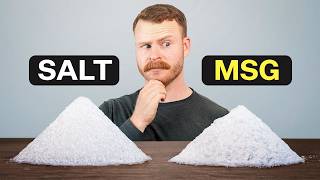

What does pure MSG taste like?
45sReveals the isolated flavor of MSG compared to salt, sugar, and sour, challenging common assumptions.
▶ Play Clip"The title promises to test if MSG makes food taste better, and the video delivers with structured experiments and clear conclusions."
MSG is one of the most misunderstood ingredients in cooking. This video explores its chemistry, taste, and proper usage through a series of taste tests. The goal is to provide a fundamental understanding of how MSG works and how to use it effectively.
MSG is often misunderstood as either a magic flavor enhancer or an artificial chemical, but the science is often ignored.
The video aims to answer what MSG is, how much to use, and which foods it improves most.
Three taste tests: pure taste comparison, salt-to-MSG ratios in scrambled eggs, and a blind test with spicy beef noodles.
Glutamates are naturally present in foods like tomatoes, mushrooms, soy sauce, meat, and Parmesan cheese.
Each taste compound (salt, sugar, citric acid, caffeine, MSG) is dissolved in water to isolate and compare pure tastes.
Monosodium glutamate: a sodium atom attached to a glutamate molecule. Glutamate provides the umami taste; sodium stabilizes the molecule.
100g of MSG contains about 78g of free glutamate, equivalent to over 100 lbs of tomatoes, 14 lbs of Parmesan, or 8 lbs of kombu seaweed.
Japanese chemist Kikunae Ikeda isolated glutamate from kombu broth in 1908 and combined it with sodium to create MSG.
MSG is a seasoning tool in a larger flavor system; it can throw a dish out of balance if overused.
Caffeine powder is intensely bitter; this highlights the importance of other ingredients in energy drinks.
MSG provides a unique savory broth-like taste, not as overpowering as salt or bitter. It is not a substitute for salt.
MSG is odorless: no aroma, only taste. This is opposite to spices like cumin or cinnamon.
MSG is water soluble but not fat soluble, similar to salt. It dissolves readily in water-based foods.
MSG diffuses through food more slowly than salt because its molecule is larger. It is often a surface-level seasoning.
MSG's umami can be amplified by nucleotides (inosinate, guanylate), explaining synergistic pairings like kombu and bonito (dashi).
MSG is heat stable up to 437°F (225°C); it does not caramelize or brown and primarily contributes umami.
The 75% salt / 25% MSG ratio was the favorite, adding a hint of savory without being overpowering.
Water-rich savory foods, roasted/sautéed vegetables, synergistic umami pairings, and spicy foods are ideal for MSG.
MSG in spicy beef noodles was not obvious overall, but the beef with MSG was noticeably more savory and delicious.
MSG is a valuable seasoning tool that raises the flavor floor of dishes, but its effect is often more subtle than expected. The ideal use is in water-rich foods, roasted vegetables, synergistic pairings, and spicy dishes.
What does MSG stand for and what is its chemical composition?
Monosodium glutamate: one sodium atom attached to a glutamate molecule. Glutamate provides the umami taste.
3:51
How much free glutamate is in 100 grams of MSG?
Roughly 78 grams or 78,000 mg of free glutamate.
5:13
Who discovered MSG and how?
Japanese chemist Kikunae Ikeda in 1908. He isolated glutamate from kombu broth and combined it with sodium to create MSG.
5:45
Name five properties of MSG discussed in the video.
1. Odorless. 2. Water soluble, not fat soluble. 3. Diffuses more slowly than salt. 4. Umami can be amplified by nucleotides (inosinate, guanylate). 5. Heat stable up to 437°F (225°C).
13:58
What is the optimal salt-to-MSG ratio recommended from the scrambled egg test?
75% salt to 25% MSG (3:1 ratio).
19:55
What are the four categories of food where MSG works best?
1. Water-rich savory foods (soups, stews). 2. Roasted/sautéed vegetables. 3. Synergistic umami pairings (combining glutamate with inosinate/guanylate-rich ingredients). 4. Spicy foods.
23:46
What is the triangular test mentioned in the video?
A blind taste test where the participant tries to identify which one of three samples is different (the odd one out).
24:01
What is MSG?
Provides a clear, chemical definition of MSG and explains the role of glutamate vs. sodium.
3:51Discovery of MSG
Historical context shows how MSG was derived from natural seaweed broth, countering the 'artificial chemical' myth.
5:45Five Core Properties of MSG
Summarizes key practical knowledge for cooking with MSG (odorless, water soluble, diffusion, amplification, heat stability).
13:58Umami Amplification by Nucleotides
Explains the science behind classic pairings like kombu + bonito (dashi) and why MSG works synergistically with certain foods.
16:14Optimal Salt-to-MSG Ratio
Provides a practical, tested ratio (3:1 salt:MSG) that viewers can immediately apply.
19:55[00:00] MSG might be one of the most
[00:01] misunderstood ingredients in cooking.
[00:04] Because depending on who you ask, it's
[00:06] either a magical white powder that
[00:07] instantly makes everything taste better
[00:09] or an artificial chemical used in junk
[00:11] food. And the problem is most
[00:13] conversations around MSG completely skip
[00:16] over the food science of what it does do
[00:19] and just as importantly, what it does
[00:21] not do. Because yes, MSG can absolutely
[00:24] make food taste better. But as we're
[00:26] going to see in some of these tests, it
[00:28] can also make food taste worse if it's
[00:30] used incorrectly. So, in this video, I
[00:33] have three big questions I want to
[00:35] answer. First, what actually is MSG?
[00:37] What exactly does it taste like and how
[00:40] is it made? Second, how much should you
[00:42] use when you're cooking with it? Like,
[00:43] is there an optimal ratio or can you
[00:45] fully replace it with salt? And third,
[00:47] what types of food does MSG improve the
[00:50] most? Can I add it to my chicken, ground
[00:52] beef, and roasted vegetables, or stick
[00:54] to more common use cases like fried
[00:56] rice? So, throughout this video, we're
[00:58] going to run through a series of taste
[01:00] tests. First is tasting MSG alongside
[01:02] other kitchen ingredients. Second is
[01:04] testing different salt to MSG ratios and
[01:06] scrambled eggs. And finally, a blind
[01:08] taste test with some spicy beef noodles.
[01:11] And by the end of this video, I promise
[01:13] you'll have a fundamental understanding
[01:15] of how MSG actually works when we cook
[01:18] with it. Now, before we get too deep
[01:20] into the MSG experiments, today's
[01:22] sponsor, Cometier, has a different kind
[01:24] of taste test you can try at home with
[01:26] coffee and their world mug collection
[01:28] that I have here is genuinely one of the
[01:30] coolest coffee experiences I've had at
[01:32] home because it's a tasting tournament
[01:34] featuring 16 different countries of
[01:36] specialty coffee. So, you can finally
[01:38] learn what kinds of coffee you like the
[01:40] most. Cometier is sourced from some of
[01:42] the best roasters in the world like
[01:44] Counterculture, Proud Mary, and Onyx.
[01:46] And the beans are first brewed to
[01:47] perfection by coffee experts before
[01:49] being flash frozen to lock in Pete
[01:51] flavor and freshness. And they come
[01:53] frozen on dry ice in these recyclable
[01:55] aluminum capsules. And at home, you can
[01:57] make any drink style in seconds. For hot
[02:00] coffee, just add 8 ounces of hot water.
[02:02] For an ice latte, drizzle the thawed
[02:04] coffee over some milk and ice. Or for an
[02:06] iced black coffee, just water and ice,
[02:08] which is my absolute favorite for an
[02:10] afternoon summer pickme up. And
[02:12] specifically, the World Mug Collection
[02:13] has 32 cups of coffee from 16 different
[02:16] origions. And the part I love is that
[02:18] they set up the pairing so you can keep
[02:19] track of what you like and don't like in
[02:21] this little passport or the app. It's
[02:23] the easiest way to taste 16 unique
[02:26] coffees from around the world without
[02:28] even needing a machine. All you do is
[02:30] keep everything in the freezer and pull
[02:31] out the ones you want to try. So, to
[02:34] grab your World Mug experience before
[02:35] it's gone, you can head to my link below
[02:37] and get $20 off your order and try some
[02:40] of the best coffee from around the
[02:41] world. And now that I've got my coffee
[02:43] secured, let's dive into that first big
[02:46] question. What is MSG? Because you might
[02:50] be surprised to learn that whether
[02:51] you've used MSG before or not, you've
[02:53] almost certainly tasted glutamates.
[02:55] They're naturally found in foods like
[02:57] tomatoes, mushrooms, soy sauce, meat,
[02:59] and parmesan reo. But most of us,
[03:02] including myself, have no idea how
[03:04] strong glutamates really taste because
[03:06] we've never tasted them in isolation.
[03:09] And that's exactly what we're going to
[03:10] do for this first test. So, in front of
[03:13] me, I poured out five glasses of water.
[03:15] And into each one, I'm dissolving 2 g of
[03:17] a single taste compound. Salt for salty,
[03:20] sugar for sweet, citric acid for sour,
[03:22] caffeine powder for bitter, and of
[03:23] course, MSG for umami. There's no
[03:26] aromomas, no fats, no cooking reactions,
[03:28] no texture. This is just pure isolated
[03:31] taste. Okay, so I'm gonna get all of
[03:33] these mixed up. And while I do that, let
[03:35] me break down what MSG is and how the
[03:37] five core tastes work because this might
[03:39] seem like a weird spot to start the
[03:41] testing in this video, but it'll make a
[03:44] lot more sense after I explain a few
[03:46] things. The easiest way to begin to
[03:48] understand MSG is to just break down its
[03:51] name, monosodium glutamate. Because when
[03:53] you look at the chemical structure, it's
[03:55] pretty simple. There's one sodium atom
[03:57] attached to a glutamate molecule. And
[03:59] the important part here is the
[04:01] glutamate. That's the compound
[04:02] responsible for the umami taste in MSG.
[04:05] The sodium is mainly there to stabilize
[04:07] the molecule and make it easier to use
[04:09] as a crystallin seasoning. Though
[04:11] technically it will provide a little
[04:12] taste. We'll talk more about that later.
[04:15] Now, all of these compounds I'm using
[04:17] here in this first test are isolated
[04:19] examples of the five taste. The sodium
[04:22] ions and sodium chloride or table salt
[04:24] primarily create the salty taste.
[04:26] Sucrossse molecules bind to our sweet
[04:28] taste receptors. Hydrogen ions are
[04:30] released from citric acid creating a
[04:32] sour taste. Caffeine is an alkoid
[04:34] compound that binds to bitter taste
[04:36] receptors. And the glutamate and MSG is
[04:38] primarily responsible for the umami
[04:40] taste. Now like I mentioned, glutamate
[04:43] itself is not unique to MSG. It
[04:45] naturally exists in lots of foods we've
[04:47] all tried before. And here's a full
[04:49] table from umaminfo.com showing just how
[04:52] much naturally occurring glutamate
[04:53] exists in a variety of different foods.
[04:56] Now, there are two key differences here.
[04:58] First, the foods on this list contain
[05:00] glutamate along with hundreds of other
[05:02] kind of taste and aroma compounds that
[05:04] shape their overall flavor. And
[05:06] secondly, compared to pure MSG, they
[05:09] have a really small amount of free
[05:11] glutamate. And to put this into
[05:13] perspective, 100 grams of MSG contains
[05:16] roughly 78 grams or 78,000 mg of free
[05:20] glutamate. And to naturally consume that
[05:23] same amount of free glutamate from some
[05:24] of the items on this list, you'd need
[05:26] over 100 lb of fresh tomatoes, 10 to 40
[05:29] lb of soy sauce, 16 lb of dried shiakei
[05:32] mushrooms, 14 lb of parmesan reano, or
[05:36] about 8 lb of comoo seaweed. And this is
[05:40] actually how MSG was originally
[05:42] discovered because back in 1908,
[05:45] Japanese chemist Kakun Iicada was
[05:47] studying kamboo broth, a seaweed broth
[05:49] naturally high in glutamate. And he
[05:51] noticed that it had a savory taste that
[05:53] didn't quite fit into the traditional
[05:54] categories of sweet, salty, sour, or
[05:56] bitter. So he eventually isolated the
[05:59] glutamate compound from the comoo and
[06:01] combined it with sodium to create a
[06:03] stabilized crystalline seasoning we now
[06:06] know as MSG. Now the MSG we can buy in
[06:10] stores today is typically produced
[06:11] through bacterial fermentation using
[06:13] carbohydrate sources like sugar cane,
[06:15] corn or sugar beets. And today MSG is
[06:18] used in all kinds of foods, soups,
[06:21] seasoning blends, snack foods, fast
[06:23] foods, restaurant cooking. And in the
[06:24] past decade or two, it has become way
[06:26] more popular in home cooking as well.
[06:30] And when it comes to the home cooking
[06:32] conversation, I think the biggest
[06:33] problem is that most people don't really
[06:35] understand what it does and what it does
[06:37] not do. And I'll tell you right now,
[06:39] it's not a magic powder that just makes
[06:41] everything taste better. I think what
[06:43] most people miss is that MSG is a
[06:45] seasoning tool that exists in a much
[06:48] larger flavor system. So, think about
[06:51] something like fried rice. You've got
[06:53] salt fats acids sugars aromomas
[06:55] fermentation compounds, browning
[06:57] reactions, and different textures. And
[06:58] all of these things are constantly
[07:00] interacting with each other to shape the
[07:02] final flavor of the dish. And MSG is one
[07:05] variable inside of that system. And just
[07:08] like too much salt, acid, or sugar can
[07:10] throw a dish out of balance, too much
[07:12] MSG can do the same thing. For example,
[07:15] here are four different chips. Two of
[07:17] them have MSG and two of them do not.
[07:19] Now, personally, I like the Doritos with
[07:22] MSG and the Simply Doritos that do not
[07:24] have MSG. And my favorite chip of all of
[07:27] them might be the Stator tortilla chip
[07:28] that's basically just Niximized corn,
[07:30] salt, and oil. But there's one chip here
[07:32] that I don't like as much, and it's
[07:34] because it has too much MSG. You can
[07:37] literally see the crystals coating the
[07:38] chip, and when you taste it, it's
[07:40] obvious that it's out of balance. Again,
[07:42] it's not bad, but it's just overdone.
[07:45] And this is the part that people really
[07:47] don't talk about, which is why this
[07:49] first taste test is so important because
[07:52] if you really want to understand what
[07:53] MSG is doing when you add it to food,
[07:56] you first need a reference point for
[07:57] what it tastes like on its own. Okay, so
[08:01] I've never done this before obviously,
[08:02] but there's kind of two things I want to
[08:04] figure out in this test. So first is
[08:05] just kind of comparing and contrasting
[08:07] the differences of the five taste. And
[08:09] then I'm also curious to see like how
[08:11] much of each taste in there. like how
[08:14] bitter does the caffeine powder taste,
[08:16] how sweet does the sugar taste, how
[08:18] salty, how sour, and how umami here on
[08:20] the end. And I use the same amounts, 2 g
[08:23] in all these. I only did two capsules of
[08:25] the caffeine powder because uh caffeine
[08:28] is supposedly very bitter and this is
[08:30] also 400 mg of caffeine worth, which is
[08:33] like two energy drinks. Um so yeah,
[08:35] we're we're going to take small sips of
[08:37] that guy. Um, so we may as well just
[08:39] start here on the end and see what
[08:42] bitter really tastes like.
[08:45] Get that mixed up one more time. Okay.
[08:55] All right. They weren't wrong about
[08:56] caffeine powder. Holy smokes is that
[08:58] bitter. Wow.
[09:01] Jeez, that's bitter. Woo. Okay.
[09:05] Will not be taking another sip of that.
[09:07] Also goes to show that like everything
[09:09] else in the energy drinks is very
[09:11] important when it comes to taste because
[09:13] if it was mostly caffeine powder, no one
[09:15] would drink them.
[09:17] Okay, so let's go to number two. I think
[09:18] this is the salt. I'll find out shortly.
[09:24] That's salty. Very salty water there. Um
[09:27] 2% I think is like close to the, you
[09:30] know, salt level of like ocean water. So
[09:32] if you imagine that, that's kind of what
[09:34] I'm tasting here. Um, again, not like
[09:37] gross compared to the bitterness of
[09:39] caffeine, but it's very salty. Um, let's
[09:42] go to the citric acid, I believe.
[09:48] Ooh, the immediate pucker.
[09:53] But satisfying because like your mouth
[09:55] salivates and actually a nice one to
[09:58] come into after the salty. Like the
[10:01] salt, the sour kind of balances out that
[10:03] salty I was getting. Man, that's that's
[10:06] a pretty cool test. And also, if you are
[10:07] wondering, you can just buy like pure
[10:09] citric acid online. It's kind of
[10:11] interesting. Okay, now let's go to our
[10:13] sweet
[10:17] M. That is really interesting because
[10:21] it's sweet, but doesn't taste very sweet
[10:24] at all. Which kind of checks out when
[10:26] you think about how sugar is used in
[10:28] cooking. You typically need quite a bit
[10:29] of it. Like if you're making a lemonade
[10:32] for example, it's very sour unless you
[10:34] add quite a bit of sugar to it to kind
[10:37] of balance it out. Or if you're using
[10:39] sugar in baking, you typically need to
[10:41] use quite a bit of sugar to make things
[10:42] sweet compared to with salt. We're
[10:44] typically adding like one one and a
[10:46] half% to a lot of foods. So again, just
[10:49] kind of an interesting takeaway. And
[10:51] then lastly, we're coming to the star of
[10:53] this video, the MSG.
[10:57] Ooh. Okay, so this is a fascinating test
[11:00] and I think I've got two big takeaways.
[11:02] So, first, all of these absolutely have
[11:05] their own unique taste. Like, take a
[11:06] sip, plug your nose, you're going to get
[11:08] the the the unique taste that each one
[11:10] of these has. It's going to go up to
[11:12] your brain. It's going to let you know.
[11:13] There's no mistaking these. Like, these
[11:15] are not substitutes at all. Now,
[11:19] what's interesting about the umami is
[11:21] that you do get that kind of savory
[11:23] broth quality. I mean, you kind of just
[11:25] need to throw some in a cup so you can
[11:26] kind of understand what I'm talking
[11:28] about. Uh, that's probably the best way
[11:29] to do it. Now, I would say there might
[11:32] be a little bit of saltiness that I'm
[11:34] getting that does kind of remind me of
[11:36] this, but nowhere near the the dramatic
[11:39] salty effect. And that's kind of my
[11:41] second takeaway from this test. So, down
[11:43] here on this end, very bitter. Do not
[11:45] want to take another sip. Very salty.
[11:48] Way too much salt. Reminds me of ocean
[11:49] water. Very sour. Like this would be way
[11:52] too sour if you're using it for some
[11:54] lemonade. You'd need to add some sugar
[11:56] water to it. And then this is where
[11:58] things get interesting with with kind of
[11:59] the sugar water because I know there's
[12:02] sugar in there, but in no way I'm like,
[12:04] "Oh, this is super sweet." You know,
[12:06] it's like 2 g of sugar in there. And
[12:08] then that's similar with how kind of the
[12:10] MSG works to me because I know there is
[12:13] MSG in there because I'm getting the
[12:15] unique taste, but it's not like
[12:17] overpowering in a way that
[12:21] that you kind of get with these other
[12:23] three tastes. And that's going to be
[12:24] what's kind of interesting and why I'm
[12:26] going to ask the next question is how
[12:28] much MSG do we really want to be using
[12:30] when we're cooking. So that's what we're
[12:32] going to test with our second scrambled
[12:34] egg test. So now that we know what MSG
[12:37] is and what it tastes like in plain
[12:38] water, we've got some much more
[12:40] practical questions that need to be
[12:42] answered. First, how much should you
[12:44] actually use in real food? And secondly,
[12:47] how strong does MSG taste when it's
[12:49] combined with other ingredients like
[12:51] salt? And this is an area of MSG that
[12:54] I've never really explored. So to test
[12:56] this, I made six batches of scrambled
[12:58] eggs with unsalted butter where the
[13:00] total seasoning weight is going to stay
[13:02] exactly the same, but the ratio of salt
[13:04] to MSG changes each time. So the first
[13:08] batch is a control with no seasoning
[13:10] added at all. Then we've got 100% salt,
[13:13] 75% salt, and 25% MSG. 50/50, 2575, and
[13:18] all the way up to 100% MSG. And
[13:22] scrambled eggs are going to be a great
[13:23] starting point because there aren't a
[13:24] lot of competing flavors that are going
[13:26] to hide what's going on, which makes it
[13:28] easier to isolate exactly how MSG is
[13:32] changing the flavor. Because if you want
[13:34] to use MSG, well, there are a few core
[13:36] properties you need to understand before
[13:38] you start throwing it into everything.
[13:41] So, I'm going to get our egg samples
[13:43] cooked up with some unsalted butter, of
[13:44] course. But while I do that, I want to
[13:46] explain five properties of MSG that
[13:49] everybody should know. And then I'll
[13:51] meet you back here because I'm very
[13:52] curious to see the results and flavor
[13:55] differences between these samples. The
[13:58] first property that everyone should
[13:59] know, MSG is odorless. And this might be
[14:03] one of the most misunderstood things
[14:05] about MSG because just like salt or
[14:08] sodium chloride, MSG does not have an
[14:10] aroma on its own. Like if you smell it,
[14:13] it does not smell meaty, roasty, savory,
[14:15] or delicious. You have to put it on your
[14:17] tongue to elicit a response to your
[14:20] brain. However, if you contrast that
[14:22] with spices, when you open up the jar,
[14:24] you'll be hit with a distinct smell of
[14:26] cumin, chili powder, or cinnamon. And
[14:28] this is important to remember because
[14:30] MSG primarily affects taste, not smell.
[14:34] So if a dish smells incredible, that's
[14:36] coming from the volatile aroma compounds
[14:38] from the cooking process and the other
[14:40] ingredients, not the MSG. The second
[14:43] property, MSG is water soluble but not
[14:46] fat soluble. And again, this is exactly
[14:49] like salt. And we already saw this in
[14:51] the first test. MSG dissolves very
[14:54] readily in water. And because food
[14:56] contains a lot of water, MSG can
[14:58] distribute very efficiently through
[15:00] soups sauces eggs noodles marinades
[15:03] and rice dishes. But if you add MSG
[15:05] directly into oil, it will not dissolve.
[15:09] And this helps explain why MSG behaves
[15:11] much more like a salt compared to
[15:13] something like a spice or aromatic oil.
[15:16] The third property, MSG diffuses through
[15:18] food, but more slowly than salt. So once
[15:21] MSG dissolves, it's going to naturally
[15:23] spread throughout food via diffusion,
[15:25] which is moving from areas of high
[15:26] concentration to lower concentration.
[15:29] But MSG is a little different because
[15:31] it's going to generally diffuse more
[15:32] slowly than salt. And this makes a lot
[15:34] of sense if you look at the molecules
[15:36] themselves. Salt is extremely small.
[15:39] It's basically just a sodium and
[15:40] chloride ion, so it moves very
[15:42] efficiently through water and food.
[15:44] Glutamate on the other hand is a much
[15:46] larger molecule. So it tends to move
[15:48] more slowly through food systems and
[15:50] tissues. Now in something like a soup
[15:52] sauce or in our scrambled egg test, this
[15:55] usually doesn't matter very much because
[15:57] everything is already dissolved and
[15:58] mixed together. But if you were
[16:00] seasoning something like a steak, salt
[16:02] would generally penetrate faster and
[16:03] deeper into the meat compared to MSG. So
[16:06] MSG is often more of a surface level
[16:08] seasoning effect unless it has enough
[16:10] time and moisture to properly diffuse.
[16:14] Now the fourth property gets a little
[16:16] nerdy, but it's also one of the coolest
[16:18] parts of how umami actually works in
[16:20] cooking. And that is the taste of MSG
[16:23] can be amplified by other compounds.
[16:26] Specifically, the glutamate in MSG can
[16:28] be amplified by nucleotides called
[16:30] inocinate and guanolate. And these
[16:32] naturally occur in foods like meat,
[16:34] mushrooms, dried fish, and aged cheeses.
[16:37] And there was a study looking at the
[16:39] interaction between glutamate and these
[16:41] nucleotides. And what they found is that
[16:43] the glutamate by itself kind of produces
[16:45] a baseline umami signal. But when
[16:48] inocinate and guanolate are present,
[16:50] they amplify that signal dramatically.
[16:52] And you can see this mapped out in the
[16:54] horseshoe effect here. And practically
[16:56] this explains why certain ingredient
[16:58] combinations across cuisines work so
[17:01] well together. For example, kamboo
[17:03] seaweed contains a lot of glutamate and
[17:05] dried bonito flakes contain inosinate.
[17:08] So when you combine them into a dashi,
[17:10] the umami perception becomes much
[17:12] stronger than either ingredient
[17:14] individually. And this same principle
[17:16] shows up in a lot of other classic
[17:18] combinations. tomatoes and parmesan reo,
[17:21] beef and mushrooms, chicken stock and
[17:23] dried shiakeis, or even in Doritos, you
[17:26] will see MSG on the label, but people
[17:28] will often miss that also do sodium
[17:31] inocinate and guanolate are present as
[17:33] well. All of these foods are essentially
[17:35] stacking glutamate together with
[17:38] nucleotide rich ingredients to create a
[17:40] stronger umami perception. And the last
[17:43] property that everybody should know is
[17:45] MSG is heat stable. So, when you're
[17:47] adding MSG to your foods, it's going to
[17:49] remain stable through sautéing,
[17:51] simmering, scrambling, stir frying, or
[17:53] roasting. At very high temperatures
[17:55] above 437F or 225 C, MSG can begin to
[18:00] degrade, but unlike sugar, MSG is not
[18:03] going to caramelize, brown, or create
[18:04] roasted flavors. Its primary role is
[18:07] staying dissolved in the food and
[18:08] contributing umami taste. So now that we
[18:12] understand these five core properties,
[18:14] it becomes a lot easier to understand
[18:16] what MSG is actually doing in food and
[18:19] just as importantly what it is not
[18:22] doing. It's not creating aroma. It's not
[18:24] browning food. It's not magically making
[18:26] everything taste good. It's primarily
[18:28] contributing and amplifying savory taste
[18:30] in a very specific way. So with all that
[18:33] in mind, let's see how these different
[18:35] salt to MSG ratios actually taste in
[18:39] practice. Okay, so I've got all six
[18:41] samples ready to go. Um, still hot. Um,
[18:44] even though these three were cooked
[18:45] first, they're still warm. So, this is
[18:46] about as close as we can get them. The
[18:49] only thing changing here is just kind of
[18:50] the ratio to salt to MSG. Um, starting
[18:53] with the unseasoned on the end, 100%
[18:55] salt here, and then down, increasing the
[18:57] amount of MSG down here. So, I think
[18:59] let's start with unseasoned as the
[19:00] control and then just work our way down
[19:02] and see how these taste.
[19:05] Okay unseasoned.
[19:08] I get a little aroma from the butter,
[19:09] but clearly these are missing salt. If
[19:11] you were served these, you'd be like, I
[19:13] need some salt on these. But now, let's
[19:14] go to 100% salt and see how it tastes.
[19:20] Instantly, you get that just I mean,
[19:22] it's salty, right? Like, we love salt.
[19:24] We crave it. We need it. Um, that one is
[19:28] just so much better than the one that
[19:30] doesn't have salt in it. Um, now let's
[19:32] go to Should we go here first? No, let's
[19:34] keep going here. Let me take a little
[19:36] palette cleanser, though.
[19:39] Cherry lime Sprite, I think, should
[19:40] fully clear us of any saltiness. Okay,
[19:43] now let's go to 7525. I'm curious to see
[19:46] like how much or like if if it's really
[19:48] that different here. Um, but let's see.
[19:55] Yeah, that's interesting. A little bit
[19:58] more rounded. I think I like this one
[20:00] better than just the plain salt.
[20:03] Let's keep going. 50/50, I believe.
[20:08] H
[20:10] 50/50 is starting to feel weird. Not
[20:12] bad. I still like these over unseasoned,
[20:14] but I think I like this one. 7525. 50/50
[20:18] definitely starts to feel weird. Um, now
[20:20] let's go to 7525.
[20:29] Again, it's it's not bad. It just like
[20:32] you can tell it's missing salt. like
[20:33] it's I mean now it is really just
[20:36] starting to taste like kind of straight
[20:37] MSG. Um it's kind of washing out the
[20:41] saltiness. Let's go all the way to the
[20:43] end with our um 100% just all MSG. No
[20:47] salt at all.
[20:53] Again, at 100% it's it's not bad, but
[20:56] it's just it's weird. like I'm I'm
[20:58] working against the bias that I'm kind
[21:00] of expecting salt um and not getting any
[21:03] feels kind of weird and out of place.
[21:04] Though technically there's a little
[21:05] sodium in there, but the glutamate is
[21:07] predominantly kind of what I'm getting
[21:09] out of 100% MSG. So, let me kind of
[21:11] quickly go back through one more time
[21:13] and then I'll give you my final thoughts
[21:15] here. But I think one of these I do like
[21:17] more than all the others.
[21:21] Man, it is crazy when you jump to just
[21:24] MSG to just salt. the I mean 100% they
[21:27] are not substitutes. Very very
[21:29] interesting.
[21:37] Okay, so this has been a very
[21:39] interesting test and quite illuminating
[21:41] in a couple of ways and I do have a
[21:42] couple of takeaways. So first things
[21:44] first, MSG and salt are not like a
[21:47] onetoone replacement for each other. If
[21:49] you try this test at home or like if you
[21:50] were served these eggs you'd be like
[21:53] what's going on? These taste completely
[21:54] different. There's I mean they're just
[21:56] fundamentally different tastes. Even
[21:57] though yes, this does have one kind of
[21:59] sodium ion in it, but not as much as
[22:02] sodium chloride. Then when we talk about
[22:04] mixing them, I think my favorite of
[22:06] these actually is the 7525.
[22:10] It's got enough saltiness, but it does
[22:12] have that hint of kind of the savory
[22:14] quality in there that you kind of get
[22:16] from the MSG and the umami, which I
[22:18] like, but there's kind of a diminishing
[22:21] return there when we get to the 50/50
[22:23] and the 2575. To me, these start to feel
[22:26] kind of out of place, and I don't really
[22:28] like them. Um, so if I was kind of
[22:30] ranking all of these, I would go 7525
[22:32] and then the salt after it in second
[22:35] place, and then kind of down the row.
[22:36] That being said, these aren't like, oh
[22:40] my gosh, the best eggs I've ever had.
[22:42] Like, just salt, eggs, and butter is
[22:44] still really good. Like, they're not
[22:46] dramatically out of this world better.
[22:48] Um, but I would say, yeah, definitely a
[22:50] little bit better. And this is got me
[22:52] interested for the last part of the
[22:54] video because I really want to try to
[22:55] answer like what types of food does MSG
[22:59] really work well in and then what are
[23:00] some foods that maybe it doesn't work as
[23:02] well in. So, that's what we're going to
[23:04] test in the final section of this video.
[23:07] But, I would highly recommend trying
[23:08] this for yourself, at least just doing
[23:09] one to one or mixing it up because it's
[23:11] a pretty interesting thing to kind of
[23:14] experience. You can start to understand
[23:15] what MSG really does. So, this scrambled
[23:19] egg test definitely helped me understand
[23:20] how MSG can change the flavor of a dish.
[23:22] And I did prefer the 3:1 salt to MSG
[23:25] ratio. However, this didn't blow me
[23:28] away, and I'm probably not going to add
[23:29] MSG every single time I need to make
[23:31] scrambled eggs. And this leads me to the
[23:33] final question of the video. What types
[23:36] of food really benefit the most from
[23:38] MSG? And after a few weeks of testing, I
[23:41] found four broad categories where I
[23:43] think MSG is worth trying at home. So,
[23:46] I'm going to break down each category
[23:48] and give you a simple experiment that
[23:49] you can recreate at home. And then, of
[23:51] course, I'll meet you back here for our
[23:52] final blind taste test. Because in front
[23:55] of me, I have two bowls of high protein
[23:57] spicy beef noodles. One of these bowls
[23:59] has MSG in them, one of them does not.
[24:01] So, I want to see if I'm able to pick
[24:02] these out in a triangle test at the end.
[24:05] So, while I get this set up, let me
[24:06] explain the four categories. Category
[24:09] one is what I'd call water rich savory
[24:12] foods. And this is probably the most
[24:14] obvious and common use case for MSG,
[24:16] which is why it often shows up in things
[24:18] like ramen, soup bases, bullion powder,
[24:21] seasoning blends, and canned soups.
[24:23] Because in these kinds of dishes, MSG
[24:25] can add a savory backbone across the
[24:27] entire bowl. So, if you're cooking any
[24:29] kind of soup, stew, braze, gravy, or pan
[24:32] sauce at home, MSG is a very good
[24:34] ingredient to try adding. And a very
[24:36] simple experiment you can do at home is
[24:38] just buying some unsalted broth, beef,
[24:41] chicken, vegetable, whatever you want.
[24:42] Then pour out three small cups, leave
[24:45] one plain, add salt to one and MSG to
[24:47] the last one, then give them a taste
[24:49] side by side and compare the
[24:51] differences. And after that, try
[24:53] combining the salt and MSG together and
[24:55] taste that version as well. The second
[24:58] category is roasted and sauteed
[25:00] vegetables. Because once vegetables
[25:02] begin browning, they naturally start
[25:03] developing deeper savory aromas for
[25:05] reactions like caramelization and the
[25:07] mayar reaction. But the actual taste
[25:10] structure underneath can sometimes feel
[25:12] a little flat or one-dimensional. And
[25:14] this is where MSG can work surprisingly
[25:17] well in vegetables like mushrooms,
[25:19] roasted cabbage, Brussels sprouts,
[25:20] onions, broccoli, or roasted potatoes.
[25:23] Now, importantly, this doesn't mean you
[25:24] should dump MSG on every single
[25:26] vegetable. In lighter, brighter
[25:28] vegetable dishes, especially in things
[25:29] that are fresh, acidic, herbal, or
[25:31] delicate, it's probably going to feel
[25:32] out of place or too heavy. And a very
[25:35] simple experiment you can do for this
[25:36] category is just making that same 3:1
[25:39] mix of salt to MSG. Set out two trays of
[25:41] vegetables, whatever you want to use.
[25:43] Add a little oil to both of them. Season
[25:45] one with regular salt and season the
[25:46] other with the salt MSG blend. Then,
[25:49] roast them side by side and taste the
[25:52] difference.
[25:53] So the third category is synergistic
[25:55] umami pairings. And this goes back to
[25:57] one of the cooler parts of how umami
[26:00] actually works where glutamate becomes
[26:02] significantly stronger when it's paired
[26:03] with compounds like inocinate and
[26:05] guanolate. So if you're cooking at home
[26:08] instead of just asking will MSG taste
[26:10] good in this dish you can start asking
[26:12] are there already ingredients in this
[26:14] dish that contain inocinate or
[26:16] guanolate? And umamifo.com has a chart
[26:18] showing which foods contain high amounts
[26:20] of glutamate, but also inoscinate and
[26:22] guanolate. So you can start
[26:24] experimenting with these combinations
[26:26] yourself. You could pair MSG with steak
[26:29] and dried titakei mushrooms, parmesan
[26:31] with a tomato sauce, or just some
[26:33] chicken in your fried rice. Now, the
[26:35] fourth category where MSG often works
[26:37] really well is spicy food. Because one
[26:40] thing that can happen with spicy dishes
[26:42] is that if they're mostly built around
[26:44] heat, salt, and acid, the flavor can
[26:46] sometimes feel harsh or one-dimensional.
[26:48] And this is where MSG can help. Because
[26:51] when you add MSG to a spicy dish, it's
[26:53] going to make it feel more savory
[26:54] instead of just aggressively hot. And
[26:57] this is part of the reason why MSG will
[26:59] commonly show up in things like spicy
[27:01] instant noodles, hot sauces, spicy stir
[27:04] fries, snack foods, taco seasonings, and
[27:06] a variety of other savory and spicy
[27:08] dishes. So, for my final taste test, I
[27:11] wanted to make my own version of a spicy
[27:13] noodle dish. And I made two bowls of a
[27:15] high protein spicy beef noodle. For the
[27:18] beef, I used 937 ground beef and added
[27:20] the 3 to1 mix of MSG to one batch and
[27:22] just regular salt to the other. Then, in
[27:24] the sauce itself, I added MSG to one
[27:27] bowl and left it out of the other. Then,
[27:29] everything got tossed together until
[27:30] glossy and finished with the same
[27:32] garnishes. And let's see if MSG actually
[27:35] improves spicy food. Okay, so I've got
[27:38] milk and some seltzer water ready just
[27:40] to make sure I cleanse my palette in
[27:41] between. But let's blindfold up and give
[27:43] these a taste.
[27:46] All right, spin
[27:48] three. Let's start with sample one.
[27:53] Noodles first. Sweet, spicy, tasty.
[27:58] Man, this is a really good quick high
[28:00] protein dish. Good for the summer.
[28:03] See if we can see if there's any
[28:06] difference between these.
[28:08] Also very good. See if I can get some
[28:10] beef in there, too. Two. Also very good.
[28:13] Not sure if there's a difference yet.
[28:15] Let's go to three.
[28:19] This third one definitely feels the most
[28:22] balanced of them. Let me go back to one
[28:25] and two. All right. Try to get a clean
[28:27] palette.
[28:29] Ah, I don't know. I don't know.
[28:32] Okay, so this definitely wasn't as
[28:34] obvious as I thought, but I think I have
[28:36] an answer. So, I had a couple bites of
[28:38] like the beef specifically on two that
[28:40] felt kind of flat to me, whereas three
[28:43] felt like it had that extra kind of
[28:46] savory deliciousness deliciousness. And
[28:49] then one, man, it starts to run
[28:52] together. I think one and three are
[28:55] going to be the same and two is
[28:56] different, but let's see.
[28:59] Okay. Green MSG.
[29:02] Nothing. Nothing green. Okay. So, one
[29:03] and three were the same, man. Okay.
[29:08] So, when I taste these again, it's
[29:09] really the beef where I'm getting the
[29:11] biggest difference. The one with MSG is
[29:12] just way more delicious, for sure. It's
[29:14] got that kind of savoryness, that
[29:17] underlying, you know, umami that you
[29:19] really like. Whereas the the beef where
[29:21] I didn't add any MSG to at the end does
[29:24] just feel a little bit flat. However,
[29:26] overall, this wasn't as obvious as I
[29:30] would have thought. Both of them are
[29:31] definitely delicious, but adding some
[29:33] MSG to your beef makes it really, really
[29:36] quite good. So, after doing all the
[29:38] testing in this video, I think the
[29:40] simplest way that I can sum up MSG is
[29:42] that it raises the flavor floor of the
[29:44] dishes you add it to. Meaning, the
[29:46] effect is probably more subtle than you
[29:48] realize. However, in the right dishes,
[29:50] it can absolutely enhance existing
[29:52] savory flavors to make your dishes feel
[29:54] more complete. And I think the answers
[29:56] to my three big questions are now pretty
[29:59] clear. First, what is MSG? And at its
[30:03] core, MSG is simply a highly
[30:04] concentrated source of glutamate, the
[30:06] compound responsible for the savory
[30:08] taste we call umami. It's odorless,
[30:10] water- soluble, can be amplified by
[30:12] nucleotides, and is heat stable during
[30:14] cooking. Second, how much should you
[30:15] actually use? And I've got three options
[30:17] here for you. First, try adding 1% by
[30:20] weight of the food, like ground beef,
[30:21] for example. Second, make a 3:1 mix of
[30:24] salt to MSG and just sprinkle it over
[30:26] whatever you want. Or third, try
[30:28] gradually adding it to your water-based
[30:30] foods until you can taste the
[30:32] difference. And my last question, what
[30:34] types of food benefit the most from MSG,
[30:36] which those four categories I just
[30:38] outlined are a great place to start. So,
[30:41] now that I understand MSG a lot better
[30:43] in this video, I kind of have a lot more
[30:45] experiments and other tests I want to
[30:47] try. And this is where I would love to
[30:49] hear from you. So, if you use MSG in
[30:52] your cooking, have you found any
[30:54] interesting use cases, combinations, or
[30:56] maybe lessons I didn't cover in this
[30:59] video. But anyway, that's going to wrap
[31:01] it up for me in this one. I hope you all
[31:03] have enjoyed. I hope you now understand
[31:04] MSG on a much deeper level. And thank
[31:07] you again to Commenter for sponsoring
[31:09] this video. Kept the uh throat nice and
[31:12] clear during this uh voiceover. So,
[31:14] that's going to wrap it up for me. I
[31:15] will catch you all in the next one.
[31:17] Peace out.
⚡ Saved you 0h 31m reading this? Transcribe any YouTube video for free — no signup needed.