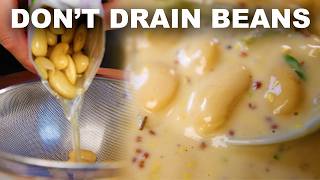

Stop rinsing your canned beans!
30sChallenges a common cooking instruction with a bold claim, sparking curiosity and debate.
▶ Play Clip"The title 'Maybe just eat the bean goo' perfectly matches the video's core argument that the canning liquid is useful and should not always be discarded."
The video challenges the common advice to rinse and drain canned beans, arguing that the canning liquid (bean goo) is often beneficial. It explains the composition of the liquid—starches, pectins, salt, and sometimes additives like EDTA—and demonstrates how using it improves texture and flavor in dishes like a creamy mustard bean stew.
The canning liquid contains natural thickeners (starches, pectins) that can enhance sauces and stews, reducing the need to overcook beans.
Salt strengthens beans and adds flavor; the 'excess sodium' argument is weak because you'll likely add more salt anyway.
EDTA (a chelating agent) is added to prevent discoloration but may affect electrolyte balance if consumed excessively; draining could help if you rely on cheap beans daily.
Drain and rinse if you want separate, clean beans for salads; otherwise, the liquid helps thicken sauces.
Using drained beans requires overcooking to thicken the sauce, leading to broken beans and possible curdling; using the liquid gives a silky, smooth sauce without overcooking.
The goo adds oligosaccharides that may cause gas, but eating more beans regularly helps the gut microbiome adapt.
Bean goo can be used as a vegan egg substitute in baking or whipped into a foam (aquafaba).
The canning liquid from beans is a valuable ingredient that can improve texture, flavor, and even serve as a vegan binder. Unless you need pristine beans for a salad or have specific health concerns, there's no need to rinse and drain—just account for the salt and enjoy the benefits.
What are the two main natural thickeners in bean canning liquid?
Starches and pectins.
0:46
Why might a packer add calcium to the canning water?
To strengthen the bean skins and make them less likely to pop open.
1:12
What is the purpose of EDTA in canned beans?
It bonds with metal ions (like iron and copper) to prevent discoloration.
1:26
What is the most common additive in bean goo besides salt?
Salt is the number one additive; EDTA is also common.
1:58
Why does the speaker argue that the 'excess sodium' argument for draining beans is weak?
Because you will likely add more salt to season the dish anyway, and the salt in the bean goo also seasons other ingredients.
2:11
What potential health issue does the speaker mention regarding sodium from food additives like disodium EDTA?
It may throw off electrolyte balance because there is no chloride (unlike table salt which has both sodium and chloride).
3:33
When is it advisable to drain and rinse beans for textural reasons?
When you want nice, clean, separate beans for a salad.
4:17
What happens to the sauce when you use drained beans in a creamy mustard stew?
You have to overcook the beans to release thickeners, which can break them apart and cause curdling from the wine's acid.
5:32
How does using the bean goo prevent curdling in a sauce with wine and milk?
The starch in the bean goo gets between milk proteins and acids, preventing curdling.
7:48
What is aquafaba, and which beans can it come from?
Aquafaba is the canning liquid used as a vegan egg substitute; it can come from any beans, not just chickpeas.
8:25
Natural thickeners in bean goo
Explains the science behind why the liquid thickens sauces naturally.
0:46Salt argument debunked
Challenges a common dietary concern with practical cooking logic.
2:11Overcooking problem with drained beans
Demonstrates a concrete cooking failure caused by removing the liquid.
5:32Gut adaptation to beans
Offers a practical solution to digestive discomfort from beans.
7:07Aquafaba from any bean
Expands the common knowledge that aquafaba is not limited to chickpeas.
8:25[00:00] This video is sponsored by Squarespace.
[00:05] I see involving canned or cartoned beans
[00:12] the canning liquid. That makes sense for
[00:17] For example, here's a stew that
[00:21] and here's the same stew made without the
[00:26] deliberately extreme example to help me make
[00:31] will vary depending on what exactly you're
[00:35] But first, what exactly is the bean
[00:40] that goo starts off as just plain old water. The
[00:46] natural starches and pectins that come out of
[00:52] they blanche the beans to cook them most of the
[00:57] they fill it up with water and then they finish
[01:01] carton that's part of the sterilizing process.
[01:06] does have some additives in it. If the packer is
[01:12] minerals like calcium back into the water. That'll
[01:18] make them less likely to pop open. The canner
[01:26] ethylene diamine tetra acetic acid, EDTA, EDTA,
[01:35] either coming from the can itself or more likely
[01:40] valuable metal nutrients like iron and copper.
[01:46] over time, in the can or the carton, some of those
[01:52] cause discoloration. The chelating agent bonds
[01:58] But the number one additive in bean goo is usually
[02:06] also strengthens them chemically, and it extends
[02:11] in favor of draining the beans is to get
[02:17] and that makes little sense to me. Unless
[02:21] pressure or something, you're probably going to
[02:26] going to require even more salt than what
[02:30] the beans in the pan with all of their liquid,
[02:37] all of the other stuff that's in the pan, which
[02:42] salt on top of what was already in the bean goo.
[02:49] long as you account for it in your recipe. Though
[02:55] chemical food additives like the EDTA that we
[03:00] reactive. That's why we're putting them in
[03:05] stabilize the chemical for storage and for
[03:09] to a sodium ion to make a stable salt.
[03:14] anion bonded to a sodium cation. It's nice and
[03:21] in water once we add it to the food and we'll
[03:26] we're looking for. The hitch is that there's no
[03:33] right, and you need both in rough balance in
[03:38] sodium in the form of food additives, that could
[03:44] So look at the ingredients on the label. If
[03:48] sodium and chloride. But if all you see is stuff
[03:56] chloride. And I can't imagine it would matter very
[04:02] every single day your entire life, maybe that
[04:06] would be a reason to drain those beans, so that
[04:11] compounds with plain old salt. But this brand only
[04:17] You might want to drain and then rinse for
[04:22] separate beans to drop onto a salad or something
[04:27] as we so often are, that liquid might actually be
[04:34] This is beans ala moutarde, French style creamy
[04:40] I'll chop up a shallot, and then this part isn't
[04:45] of green beans just to make this a more complete
[04:50] in the pan, give the shallots a little head
[04:55] give them a couple minute head start. Maybe add
[05:00] it because it tastes good and then deglaze with
[05:06] For demonstration purposes, I will put
[05:11] Enough milk to almost submerge everything, bring
[05:18] liquid is very thin as you can see. The way we
[05:24] beans until more of their starches and pectins and
[05:32] The problem is these beans already gave up a lot
[05:39] We now have to overcook them to get more
[05:44] starting to break apart more than I would
[05:49] It'll thicken a lot as it cools and our remaining
[05:55] of whole grain mustard. I love how those
[06:00] then I'll finish with just a little cream. You
[06:05] give it pepper and a lot of salt. Remember
[06:10] Here is our final texture. It doesn't look very
[06:17] beans to thicken the sauce. Plus the acid in
[06:23] bit. It tastes fine, but the texture could
[06:28] this time we add the beans with their liquid, or
[06:35] I drain one carton of beans and then I don't drain
[06:40] into a separate container and then you can just
[06:46] on how much thickening it seems like it needs.
[06:51] only need a little milk to bring that liquid
[06:56] thick and that happens much faster because we
[07:01] We don't have to overcook the beans. That
[07:07] in a sauce it is silky, smooth, and delicious.
[07:12] total load of oligosaccharides and other things
[07:18] to digest. So that could be a reason to drain
[07:23] your beans. But my advice for that is just
[07:28] the more your microbiome in your gut adjusts,
[07:33] of beans these days. I have no digestive
[07:37] That'll be thick enough once it cools
[07:42] which also function as thickeners. The starch in
[07:48] and the acids from the wine, thus preventing
[07:54] but remember that we're going to need less
[07:58] Maybe finish with some fresh parsley, and there we
[08:04] slightly less milky because we use less milk, but
[08:11] the balance that you want for the particular dish
[08:15] one package and I don't drain the other one.
[08:20] consider saving it. You can use it to thicken
[08:25] substitute for eggs in baked goods. It serves as
[08:32] replace meringue in something. In that context,
[08:37] can sometimes refer exclusively to the bean goo
[08:43] aquafaba. The point is the bean goo is good.
[08:50] A can of beans has protein and carbs and
[08:56] own thickener. Squarespace is a similar all in
[09:02] and run a website. Everything from a simple
[09:07] Squarespace does the payment processing,
[09:12] domain name for you. They can start you
[09:17] or you can just tell the computer what you
[09:21] and drop to customize for your own needs, and
[09:26] display, which is obviously very important.
[09:32] has tools that can help the new chatbots find
[09:38] My audience can save 10% off a Squarespace
[09:43] Ragusea. Save 10% with my code, Ragusea.
[09:48] canned beans. All things considered, you


⚡ Saved you 0h 09m reading this? Transcribe any YouTube video for free — no signup needed.