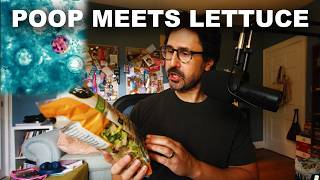

Norovirus vs Cyclospora: Which Is Worse?
45sCompares a familiar threat (norovirus) with a scary new one (cyclospora), making viewers feel informed and less panicked.
▶ Play Clip"Title accurately reflects the video's balanced message: don't panic, but stay informed."
The video discusses the 2026 cyclospora outbreak in the US, comparing it to more common foodborne illnesses like norovirus. It explains the biology of cyclospora, how it spreads, and the political and regulatory context surrounding the outbreak, including delays in food safety rules and government staffing cuts.
Norovirus causes about 10 million US cases yearly and kills ~1,000 Americans, while cyclospora has only 7,000 confirmed cases and zero deaths so far. Norovirus is the more immediate threat.
New pathogens like COVID-19 warrant extra caution because their impact is unknown. COVID-19 turned out to be worse than flu, justifying initial severe measures.
Cyclospora is endemic in tropical regions but new to the US; this summer's outbreak is the largest on record. It's worth taking seriously due to uncertainty.
The outbreak is likely linked to shredded iceberg lettuce from Taylor Farms in central Mexico. The FDA's traceback investigation points to this source despite a false positive test.
Cyclospora cayetanensis is a parasite that spreads via human feces. Its oocysts are hardy, surviving freezing, salt, and cleaners, but are killed by drying or cooking above 158°F (70°C).
Cyclospora oocysts need at least a week in the environment to become infectious, so it doesn't spread person-to-person like norovirus. Contaminated irrigation water is a key vector.
Farm workers with diarrhea may defecate in fields due to lack of toilets, contaminating crops. Urban farming also risks sewage runoff.
The Food Safety Modernization Act of 2011 has stalled due to insufficient staffing and industry resistance. The Trump administration delayed the traceability rule by 2.5 years in 2025.
The second Trump administration cut 25% of CDC staff via DOGE, hampering outbreak response. Funding for FoodNet, a foodborne illness database, was also cut.
The FDA initially reported a positive test on Taylor Farms lettuce but later called it a false positive. The agency maintains that epidemiological data still supports the recall.
Avoid pre-shredded iceberg lettuce from Taylor Farms. If infected, use oral rehydration solution (1L water, 6 tsp sugar, 1/2 tsp salt). Most infections clear on their own.
Public trust in institutions has eroded due to failures during COVID-19. Rebuilding trust requires acknowledging institutional shortcomings and engaging in open debate.
While the cyclospora outbreak is notable, it remains a minor threat compared to norovirus. The real issues are systemic: delayed regulations, underfunded agencies, and eroded public trust, which hinder effective outbreak response.
How many confirmed cyclospora cases were there in the US in 2026?
7,000 confirmed cases.
00:20
What temperature kills cyclospora oocysts?
158°F (70°C).
09:21
How long does cyclospora need to mature in the environment before becoming infectious?
At least a week.
11:42
What is the primary suspected source of the 2026 cyclospora outbreak?
Shredded iceberg lettuce from Taylor Farms in central Mexico.
05:48
What percentage of CDC staff was cut by the second Trump administration?
25%.
22:52
What is the World Health Organization's oral rehydration solution recipe?
1 liter clean water, 6 teaspoons sugar, 1/2 teaspoon salt.
30:30
Why can't cyclospora be cultured in a lab?
It can only reproduce inside human epithelial cells of the gut lining.
24:02
What is the false positive rate of PCR tests for cyclospora?
Less than 1%.
25:21
Norovirus is the bigger threat
Puts cyclospora outbreak in perspective by comparing to much more common norovirus.
00:04Cyclospora is new to the US
Explains why this outbreak warrants attention despite low case numbers.
03:13Cyclospora biology and resilience
Details the parasite's hardy oocysts and why washing doesn't remove them.
08:17Regulatory delays and industry influence
Highlights how political contributions and staffing cuts hamper food safety.
16:38Rebuilding public trust
Argues that institutions must acknowledge failures to regain credibility.
30:59[00:04] definitely one for the books as food born illnesses go, which is why we're going to talk about it. But let's get one thing straight. If you eat something this summer and it sends you to the bathroom with diarrhea for days, the bug
[00:20] responsible is probably going to be norovirus, not cycllospora. In the US, we've got about 7,000 confirmed cases of cycllosporasis so far in 2026. 7,000 confirmed cases. Over
[00:37] in 2026. 7,000 confirmed cases. Over those same months, year to date, we've those same months, year to date, we've probably had 10 million neurovirus cases probably had 10 million neurovirus cases at least. And norovirus is no joke. It
[00:50] kills about a thousand Americans a year. So far, there have been zero US deaths So far, there have been zero US deaths in this cycllospora outbreak. Even if it's under reportported, which it probably is, the cycllospora thing is
[01:05] still a blip compared to our normal baseline levels of foodborne illness. If you ate something bad and you're watching this video in misery on the porcelain throne right now is probably norovirus. And norovirus is nothing new.
[01:22] Pedialyte. Get you some Pedialyte. You'll feel better. Hashtag not an ad. Also, clean your phone. All that said, it is perfectly rational to be extra
[01:34] cautious about new things because you don't know what a new thing is going to do. Just like when the new corona virus showed up in 2019. At first, we did not know if it was going
[01:49] first, we did not know if it was going to be any worse than typical seasonal influenza, which is always really bad. Flu is awful. There's tens of thousands of US influenza deaths every year. Back
[02:02] in 2019, we did not know how COVID was going to stack up to flu because COVID was new. And so for better and for worse, public health authorities all
[02:15] over the world adopted a posture of severe caution. And indeed, in 2020, COVID turned out to be way worse than influenza, killing hundreds of thousands
[02:27] of people in the US alone. We've since gotten that somewhat under control. And flu killed more Americans last year than CO did, but CO still killed tens of thousands of people here. With foodborne illness, norovirus may be
[02:44] the worst, at least for now, but it it is the devil. We know we know how to test for it. We know how to track it, how to treat it. We know how it spreads. We know it peaks in the winter and dips in the summer, though a lot of people
[02:59] still get it in the summer. We know it loves a good cruise ship. Norovirus is the devil. We know cycllospora has really only been a thing in the US since the 2010s.
[03:13] It is endemic in tropical climates where lots of humans live. And so 3 or 4% of humans worldwide are thought to be carrying this parasite in their bowels
[03:26] right now. But cycllospora is a new entry to the US market. And this summer's outbreak is by far the largest on record here. So, it is worth taking seriously because we don't know where this is headed. This
[03:41] outbreak also has a lot to tell us about the current state of our public health systems, about our fresh produce industry and its relationship to industry and its relationship to government, to this government.
[03:54] I will attempt to untangle truth from exaggeration. There is stuff to be legitimately alarmed about here. But if you slept okay last night, you should be able to sleep just as soundly tonight. Perhaps
[04:08] on a mattress from Helix Sleep, sponsor of this video. Helix is USA Today's most of this video. Helix is USA Today's most trusted mattress brand of 2026. They make super premium mattresses, all wrapped up like a delicious Swiss roll
[04:22] and shipped to your home under vacuum seal. Shipped free in the US. It's not an air mattress. You're going to feel the quality in how heavy it is. Lift it with a buddy. I have long since replaced all the mattresses in the house here
[04:36] with Helix mattresses. They make a different one for everybody. The quiz online asks you about you and your bedmates shape and size, the positions you tend to sleep in, the problems that you have, neck pain, sleeping too hot,
[04:51] etc. And then they've got a model for you. On these hot summer nights, I've been loving my comfort adjust cooling pillow from Helix. The material conducts pillow from Helix. The material conducts heat away, and you can zip or unzip the
[05:05] side flaps to make the pillow more or less firm. Your body is not one sizefits-all. Your bedding shouldn't be either. In their Westper Sleep study, 82% of people saw an increase in their deep sleep cycle on a Helix mattress. I
[05:21] don't know what the numbers say about dogs, but the dog also sleeps up there with us almost every night, and she has not complained even once. Get a Helix mattress andor a pillow. Helixleep.com/regusia.
[05:34] You can still get in on their 4th of July sale, 27% off sitewide. Helixleep.com/regusia. Thank you, Helix. Anyway, the unprecedented cycllospora outbreak happening in the United States right
[05:48] now, it's actually probably a few distinct outbreaks happening at the same time, but the biggest one centered in the Midwest, it's probably coming from shredded iceberg lettuce grown in central Mexico for Taylor Farms. This
[06:05] central Mexico for Taylor Farms. This bag is not one of the recalled products, but it is still a manager special at Kroger. can't imagine why. Yes, US health authorities have
[06:17] apologized to Taylor Farms for what they call a false positive test and we will get back to that. But the Taylor Farms Associated operations in Mexico are still the prime suspect in this investigation. According to the latest
[06:32] from the Food and Drug Administration as of this recording, which is Wednesday, of this recording, which is Wednesday, July 22nd, cycllospora is a genus of tiny single-sellled parasites. It's a prozzoa in the same class as
[06:47] toxopplasma, which is one that cat owners are all familiar with because cats pick up toxopplasma from catching infected rodents and then you can pick it up while cleaning the litter box. It also
[06:59] gets on food sometimes. These are obligate intracellular parasites, obligate intracellular parasites, meaning they can only live and reproduce meaning they can only live and reproduce inside an animal cell. These are not
[07:13] worms swimming around the contents of your gut. They live inside the cells of your gut lining, which is one reason why a colon cleanse does nothing to help you
[07:25] here. or at least there is no evidence that it does anything beneficial at all. Taking a bunch of fiber and laxatives or squirting an enema up your butt, I have
[07:37] seen lots of people on the internet saying that everybody should do a colon cleanse to get rid of cycllospora. There is no evidence at all that that would do anything good here. But good luck convincing Aunt Vicki on Facebook.
[07:52] The cycllospora pararasite that gets humans is Cayotenencis named after Cayatano Aerodia University in Peru where it was first taxonomized
[08:05] in the 1990s. Humans are the only known carrier of this particular species. So if you get it, you got it from human pooh.
[08:17] it, you got it from human pooh. Cylo means circle, spora means spore. It spreads in the form of tiny tough thickwalled spherical spores called oasists. If an organism is the death star, its
[08:34] If an organism is the death star, its spore is the plans for the death star spore is the plans for the death star safely enclosed in the escape pod. Or in the case of an oasist, it's a particularly hearty R2 unit. An infected
[08:48] human poops out the oasist and in the environment it sticks to certain surfaces and it can survive the apocalypse. I mean almost. It can survive freezing. It can survive salt. It can survive
[09:05] extreme pH and other chemical hazards posed by household cleaners. It can posed by household cleaners. It can survive in soil, in water, on leaves. Pretty much the only normal things that kill the spore are drying it out,
[09:21] extreme desiccation, or extreme heat, i.e. cooking. The spore or extreme heat, i.e. cooking. The spore starts to die at 158 Fahrenheit, 70 C,
[09:33] which may sound like an awfully high cooking temperature, but you're probably thinking of internal food temperature, not external temperature. This bug is most likely to be on the surface of food. And we generally get the surface
[09:47] of our food up to boiling temperatures at least, even if we simmer it for a long time at a much lower temperature. This is one of many reasons why recipes This is one of many reasons why recipes tend to say bring to a boil, then reduce
[10:00] to a simmer. That minute of full boil at 100 Celsius, 212 Fahrenheit is a good insurance policy against pathogens in foods that you're going to slow simmer. But people rarely cook lettuce at all, hence the
[10:16] current problem. This outbreak is thought to be coming This outbreak is thought to be coming from bagged shredded iceberg lettuce. I'm normally a big fan of bagged salads. They tend to be free of the more common
[10:30] pathogens because it's much easier to wash salad greens thoroughly when they're all chopped up into little bits. When you have like a whole head of lettuce or a whole leak or something, you can only wash the surface. And
[10:43] sometimes there's mud or sand trapped inside the layers. Chop it up into thoroughly wash every single nook and cranny. Perhaps with a weak chlorine solution, which is very common for vegetables, bagged salads in particular,
[10:59] and it's very effective at getting rid of salmonella and other bacteria. Side of salmonella and other bacteria. Side note, I have no idea why people are fine note, I have no idea why people are fine with chlorine rinses for vegetables, but
[11:11] not for meat. Europeans have many good reasons to be wary of US agricultural products, but the fact that a tiny handful of US chicken producers still use chlorine solutions is is not one of them. Anyway,
[11:27] washing is great for lots of things, but it does not help you much with it does not help you much with cycllospora because the spore, the oasis, is uh it's chemically tough and it sticks to the natural waxy cuticle on
[11:42] the surface of plant parts. The good news is when a person poops it out, often explosively, the oicyst is not immediately infectious. This is why cycllospora will probably
[11:56] never be as big a deal as like norovirus. It cannot pass person to person the way norovirus can. When you know somebody gets sick, they have diarrhea, they don't wash their hands thoroughly, then they shake your hand or
[12:12] they roll your burrito and that virus is right there as alive as a virus ever is and able to infect you immediately. That's neurovirus.
[12:25] Cycllospora has to mature out in the environment for at least a week before it can make you sick. So, you're not going to get it from a postbroom handshake. Infected person explosively poops. The
[12:40] oasite sits in the environment and in a warm environment, this happens faster. warm environment, this happens faster. Over a week or two, it sporulates into its infectious form. Then you drink the water where it's hanging out or you eat
[12:56] raw fresh vegetables that have been irrigated by that contaminated water. Even far away from human population centers, it is easy for the water around a farm to get contaminated with human poo.
[13:12] Imagine you're a farm hand. Somebody has packed you on a bus with a bunch of other farm hands and driven you deep into a field in the middle of nowhere and you're out pulling weeds and your bowels become angry.
[13:27] your bowels become angry. What are you going to do? Are you going to ask the boss to drive you 45 minutes back to the farmhouse just you on the bus? Are you going to confess that you have
[13:40] diarrhea? Because if you have diarrhea, that probably means you're literally not allowed to work that day and you're poor enough to be working as a farm hand. So, you really need the money. What are you
[13:55] going to do? You're going to make a beline for the nearest hedro and let her rip. That's what you're going to do. There's laws in the US about having portaotties out in the fields within a/4 mile walk of where
[14:09] people are working, but happens, as they say. And there's even more opportunities for contamination if you're farming near a populated area. Big storm overwhelms the sewer system and there's runoff. Urban
[14:25] farming comes with an elevated risk of sewage runoff, to say nothing of industrial contamination, etc. My friend Sarah Taber made a point on her channel the other day that most traditional cuisines involve cooking the particular
[14:40] vegetables that grow down on the ground where the poop is. Fruits that grow up where the poop is. Fruits that grow up in trees are a different matter. Yes, your hunter gatherer ancestors probably ate all kinds of raw foods
[14:54] right up off the ground. And that's one reason why they died all the time. Cooking is one of the technologies that allowed our species to proliferate and conquer the world because cooking kills germs and in some cases it makes
[15:08] nutrients more available. Anyway, how did human poop get on the lettuce? Again, we currently have zero official confirmed point sources for this
[15:20] particular outbreak in the American Midwest, but it is still the stated position of the US government that the prime suspect is lettuce fields in central Mexico. Lettuce is a cool weather crop. We grow
[15:37] about half of our fresh produce domestically in the US, mostly from California's Central Valley, but most of the rest comes from Mexico because the labor is cheaper, of course, and for climate reasons. It's summer right now.
[15:52] It's too hot to grow lettuce in much of California. Yes, Mexico is closer to the equator and yes, northern Mexico is hot as balls, but the central Mexican plateau where most Mexicans live, that is actually
[16:08] quite cool because the elevation is up so high. And that's why I cannot have an axelottle in my greenhouse in Tennessee. It's too hot for axelottals. They live in the mountains where it's cool, which is why the people live there, too.
[16:23] But it's also dry on the central Mexican plateau. So crops require irrigation. Contaminated irrigation water or wash water is probably what they're looking at as the source for this outbreak. The
[16:38] government is looking at farms that supply Taylor Farms, which calls itself the world's largest salad and fresh cut vegetable processor, headquartered in California, naturally, but with extensive Mexican operations. The
[16:52] founder, Bruce Taylor, is a farm heir who got real rich founding Fresh Express, the salad kit company, which he sold to Chaita, the banana people. He
[17:04] then founded Taylor Farms, which made this particular bagged salad. And they make products sold under lots of other brands, like store brands. Look for a product code on the package that starts with TF for Taylor Foods. Bruce Taylor
[17:21] is big in Republican politics. He's a big booster of Florida Governor Ron DeSantis and his company has been active in lobbying both for and against certain provisions of the Food Safety Modernization Act of 2011.
[17:37] Food safety regulations in the US have historically focused on meat and dairy. bunch of health scares involving hamburgers and the feal bacteria E. coli
[17:50] because as Eric Schloasser famously wrote in his book Fast Food Nation, there's in the meat, but there can also be on the vegetables, particularly ones grown in proximity to animal agriculture. And in
[18:05] proximity to animal agriculture. And in 2006, there was a big E.coli outbreak from spinach traced back to one California farm contaminated with pig and cattle manure. This was one of the first news stories that I ever covered
[18:19] in my first job as a local news reporter in Indiana in 2006. This and similar outbreaks led to a few initiatives to more closely regulate vegetables and leafy greens in particular because leafy greens offer
[18:32] lots of surface area for contamination and we often eat them raw. One such initiative was the Food Safety Modernization Act of 2011 signed by then
[18:44] President Obama but never fully implemented. It wasn't supposed to go into effect all immediately. There was always supposed to be a period of years where civil servants worked with industry to develop specific rules. But
[18:59] that process has stalled out in a number of areas because there aren't enough civil servants to do the work. a problem that has existed under both Republican and Democratic administrations and because the industry has resisted
[19:14] and because the industry has resisted certain things. In 2011, Taylor Farms vice president, Drew McDonald, testified before Congress, saying that his company did not want governmentmandated random testing of their bagged salads. He
[19:28] argued that food safety is better assured early in the production cycle rather than at the end. This is an uncontroversial view as far as I know. He also said that finished product testing quote punishes good companies
[19:44] for their surveillance when a positive is found. I do not have the expertise to evaluate the veracity of that claim, but as a lay person, it definitely makes me go hm.
[19:58] That's like me saying that it's it's unfair to judge my YouTube videos by fact-checking the finished YouTube videos. Yes, the best time to catch an inaccuracy is early in the production process, but the ultimate proof is in
[20:12] the pudding that you eat at the end. Am I right? concerned with making sure that authorities can trace outbreaks back to their source. So it requires everybody to keep certain records in the supply
[20:28] chain about where they got their vegetables and from whom. It also covers cheese, fresh fruits, eggs in shells, and seafood. and seafood. The FDA's new food traceability rule was
[20:42] supposed to take effect in January of this year. It did not. In March of 2025, the Trump administration pushed the deadline back by two and a half years in response to industry lobbying. Also in March of
[20:59] 2025, Taylor Farms made a $1 million contribution to a Trump aligned political action committee. Such contributions are easily searched online at places like opensecs.org. And
[21:15] Taylor and Taylor Farms have given money to Democratic politicians as well, but they've given way more to Republicans. And these are the contributions we know
[21:27] about. If you want to give even more money to If you want to give even more money to President Trump, you can buy billions in crypto from him and no one else would ever know. And I'm not saying Bruce
[21:41] Taylor did that. I'm just saying he could. anyone could and that is completely insane. This is not a tolerable state of affairs.
[21:53] Yes, US politicians in the modern era have always been able to get little bribes here and there, but these are big bribes and big bribes are a bigger bribes and big bribes are a bigger problem than little bribes. A lot of
[22:07] corruption is a lot worse than a little corruption. You will pine for the days when politicians took tiny half bribes and they told little white lies. That was meaningfully less bad than when they
[22:23] take billions in bribes and tell big bald-faced lies with impunity. would have helped track down the source of the current cycllospora outbreak
[22:38] before so many people got sick. And another reason its implementation has been delayed is that there aren't enough civil servants at the relevant agencies to do the work. And that is a bipartisan failure.
[22:52] But the second Trump administration bears particular responsibility. They swooped in with Elon Musk and Doge in early 2025 and they laid off, bought out, or otherwise disposed of a quarter of the workforce at the Centers for
[23:07] Disease Control and Prevention, leaving the agency even less able to respond the agency even less able to respond effectively to outbreaks like this one. Another thing that Doge cut funding for was Foodnet, which is an online database
[23:21] tracking food born illnesses, including cycllosporasis. Much has been reported about this in recent days and it probably is not particularly relevant to the current outbreak. Foodnet is mostly a research
[23:35] tool. It is not used for up tothe-minute surveillance. The government has other databases for that. Rather, it is the staff cuts and the delays in rule implementation that have probably made this situation worse than it needed to
[23:50] be and which will make future situations worse than they need to be. Now, because this particular cycllospora species can only reproduce in human
[24:02] epithelial cells of the gut lining, it is apparently impossible to culture in a is apparently impossible to culture in a lab. When you ingest the spores, you generally don't get sick for like a week or two. And so it's really hard to
[24:16] trace back to any one particular meal that you ate. Infected people shed the spores through diarrhea only intermittently. So one sample from one day might be clean, the next one not. And the symptoms are relatively mild in
[24:34] healthy adults at least. Do you go to the doctor every time you have awful diarrhea? If you don't go, your case is never going to be counted. This and more factors make cycllospora
[24:48] particularly difficult to trace. Administration announced they had finally gotten a positive test on a product, some shredded iceberg lettuce from Taylor Farms. On Sunday, the FDA
[25:04] backtracked, saying that was a false positive, and they apologized to Taylor Farms. A PCR tests like the kind they used, they generally have a false positive rate of less than 1%.
[25:21] Apparently, cycllospora presents some particular challenges for gene-based testing. I am not expert enough to tell you about that. Should we be suspicious about this false positive?
[25:34] executives met with the White House in the FDA last week. Though you would expect them to do that in any administration, this is a big deal for everyone involved. As corrupt as things have recently
[25:49] gotten at the highest levels of US government, it is hard for me to believe that somebody just flipped the results on a test to make a Republican donor happy. If something that egregious had
[26:04] happened, we probably would have seen some public resignations by now. This work still involves many serious dedicated civil servants and we have seen public resignations in other instances in recent months. None here,
[26:20] instances in recent months. None here, not yet. So, if you put a gun to my head and made me guess, even though I am not an epidemiologist or anything like that, my guess would be that the outcome of this test was legitimately
[26:35] scientifically questionable and questioning it was politically convenient. Put those two things together and they announce a false together and they announce a false positive. But to clarify, the FDA
[26:49] positive. But to clarify, the FDA subsequently posted, quote, "This false positive lab sample does not change the basis for FDA's ongoing outbreak investigation or the overwhelming epidemiological data supporting the
[27:04] current voluntary recall by Taylor Farms. FDA's traceback investigation and outbreak data continue to converge on shredded iceberg lettuce from Taylor shredded iceberg lettuce from Taylor Farms locations in central Mexico. End
[27:18] So, what should you do? Be more worried about norovirus. Even in the summer when neurovirus is
[27:30] less prevalent, you're still way more likely to get that than cycllospora. To avoid cycllospora, avoid pre-shredded iceberg lettuce, in those products should have been pulled from storeshelves by now. Go ahead and
[27:45] keep eating at Taco Bell if you want. Some Taylor Farms lettuce used by Taco Bell was implicated early on in this investigation, and Taco Bell has apparently done a a really good job of investigating the matter internally. Big
[27:59] corporations are bad in lots of ways, but they do tend to be better about this kind of stuff than mom and pop operations. Big corporations have the resources to investigate outbreaks and they have huge, very valuable public
[28:14] reputations to protect. So, they are very motivated to fix the problem or hide the problem or both. If you get infected, you may have explosive diarrhea for days
[28:30] and then you might get better and then get even more explosive diarrhea for days. The fact that it comes back is a hallmark of this particular bug. What makes explosive diarrhea different from normal diarrhea? Isn't all diarrhea
[28:47] from normal diarrhea? Isn't all diarrhea explosive? Well, it's kind of like when I advise you to cut your onions with a sharp knife. All knives are sharp, or else they wouldn't be knives. They would just be bars of metal. What I mean is a
[29:01] particularly sharp knife. Explosive diarrhea is particularly explosive. The intestinal lining, which is an adaptation that your body evolved to keep you from absorbing harmful things that you ingest. The swelling closes off
[29:17] biological pathways through which water and nutrients pass from your intestines and into your bloodstream. So water and nutrients build up in the intestine. Bacteria feed on the nutrients producing gas. Pressure builds. Water and gas
[29:34] explode out. Cycllosporasis is apparently particularly bad at doing that to you. Between dehydration and loss of appetite, patients see an up to 10% weight loss. It's not worth it. Don't
[29:49] weight loss. It's not worth it. Don't get it intentionally. antibiotics, though most infections apparently clear on their own after some weeks of unpleasantness that could be dangerous, especially to the young, the
[30:03] old, and the otherwise unwell. When diarrhea really hurts people, it usually does so via dehydration. Drinking water only helps you so much because you aren't just losing water,
[30:16] you're losing the electrolyte minerals that help you to maintain your overall fluid balance. The product Pedialyte is a great electrolyte drink even for adults to recover from a stomach bug. Gatorade is not as good, but it works.
[30:30] Or you can use the World Health Organization's recipe. One liter of clean water, 6 tespoons granulated sugar, 1/2 teaspoon table salt. Dissolve
[30:42] and sip throughout the day. That is your basic oral rehydration solution. The solution to our political problems is more vexing. Corporate greed combined with a collapse in the public's trust in institutions is
[30:59] in the public's trust in institutions is a great recipe for diarrhea. Step one of the solution is to acknowledge that the public's suspicion of institutions is at least partly warranted.
[31:12] Stop wagging your finger at people for being skeptical. Our institutions have earned the skepticism. That doesn't mean that every COVID truth That doesn't mean that every COVID truth or fever dream is correct. Mostly, I
[31:25] or fever dream is correct. Mostly, I think CO sucked. It was a bad thing that happened to us and we blamed the messenger, which is a very normal, very human thing to do. We got mad at the people telling us to stay home because
[31:39] we didn't want to stay home when the real villain was the virus itself. But that is not the whole story. Our institutions failed us in a lot of ways. We did not handle everything as well as we could have. We did not
[31:55] balance the interest of slowing the spread against other interests like spread against other interests like keeping kids in school. Or at least we shut down legitimate debates about how to balance those interests. Shut up.
[32:09] Stop asking questions. Follow the science. science. Well, the science at best tells you what is happening. What we do about it is a political question and too many of us
[32:23] pretended otherwise. Part of the job of public health is to build and maintain public trust and our institutions manifestly failed at that. Yes, bad actors exploited the situation and fanned the flames of suspicion for
[32:39] their own political or entrepreneurial reasons, but there's nothing you can do about that. And they wouldn't have been able to do it so easily if our institutions had been more trustworthy. So stop wagging your finger at people
[32:52] and instead work to earn their trust back, even if their trust was unjustly taken away from you. I have much more to say about that, but not right now. Before we finish, a quick note about
[33:07] wildfires. Much of North America is currently choking on smoke from wildfires, mostly in Canada. More than 5,000 Canadian firefighters are currently deployed. Some of them paid professionals, but many of them are
[33:22] volunteers. people who work normal jobs, people who put themselves in grave danger for their communities and for nothing else. nothing else. My friend and agent Colin West is
[33:34] currently deployed fighting wildfires in British Columbia, and I want to give him a big shout out. I realize that the guy who books my sponsorships might not be super popular around here, but he should be because his work makes my work
[33:48] possible. Also, as people use YouTube more and more like a podcast app, I have been struck by how annoying the YouTube midroll ads are.
[34:00] They seem to interrupt the video every few minutes. And yeah, you can skip them, but I usually have my hands up a chicken or something, so I can't always chicken or something, so I can't always hit skip. Because of Colin, I do one
[34:15] minute long sponsor message in these videos and then I turn off the YouTube mid rolls because the integrated sponsorship makes way more money. And I think it's way less disruptive to the listener. It's a win-win.
[34:30] Be happy for the sponsorships and be grateful to Colin, a guy who makes a great living and gives back to his community as a volunteer firefighter. He middle of like a two-week deployment fighting these wildfires. Thank you for
[34:44] your service, Mr. Colin West. A guy who immigrated to Canada in part because it's easier to immigrate to Canada than to the US. And now look at everything he's doing for his adopted country. He's built a lucrative 21st century business
[35:00] there, and he's putting out fires. Thank you, Colin. Thank you, immigrants. Thank you for listening. Talk to you next time.




⚡ Saved you 0h 35m reading this? Transcribe any YouTube video for free — no signup needed.