
Why I use a whole steak for steak pie
42sShows a unique technique for cutting steak across the fibers, which is educational and visually satisfying.
▶ Play Clip"Title accurately describes the recipe; video delivers exactly what it promises."
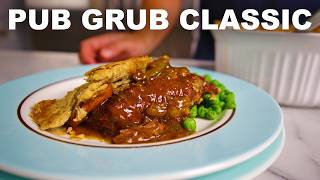
This video demonstrates how to make a classic British steak and ale pie, using a large chuck roast cut into steaks and braised in ale, topped with a flaky tallow crust. The chef emphasizes proper browning, avoiding pan crowding, and using beef tallow for the pastry.
Uses a large chuck roast (3 lb / 1.5 kg), cut across the fibers into wide, thin pieces to create steaks. Pulls meat apart at natural seams, trimming intermuscular fat.
Starts with fat chunks in a cold pot with a little water, slowly rendering fat. Adds water if browning occurs too early.
Seasons steaks heavily with salt and pepper. Searing in hot fat, avoiding crowding the pan to ensure proper browning.
After browning meat, adds onions to the pan, using their moisture to deglaze. Adds tomato paste for umami, then deglazes with ale.
Recommends malty, roasty beers; avoids bitter IPAs as hop bitterness concentrates during cooking.
For 200g flour, uses 100-130g cold beef tallow. Cuts fat into flour until mealy, then adds minimal water/beer to form dough. Chills before rolling.
Slices carrots and celery at an angle. Sautés in hot tallow until half-cooked and browned, then sets aside.
Steaks braised for 3.5 hours until tender but not falling apart. Layers vegetables and meat in pie dish, thickens sauce with cornstarch slurry, adds celery leaves.
Rolls dough carefully to avoid cracking, places over pie, brushes with egg. Bakes at 400°F (200°C) for 30 minutes until golden.
Allows pie to rest until just warm to prevent sauce from running. Serves with peas and extra sauce.
The steak and ale pie is a hearty dish with tender, pink-centered steak and a rich, malty sauce, all encased in a flaky tallow crust. Perfect for celebrating or commiserating during football season.
What cut of beef is used for the steak and ale pie?
A large chuck roast (shoulder meat).
00:16
Why should you avoid crowding the pan when searing steaks?
Because the water coming out of the meat can interfere with browning.
01:56
What type of beer is recommended for the ale in this recipe?
Malty, roasty beers; avoid bitter IPAs.
03:32
What is the ratio of fat to flour for the tallow pastry?
1/2 to 1/3 of the flour's weight in fat.
04:28
How long should the steaks braise before assembling the pie?
3.5 hours.
07:04
What is used to thicken the sauce for the pie?
A cornstarch slurry.
07:32
At what temperature and for how long is the pie baked?
400°F (200°C) for about 30 minutes.
09:11
Choosing chuck roast
Explains why a chuck roast cut across the fibers works as steak for pie.
00:16Avoiding pan crowding
Key tip for achieving proper browning on meat.
01:56Ale selection advice
Warns against bitter IPAs because hop bitterness concentrates during cooking.
03:32Tallow pastry ratio
Provides precise fat-to-flour ratio for flaky pastry.
04:28Thickening sauce with cornstarch
Demonstrates how to avoid lumps when adding cornstarch slurry.
07:32[00:02] sounds like, a hearty British classic, often made with little chunks of stew meat, but with steak in the name, I like to have a large steak of beef that I can cut up on my plate. And to get that, you
[00:16] could use many different things. I'm using a large chuck roast, which is using a large chuck roast, which is shoulder meat, 3 lb, kilo and a half. If technically a steak. You see the meat fibers running up and down there. This
[00:30] has been cut across the fibers into a wide, relatively thin piece, aka a steak. I want to break it into a few steaks for serving, so I'll just go ahead and pull the meat apart at the seams. A big shoulder steak has pieces
[00:44] of many different muscles, all separated by fat and connective tissue. You should only need the knife here and there to separate the muscles, and once I have, I'll trim out some of that intermuscular fat. Intramuscular fat, aka marbling,
[01:00] crucial. It flavors and moistens the meat. These concentrated hunks of fat from between the muscles just melts over the cooking, and they contribute an excess of grease to the sauce, so out they come. There is my steaks. Maybe
[01:15] I'll cut that big one in half. Yeah, one or two of those per person, you got at least four portions worth here. I'll need some fat to brown them in, and we already have these chunks, so in a cold pot they go with a little water. Turn
[01:29] the heat on moderate, and just slowly render some fat out of those chunks. If things start browning before much fat has come out, add more water. It'll rapidly evaporate. There we go. That is plenty of fat. Plus, we've already got
[01:43] some brown flavor going. Take out those chunks and discard. Season the steaks really heavily, lots of pepper and salt. These are thick pieces. I always just leave extra seasoning on the board that I can mop up with the other sides. That
[01:56] way I only have to wash my hands once. And in these go to sear in that hot fat. Actually, I'm going to take that one out. I'm worried about crowding the pan, which is when the water coming out of the meat is so great that it interferes
[02:11] with the browning process. You can't overwhelm the pan with more moisture than it can readily evaporate. I've got good color on the first side there, so And the meat is already shrinking, so I can probably fit that piece back in
[02:25] there. Now we can try to brown the rest of these on their sides a little bit, which then opens up room for these smaller pieces that'll take less time to cook anyway, so it all worked out. Real quick, I'll peel and slice this onion.
[02:38] because these pieces are just going to melt by the end. Move the meat around, try to get as much color on all the sides as I reasonably can without pan burn, which would ruin the sauce.
[02:51] could take the meat out to make room, but I'm lazy. I'm just going to pile it up on one side, drop in my onions, and keep them moving as I get some color on them. Use the water that comes out of them to scrape off the bottom of the pan
[03:06] before it burns. Maybe push the onions under the meat a little bit. They don't have to be all the way soft, just get them a head start. Small squeeze of tomato paste really brings a lot of umami and sweetness without making it
[03:18] taste too tomatoey. Stir that in and let it brown for just a minute, and before it burns, deglaze with the ale. Any ale or other beer would work. This one is really good for cooking, I find. It's barrel aged, so
[03:32] it's got some like vanilla sweetness from the wood. Really malty, roasty beers work well. The only thing I don't like is a bitter beer, like an IPA. The bitter hops flavor doesn't break down when you cook it. It actually
[03:45] concentrates, so I don't like that. We can top that off with some beef broth or some such, and there we got it. Bring to a boil, reduce to a simmer, cover and braise until soft, which will be a few hours. Here it is after 1 hour. I'll
[03:59] flip the steaks around. They feel very chewy, which they would be if you ate them now. Keep going. I like to put fresh herbs inside savory pie crust. It looks pretty, it tastes nice. Chop up these sage leaves nice and fine. Big
[04:14] pieces might create fault lines in the pastry. Normally I would eyeball this, but fine, I'm going to use a scale. About 200 g of flour, that's a cup and a half. For that much I'll want half a teaspoon of kosher salt. And for a short
[04:28] crust pastry you want 1/2 to 1/3 of the flour's weight in fat. You could use butter, but I'm going to make this extra beefy with beef tallow from Kettle & Fire, sponsor of this video. Your grandmother probably used tallow to make
[04:43] pie crusts, even sweet ones, because its particular composition makes pastries incredibly flaky and tender. You'll see in a minute. What is tallow? It's what we made before, beef fat melted down with the solids removed. That's it, the
[04:57] only ingredient in this bottle. Kettle & Fire tallow is from grass-fed, grass-finished cattle, which gives it this delicious, strong, beefy flavor. All those aromatic short-chain fatty acids produced by the rumination of
[05:12] grass. It is great for baking and for high-heat cooking. You can get it really hot before it breaks down, which means you can get great color on almost vegetables that we're going to do in just a minute. It's a great all-purpose
[05:26] fat from the same people who make my go-to beef broth. They know what to do with quality cow scraps. Try Kettle & Fire beef tallow today and get 20% off your order when you use my code Adam 20 and my link in the description,
[05:40] and my link in the description, kettleandfire.com/adam20. Thank you, Kettle & Fire. So, for 200 g of flour, I'll need 100 to 130 g of fat, cold from the fridge ideally. I'll just cut that into the flour until I have a
[05:55] mealy texture, like that. Bring this into a dough using the minimal amount of water or beer. That is a very minimal amount. The less water you use and the less you work this, the more crumbly and tender the pastry will be. But, it will
[06:11] be more delicate and harder to roll out. I'mma live dangerously today and call this done, but you got to wrap it up and let the flour particles hydrate in the fridge before it's going to roll out smooth. Half an hour at least, I'd say.
[06:25] Do our veg while we're waiting. Four or five carrots, same with the celery. Slice those up and do it at an angle, it looks extra pretty. I'll save those celery leaves for later. Slice these up at the same angle, done. You could
[06:38] totally just drop these in with the steaks for the last 20 minutes of simmering, but today I'm going to go for a roasty, browned flavor and sauté these in some really hot tallow. Toss, and then just let them sit on one side for
[06:52] serious browning on the pieces, like that. But, I want to stop before these are tender. They feel half-cooked and that is perfect. They're going to finish in the pie. Set those aside for now. Steaks
[07:04] have been braising for 3 and 1/2 hours. They're not falling apart yet, but I can push a knife through them with minimal resistance. These are very tender. And if I want them to stay whole, I need to stop and delicately remove them to my 2
[07:17] and 1/2 quart pie dish. Actually, this is going to be a tight fit, so let me put some vegetables in first, then the meat. Nice, distinct steaks all in one smooth layer. Rest of the vegetables on top. I think we've got more liquid than
[07:32] jack up the heat and boil this down by maybe a third. Concentrate those flavors, like that. To thicken, I'm just going to use a cornstarch slurry. Start with a spoonful. You can always get more. Disperse those grains in some cold
[07:47] water or that beer. Just get it smooth and then it won't clump up as you mix it into the hot sauce. But you do need to stir aggressively. Otherwise, you're Especially when the liquid is this hot. It's safer to do this at a simmer.
[08:01] I like the sauce for a pie to be really thick. I don't want it running right out of the pie and onto the plate. This will thicken even more as it cools. So, this counts as really thick. Taste it. It's plenty salty enough. I'll just do a lot
[08:14] more fresh pepper and maybe brighten it with a tiny splash of vinegar. Last thing is I'll chop up these celery leaves that we saved. Very flavorful fresh herb. Drop those into the sauce at the last minute. Pour the sauce into the
[08:28] pie dish. It'll percolate through all those solids in the oven. Trust me. Finally, we can roll out our pie crust. A little flour. Go slow or it'll crack for sure. Roll a little and turn. Roll a little and turn. The turning keeps it
[08:43] from sticking to the board and it helps you roll everything more evenly. Wide enough to cover the pie? Yep. This is going to be an extremely tender pie tear when I put it on and there it totally tore. But oh well. You generally
[08:57] need a hole to vent steam anyway. Brush with egg if you want it to be shiny. If you want your pastry to look prettier, use more water and or knead it some more to get it more elastic. But this is going to taste the best. In the oven at
[09:11] going to taste the best. In the oven at 400° 200° C, bake for like a half hour or until the pastry looks cooked. That looks cooked. If I can just barely hold the dish with my hands, that's a good indication that I've let it rest long
[09:24] enough to serve. If it's too hot, the sauce will run everywhere. Feel around for one of those big chunks of steak and carefully dig down underneath it to keep it whole. Plop that on a plate with some extra sauce and some peas on the side
[09:38] and there, that is a steak and ale pie. A legit steak and it'll still be a little pink on the inside if you simmer it gently. The multi-sweetness from that ale really does make an awesome sauce base. If you need to celebrate or mourn
[09:54] England's victory or loss in the World Cup, neither of which have quite happened as of this recording, well, try steak and ale pie, fueling football steak and ale pie, fueling football hooliganism for generations.
⚡ Saved you 0h 10m reading this? Transcribe any YouTube video for free — no signup needed.