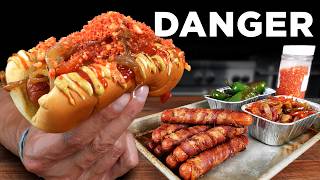

LA's Most Dangerous Hot Dog
45sThe vivid description of a late-night, illegal hot dog cart creates immediate curiosity and a sense of forbidden food culture.
▶ Play Clip"The video fully delivers on recreating the iconic LA hot dog, including the ingredients, technique, and local lore, as promised in the title."
The video documents the recreation of LA's famous late-night 'danger dog'—a bacon-wrapped hot dog served from street carts. The creator explains the origin, the cooking technique, and the key components, including onions, peppers, jalapeños, and a signature Flaming Hot Cheetos topping.
Introduced as LA's iconic late-night street food, originally from a push cart with a bacon-wrapped hot dog, onions, peppers, and jalapeños, cooked on a sterno.
Uses Sabrett hot dogs (New York style) and thin-cut bacon to ensure even rendering. Bacon is wrapped around the hot dog and refrigerated to firm up.
Refers to the 'danger zone' in food service (40°F–140°F). Historically questionable, but now recognized as a legitimate street food.
Onions cut orbitally (along the fibers) for a tender but textured result. Red bell peppers sliced into strips.
Flaming Hot Cheetos are processed into a dust and used as a signature topping, dispensed from a retro-fitted container.
Uses a carbon steel griddle (Made In brand) with a hot spot to mimic the sheet tray's dimple. Bacon-wrapped dogs are placed seam-side down and pressed to seal.
After the dogs, jalapeños, onions, and peppers are cooked in the bacon fat. Cherry peppers are added for acidity.
Buns are lightly warmed. Dogs are topped with mayonnaise, ketchup, mustard, sriracha, Flaming Hot Cheetos dust, cooked onions/peppers, and jalapeños. Served with a signature sauce drizzle.
The LA Danger Dog is a hearty, flavorful street food experience that can be recreated at home with proper technique. The key is slow rendering of bacon and cooking vegetables in the rendered fat for maximum flavor.
What is the 'danger zone' in food service?
Below 40°F or above 140°F; the temperature range where bacteria grow most rapidly.
01:44
Why is thin-cut bacon preferred for bacon-wrapped hot dogs?
Thicker bacon would not render at the same time as the hot dog cooks, leading to uneven cooking.
01:18
What is the signature topping that Martinez uses on his danger dogs?
Flaming Hot Cheetos dust.
03:51
How does cutting onion orbitally affect its texture after cooking?
It cuts fewer cell walls, so the onion remains tender with a bit more texture compared to cutting across the fibers.
02:46
Why is a press used on the bacon-wrapped hot dogs during initial cooking?
To keep the bacon sealed and secured to the hot dog so it doesn't unravel while rendering.
06:41
Origin of LA Danger Dog
Establishes the cultural context and iconic status of the dish in LA street food.
Danger Zone Explained
Provides a food safety principle relevant to the dish's name and preparation.
01:44Onion Cutting Technique
Offers a practical cooking technique that affects texture, useful for home cooks.
02:46Flaming Hot Cheetos Dust
A creative, signature ingredient that adds a unique crunch and heat.
03:51Cooking Vegetables in Bacon Fat
Highlights flavor extraction by using rendered fat to cook secondary ingredients.
08:12[00:00] I will never forget the moment I was
[00:01] introduced to LA's most dangerous hot
[00:04] dog. Let me paint you a picture. You're
[00:06] in LA, it's 2:00 a.m. You had a few,
[00:09] three, four, five martinis, and the bars
[00:12] are closing, and nothing is open. As
[00:14] you're leaving, a crowd starts forming
[00:16] around a Mexican lady equipped with the
[00:18] most interesting and questionable
[00:20] cooking rig you've ever seen. A small
[00:23] pushcart topped with a sheet tray filled
[00:26] to the brim with bacon-wrapped hot dogs,
[00:28] onions, and peppers, jalapenos,
[00:30] all powered by one single heat source, a
[00:33] Sterno. And while there are some
[00:35] questionable practices associated
[00:37] historically with the [music] LA danger
[00:39] dog, it is the iconic, undisputed
[00:42] late-night food of LA. And while there
[00:44] are operations all over the city, there
[00:46] is one guy that I am particularly
[00:49] obsessed with.
[00:51] Today, I take inspiration from him.
[00:53] >> You are not him. You are not him.
[00:55] >> This is the LA danger dog, and I assure
[00:58] you it's safer than you think.
[01:01] Now, the basis for our recipe is hot
[01:04] dogs and bacon [music] to make our
[01:06] bacon-wrapped hot dogs. Now, I'm a New
[01:09] Yorker, we're going with Sabrett. This
[01:11] is the undisputed New York hot dog, in
[01:13] my opinion. It's the one found on every
[01:15] cart on every corner in New York.
[01:17] Probably not what they use, but the hot
[01:19] dog itself doesn't really matter. I'm
[01:21] just going to get them out of their
[01:22] package and dry them a little bit. For
[01:24] the bacon, we want to lean on the
[01:26] thinner side. Otherwise, too thick,
[01:29] you're not going to re- render that
[01:30] bacon out the same time of the hot dog
[01:32] cooking. And so, what we're going to do
[01:34] is we're just going to start like this.
[01:35] I'm going to go ahead and I'm going to
[01:37] wrap that bacon around the hot dog. Now,
[01:40] why the name danger? If you know
[01:42] anything about food service, or if
[01:43] you've ever worked in food service, is
[01:45] that when you work with food, you must
[01:48] keep that food either below 40° or above
[01:51] 140°.
[01:53] Anything in between, referred to as the
[01:55] danger zone. And while there was a time
[01:57] when this was highly suspect, this is
[01:59] now actually been legitimized and
[02:01] recognized as a legitimate food option
[02:04] on the streets. And the original
[02:06] Martinez is one of the most popular. But
[02:08] I don't know what it is about this guy.
[02:12] >> [screaming]
[02:13] >> He's kind of a vibe.
[02:17] And I'm a sucker for the theatrics, and
[02:20] this guy knows how to bring the
[02:21] theatrics.
[02:25] This is going to go into the fridge,
[02:27] where it's below 40°, we're going to
[02:29] allow that bacon to kind of firm up and
[02:30] wrap tightly around those hot dogs. Next
[02:33] up, onions and peppers. For the onion,
[02:35] we're just going to take the top, take
[02:37] the bottom off, cut it in half, get
[02:39] those skins off. Now to cut this onion,
[02:42] you can cut it two ways. Orbitally,
[02:43] which is cutting along the lines that
[02:46] run across the surface, or you can cut
[02:48] it across. This way, it's going to cut
[02:52] more of the fibers of the onion, so this
[02:54] will break down more tender, more
[02:56] buttery after cooking. If we cut along
[03:00] the sides, we got less cells cut through
[03:02] in the onion,
[03:03] >> [music]
[03:03] >> so while it'll cook down and soften,
[03:05] it's going to still have a little bit
[03:06] more texture. I want a little texture,
[03:08] so I'm going to cut orbitally along
[03:10] those lines. Not paper thin, but we want
[03:13] them on the thinner side. Make our way
[03:15] across until we no longer have stability
[03:19] in the onion, and then we're just going
[03:20] to push it over, do the same thing.
[03:25] Next up, we've got some red bell
[03:26] peppers. We're just going to slice the
[03:28] cheeks around the pepper, not
[03:30] lengthwise. We're going to turn [music]
[03:31] it,
[03:32] and we're going to cut strips.
[03:38] >> [music]
[03:38] >> Our veg is ready. The last thing to
[03:40] prep,
[03:42] flaming hot Cheetos, bro. This is
[03:44] Martinez's sort of signature move. And
[03:46] while I'm not a flaming hot Cheeto guy
[03:48] myself, there's a time and a place for
[03:50] everything. Bag of flaming Hot Cheetos
[03:52] into a food processor.
[03:54] We're just going to process it into like
[03:56] a dust.
[03:58] Just going to get it in here so I can
[04:00] transfer it into my retrofitted
[04:02] dispenser. Now, I'm not saying this to
[04:05] brag, I have made ravioli dough out of
[04:08] Flaming Hot Cheetos. So, they are while
[04:10] a versatile cooking tool, you don't you
[04:13] don't need it every day. Then we've got
[04:15] our jalapenos, which we're going to just
[04:17] stir up with our veg. We've got our
[04:18] sauces. We're going to take some
[04:21] creative liberties here. We've got our
[04:22] regular ketchup, mayonnaise, mustard. I
[04:25] love Sriracha on a hot dog. So, I'm
[04:27] going to add a little bit of that. Also
[04:29] going to with our veg going to add some
[04:30] cherry peppers. And then of course, the
[04:33] sturdiest bun for something like this in
[04:35] my opinion that I can find, Martin's hot
[04:37] dog rolls. Now, you know I like to
[04:39] recreate things true to form,
[04:41] authentically. And like I said, we're
[04:43] not setting up a pushcart with a sheet
[04:45] tray, but we're going to try and make
[04:46] this very much in the spirit of the
[04:48] Martinez LA dog. Now, while we will not
[04:51] be using a sheet tray to cook these, I
[04:54] am going to need a flat top style
[04:57] griddle to cook our danger dogs. So, I'm
[04:59] going to need our carbon steel griddle
[05:02] and the press from our sponsor today,
[05:04] Made It. And by the look of it, you
[05:05] could tell it's something I use all the
[05:06] time. It sits right on my stove. I
[05:09] flaunted it. The Made In griddle brings
[05:11] restaurant quality cooking right to your
[05:12] home. It's heat safe up to 1,200° so it
[05:15] can be used outdoors on a grill, over an
[05:18] open flame, or indoors on a gas,
[05:20] electric, or induction cooktop. The
[05:22] griddle's pre-seasoned and naturally
[05:24] nonstick, ready to use right out of the
[05:26] box without any chemicals or coatings.
[05:29] And just like cast iron, as you use and
[05:31] season your carbon steel griddle, it'll
[05:33] continue to develop a naturally nonstick
[05:36] surface. And one of the reasons I love
[05:38] it so much is because it covers two
[05:40] burners, it maximizes the cooking space,
[05:43] so I can cook large batches of things
[05:45] without worrying about overcrowding the
[05:47] pan. It really is a great thing to have
[05:49] at home. If you want to pick yourself up
[05:50] one and save on all of the amazing
[05:53] products Made In has to offer, head on
[05:55] down to the link in my description. Now
[05:57] it's time to make LA danger dogs. Now as
[05:59] far as setup goes, if you pay close
[06:02] attention to the actual sheet tray
[06:04] cooking surface, you'll notice a warped
[06:07] dimple at the center where the heat
[06:09] source sits. That's the hot spot and
[06:11] that's where all the fat pools and where
[06:13] everything cooks. With our griddle,
[06:15] we're going to do similar thing. I'm
[06:17] going to have the hot spot be here and
[06:19] turn the front burner on. The back's
[06:21] going to stay warm and I can push
[06:23] everything off to the back and just cook
[06:25] everything sort of right here. While
[06:27] that's slowly heating up, so we can
[06:30] render our bacon nicely, going to place
[06:32] seam side down. Keep that bacon nice and
[06:34] secured right on the griddle.
[06:38] >> [music]
[06:39] >> Then I'm going to place my press on them
[06:40] just to make sure that we keep that
[06:42] bacon nice and sealed and secured to the
[06:45] hot dogs. We're just going to cook these
[06:47] slowly allowing the bacon fat to render.
[06:50] You don't want to cook them too fast,
[06:52] too hard. [music] If it was just hot
[06:53] dogs, it'd be different, but now we're
[06:55] trying to render that fat not only to
[06:57] get the bacon crispy around the hot dog,
[07:01] but to give us a cooking fat to [music]
[07:03] cook the rest of our vegetables with.
[07:05] After about 5 or 6 minutes, once you can
[07:07] tell starting to brown on that first
[07:11] side, but the bacon still holding
[07:12] together, you can rotate them.
[07:14] >> [music]
[07:16] >> And the trick that I found to prevent it
[07:18] from unraveling around the hot dog is
[07:20] not too hot of a temperature to start.
[07:25] Once they start browning and we get
[07:27] close, we're really just turning them
[07:29] and ensuring there is no unrendered fat
[07:31] [music] in the bacon.
[07:34] That's starting to look like what you
[07:36] want to see. Golden brown all over the
[07:38] surface.
[07:42] And you see how the bacon has completely
[07:44] browned. There's no visible white fat
[07:47] present any longer. You've just got
[07:49] crisp bacon wrapping around hot dog. As
[07:52] they sort of finish, we can transfer
[07:54] them back to the holding position.
[07:57] We can get our jalapenos on and you'll
[08:00] notice we have all of this bacon fat and
[08:02] that's what why we cook this first. We
[08:05] want that bacon fat for our vegetables.
[08:07] And you see the jalapenos start
[08:09] blistering. Let's just keep rotating
[08:11] them and I think our dogs are just about
[08:13] done.
[08:14] Now, where we cooked our hot dogs, in
[08:16] with the onions. [music]
[08:18] And now we're cooking like Martinez.
[08:21] Love it. All the bacon fat, all the
[08:24] little bacon bits will be picked up by
[08:27] the moisture of the onions.
[08:29] >> [music]
[08:32] >> After a minute or two, when we've
[08:34] started to get a little bit of color and
[08:36] those onions softening,
[08:38] then we go on with our peppers.
[08:41] Salt as well. Now we're just looking to
[08:43] get a little color, a little char,
[08:44] soften all the vegetables
[08:46] >> [music]
[08:46] >> and we're almost there. Once our
[08:49] jalapenos are roasted, we can kind of
[08:51] keep them warm in the back. We got a
[08:52] little aluminum foil tin here. Now we
[08:55] can start to combine it all.
[08:57] >> [music]
[08:59] >> Finally, in with our cherry peppers.
[09:02] >> [music]
[09:03] >> All those vegetables, the acidity of the
[09:05] cherry peppers, everything cooking in
[09:08] that bacon fat has such an incredible
[09:10] aroma.
[09:12] Once our onions are cooked, we can
[09:13] transfer them to our little tray, keep
[09:16] them warm and then go over to our
[09:19] serving station.
[09:22] Now we're ready for service. I got my
[09:24] real cam. [music] Two with everything?
[09:26] You got it. Just let the buns touch.
[09:29] Give it a gentle warm, barely any heat.
[09:34] Mayonnaise, ketchup, mustard, a little
[09:38] Sriracha. Flaming hot Cheetos, bro?
[09:41] Cebollitas.
[09:44] Jalapeno.
[09:45] There you have an LA danger dog.
[09:49] But actually, this is how I prefer to
[09:51] serve it.
[09:52] >> [music]
[09:52] >> The Martinez sauce drizzle is much
[09:54] harder than it looks. I don't even know
[09:56] how he does it. So, this is how we're
[09:57] going to do it.
[09:59] >> [music]
[10:01] >> Sick, bro.
[10:04] There's so much good stuff going on in
[10:05] here. That's a complete meal. It tastes
[10:08] as good as it looks. And if you want to
[10:09] throw together an LA dog set up at your
[10:12] house, recipe's going to be down in the
[10:14] description. That's all that I have
[10:16] today. I'll see you next time. Until
[10:17] then, take care of yourself, stay safe,
[10:20] and go feed yourself.
⚡ Saved you 0h 10m reading this? Transcribe any YouTube video for free — no signup needed.