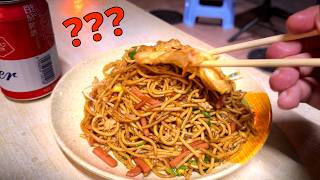

Secret weapon for perfect street noodles
45sReveals a little-known trick (box fan) that makes home cooks feel like they can replicate street food effortlessly.
▶ Play Clip"Delivers exactly what the title promises: a full guide to street-style fried noodles with practical wok and skillet methods."
This video teaches you how to make authentic Chinese street-style fried noodles at home, focusing on the key technique of preparing 'youmian' (pre-cooked noodles) using a box fan to dry and oil them. It covers both wok and skillet methods, including a detailed breakdown of ingredients and seasonings for that signature street food flavor.
You don't need a wok, but a box fan is essential for making youmian. It helps cool and dry the boiled noodles while coating them with oil, preventing sticking and giving them the right texture for stir-frying.
Youmian are pre-cooked noodles that are easy to stir-fry, never stick, and absorb flavor well. You can use fresh alkaline noodles, dried noodles, Japanese ramen, or even angel hair pasta.
Boil noodles al dente, drain, toss with 2 tbsp oil, then fan with a box fan while jiggling with chopsticks to release steam. Cool for about 5 minutes. These can be refrigerated for up to 8 days for meal prep.
The seasoning mix includes 1/8 tsp each of salt, MSG, five spice powder, chicken bouillon powder, and cumin powder. The seasoning sauce is 1 tbsp light soy, 1/2 tbsp dark soy, and 1/2 tbsp oyster sauce.
Heat wok, longyau (swirl oil), then add noodles. Fry on one side for 1 minute to brown, flip, add ham, aromatics (garlic, chili), vegetables, then swirl in sauce. Fry 2 more minutes.
Use a non-stick skillet over high heat. Mix half the dark soy with noodles beforehand. Add oil to cold pan, then immediately add noodles. Fry 1 minute, flip, 30 seconds, then add ingredients. Remove from heat to add seasoning to avoid burning.
Non-stick pans degrade at high heat, so keep food in pan to stay safe. Use a temp gun to monitor temperature, or reduce heat slightly. Avoid heating empty pan.
With the youmian technique and either a wok or skillet, you can replicate authentic Chinese street-style fried noodles at home. The key is proper noodle preparation and using the right seasoning blend.
What is 'youmian'?
Pre-cooked noodles that are commonly used for Chinese street-style fried noodles. They are already cooked, fry nicely, don't stick, and absorb flavor well.
00:33
What is the 'secret weapon' for making youmian at home?
A box fan. It is used to cool and dry the boiled noodles while they are tossed with oil.
How long should you fan the noodles after boiling and oiling?
About 5 minutes, until they are cool.
01:36
What are the ingredients in the dry seasoning mix?
1/8 tsp each of salt, MSG, five spice powder, chicken bouillon powder, and cumin powder.
02:54
What is the seasoning sauce composed of?
1 tbsp light soy sauce, 1/2 tbsp dark soy sauce, and 1/2 tbsp oyster sauce.
03:08
When using a non-stick skillet, what should you avoid doing?
Heating the pan empty, as non-stick coatings can degrade at high temperatures and can go from safe to damaged very quickly.
06:23
What is a tip to make stir-frying easier in a skillet?
Mix half of the dark soy sauce with the noodles beforehand to pre-coat them.
05:51
Box Fan as Secret Weapon
Introduces a surprising but effective tool for achieving the right noodle texture at home.
Youmian Preparation Method
Step-by-step process to make pre-cooked noodles from any noodle type, enabling meal prep and authentic texture.
01:10Street Food Seasoning Blend
Reveals the exact combination of spices (including MSG and cumin) that gives Chinese street noodles their signature flavor.
02:54Skillet Dark Soy Pre-coating
A clever adaptation from Thai cooking to improve flavor distribution when using a skillet instead of a wok.
05:51[00:00] you actually don’t need a wok. But you’ll need this, secret weapon! (it’s a fan, a box fan). Today we’ll be showing you the technique of making ‘youmian’. This is the pre-cooked noodles
[00:15] that’s the mainstay for street style fried noodles everywhere from Chengdu to Shenzhen. And that’s because this noodles they make stir frying noodles so easy and quick. They’re already cooked to begin with, they fry so nicely, they never stick,
[00:33] they love to take on flavor, so that stir fried noodle can come together in no time. And you can make them with literally any noodle you want. While in China what you’d usually see
[00:45] is this kind of fresh alkaline noodle… you can actually just use dried. Or you could use Japanese style ramen noodles like what we opted for today, or you could even try
[00:57] something like angel hair pasta – that actually works very well as well. Just simply boil your noodles until they’re al dente, then strain.
[01:10] tray and oil them: drizzle in a couple tbsps oil, coat it evenly, and place that in front of our secret weapon box fan – or you can also use a hand fan or a magazine if you’re skillful.
[01:24] As you’re oiling and fanning the noodles, jiggle them with a pair of chopsticks in front of the fan to let the steam escape, or use your hand if chopstick is a bit hard to control.
[01:36] Just keep it moving, after it cools down, about 5 minutes of doing this, set it aside, and these youmian are ready to be used. Now my suggestion is to make a larger batch here. Because these noodles,
[01:49] they keep really well in the fridge – we’ve gone up to eight days, so this can be great for meal prep, for a couple meals throughout the week. Or, if you have a good Chinese supermarket around you,
[02:02] sometimes you will be able to find this kind of noodles, on the package the characters are called “油面”, and it seems like in English it’s called ‘pre-cooked noodles’. Either way, once we have this ready, we can chow our mian.
[02:16] So you can really add anything you want into this fried noodle. This can be a proper one person meal, but for your add ins, you don’t want to push it over the weight of your noodles.
[02:28] So today in our recipe, we’re using the following add-ins: ham, onion, carrot, and baby bok choy, with everything cut into slivers to fit the shape of our noodle.
[02:40] Then besides those, because we’re aiming for a Chinese street food style fried noodle, we’re going to need a Chinese street food style seasonings. So… for the seasoning mix we’ll have 1/8 tsp each of salt, MSG, and five spice powder…
[02:54] Then, for that street food flavor, we can’t miss that 1/8 tsp each of chicken bouillon powder and the very important, cumin powder. And together with that we’ll also have a seasoning sauce – here we
[03:08] have 1 tbsp light soy sauce, 1/2 tbsp dark soy, and 1/2 tbsp oyster sauce… mix well and keep those on the side until you’re ready to fry.
[03:20] So… wok up first, and don’t worry, we’ll show you how to switch to a skillet in just a second. But if using the wok, as always, first, longyau. Get your wok piping hot, shut off the heat, add one tbsp of oil, give it a quick swirl, then over a high flame add in our noodles.
[03:38] Spread our noodles out, move it around, and let it fry on one side for about 1 minute to brown a bit… then flip, quickly brown the other side for another minute. Now add in the ham, quick mix, then in with the aromatics – here we have two big cloves
[03:55] of minced garlic, and one spicy fresh chili. Give it another mix, then add in all of our vegetables. Mix well with your spatula and chopstick… or a tong if you prefer.
[04:08] swirl the sauce onto the noodle so that it doesn’t burn on the side of your very hot wok. Now fry everything together for about another two minutes or so, then heat off and out.
[04:24] Optionally place a fried egg on top, and now you have your Chinese style street food fried noodles. who’ll show you how to make this with nothing but a skillet over a simple induction stove.
[04:40] So, as we teased in the intro, this it can also totally work in a non-stick skillet too. Now I have the generally unpopular opinion that skillets and especially griddles they can
[04:52] actually do a really reasonable job stir frying too. Like… just think about a Japanese Teppenyaki joint… and similar styles of stir-frying also totally exist on the street in China too.
[05:04] Now in a home setting skillets, they will have a couple of downsides – and the biggest one I think is splatter. Like sometimes if you’re working in a skillet on a really oil heavy recipe your kitchen can really end up turning into a disaster zone? And then you kinda gotta
[05:19] cosplay Dexter after dinner. But for this kind of recipe – stuff like fried noodles, fried rice, that kind of thing – they really don’t take all that much oil, like we were just working off of one tablespoon, so that’s not gunna be a really big problem with this one.
[05:34] With that said though, I do still have a couple of other suggestions. First, because skillets they do have a little less room to maneuver than a big wok, something that you can do is take about half of your dark soy sauce and you can mix it with the noodles at first.
[05:51] This was a technique I picked up from Thai Pad See Ew making, and it also seems to work pretty well here. And second, if you’re working with a non-stick skillet like I was today – definitely don’t do that whole longyau process like we just did. Instead, add the oil to a cool pan, turn the
[06:10] heat to high and then immediately, immediately go in with the noodles and spread them out. And that’s because non-stick it famously degrades at high temperatures, but you’re generally still
[06:23] okay over a high flame so long as you have enough stuff inside of it. If you’re really worried, one of these cool little temp guns they can help make 100% sure you’re on the safe side of 260,
[06:36] or you could knock the heat back a little bit, but whatever you do not heat this pan up empty because it can really go from zero to midnight in an absolute flash. So for me, on this induction, it takes about one minute for the surface to dry up a bit, then
[06:51] I’ll flip, then I’ll go for another 30 seconds. Then we’ll do the ham, mix another 30 seconds, then in with the aromatics and give it a quick mix. Vegetables in, and then fry that all together for another minute, or until the vegetables wilt a touch… then we’ll take the skillet
[07:06] off the flame and toss in the seasoning, both the dry and the liquid. Quick mix, back on the flame, and fair warning that mixing this in a skillet can be a touch of a pain, like here I’m trying to mix
[07:20] this with chopsticks and my rice cooker spoon because we don’t have any not-metal wok chuan, it’s awkward but does the job… a couple flips can also help, and once that seasoning’s all
[07:34] good and mixed in, about a half a minute… out. Non-stick skillet fried noodles, done. So yeah! Skillet frying… I would still suggest a round bottomed wok if you have the stove set-up
[07:48] for it, it has all the benefits of a skillet and a pot with none of the splatter… or at least I guess a lot less of the splatter… but we also don’t really sautee or stir fry in a skillet
[08:02] all that much personally, so if you have any tips on splatter avoidance definitely let us know down in the comments because it would be nice if our recipes could be a bit more accessible to the
[08:14] wok-less too. But yeah. Huge, huge thank you to everyone that’s supporting us on Patreon… we could not make these videos without you – and subscribe for more Chinese cooking videos.

⚡ Saved you 0h 08m reading this? Transcribe any YouTube video for free — no signup needed.