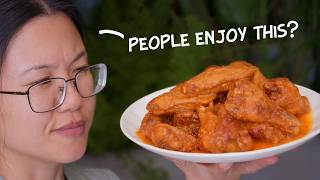

Why Chinese People Hate Buffalo Wings
45sThe bold, controversial claim immediately sparks curiosity and debate among food lovers and cultural enthusiasts.
▶ Play Clip"Title promises explanation and a fix, and the video delivers both with detailed analysis and a recipe."
The video explores why buffalo wings, a beloved American food, fail to appeal to the Chinese palate. The creator argues that the core issue lies in Frank's Red Hot sauce being overly vinegary and lacking spice for those accustomed to Sichuan-level heat. He then attempts to rebuild a better buffalo wing from first principles, using Chinese ingredients and techniques to create a version that balances heat, tang, and richness.
The creator notes that in 15 years in China, no Chinese friend has liked buffalo wings, citing them as 'too sour'.
Frank's Red Hot is described as 'completely fucking garbage'—mostly vinegar with no chili flavor or heat, unlike Crystal, Valentina, or Tabasco.
For low spice tolerance, buffalo wings taste balanced because vinegar, garlic, blue cheese, and butter cut the heat. But for Chinese spice enthusiasts accustomed to Sichuan hot pot, Frank's tastes like vinegar, not spicy.
Goal: spicy to the point of challenging, buttery, slight tang, mild garlic, no weird ingredients, no overly Chinese flavors. Must appeal to Chinese palate.
Instead of Frank's, use lacto-fermented millet chilies (Xiaomi La) which are spicier. Blend 85g with garlic and water, then strain to make hot sauce base.
Traditional butter mounting is unstable and too rich. Instead, use Chinese stir-fry technique with starch (potato starch) to thicken, ensuring sauce coats wings without breaking.
Inspiration from Yunnan dish shengjianji: marinate wings with salt, chicken bouillon, chili powders, soy sauce, bourbon, Tabasco, white pepper, garlic powder. Then coat with egg white and cornstarch slurry before double-frying.
Add Yunnan ghost pepper (chuan chuan la) for extra spice. Swish in the sauce briefly, then remove to avoid overwhelming heat.
Serve wings with deep-fried mantou (like Singaporean chili crab) and blue cheese dressing made with blue cheese, fermented tofu, yogurt, mayonnaise, sugar, salt, MSG, rice vinegar, and celery.
The wings are better than local foreign bars in Bangkok and Shenzhen, but rank slightly above deep-fried pineapple pizza among the creator's 401 recipes.
By replacing Frank's Red Hot with Chinese pickled chilies and using a stir-fry technique with starch, the creator successfully creates a buffalo wing that is spicy, buttery, and tangy, appealing to the Chinese palate while remaining authentically American in spirit.
Frank's Red Hot
tool
Crystal hot sauce
tool
Valentina hot sauce
tool
Tabasco
tool
Millet chilies (Xiaomi La)
tool
Ghost pepper (chuan chuan la)
tool
Potato starch
tool
Cornstarch
tool
Bourbon
tool
Blue cheese
tool
White fermented tofu
tool
Plain yogurt
tool
Mayonnaise (non-Asian)
tool
MSG
tool
Chicken bouillon powder
tool
Milk powder
tool
Rice vinegar
tool
Soy sauce
tool
Chili powder (spicy)
tool
White pepper
tool
Garlic powder
tool
Sugar
tool
Salt
tool
Celery
tool
Deep-fried mantou
tool
What is the primary reason Chinese people dislike buffalo wings according to the video?
They find them 'too sour' because Frank's Red Hot is mostly vinegar and lacks heat for those accustomed to Sichuan-level spice.
01:38
What hot sauce does the creator use as a base instead of Frank's Red Hot?
Lacto-fermented pickled millet chilies (Xiaomi La) blended with garlic and water.
06:55
What technique does the creator use to thicken the sauce instead of traditional butter mounting?
Chinese stir-fry technique with a potato starch slurry.
09:30
What is the name of the Yunnan dish that inspired the wing coating?
Shengjianji (directly fried chicken).
10:09
What ghost pepper variety from Yunnan is used to add extra heat?
Chuan chuan la (swish swish spicy), a ghost pepper from Dehong near the Myanmar border.
12:20
What is the canonical ratio of butter to hot sauce in traditional Buffalo sauce?
Half and half (1:1).
08:52
What ingredients are in the blue cheese dressing substitute?
75g blue cheese, 1 cube white fermented tofu, 75g plain yogurt, 20g non-Asian mayonnaise, 1 tsp sugar, 1/4 tsp each salt, MSG, rice vinegar, and minced celery leaf.
15:28
What temperature is used for the first fry of the wings?
120°C (250°F).
11:06
What is the purpose of adding bourbon to the sauce?
It is added for flavor; poured over the spatula and around the side of the wok.
13:49
What does the creator serve alongside the wings, inspired by Singaporean chili crab?
Deep-fried mantou (Chinese buns).
14:48
Frank's Red Hot is Garbage
The creator boldly claims the iconic sauce is the root cause of Chinese dislike, challenging a staple of American cuisine.
02:09Spice Tolerance Hypothesis
Explains how different spice tolerances affect perception of buffalo wings, linking cultural palate to food preferences.
03:07Chinese Pickled Chilies as Substitute
A clever use of locally available ingredients to recreate a fermented hot sauce base with more heat.
06:27Stir-Fry Technique for Sauce
Innovative fusion of Chinese cooking method with American flavors to solve stability and richness issues.
09:30Ghost Pepper for Extra Heat
Introduces a regional Chinese ingredient (chuan chuan la) to boost spice without overpowering.
12:20[00:00] Now, I don't want to say that every single Chinese person hates buffalo wings. I mean, 60th humanity, I'm sure you could find somebody somewhere. But in a decade and a half of living here in China, every single Chinese friend that
[00:14] I tried to introduce them to hasn't been a fan. Now that's, of course, just my personal experience, but maybe a little bit more objectively, you can definitely get Western food here in China.
[00:26] I mean, burgers, hot dogs, fried chicken, french fries, pizza, even bagels, kind of. But buffalo wings outside of an expat haunt or two, nada. Which like, I don't know, kind of sucks, right?
[00:41] Like, I don't know about you, but when I was in high school, college, my absolute favorite food in the world was buffalo wings. They were, for me, a little like what Niu Zai Cantonese street beef shops were for
[00:53] staff coming from a very white bread American home cooking background and white rice Cantonese home cooking background. Those two respective dishes were our first introduction to, well, flavor.
[01:09] Like for me, back when I was 17, me and my buddies, we would kind of get together for these makeshift wing eating contests, your mouse on fire, your hands are sloppy, but the blue cheese, the butter, it's just, I don't know, good memories.
[01:25] So naturally, over the years, I've tried to introduce my Chinese friends to the same experience. And try as I might, basically to a man, none of them have ever actually been into it.
[01:38] And if I try to grill them down a little bit as to why, also basically to a man, the response is that it's just to sour. And so I've thought about this problem a lot over the years, maybe a little bit too much.
[01:52] And after all this time, I think I might have been able to figure it out. Now it's pain me to admit it, but I think if you look inside yourself, you'll find it to be true too. And that is the very base of a buffalo sauce, the canonical hot sauce for an authentically
[02:09] correct buffalo, Frank's red hot, is completely fucking garbage. Now if you're anything like me, you're going to want to resist this information. But I want you to take a bottle of Frank's, I want you to open it, I want you to take a
[02:24] sniff and compare it against a crystal or a Valentino or even Tabasco. Like this shit here is vinegar. It tastes like vinegar essence, the fragrance is basically non-existent.
[02:39] It doesn't have a good chili flavor and it's not even spicy. This here is basically some white vinegar that somebody lightly whispered the words, chili pepper over and called in the rest of the day.
[02:55] Now maybe Frank's used to be better. Maybe this is another one of those cases of the NBA crowd taking an American food product, running it straight into the ground and hoping that nobody noticed.
[03:07] But in this specific case, I don't think that there's any conspiracy needed. I've got a different hypothesis. So cut back to me back when I was 17. Back then, white person crunchy taco night was my idea of some wild flavors.
[03:24] So predictably my spice tolerance, it was really quite low. And so I think if you're the type of person that if you just had a teaspoon of this straight,
[03:38] your predominant feeling is, that is a spicy meatball. Buffalo is going to taste balanced to you because the vinegar cuts the heat. The garlic cuts the heat.
[03:52] The blue cheese dressing will definitely cut the heat but especially the butter cuts the heat. The end result is a product that in Buffalo's defense is actually one of the perfect gateway
[04:05] spicy foods. But now I want you to picture the average Chinese spicy food enthusiast. Like this here functionally is your local bar.
[04:17] When you're at the shout-out, you're definitely going to be ordering a fistful of the beef chili bombs. When you have some white rice, you're dumping lalgama on. Not because it's actually spicy, just so that you can actually feel something.
[04:30] If your mouth has already adjusted to Sichuan hot pot, tamatala, levels of spicy, you're going to taste Frank's and it's going to taste like vinegar. It doesn't matter how much extra cayenne pepper your foreigner friend added, even compared
[04:46] to a simple malatang. Buffalo wings, they're not going to be spicy and so they're not going to taste balanced. So in this video, what I decided to do was try to rebuild a new,
[05:00] better Buffalo wing from first principles. So just to make sure that we are all on the same page here, I think a Buffalo sauce, it should be spicy just to the point of challenging, maybe getting past challenging it around wing
[05:15] for or so. The sauce itself, it should be definitely quite buttery. It should have a slight tang and a mild hit garlic to it. I also don't want any weird ingredients in the sauce, like ketchup or god forbid blue
[05:33] cheese, that belongs in the dip. But also at the same time, for the purpose of this exercise, I don't want to cheat and use anything that tastes overly Chinese either.
[05:45] So that's the goal. I want an authentic tasting, but better Buffalo wing that can finally appeal to the Chinese palate. So right, basics.
[05:59] Now Frank's is, of course, an American style fermented hot sauce. Now before I could easily get Frank's here, I still remember in my love of everything Buffalo, frantically searching for recipes online on how to ferment chilies for hot sauce so that
[06:15] I could recreate it here in China, which was a project that I never ended up doing because lazy. But a little bit ago, I was at the market and I was realizing that 20's me was really
[06:27] being pretty stupid. Because here in China, we can get some fantastic quality, lacto-fermented chili peppers, some of which can really get quite spicy, definitely spicier than Frank's.
[06:40] So if you are in the market of following along at home, this here is a variety of pickled chili that's actually pretty available at Chinese supermarkets in the West as well. They're called millet chilies, Xiaomi La.
[06:55] And if you ate one of these straight, it would be really quite uncomfortable, which is what we want because remember, the remainder of our Buffalo sauce is going to be a conspiracy to balance that heat. So what we'll do is we'll blend 85 grams of those together with a clove or two of garlic,
[07:12] together with a third of a cup of water. Then we'll pass that through a fine mesh sieve. And then with that, this is going to be our hot sauce base, no Frank's required.
[07:25] But that brings me to pain point number two, which is the fundamental technique of how Buffalo sauce is made. Now for the unaware, you make a Buffalo sauce by taking hot sauce and then using a French
[07:39] technique called mounting with butter. It's kind of the same idea as something like a beer blanc. You take your sauce and then you whisk cubes of cold butter in the thick butter. It blends in and then you're left with a thick rich sauce.
[07:54] But I think for hot wings, there's a couple of problems with this approach. The first one is that this here, this is not that stable of a concoction. Like I want to toss wings in a sauce while they're still piping hot from deep frying.
[08:10] And when I do that with this kind of butter mounted sauce, it's at a high risk of breaking on me. Now from what I can tell, the OG Buffalo sauce, it actually used margarine instead of butter.
[08:23] And these days at sports bars and the like, oftentimes people work off of this product. Both of which have stabilizers to thicken. Which then brings me to the pain point number two.
[08:35] I want a thick sauce that actually really coats to my wings. I don't really like those thin hot sauces like at that point. I'd rather just dip the thing and keep the crispiness. But to get to the thickness that I want by mounting it with butter, I usually end up needing
[08:52] to go half half which is one of the canonical ratios for a Buffalo sauce. But by that point, the sauce ends up losing much of the spiciness that we've worked so hard
[09:04] for. And importantly, also for the Chinese palate, is also really rich. Like, I don't know if you've ever actually let homemade Buffalo sauce sit out and get cold
[09:16] for a while. The stuff it ends up almost gross. Like you could take it and literally spread it on toast. So I was thinking about this problem for a while. And I couldn't think of anything overly elegant.
[09:30] So in the end, I'm going to do what I know how to do, which is stir frying up a sauce. Now I'll be adding a bunch of butter, of course. These are Buffalo wings, fear not the butter.
[09:43] But I'm also going to be thickening with starch, specifically a potato starch in the Chinese style so that the final product can actually hold. So Buffalo flavors, saucy Chinese stir fry technique.
[09:57] So here we've got 15 wings. And of course, the authentic move for an American style hot wing is definitely to fry them naked. No marinade, no coating, no nothing.
[10:09] But for me, I'm not going to do that. I'm going to be taking a little bit of inspiration from an old-school Yunnan dish called shengjjaji, or directly fried chicken, which is marinated and does have a light crispy coating.
[10:26] I know you might be skeptical. Just stay with me. I promise that it does work. So then, two marinade, two my wings. I'll just toss in a teaspoon of salt, half teaspoon chicken bouillon powder, half tablespoon
[10:38] each of a red-fraver and chili powder, a spicy chili powder, soy sauce, bourbon, and Tabasco. Together with a quarter teaspoon each white pepper and garlic powder, mix that well and then let that marinade in the fridge for at least a couple of hours.
[10:52] Then, right before deep frying, we'll whisk one egg white and then mix that in with a slurry of just 10 grams each of water and cornstarch. And then mix that super, super well with the wings.
[11:06] Then we'll get a walk of oil up to about 120 Celsius, drop in the wings, quick jostle, and let the coating form for about one minute. Then remove that, get your oil up to about 175 and then drop the wings in again.
[11:22] Try those for about four minutes or so or until everything's totally cooked and the wings are good and crispy and then take those out to drain. Now for our sauce then, together with our makeshift hot sauce from before, we'll toss in enough
[11:37] chicken stock or water or combination to get to one cup worth of liquid. And also toss in a half tablespoon each milk powder and Tabasco, a teaspoon each sugar and rice vinegar, a quarter teaspoon each white pepper and MSG, a half teaspoon chicken
[11:53] bouillon powder, and an eighth teaspoon of garlic powder. Mix that well and then we're ready to fry. But one last final thing before we stir fry.
[12:05] Everything up to now, it was all pretty tasty, I liked it, stuff liked it, but I still did want it a little bit spicier. So what I decided to do, and this is completely optional, is amp things up with a little bit
[12:20] of the spiciest chili pepper that the nation state of China has to offer. And that is a little bit of Yunnan's very own chuan chuan la. So this thing here, what it is, it's a ghost pepper, it comes from a dill hong near the
[12:38] Myanmar border. Apocryphally, one of the most traditional uses for the thing was to keep elephants away from your vegetable fields. But the culinary use there is also really quite interesting.
[12:50] So it's called chuan chuan la because it's used for dips. The character shuan in Chinese, it means dip or swish maybe. And so this thing, it's literally called swish swish spicy because what you do is you'll
[13:07] take your dip, you'll take your ghost pepper, and you'll just swish swish, and then that's already enough for spicy. So we'll just toss a half a ghost pepper in here.
[13:19] Just for as long as it takes for everything to get started with the stir fry, then we're going to take it out because I'm not a masochist. But if you have a higher spice tolerance than I do, definitely you can leave it in.
[13:32] So, to our wok, we'll first toss in two tablespoons of butter, and then let that foam over a low flame. Then go in with one finely minced clove garlic, and then one set's fragrant. We'll toss in three more pickled spicy chilies for the sake of good looking, and a half teaspoon
[13:49] of a spicy chili powder. Now up the flame to high, give it all a quick mix, then pour a tablespoon of bourbon over the spatula and around the side of the wok. Like mix, sauce in, and once that's at a light boil, swap the flame down below, and drizzle
[14:04] in a slurry of about two teaspoons of starch, mix through the equal amount of water. Once that's thickened to about this kind of consistency, we'll then shut off the heat and mount things with cold, cold cold, butter, bit by bit to get to our desired butteriness,
[14:20] which was for us two and a half more tablespoons. Then piping hot deep fried wings in, give that all really good mix, then transfer the sauce wings over to a plate, and the excess buffalo over to a bowl.
[14:35] And excess buffalo, because looking at this dish during testing for some reason, a little moat of my brain kept on thinking of Singaporean chili crab.
[14:48] Now I'm really not sure why the dishes really don't have much in common with each other, but I did decide to serve this alongside some deep fried mantos, just like in Singapore,
[15:00] which honestly is a fantastic combination, and might actually be the best idea of this entire exercise. But besides that, of course, we'll also have the mandatory side of celery, albeit peeled
[15:12] to get it stringless in the Cantonese style, and also a side that I personally like, which are some fresh-mile chilies. Then we'll serve that all with some blue cheese dressing, of course, and you should definitely buy yours, but here in Yushi, I can't go to the supermarket and buy some.
[15:28] So I just whipped together a bog standard, 75 grams of blue cheese, 1 cube of white fermented tofu, 75 grams of plain yogurt, 20 grams of a non-Asian mayonnaise, a teaspoon of sugar,
[15:41] and a quarter teaspoon each salt, MSG, and rice vinegar. Sprinkle of mincella relief, and with that, these are my American-style buffalo wings. You're not sure, I'm just so tall, everybody.
[16:05] Let's see. Now, this buffalo wings tastes pretty good to me now, better than our local foreign balls and both Bangkok and Shenzhen, but important thing is, where does it rank among all
[16:22] the far 401 concautions, from Taco Bell jam being two Henry Kissinger's Mo Gu Gai Pin? While first, I think our all-time best is our chili chip la zizi, the Sichuan style chili
[16:35] chicken, where you can eat the chili chips. It's so good that it should really be a thing. As for this buffalo wing, I think it ranks slightly above the deep fry pineapple pizza
[16:47] about. Anyway, all of our 401 recipes are real recipes, test it, if you're ever curious of anyone of them, I do really recommend you give it a try.
[16:59] They are quite fun and tasty. Anyway, real normal Chinese recipe coming out next week, ish. In the meantime, thank you for everyone supporting us on Patreon and subscribe for more Chinese
[17:14] remixed-ify videos. You don't want that. You don't get a shabby date, would you be afraid of the vegetable fields?


⚡ Saved you 0h 17m reading this? Transcribe any YouTube video for free — no signup needed.