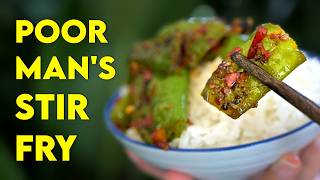

Why Chinese farmers used chili instead of salt
38sReveals a surprising historical reason for spicy food that challenges common assumptions.
▶ Play Clip"The title perfectly matches the content, as the video is a step-by-step tutorial on cooking chili-fried chili."
The video explores the cultural and historical context of chili-fried chili, a humble dish from Hunan and Jiangxi. It explains how spicy flavors were used to compensate for salt shortages in imperial China and how chili peppers serve as both a flavoring and a vegetable. The host then demonstrates the cooking process, including the tiger skin chili technique and the final stir-fry.
Chili fried dishes are a stir fry base of fresh chopped spicy chilis, aromatics like garlic and ginger, maybe a little douchi, resulting in dishes like chili fried beef, chili fried pork, or chili fried century egg..
Mountain villagers used spice to make up for a shortage of salt, which was monopolized by imperial governments.
Chili peppers are used as a vegetable in rustic cooking, as they are healthy and grow well in poor soil.
The tiger skin chili technique involves charring chilis over high heat, then covering and softening them.
The flavor profile uses spicy chilis, garlic, ginger, and optionally douchi (fermented black soybeans).
The final stir-fry combines the charred chilis with the aromatic base, soy sauce, and seasonings.
The entire meal (chili fried chili and tofu) costs about one US dollar, highlighting its affordability.
Why did mountain villagers historically use spice in their cooking?
To make up for a shortage of salt, which was monopolized by governments and hard to get in remote areas.
00:43
What technique is used to cook the green chilis in the recipe?
The tiger skin chili technique.
02:32
What types of chili are recommended for the 'vegetable chili' part of the dish?
Luosijiao (screw peppers), long hots, Anaheims, poblanos, or even bell peppers.
02:09
How much mild chili is needed for the recipe?
450 grams.
02:24
What amount of salt is sprinkled over the chilis during cooking?
3/8 teaspoons.
02:54
How long should the chilis fry covered after salting?
4-5 minutes.
03:04
What is douchi?
Chinese fermented black soybeans.
03:50
How much does 500g of green chili cost in the video?
About 6 mao US dollars (4 kuai RMB).
04:53
How much does the tofu cost in the video?
About 4 mao US dollars (3 kuai RMB).
05:22
What is the total cost of the chili and tofu combined?
One US dollar.
05:31
Village Wisdom in Cooking
Explains how chili-fried dishes are rooted in practical adaptation to scarcity.
00:19Historical Use of Spice to Substitute Salt
Provides historical context for the spice-heavy flavors in Chinese mountain cuisine.
00:43Tiger Skin Chili Technique
Key cooking method that creates a charred, blistered exterior on the chilis.
02:32Affordability of the Dish
Demonstrates that the entire meal costs only about one US dollar, emphasizing its practicality.
04:49[00:00] This is chili fried chili, lajiao chao lajiao,
[00:06] to be one of the all-time greats when it comes to
[00:14] Because this, this is village food – together with
[00:19] like, you can find these ‘chili fried’ dishes
[00:24] are a stir fry base of fresh chopped spicy chilis,
[00:30] douchi… resulting in dishes like chili fried beef,
[00:37] Now the reason that that flavor is so synonymous
[00:43] people up in the mountain villages would
[00:48] flavor wise at least, a shortage of
[00:54] product monopolized by the various
[00:57] a very important commodity… and so if you were a
[01:03] often that salt supply chain wouldn’t exactly
[01:09] your supplies, those spicy chili-fried flavor
[01:15] But – that’s just flavor. Simultaneously, chili
[01:22] are often used as a vegetable in a lot of rustic
[01:27] healthy, lots of vitamin C, and importantly they
[01:33] rocky soil. So throughout China’s mountainous
[01:39] chili or ghost fire green – basically dishes
[01:45] So now put A and B together. A chili-fried
[01:53] of course, white rice as the base of it
[02:04] So. To make it, for your ‘vegetable chili’, you
[02:09] the mild to medium side – these ones are luosijiao
[02:15] same thing as an Italian long hot? But either way
[02:21] even bell peppers if you wanted… we’ve got 450
[02:27] to chop them into sections for ease of consumption
[02:32] Now, then, the technique that we’ll use
[02:37] skin chili technique. To do the move, just
[02:43] just enough to get a thin shmear, then toss in
[02:48] maximum flame. Let one side char for about 60
[02:54] move on the other side. Then we’ll sprinkle in 3
[03:00] mix that super super well, then swap the flame
[03:06] and let those fry for about 4-5 minutes soften
[03:11] you’ll be looking for is for the chilis
[03:16] to just start separating from the flesh. Then
[03:22] But. For the flavor profile today, we’ll be
[03:29] these guys are Chinese Heaven
[03:32] and an inch worth of ginger. Slice your chilis,
[03:38] mince those all together until you get something
[03:44] our base. …but in addition I will also
[03:50] Chinese fermented black soybeans, wetting them
[03:55] water – but… definitely optional, definitely not
[04:02] But… right. Back to the stir fry, we’ll first
[04:09] you’re keeping veg, and let that melt over a
[04:15] give that a quick mix, then toss in the wetted
[04:20] until they’re fragrant, or about one minute.
[04:25] go back in with the green chilis, stir
[04:30] then pour a half tablespoon of soy sauce over your
[04:36] seasoning in, up here on the screen, and then
[04:41] mix and dissolve. Then out, and with that,
[04:49] So. A lot of people may not associate
[04:53] cheap? But – what we just got here is
[04:59] rmb which is basically 6 mao us dollar. And it
[05:06] now let’s go get some tofu and make
[05:22] And now we got another three kuai of tofu,
[05:31] one us dollar in total here and now let’s go home
[06:16] So right! There you have it – chili fried
[06:21] balanced, nutritious, cheap meal that’s just
[06:28] recipe for both of these dishes are over on
[06:33] supporting us on Patreon, and of course,




⚡ Saved you 0h 06m reading this? Transcribe any YouTube video for free — no signup needed.