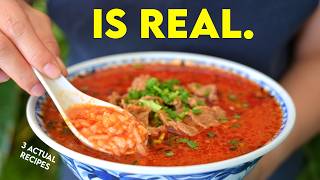

The Brothy Rice Trend Explained
45sAddresses a trending controversy and curiosity about whether brothy rice is authentic or just an influencer fad.
▶ Play Clip
[00:00] So over the last year or so, the short-form cooking internet seems to be really into brothy rice. Pretty brothy rice, creative brothy rice, brothy rice controversy.
[00:12] But the real question is, is this only an influencer thing, or is it a real thing in China? Because there's rice and there's broth here. So of course it's a thing, depending on where you are, it can be called pao fan, soaked rice,
[00:26] Tang Fan, broth rice, or Tang Pao Fan, soaked broth rice. But before we go further, let's make it clear that this form of rice and liquid is different from congee, aka juk or jow.
[00:40] Congee is made by cooking dry rice with a lot of liquid and make a porridge, while Tang Fan, brothy rice, is made by putting cooked rice in with a soup. And it's definitely very much a home cooking thing rather than a dish that you will see on restaurant menus,
[00:56] because pao san, broth rice, that is core, it's just a very good way to reheat rice. Like when you want to have that extra rice laying around in your fridge, of course you can make a fried rice,
[01:09] but sometimes you just want something soupy and soothing, so that's when pao san comes into play. Now there are two general approaches here. You can think of it as cook-in-soup method and ladle-in-soup method.
[01:23] For the cooking soup method, you will make a soup and toss some cooked rice in. For this method, you do want to use some leftover dry rice and then quickly cook it together. For the ladle and soup method, you will simply make a soup and then ladle that onto your rice.
[01:41] For this method, you can use fresh rice straight from the rice cooker. So in this video, we'll cover three brothy pao fang. First, a home cooking staple from around Shanghai that's called chai pao.
[01:53] which uses the cook-in-soup method and is such a classic that's basically mandatory to cover. Second, a chicken soup pao fan from Guizhou that uses the ladle-in-soup method. And finally, tomato and beef pao fan, a late-night drinking food from Chongqing
[02:09] that may just be our favorite among the three. So first, cai pao fan. Okay, I know this doesn't look like much, and it's leftover food soon and soon, But it's a great introduction to the simplicity of Pao San's philosophy and techniques.
[02:24] So the basics of this dish are only two things, leftover rice and baby bok choy, Shanghai Qing. Besides that, it's really just clearing out your fridge. Some pork classic, maybe some mushrooms, or even some chili rice cake.
[02:38] So while we are giving you a recipe, remember that these are just the essence, and you should definitely work off of this idea and use what you have around. We'll be using leftover rice for this. It's drier and will have a better texture, but you do have a bit of flexibility.
[02:55] You can use fresh rice straight from the rice cooker, but it will be softer, so just remember, do not cook it for too long. Now, let's quickly prep the essentials. Here are 250g baby bok choy, cut it into half-inch sections and set aside.
[03:11] Then, let's slice the other two aliens into swifers. Here we have 4 fresh shiitake with stems cut off slice them and fillet site Next is 100g lean pork slice into slivers to then a quick marinade with the classic seasoning listed on the screen And now we can cook our pao fan
[03:31] First, long yam. Add in 1 tablespoon lard into a hot wok, then heat on medium. Add in the shiitake, fry until softened and darkened about 3 minutes, then scooch to the side.
[03:44] Now, add a bit more oil if needed, then add in our pork. Spread it out, fry for 30 seconds, then flip. Fry for another 30 seconds, then loosen it up. Once the pork's changed color, mix everything together and add in 1 liter of cool water.
[04:02] Turn the heat to high and bring it to a boil. Then let it simmer for 3 minutes on medium heat. And that's our broth base. Now add in 300 gram left over rice. Break it up until there's no big clumps.
[04:15] Then add in the baby bok choy and season with half teaspoon salt plus 8 teaspoon each MSG and chicken powder. Once the baby bok choy turns a delicate green, heat off. Now scoop it out into your bowl, sprinkle on some green scallions,
[04:30] and now your Shanghai-style Cai Pao Fan veggie brothy rice is done. Next up, Guizhou chicken soup rice. Now when it comes to home cooking from Guizhou, this is not so much of a dish,
[04:43] but more of something that you can just do. When you have some chicken soup in front of you, you can just ladle some soup onto your rice and mix it together. People do that all the time. But at the provincial capital of Guiyang,
[04:56] some shops took that homely idea and turned it into restaurant concepts. So what you do is you walk in, get a jitang fan, and choose the toppings that you want. It can be a big chicken leg, maybe some gizzards,
[05:10] hearts, eggs, whichever parts you want. For us today, we don't want to go too intense, so no worries, we don't need to handle the whole chicken or our organs. Instead, we'll take inspiration from some of the shops and focus on big chicken thighs. And because we'll
[05:26] be relying on the legs to flavor and make a proper soup, do try your best to get the best quality supermarket chicken that you can get. But then Chris was making me really paranoia about the chicken qualities in the West he insisted that the chicken
[05:40] size will dissolve after the two-hour cooking time and it won't have enough fat or flavor so I'm not sure if his right but to cover our basis will also toss in one tablespoons of dry shrimp at the beginning taking inspiration from
[05:55] this classic soup from Southwest China and if there's not enough fat I just finish with some schmaltz at the end so this one got so simple so just to a big pot toss in two big chicken thighs about one kilo in total then together with one inch ginger smashed
[06:13] a scallion tied into a knob half teaspoon white peppercorn slightly crushed and our one tablespoon dry shrimp now add in one and a half liter cool water bring it to a boil skim if needed then cover
[06:27] and let it cook for two hours on low or when you can easily poke a chopsticks through the thigh and it's starting to fall off the bones. Maybe one hour for supermarket chickens. Then to serve, we can use fresh rice
[06:41] straight from the rice cooker. So scoop 150 grams fresh rice to a bowl add in the seasoning listed on the screen then ladle 2 cups of soup in Carefully put the thigh over the rice sprinkle on some scallion greens and now your chicken
[06:57] pao fan is also done. Lastly, tomato and beef tang fan from Chongqing. Now, this one is definitely squarely restaurant food. From a homey dish to a late night drinking snack, it got a similar lineage with the tomato
[07:12] and egg noodle soup from Chengdu that we covered before. It's something tasty and comforting for the young people after they leave the club. So, fair warning, this version is not a home-cooking dish,
[07:25] but it's incredibly delicious, so not too bad to make, and totally worth it. So, to make it, first we'll grab 300 grams of fatty pork belly, slice those into strips, and quickly marinate those with 8 teaspoons salt and MSG,
[07:40] half teaspoon soy sauce, mix well, then coat with a generous amount of oil. Add that to a cool pot or wok and slowly rent out that lard for 15 to 20 minutes,
[07:52] or until the pork belly is nice and crispy, reserve the lard in a bowl and the crispy pork belly on a paper-tall lined plate. Then grab 650 grams of tomatoes, preferably ripe if you can find it,
[08:06] cut a little asphalt on it, quickly blend, peel, remove the stem, and toss it into a blender. Now, we're using a blender here because we're specifically making a restaurant version of this,
[08:18] many of which will include some blended or broken down tomatoes. So then, to that, toss in one tablespoon of shucking wine, quality spoon salt, and half cup of water.
[08:30] Blend that well and set aside. Next, we'll separate the white from the greens from four scallions. slicing the greens and reserving, and mincing the white bits together with 4 cloves of garlic
[08:42] and an inch of ginger. Set those aside and now we can make our soup. To do so, just toss 4 tablespoons of your render lard into a pot and over a medium flame, fry your minced aromatics
[08:54] until fragrant, about a minute. Then toss in 1 and 1⁄2 tablespoons tomato paste and 1 tablespoon of red mild chili powder like Kashmiri or Goshkaru and fry until the oil is good and
[09:07] steamed. Then add the blended tomatoes, you can stir it a bit to let the froth subside, then toss in 2 cups of stock, water or a combination together with the rest of the seasoning up here on the screen.
[09:19] We'll want to simmer that for at least 30 minutes, so during that time we'll slice up 200g beef loin, give it a quick marinade with the listed ingredients, massage until all the liquids absorbed then coat it with one tablespoon of oil and cello-cite.
[09:35] And after this 30 minutes simmers down, we'll first add in 300 grams of leftover rice into the broth, break up the bed clumps, max the beef, give it a final massage then put in bit by bit
[09:48] so that the beef doesn't clump together. And once the beef completely changed color, shelf the heat, and then transfer the rice to a bowl, sprinkle some scallion greens on, and optionally a bit of that crispy pork belly, and then your tomato beef brothy rice is done.
[10:08] Now I gonna be honest when my algorithm first introduced me to the English world of blocky rights it was in the form of blocky rights controversy And my first thought was
[10:20] are we really doing this again? I guess there are new generations, the new platforms, that were doomed to repeat the same outrage they make. But after watching a lot of those short videos,
[10:34] I could kind of start to understand some of the frustrations. If you know Chinese food, sometimes it can be a bit painful to watch. There's this liminal feeling that everything is a mishmash. I think it's fair to say that a lot of those people, they don't know much about
[10:50] Asian cuisines. There's not really all that much to critique here because they're not engaging with the culture or the craft of cooking. Like this is their Western cooking. What are you expecting? But I really, really don't want to be too classic here because not everybody has the opportunity to travel around the world and learn to appreciate different cooking traditions.
[11:13] Like in China, there's this classical division between two types of art. There's Yangcheng Baixue, the music and art of the educated elite, the cultivated, you know, something like... The Kaoshan Liu Shui archetype.
[11:33] Then there's the Xiaoli Baren, the vulgar, the arts, the music and aesthetic of the masses, you know. Now, I love some nice and serene Guqin time
[11:51] myself, but I equally, if not more, also enjoy some 老司機代表我我要吃口麵呀, my favorite song. It's just so fun, it grabs you and pulls you in. It's so human. If you're
[12:06] watching this, you're probably pretty worldly, pretty educated. Going by our analytics, don't guess that our comment section probably has one of the highest grad degrees per capita of the English cooking internet. But for a lot of people, people that haven't had the
[12:23] economic opportunities to develop that kind of taste, what they will be attracted to would likely be some basic pretty forms, or something in that cozy zone of being close enough for comfort and just barely enough to be interesting. But that's fine, it's human, you don't
[12:42] have to be an expert at everything. Like, I enjoy watching ZhenHuanZhuang and listening to Yunnan Shanggu, Chris likes some pooh-tee high fantasies and 90s pop punk. And even if you are really into food, there's nothing wrong with following this and getting
[12:58] inspirations from their plating and food styling. And honestly, we've had these video ideas on our back burner for a while now and originally we were just gonna call it Soaked Rice.
[13:10] In blocky rights, it's a much better name because there's a mark to all of this. Or, 家園家友家朋友家朋友,老公看着主动手。


⚡ Saved you 0h 13m reading this? Transcribe any YouTube video for free — no signup needed.