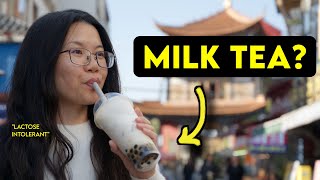

If Asians Are Lactose Intolerant, Why All the Milk Tea?
45sChallenges a common stereotype with a paradoxical observation, sparking curiosity and engagement.
▶ Play Clip"Delivers a nuanced answer to the title's paradox with scientific and cultural depth."
This video explores the paradox of high lactose intolerance rates in Asia alongside the widespread consumption of milk tea and other dairy products. Hosted by a Cantonese presenter in China, it features Dr. Jennifer Dubois, a biochemistry professor, to explain the science behind lactose intolerance and how the gut microbiome can adapt to digest dairy. The video also delves into cultural and historical reasons why China never developed a traditional cheese industry, concluding that sometimes the answer is simply 'no why'—a matter of cultural evolution.
Common knowledge says 92% of Chinese are lactose intolerant, so no dairy industry—but milk tea is hugely popular in China, Japan, Southeast Asia, etc.
The host is Cantonese and grew up with milk, yogurt, and cheese dishes like deep-fried milk, contradicting the simple lactose intolerance narrative.
Dr. Dubois explains that lactose is a sugar in milk broken down by the enzyme lactase. Many adults stop producing lactase, leading to intolerance.
Lactose intolerant individuals exhale hydrogen gas because their microbiome ferments undigested lactose, causing bloating and discomfort.
Regular dairy consumers can train their microbiome with lactobacilli bacteria that digest lactose, reducing symptoms over time.
Genetically lactose intolerant Somali herdsmen drink half a liter of milk daily due to a well-adapted microbiome that handles fermentation byproducts.
Food historian Thomas Dubois suggests lactose intolerance is part of the reason, but also a chicken-and-egg scenario: without a dairy base, there's less incentive to make cheese.
The host proposes that sometimes there is no single reason—just like India has no tofu or Scandinavia has no fish sauce, culture evolves arbitrarily.
Lactose intolerance is a spectrum influenced by genetics and microbiome adaptation, explaining why many Asians can enjoy dairy. The lack of traditional Chinese cheese is due to a combination of low dairy base and cultural path dependence, not just intolerance alone.
What enzyme breaks down lactose?
Lactase
03:28
How is lactose intolerance diagnosed?
By measuring hydrogen in the breath after lactose consumption.
04:48
What bacteria help digest lactose in the gut?
Lactobacilli (e.g., L. acidophilus, L. casei, L. rhamnosus)
05:59
What percentage of Chinese are genetically lactose intolerant?
92%
Why can Somali herdsmen drink milk despite being lactose intolerant?
They have a well-adapted microbiome that ferments lactose and handles downstream products.
06:58
Personal Dairy Consumption
Challenges the assumption that lactose intolerant people cannot consume dairy.
01:46Microbiome Training
Explains how regular dairy intake can adapt the gut microbiome, reducing symptoms.
05:44Somali Herdsmen Adaptation
Real-world example of high dairy consumption in genetically intolerant populations.
06:58Chicken-and-Egg of Cheese
Cultural path dependence explains why China lacks cheese despite digestibility fixes.
11:18The 'No Why' Hypothesis
Suggests that not all cultural phenomena have a clear causal explanation.
12:40[00:00] So why doesn’t China traditionally have cheese? It’s a common question, and if you’ve ever spent some time online, you’ve probably seen an answer with a graphic a bit like this. Lactose intolerance around the world. For China, we’re at 92%. So, of course you’re not going to
[00:19] develop a dairy industry if no one can eat it – and of course it’s why China’s always been the land of tofu… so no milk, no yoghurt, no cheese…. simple question, simple answer, case closed.
[00:34] I live in China, and there’s nothing more Chinese than our collective obsession over milk tea. It started in Hong Kong with Hong Kong style milk tea, then that was layered with boba
[00:49] milk tea from Taiwan, and now throughout the country you can find a ton of milk tea shops. Milk tea streets like this are a popular hangout for young people, there’s premium brands like HeyTea with their famous cheese froth,
[01:05] and in every single little town around the country you’d at least be able to find one Mixue. But that’s just China, what about Japan, 98% lactose intolerant,
[01:17] and they seem to love their royal milk tea. What about southeast Asia, 96% lactose intolerant, but in Bangkok you can’t go far without a Thai style street milk tea, or what about Vietnam,
[01:31] isn’t their coffee like half condensed milk? ranging from 20%-68%? But isn’t Italy the place that actually invented cappuccino?
[01:46] So I’m not going to lie, this whole thing is starting to make me feel like a lactose intolerance truther. consensus that there is a specific gene for breaking down lactose – the LCT gene,
[02:01] and apparently 92% of China don’t have it. But there has to be something else going on here. So, I’m Cantonese, I grew up with milk, yogurt, and ice cream. And I lived in Shunde,
[02:15] where they’re famous for their deep fried milk, stir fried milk, and double skinned milk. And nowadays in China, every kid’s favorite is pizza. Which sometimes you might be able to find
[02:28] it without tomato sauce, but never without cheese. So with these questions in mind, we reached out to a proper expert: Dr Jennifer Dubois, who is a professor of Biochemistry at Montana
[02:43] State University and runs the Dubois lab, and specializes in microbiome. So, uh, Jen is our professor here. Sounds good. Um, so let's talk about lactose intolerant
[03:01] because I also did a gene test and it says that I'm also genetically lactose intolerant. Um, so but I drink milk all the time. So what does that mean to be lactose intolerant?
[03:15] So lactose intolerance is actually a really interesting genetic condition. So I have a model of lactose. It's two simple sugars linked together. And there's a single
[03:28] enzyme called lactase that pops them apart. And if you lack the enzyme that's capable of doing that, you can't digest lactose any further. But the genetic reason behind a
[03:43] lactose deficiency is that you just simply aren't making the functional lactase gene - product. And that's because lactose, which is the major sugar in milk,
[03:56] is baby food. So if you're an adult, you don't have any real need for lactose. I see People always say that if you're lactose intolerant, it will cause some kind of discomfort. I got full very fast from drinking milk straight or sometimes even eating cheese.
[04:16] If I eat a lot of cheese, I'll also get full. Um… is there any like kind of common diagnosis? So, lactose intolerance is sort of a spectrum. People can experience a little bit of discomfort
[04:32] or they can experience a lot of it. But if you experience really significant lactose intolerance, enough to take you to a doctor, they'll ask you to breathe into a tube. And if you're exhaling
[04:48] hydrogen, hydrogen gas like the Hindenburg, that's the easiest diagnostic for lactose intolerance. And the reason why somebody who's lactose intolerant would exhale hydrogen is that they're
[05:04] not digesting their lactose. Their microbiome is digesting their lactose, by fermentation. Oh! So if you are one of those 30% of the people on the planet who can actually make
[05:18] functional lactase well into adulthood, you would not be exhaling hydrogen gas. But if you're relying on your microbiome to do it for you, then you would probably
[05:30] be exhaling a lot of it and that's part of the reason for your discomfort. Now, if you are a regular drinker of milk and there are people who drink milk every day despite
[05:44] being lactose intolerant, then you probably have a very well-trained microbiome. And your microbiome is probably chalk full of microbes that are fermenting your lactose to make hydrogen gas.
[05:59] And these are called lactobacilli. And if you, like me, are a lactose intolerant person who likes yogurt and you look at the cultures in your yogurt,
[06:12] you'll see that they say “L. acidophilus, L. casei, L. rhamnosus”. And the L is for the genus name Lactobacilli. So these are lactose consuming microbes that live in
[06:28] your GI tract and they're enjoying all that lactose that is causing you a problem. Making hydrogen gas. So that means our guts making yogurt for us. Your gut is making it for you.
[06:43] And that can cause a little bit of discomfort. But there are people in Africa for example these Somali herdsmen who are completely lactose intolerant genetically but who consume at least
[06:58] a half liter of milk every day as part of their diet because that's how they survive. Although we do know that things like lactobacilli are almost universal. Almost every person on Earth
[07:12] is going to have some kind of lactose digesting organism in them. Whether you have a huge army of them or just a small little friendly band might have more to do with what you eat.
[07:29] Now if you're the sort of person who really rarely drinks milk and one fine day you decide that you're going to go out for an ice cream party or you're going to drink a liter's worth of milk,
[07:43] then you might experience some very bad clinical symptoms because it turns out it takes a while to build up a microbiome that has enough lactobacilli to do this work for you.
[07:56] So, what you're probably going to feel is sort of like you just ate a sweater! Because you've filled your GI tract with something that you can't digest. Your microbiome can't digest. And so,
[08:09] what happens is a bunch of water will rush into your GI tract. It'll really inflate your intestines and you might end up with a little bit of diarrhea. So that's when people end up with a
[08:25] clinical manifestation that might actually send them to the doctor. But if if the consequence is, you know, feeling full because you have a little bit of extra gas or maybe you have
[08:38] extra water retained in your GI tract, that's not the worst thing in the world? It would probably be clinical if you were vomiting or really showing something that took you to a doctor and then
[08:53] they would probably say you should take lactase pills. If you really have to have that milk tea. So right now my understanding is that the effect has a couple different factors.
[09:09] One very important is that they have a microbiome that can that can help them digest. If you're lacking the ability to produce lactase, then yes, having a well functioning microbiome
[09:24] that can do the work for you is very important. And part of that well functioning microbiome in terms of your comfort could be when you ferment the lactose… a downstream product of that is
[09:37] hydrogen gas. And hydrogen gas is a gas, and it's going to literally bloat you up. And so if you have a friend of that initial consumer who likes to eat the hydrogen, they can cooperate. And so,
[09:53] you know, this is how I imagine these people who are the Somali herdsmen who are really punching above their weight drinking a liter of milk a day. They probably have a very well-
[10:07] conditioned microbiome, not only to break down the lactose but to take care of all the downstream metabolic products that come after. And they feel plenty fine. So, so I really appreciate
[10:23] your time and help today to help me a lactose intolerant Asian understand what is going on with my gut and why I can actually eat and consume dairy. And most importantly, I learned this pill
[10:37] lactase. I'm going to bring it with me next time traveling to a dairy heavy area so that I can eat all the things that I love. Do that! Especially when you're in Europe and all those
[10:50] happy cheese eaters are- Yeah, I know! -making fun of you because you can't enjoy with them. I know. It's such a shame that I feel full so fast now that I know the trick. They say it helps! Yeah,
[11:05] that that will definitely be my biggest takeaway for today as a food lover. So again, thank you very much for your time. You're very welcome, Steph, and it was great meeting you.
[11:18] So besides bringing lactase pills to any potential cheese feasts in France, my biggest takeaway is that this map is probably better communicated in the inverse.
[11:30] We see a specific genetic mutation that allows some people to digest and get calories from lactose into adulthood. But the phenotype of lactose intolerance is messy, it’s a spectrum, and some people
[11:43] like those Somali herdsmen, they have a microbiome that makes no problem at all. Which brings us back to the original question: why didn’t China have cheese?
[11:55] For this, our friend and food historian Thomas Dubois – yes, the same Dubois – has his answer. That lactose intolerance was part of it, but it’s also a chicken and the egg kind of phenomenon.
[12:09] Sure, souring and coagulation can solve most of the digestibility issues (like 71% intolerant Turkey), but you also have a lot less of incentives to make those
[12:24] higher-value-add products when you don’t have a base dairy industry to begin with. But China’s a big place, and you do still see it in pockets… like our old home of Shunde, or our current home of Yunnan.
[12:40] like to humbly submit my own hypothesis of ‘why’ – it’s ‘no why’. Just because. It’s definitely not a satisfying answer, but sometimes it’s just the way it is.
[12:54] Because, why doesn’t India have tofu? Or why doesn’t Scandinavia have fish sauce, or why doesn’t Italy have shrimp paste? Sometimes it’s just the way culture evolves.
[13:08] When we look at history, we can usually do a pretty good job figuring out why something happened, but it’s a lot harder to answer why something didn’t happen. Sometimes, it’s not even knowable. Sometimes, that’s just the way the cookie crumbles.
[13:24] So right! I know this was a bit of a weird one, we just really want to get to the bottom of this. So huge thank you to Jenn and all of the Dubois out there for helping us to answer these questions, recipe video will be back next week… in the meantime, thank you for everyone
[13:41] that’s supporting us on Patreon, and of course, subscribe for more Chinese milk loving videos.


⚡ Saved you 0h 14m reading this? Transcribe any YouTube video for free — no signup needed.