
Why American Pancakes Need Sichuan Fillings
45sThe creator's critique of American food's monotony sparks curiosity and cultural debate.
▶ Play Clip"The title is accurate and the video delivers a full recipe and taste test, though it could be slightly more concise."
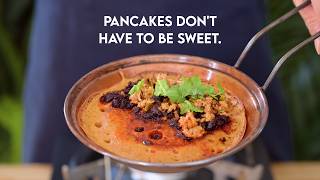
This video explores the Sichuan street food danhonggao (egg baked cake), a pancake-like snack that can be filled with a variety of sweet, savory, and spicy fillings. The creator demonstrates how to make the batter and several classic fillings, then tests whether these fillings work on American-style silver dollar pancakes.
The creator introduces danhonggao, a Sichuan street food similar to American pancakes but with a wider range of fillings, from sweet to savory to spicy.
The batter uses a mix of yeast, baking soda, and baking powder instead of traditional sourdough. Ingredients: 100g brown sugar, 190g hot water, 2g osmotolerant yeast, 2 eggs, 200g AP flour. Ferment for 1 hour, then add 2g baking soda and 1g baking powder dissolved in 10g water.
Use a small pan (15cm copper pan, blini pan, or 6-inch cast iron). Heat on medium-low, wipe with oiled paper towel, pour 3 tbsp batter, swirl to create crispy edge, cover for 30 seconds, add filling, cover for 30-45 seconds, then fold with tweezers.
Fillings include: Laoganma, nuts and sugar, minced pork with zhacai, minced pork with sour pickled long beans, chicken with chili oil, cream with pig floss, and Thai Nam Phrik Pao chili jam with mayo and pig floss.
Mix 100g minced pork with 1/4 tsp starch, 1/4 tsp soy sauce, 1 tsp white pepper. Mince 20g zhacai. Fry pork until golden, add zhacai, fry for 1 minute.
Pound 10g toasted peanuts, mix with 20g granulated sugar, add 10g toasted sesame seeds, pound briefly.
Whip 250g cold heavy cream with 1 tbsp sugar, 1 tsp salt, 1/4 tsp vanilla extract to stiff peaks. Add pig floss and whipped cream at the end.
The creator tests fillings on silver dollar pancakes. Results: Laoganma, cream with pig floss, minced pork with pickled long beans, and Thai chili jam work well; pork with zhacai and chicken with chili oil are 'kind of works'; nuts and sugar does not work.
Danhonggao is a versatile Sichuan street snack that can be adapted to American pancakes with many fillings. The video provides a complete recipe and encourages viewers to try it at home.
What is danhonggao?
A Sichuan street food similar to American pancakes, but with a variety of sweet, savory, and spicy fillings.
00:57
What are the ingredients for the danhonggao batter?
100g brown sugar, 190g hot water, 2g osmotolerant yeast, 2 eggs, 200g AP flour, 2g baking soda, 1g baking powder.
01:54
How long should the batter ferment?
1 hour.
03:05
What is the purpose of the baking soda and baking powder?
To balance acidity and leaven the pancake.
02:11
What is the traditional leavening agent in danhonggao?
Chinese laomian (sourdough or natural yeast).
01:54
What is the recommended pan size for danhonggao?
15 cm wide, smaller at the bottom.
03:34
How do you create the crispy thin ring on the edge?
Swirl the batter quickly after pouring it into the pan.
04:29
What is the classic sweet filling for danhonggao?
Nuts and sugar (toasted peanuts, sugar, and sesame seeds).
06:58
What is the 'cream' in old-school danhonggao?
Steamed meringue, but modern versions use whipped cream.
07:37
Which fillings work best on American silver dollar pancakes?
Laoganma, cream with pig floss, minced pork with pickled long beans, and Thai chili jam.
10:06
Danhonggao as a versatile alternative
Introduces a unique Sichuan street food that solves the monotony of single-flavor pancakes.
00:57Modern batter technique
Simplifies traditional sourdough batter using yeast and baking soda, making it accessible for home cooks.
01:54Equipment flexibility
Shows that various pans can be used, making the recipe adaptable to what you have.
03:20Cross-cultural fusion test
Systematically tests Sichuan fillings on American pancakes, providing practical results for fusion cooking.
10:06[00:00] My absolute favorite American food is pancakes. Whenever I travel to the USA, it will be the very first meal on the very first day. Berries, lemon, chocolate, love it all.
[00:13] But as much as I enjoy pancakes, there's also a problem. Having one stack of pancake with just one flavors? Sometimes… it can be a bit much. And same with many American restaurant foods: for me
[00:28] at least, many dishes are often centered around one big thing. And halfway eating through it, without a change of flavor, sometimes it gets a bit monotonous. Maybe that's just my Chinese
[00:42] mindset, but wouldn't it be great if instead of one big cheeseburger or one stack of pancakes… having multiple burgers with different flavors or many pancakes with different tastes? Well, Sichuan
[00:57] may have an answer to that question. In China, we don't have anything exactly the same as the American style pancake, of course, but in Sichuan, there's something that comes pretty close. It’s called danhonggao or egg baked cake. While there's no milk, the rest are just basically like
[01:14] an American style pancake. It's a mix of flour, egg, leavening agent, and… not much else. But unlike American pancakes, the Sichuan one can be stuffed with a whole array of different feelings
[01:27] with flavors ranging from sweet to savory to spicy or all of them combined. So in this video, we'll show you how to make danhonggao just like how you will see it on a afternoon street cart
[01:41] outside of a school in Chengdu, fillings and all. And besides that, we'll also take those fillings and put them onto some American-style silver dollar pancake and see if that works too.
[01:54] But let's go over the danhonggao first. And step one in making danhonggao, is, of course, the batter. Now, traditionally, this batter uses Chinese laomian, which is sourdough or natural yeast, and then adds baking soda to balance out the acidity and leaven the pancake.
[02:11] But for this recipe, I just want to keep things simple and do a modern Sichuan homecooking style, which instead of Chinese Laomian, we'll be using a mix of yeast, baking soda, and baking powder.
[02:25] So, first we'll melt 100g brown sugar with 190 gram hot water. Stir until the sugar is all dissolved. And when the water gets back down to room temperature, dissolve 2g or a half teaspoon
[02:40] of osmotolerant yeast into it. Then, add two eggs and whisk well until no stray strands remained. Then sift in 200 g of AP flour, mixing it by folding from the bottom and cut it back down
[02:53] onto the center just like how you would mix a pancake batter. Once it's basically all mixed in like this, strain the batter through a sieve just to make sure there's no big clumps.
[03:05] Then cover and set this aside and let it ferment for an hour. Then 1 hour later, come back, mix 2g baking soda and 1g baking powder with 10g water. Fold in our batter and then it's ready to make
[03:20] some danhonggao. Real quick though, quick aside on equipment. For this one, you'll want the smallest possible pan you can get your hands on. I have a little copper pen here that I got online, which is
[03:34] the pan in making danhonggao. It's 15 cm wide and smaller at the bottom. Chris was saying that a Blini pan might work, but I also tried my hands at this, the Vietnamese and Thai breakfast egg pan.
[03:50] It's slightly bigger, but it just works great as well. And even our 6 inch cast iron skillet works. But because the surface is a little bit more porous, so it will end up being a little bit
[04:03] more oily and slightly less crispy on the edge. But it's just subtle, you can totally use it. Besides that, you will also want a pair of tweezers, a folded paper towel that's dipped
[04:15] in a minuscule amount of oil, and preferably a rack to lift our pan slightly above the stove. So, heat on medium low, then heat up the pan. And once you can feel some warmth coming through, lift your
[04:29] pan up and take that oiled paper towel and give it a wipe. Then scoop in three tablespoons worth of batter and quickly give it a swirl to create that signature crispy thin ring on the edge.
[04:41] Then let the batter evenly cover the pan. Cover for 30 seconds. Then we can add in our filling. For this one, we'll just keep it super basic to just show you the techniques. So, we'll
[04:53] just be adding in some Laoganma, which is a legit feeling that they will use in Sichuan. Then cover it back up and bake for another 30 to 45 seconds. Remember to move the pan around to make sure it
[05:06] heats evenly when baking. Once you see the edge is slightly golden brown, using one end of your tweezer gently slide it in between the edge and the pan. Loosen it bottom, then fold it over onto
[05:19] the filling. So then now we can just take it out, put it onto your serving plate or alternatively a paper box for that ultimate street food vibe. But we do definitely need to expand on those feelings,
[05:33] so this is what we whipped up today. Besides the Laoganma that we just showed you, we also made nuts and sugar, which is basically the OG sweet feeling. Minced pork with Zhacai, that's another
[05:45] classic. Minced pork with sour pickled long beans, chicken with chili oil, and cream with pig floss… and a fusion-y one with the Thai Nam Phrik Pao chili jam, some mayo, and more pig floss.
[06:00] So we'll show you these three right now but if you want to know how to make all seven check out the written recipes in description box. So let's start with the savory one - pork and zhacai. To make it, just take 100 grams of minced pork and toss an quarter teaspoon each starch and
[06:16] soy sauce together with a teaspoon white pepper. Mix well and set aside. Then mince 20g of zhacai preserved mustard greens into half centimeter bits and set aside. Now, as always, longyau. Get your
[06:30] wok piping hot, heat off and add in one heaping tablespoons of oil. Then heat back on medium. Toss in that 100g of minced pork. Break it up with your spatula and patiently fry until slightly
[06:44] golden brown and starting to release a little bit of oil. At this point, toss in the minced zhacai. Fry the two together for about 1 minute. Then heat off and out. Filling number one, done. Then next,
[06:58] let's show you the OG sweet filling. This sweet filling you not only see at danhonggao, but also in sweet Baozis or Cantonese deep fried flaky dumplings. So to make it, all we need is sugar,
[07:11] toasted peanuts, and toasted sesame seeds. So first, toss 10 grams of your toasted peanuts into a mortar. Roughly pound it into half centimeter bits. Then add in 20g granulated sugar into it.
[07:24] Quickly pound it together with the peanut. Then finally add in that 10g toasted sesame seeds. Another quick pound to break the sesame kernels. And this is it: filling number two, done.
[07:37] And finally, we'll have cream – naiyou - and pig floss. And there's something I should probably back up and explain. I call it “cream”, naiyou, but the cream as they call it in old school danhonggao was actually meringue that’s steamed to set. But as whipped cream
[07:54] got more and more popular, it became the “cream” that you will get at many stands. And personally, I prefer whipped cream to meringue, so this is what we'll be using today. That said though, both
[08:06] me and Chris hate the stuff from the bottle. So, we will actually whipping our cream from scratch. So, to make whipped cream, here we have 250g or 1 cup of cold heavy cream. Add in 1 tbsp of
[08:19] granulated sugar and teaspoon salt. First on low to incorporate our sugar. Then, turn to medium and whisk till we have a soft peaks. Then add in 1/4 teaspoon vanilla extract and keep on whipping
[08:34] it on high until we have a stiff peaks. And now the whipped cream is ready to be used, keep it in the fridge until you are about to assembled. As for pig floss, you should be able to find it at
[08:46] Asian supermarkets or online because it's a very popular snack/ ingredients and many parts in Asia. And now we have these fillings ready, so let's make a couple more meringue. So, same as we showed
[08:59] you earlier in the video, heat up the pan, scoop in three tablespoons worth of batter in, cover and let it bake on medium low for 30 seconds. Then, put in the minced pork with zhacai. Cover
[09:12] and continue to bake for another 30 to 45 seconds. Carefully loosen the crispy edge, fold it up, and take it out. Now for the mixed sugar and nut one. We'll put the feelings in after it's baked for 45
[09:26] seconds because sweet feelings goes in later. Then a final 30 second bake and take it out. As for the whipped cream, it needs to go in at the very very end. So, at the 1 and a half minute
[09:40] mark, shut off the heat, loosen the edge, transfer the pancake to a plate. Then, sprinkle in about one tablespoon of pig floss and scoop or pipe in your whipped cream, about 1 tbsp worth.
[09:53] Then, fold it up. And this is done. And now you've got your various assortments of pancake fillings just like how you would see on street carts in Sichuan. So, then it comes to our other question.
[10:06] Will those fillings work on American-style silver dollar pancakes? Let's find out. So, we'll have three categories of the feelings, which is: (1) definitely works on pancake, (2) kind
[10:18] of works on pancake, (3) not really works on pancake. First up, the zhacai and minced pork. So, for the zhacai and minced pork one, I think it belongs to “kind of works on pancake”. It’s
[10:31] slightly drier in this context with the open faced silver dollar pancake. Next one. This is the cream and pig floss. I would assume that it will really work.
[10:47] Because whipped cream is already a super classic topping for pancakes and now you're just topping it with some extra tasty bits. Of course, it will work on pancake.
[11:01] Now, this is the nuts and sugar one. Smells good though.
[11:13] So the nuts and sugar one uh they taste like two completely separate things. So yeah, it doesn't work. I think it works in Danhonggao because you kind of bake it a little bit more, so it slightly melts. It's more moist. So for this one that doesn't work. And now we have our Lao Gan Ma.
[11:37] Lao Gan Ma definitely works. Um my one suggestion will be kind of spread it out a little bit so that you don't just bite into one big chunks of Lao Gan Ma. But yeah, definitely works. Great.
[11:49] Okay. Now we have uh chicken with chili oil, which is poached chicken breast coated up in a classic Sichuan liangban chili oil sauce. It's a very classic one in Sichuan and it's one of the signature toppings
[12:07] in that very popular stand outside of Chengdu. So now let's see how it works on pancakes. As much as the chili oil with chicken is awesome within Danhonggao, somehow in this context,
[12:23] it kind of works but not as good as like the really works one like Laoganma or cream and pig floss. So my guess is that if you shred your chicken into strings, it will work a lot better.
[12:38] And this is the minced pork with sour pickle long beans. Another classics for Danhonggao, let's see how this is on silver dollar.
[12:52] The mince pork with pickle long beans really hits that great sweet savory spot. So definitely works. I think it works better than the minced pork with zhacai is because pickled long beans, somehow,
[13:05] there's a little bit more moisture. So when you bite into it, there's like a little bit of a pouch of flavor. All right, our last one, the Thai Nam Phrik Pao chili jam with mayo and pig floss.
[13:18] Um, we actually make this flavor of toast in Thailand pretty often and it's also a classic street snack flavor there as well. So, let's see if this works.
[13:37] Yeah, this one works, because similar reason as Laoganma. It's a sauce, but you kind of want to spread it out a little bit more so that you're not biting into big chunks. So, going back to
[13:50] our earlier question, do these fillings work on American style silver dollar pancakes? And I think the answer is yes, they work and works pretty well. And looking at it,
[14:04] maybe we just reverse engineered Blini? Maybe, but uh with Sichuan flavors. Anyway, this is a super fun Sichuan street snack… I hope you can get your hands on and
[14:19] try it no matter on an actual Danhonggao or an American-style pancake. So check out the recipe in description box. A big thank you for everyone that's supporting us on Patreon and subscribe for
[14:31] more fun Chinese cooking videos. This is classic and popular for a reason. ...Hayek?
[14:48] You have some on your nose, dude.

⚡ Saved you 0h 15m reading this? Transcribe any YouTube video for free — no signup needed.