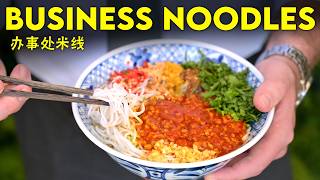

Why Are These Called Business Noodles?
44sThe intriguing name origin story sparks curiosity and is perfect for a hook.
▶ Play Clip"The title accurately describes the dish and the video delivers a full recipe and office lunch prep guide."
This video explores the Dai people's 'Business Noodles' (办事处米线), a dish from the Yunnan province featuring mixed rice noodles with a tomato-chili meat sauce and various toppings. The name humorously references government offices and big events like weddings, where these noodles are served. The video provides a detailed recipe and tips for preparing the dish at home or for a work lunch.
The dish consists of mixed rice noodles with a tomato-chili meat sauce and toppings like deep-fried garlic oil, fresh chilies, peanuts, and herbs. It originates from the Dehong region in Yunnan province.
The Chinese name 'banchertroum' translates to 'office' but refers to places where things get done, like government offices or events such as weddings and funerals. The name is a joke, as these events often turn into parties where noodles are served.
To make Dai-style garlic oil, fry onion and cilantro roots in oil until golden, then remove. Add minced garlic, ginger, salgull, black cardamom, and star anise, frying until garlic is golden. Reserve spices for later.
The traditional Dehong Dai-style chili sauce is hard to find. Substitute with a mix of tomato paste, Pixiandoubanjiang (Sichuan chili bean paste), and Hunan dojiao (fermented chilies).
Fry minced pork in garlic oil, then add the sauce substitute and chopped tomatoes. Cook until tomatoes break down, then add a starch slurry with seasonings like soy sauce, dark soy, oyster sauce, MSG, salt, and chicken bouillon powder. Thicken and set aside.
For a fresh serving, combine rice noodles with salt, MSG, Sichuan pepper powder, chili flakes, sauce, garlic oil, peanuts, minced garlic, fresh chili, and herbs like culantro and cilantro.
Use dry Vietnamese rice noodles. Soak in cold water for an hour, boil for 30 seconds, rinse in cold water until slippery, drain, and refrigerate overnight.
Garlic oil keeps for a month in the fridge; sauce keeps for half a week or frozen. Combine sauce and garlic oil in a bag. Pre-chop garlic, chili, and herbs, and mix peanuts with seasonings.
To revive refrigerated noodles, pour hot water over them for 15-30 seconds, drain, then microwave the sauce and assemble with toppings.
Business Noodles are a flavorful, customizable dish that can be prepped in advance for a quick office lunch. The key is preparing the sauce and garlic oil ahead, and using the 'mowing' technique to revive refrigerated rice noodles.
What is the Chinese name for 'Business Noodles' and what does it literally mean?
The Chinese name is 'banchertroum', which literally means 'office' or 'the place that shit gets done'.
00:44
What are the key components of the Dai-style garlic oil?
Oil, onion, cilantro roots, minced garlic, ginger, salgull, Chinese black cardamom, and star anise.
02:32
What is the traditional hard-to-find ingredient in the tomato chili meat sauce?
Dehong Dai-style shangladang chili sauce, a fermented mix of soybean, split peas, rice, and chilies.
03:47
What three ingredients are used as a substitute for the traditional chili sauce?
Tomato paste, Pixiandoubanjiang (Sichuan chili bean paste), and Hunan dojiao (fermented chilies).
04:00
How long should you fry the minced pork before adding the sauce?
About five minutes, until almost starting to brown and releasing oil.
04:26
What is the slurry mixture added to the sauce?
One tablespoon starch mixed with 1.25 cups water, plus seasonings: soy sauce, dark soy, oyster sauce, MSG, salt, and chicken bouillon powder.
05:39
How do you prepare dry Vietnamese rice noodles the night before?
Soak in cold water for 1 hour, boil for 30 seconds, rinse in cold water until cool and slippery, drain, and refrigerate.
07:53
How long can garlic oil be stored in the fridge?
About a month.
08:59
What is the 'mowing' technique for reviving refrigerated rice noodles?
Pour hot water over the noodles, submerge and jiggle for 15-30 seconds, then drain well.
09:54
Name Origin
Explains the humorous cultural context behind the dish's name, linking it to government offices and celebratory events.
00:44Ingredient Substitution
Provides a practical substitute for a hard-to-find traditional ingredient, making the recipe accessible.
03:34Office Lunch Prep
Offers a complete strategy for preparing and assembling the dish at work, including noodle revival technique.
07:27Noodle Revival Technique
Demonstrates a simple method to restore texture to refrigerated rice noodles using hot water.
09:54[00:00] So these are the die people's business noodles, banchertroumixien. And what they are, some mixed rice noodles, together with a tomato-y chili meat sauce, and a tiny smorgasbord of various toppings, including some deep fried garlic oil, spicy
[00:15] fresh chilies, peanuts, and a nice handful of herbs. It's a dish from around Dihong in the Yunnan province, and this combination tomato-chilli garlic peanut. It's just such a classic profile there that you could really kind of think of it as their
[00:30] holy trinity. But like, why are they called business noodles? Now, okay. The Chinese name here, banchertroum, directly translated, kind of means office, but it's not a physical office.
[00:44] Like, your company might have a Hong Kong representative office, or maybe the government in China, they have regional offices. But translating it directly, character by character, it literally just means the place that shit gets done. And simultaneously, around Dihong, but also elsewhere,
[01:01] big personal events, stuff like weddings or funerals, they're often referred to as having to banchert, or get something done. But coming from a die-cultural background, a little like their cousins
[01:15] down in Thailand, those kind of events, they inevitably turn into a big party, they sometimes get a little sloppy. And so these noodles, they're often at these kind of events because they're the
[01:27] kind of thing that the guests, they can just kind of mix themselves. So the name, it's basically a big joke. It's named after a very serious government office, you're ostensibly doing something serious
[01:39] like a wedding, all while you're slugging down a bottle corn by jail and downing these noodles. But I mean, at the same time, I really am not interested in pulling a rug. Our tight-on thumbnail,
[01:52] they do say business noodles and I'm gonna keep that promise. So in what is now our second lunch time integration initiative video, we are gonna show you how you can eat this for lunch at your place of
[02:08] business because like the sauce, it's nuccable, the toppings, they're baggable, and the rice noodles are of course eminently malleable, a Chinese technique that can revive fridged rice noodles that
[02:20] will show you a bit later in the video. But whether you're in your office or just for dinner, let's talk components, and one of the fundamental components in a lot of die-unite cooking,
[02:32] like a lot of Southeast Asian cooking too, is garlic oil. Now to make the die version, to a walk, first just toss in a half a cup of oil, an eighth of an onion, and a couple cilantro roots
[02:44] if you happen to have some on hand. Fry those over a medium flame until the onion is nice and golden or about 10 minutes, then shut off the heat and remove those two things. Then to that oil, just toss
[02:57] in four cloves worth of minced garlic, one inch of smashed ginger, one salgull, a Chinese black cardamom, and one star anise. Then just swap the flame to medium low, and let those fry until the garlic
[03:09] is just barely starting to get golden about 45 minutes. Then just shut off the heat, let that garlic continue to fry with the heat off for another minute. Then remove and reserve those spices, we'll
[03:21] still use those guys a little later on in the recipe. But then just transfer the garlic oil to a bowl and reserve, which will then bring us to our tomato chili meat sauce. Which we are going to need a
[03:34] quick aside, because the tomato chili meat sauce is very much the whole essence of this whole thing, but unfortunately it traditionally relies on one ingredient that is going to be 100% impossible
[03:47] for you to find. Dihong die style shangladang chili sauce, which is a rich fermented mix of soybean split peas, rice, and a whole bunch of chilies. It's really kind of hard to find here even in
[04:00] central Yunnan, so we'll obviously need to substitute it. So instead, what we're going to use is a mix of one tablespoon each tomato paste, pixiandobanjang, Sichuan chili bean paste, and Hunan dojiao chop
[04:14] fermented chilies. The last guy you could also sub for a simple oil if you need it. So with that sorted then, straining in four tablespoons aka a quarter of a cup aka half of our garlic oil back
[04:26] into the wok. Over a medium high flame, start to fry 250 grams worth of minced pork. Fry that for about five minutes or so, or until things are almost starting to brown and rerelease of touch that oil.
[04:38] Then heat off, scooch that up the side of the wok and let a bit of the oil drain off, and then we'll add in our sauce substitute, which is up here on the screen in case you forgot. Then over a low flame,
[04:50] fry those three things together until the oil stained nice and red, or about two minutes, then mix everything back together and add in some chopped tomato. This here was 450 grams worth of tomato, little x cut in, blanched peeled stem removed, chopped into a rough mince, and then fast-forwarded,
[05:08] tossed in with our sauces. Then a nice mix now, add back in those spices that we reserved from before, and fry that all over a medium flame for about 10 to 15 minutes, which after that time your
[05:21] tomatoes should be good and broken down, and starting to fry in a bit of that red oil once again, and it's at this point that we'll add in a slurry. But, slurries, over in die land, might be a little different than you might be used to. So this was one tablespoon of starch,
[05:39] so far, so familiar, but then that's mixed in with a cup and a quarter of water. And then it's to that mix that we'll also add in our seasoning, two tablespoons soy sauce, half teaspoon dark soy for color, half tablespoon oyster sauce, quarter teaspoon MSG,
[05:54] and an eight teaspoon each salt and chicken bouillon powder. Mix that all real well, and then you'll toss that into your sauce. Let it continue to cook for about three to four minutes, or until it's
[06:06] all thickened your liking, or something like this is about perfect. Then remove, reserve, and the sauce itself is done. Now that when it comes to the lunchtime integration, and with your office, that sauce
[06:21] and that garlic oil, those are what you should definitely prep up in advance. You can bag them, they can keep. But before we delve down into the workplace means, let's just show you how you could
[06:33] whip up a bowl real quick if you decided to eat it fresh the day of. So to one serving of rice noodles, 230 grams fresh or 120 dried, to that toss in an eight teaspoon each salt MSG citron pepper powder,
[06:46] one teaspoon chili flakes, preferably a toasted or smoked sort, and smother over a third of a cup of your sauce. Then drizzle over a tablespoon of the garlic oil together with the fried garlic that's
[06:58] inside, a tablespoon of chopped roasted or toasted peanuts, one clove of minced garlic, one chili worth of a minced spicy fresh chili, and a bit of herbs. 10 grams chopped coolantro, and you could
[07:12] just swap that for cilantro if you can't find coolantro, and 10 grams of, well, cilantro. And then with that, now you've got yourself a nice bowl of dye business noodles. Just mix it well, devour, and now
[07:27] I'll hand it off to Steph who's going to teach you how you can prep this for your office. So first things we need to discuss that Chris just can glance over its rice noodles because rice noodles
[07:39] comes in such a variety. Fresh, different from dry, and there's also semi dry. The rice noodles in Yunnan are different from the ones in Guangdong which are different from Jiangxi. So for ease of
[07:53] international replication, we are using the dry Vietnamese rice noodles which are very similar to dry Yunnan rice noodles. You can also use the other common brands of the Vietnamese rice noodles.
[08:06] They all work great. So the night before work, you want to cook your rice noodles first. So just soak them in cold water until they are softened about an hour, and then quickly toss it in boiling
[08:18] water to cook it until al dente for about 30 seconds. And after that time, you do want to rinse it right away. So toss it in cold water and keep on lifting and jiggling it until it completely cools down.
[08:32] This process will take about 2-3 minutes and you can actually feel the texture of the rice noodle changing in your hand, especially when it's starting to get slippery. Then after rinse it, let it
[08:45] drink on the side and when the surface of the rice noodles is not wet anymore, you can back it up and keep it in the fridge. Now we've stored our sauce and garlic oil. The garlic oil can stay well
[08:59] in the fridge for about a month and the sauce can keep well for half a week or forever in the freezer. But when bringing it to work, you can combine both in one bag so just take about a third of a cup
[09:13] of your sauce in a bag and top it off with one tablespoon of the garlic oil and tie it up, keep it in the fridge. Next is the rest of our toppings. So again, the night before quickly chop up some
[09:26] garlic, fresh chili, cilantro and cilantro and toss them all into a little baggie. Then separately, mix the chopped peanuts with all the seasonings up here on the screen as a reminder and that's all
[09:41] of the prep for our lunch next day. Then the next morning, just pack everything up, bring it along and keep it in your work fridge. Then for lunch time, when you want to eat it, you will notice that the rice
[09:54] noodles staying in the fridge is kind of hard and actually not good. So now you can revive them by using the technique of mowing. So what you do is pour in some hot water from the water kettle or even
[10:10] from the hot water button from the water dispenser and submerge the rice noodles jiggle to loosen it up for about 15 to 30 seconds and then you can drink the water well and now your rice noodle will be bouncy
[10:26] again and ready to be mixed. So then just nuke your sauce until it's warm or kind of room temperature up to you. Toss it onto your rice noodle together with the rest of the topping and now you can make all
[10:40] your co-workers jealous while they are having tuna and you are having some authentic rice noodles with flavors straight from the China Myanmar border.

⚡ Saved you 0h 11m reading this? Transcribe any YouTube video for free — no signup needed.