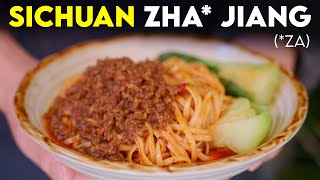

Why Sichuan Za Jiang is NOT Zha Jiang
45sThe surprising linguistic difference between Beijing and Sichuan noodle sauces hooks foodies.
▶ Play Clip"Delivers exactly what the title promises: a clear, detailed Sichuan meat sauce noodle recipe."
This video teaches how to make authentic Sichuan-style Zajiang Mian (meat sauce noodles), highlighting the unique 'Za Jiang' sauce made from Pixian doubanjiang and sweet bean paste. The presenter explains the difference between Beijing Zha Jiang and Sichuan Za Jiang, and demonstrates both mixed (ganban) and soup noodle preparations.
There are Beijing, Korean, Cantonese, and Sichuan styles. Today focuses on Sichuan Za Jiang.
Sichuan Za Jiang is a noodle topping called Saozi, used in dishes like red braised beef noodle soup and Dandan noodles.
Beijing 'zha' means fry; Sichuan 'za' means miscellaneous, reflecting a combination of sauces.
Pixian doubanjiang (chili bean paste) and Tianmianjiang (sweet bean paste) are essential. Mince doubanjiang to avoid broad bean chunks.
Northern sweet bean paste differs; Cantonese Minsi (ground bean sauce) is a closer substitute.
Render lard from fatty pork until lightly brown and tender, not crisp – called 'Gan Xiang You Ren'.
Mix some rendered lard into the sauces first to prevent scorching and ensure even mixing.
Includes garlic water, dark vinegar, Sichuan chili oil, Sichuan peppercorn powder, sesame oil, soy sauce, salt, MSG, and stock or water.
Sichuan Za Jiang Mian is a versatile and flavorful noodle dish that can be served mixed or in soup, with a complex meat sauce that also pairs well with rice. Master the sauce and customize with your preferred noodle style.
What does 'Za' mean in Sichuan Za Jiang compared to Beijing Zha Jiang?
'Za' means miscellaneous, reflecting a combination of sauces; Beijing 'zha' means fry.
01:12
What two fermented sauces are essential for Sichuan Za Jiang?
Pixian doubanjiang (chili bean paste) and Tianmianjiang (sweet bean paste).
01:39
What is a good substitute for Sichuan Tianmianjiang if unavailable?
Cantonese Minsi (ground bean sauce) is a closer substitute than northern sweet bean paste.
02:10
What does 'Gan Xiang You Ren' describe in the cooking process?
It describes the pork when it is lightly brown and tender but not crisp, after rendering lard.
03:48
How do you prevent the sauces from scorching when adding to the wok?
Mix some of the rendered lard into the sauces before adding them to the wok.
04:01
What are the two ways to serve Sichuan Za Jiang Mian?
Mixed (ganban) style or soup noodle style.
05:14
What base seasoning ingredients are used for the mixed noodle version?
Garlic water, dark vinegar, Sichuan chili oil, Sichuan peppercorn powder, sesame oil, soy sauce, salt, MSG, and stock or water.
05:26
Za Jiang as a Versatile Saozi
Highlights that Sichuan Za Jiang is not just a noodle dish but a versatile topping used in various Sichuan dishes.
00:31Etymology of Zha vs Za
Explains the linguistic difference between Beijing and Sichuan styles, adding cultural context.
01:12Achieving Gan Xiang You Ren
A key technique for texture in Chinese cooking; knowing when the pork is perfectly rendered.
03:48Lard-Sauce Mixing Technique
A pro tip to prevent scorching and ensure even distribution, applicable to many sauce-based stir-fries.
04:01Versatility of Za Jiang
Emphasizes that the sauce can be used beyond noodles, e.g., on rice, showing its value in meal prep.
06:57[00:00] There's Beijing style Zha Jiang, Korean style Zha Jiang [Jajang], Cantonese style Zha Jiang [Zaa Zoeng], and today I'm going to show you the Sichuan style Za Jiang. Notice though that it's ‘za’ instead of ‘zha’… but I'll get to that in a sec. Unlike Beijing Zha Jiang or Korean jajang
[00:18] though, Sichuan Za Jiang is less of a specific noodle dish, but more of a general noodle topping called Saozi. If you ever had a Sichuan style red braised beef noodle soup, the beef there, it's a
[00:31] Saozi. The minced pork on top of a Dandan? Also a Saozi. And that's basically the same idea with our meat sauce here today. It is a star for one specific noodle dish, the Chongqing Wanzamian, but
[00:46] it can also top various noodle shapes, it can be a mixed noodle, it can be a soup noodle... Sichuan Zajiang is just very versatile. Now the basic way you make a Zajiang is a lot like
[00:59] Beijing or Cantonese style. You render out some lard from fatty pork and then you fry the sauces in it. But notice the difference in character here. For Beijing it's zha jiang – ‘zha’ means
[01:12] ‘fry’ and basically you are frying the sauce in the render out our lard and that's the essence there. However, in Sichuan and Southwest Mandarin in general, it's “Za Jiang”, or “miscellaneous
[01:26] sauce”. Why that is, we'll have to leave it to the historical linguists. We cannot find anything conclusive here. However, “Za” does kind of tell the essence of the Sichuan style style zajiang
[01:39] because it is a heavy combination of two local fermented sauces, chili bean paste and Sichuan style sweet bean paste. Now, chili bean paste – Pixian Doubanjiang – needs no introduction. It's a
[01:53] classic in a lot of Sichuan dishes. So, just make sure that you mince your chili bean paste well so that you don't have big chunks of broad beans floating around in your sauce. The second one, Sichuan style sweet bean paste, Tianmianjiang, has a couple considerations though. Annoyingly,
[02:10] the northern style sweet bean paste, which is the one that's usually available abroad, tastes quite different from the Sichuan one, and it's not a direct substitute here. Much closer to what the Sichuan one tastes like in our experience, it's the Cantonese Minsi, ground bean
[02:28] sauce. You can use it here in this application or you can try our convoluted substitute here for those truly obsessives or you can just directly buy a pack from Weee or Mala market. It's a nice
[02:43] ingredient. So with the sauces in place, we can fry up our Za Jiang. To do so, first drizzle in a tablespoon of oil and then go in with 500g of ground fatty pork. It will be best if you can
[02:56] use a coarser grind because coarser and slightly bigger chunks can help you get a smoother and more tender final sauce texture. But in a pinch, you can also use the fattiest ground pork that you can
[03:11] find. Then over a medium flame, slowly render out our lard, which does take a little bit of time, and we can think of it as three stages. First, fry it until it starts to get loose and flow off
[03:23] your spatula, which takes a couple minutes. After that time, it will start to reach its annoyingly-sticking-to-the-wok stage. When that happens, just patiently scrape off anything
[03:35] that's sticking, and you can add a little extra oil if you need. After about 5 minutes or so, the pork will begin to release as lard and fry. And in this stage, what you will be looking for is
[03:48] something like this: lightly brown but not crisp, [you don’t want it to] get hard… and as they call it in Sichuan, “Gan Xiang You Ren”. Now a good technique for adding sauces into the Za Jiang,
[04:01] especially for the Sichuan version, will be adding some lard into the sauce and mix well first. This way, it can help the sauce mix more evenly as well as prevent scorching.
[04:13] So now fry it for about a minute to tint our oil red first… then add in our tianmianjiang. Fry all together for another 2 minutes or so… Then we can add in half cup of stock. Let it simmer together
[04:28] for about 3 minutes. Then add in the seasoning of 1/4 teaspoon salt plus half teaspoon each MSG, white pepper, and sugar. Mix well. Then add in 1 tbsp liaojiu aka Shaoxing wine.
[04:42] Let it simmer for a minute and then we can thicken. Just slowly drizzle in a slurry of one tablespoon potato starch and two tablespoons water bit by bit. Let it come together to a consistency
[04:56] a bit like this. Then reserve it in a bowl. Now let's make the noodles. And again in Sichuan there are usually two ways that you will see Za Jiang Mian – ‘ganban’ [mixed] or a soup noodle. Either way you want, it will be most delicious if you have some stock handy. But for the dry mixed
[05:14] ganban version, the stock is optional. So to make the mixed version, we'll put the base seasoning into the noodle serving bowl first, which is one teaspoon garlic water, half teaspoon Chinese dark
[05:26] vinegar, half tablespoon Sichuan chili oil, 1/4 teaspoon Sichuan peppercorn powder, 1/4 teaspoon toasted sesame oil, half tablespoon soy sauce, 1/8 teaspoon each salt and MSG, and 1/4 cup
[05:40] stock or water. Then boil 60 gram dry noodles per serving together with a couple pieces of baby bok choy. When they're done to your liking, place it neatly into the noodle serving bowl. And finally,
[05:52] top it with two to three tablespoons of your Za Jiang, a bit of scallion, and cilantro. And that's that. For the soup noodle, the base seasoning is the same, but the stock is mandatory. Now,
[06:06] at noodle shops, they will usually have a simple pork bone stock handy, and we show you how to make one way back in our red braised beef noodle soup video. And we'll also leave you a simple recipe in
[06:18] the description. But for me today, I'm going to use our personal concentrated frozen stock from our cool little ice cube bags and add some hot water to it and make a very nice quick stock.
[06:30] Then, same as the mixed noodle, put all the seasoning into the serving bowl first and then add in the stock. And next, cook the same 60g dry noodle per portion, plus some baby bok
[06:43] choy. Carefully place the noodles and veg into the soup. And top it off with a couple tablespoons of our delicious Sichuan Za Jiang. And there you have it, Sichuan Za Jiang Mian, mixed or soup,
[06:57] however you like it. Right. This is how you make Sichuan style Za Jiang… and this jiang, it's probably my personal favorite because it has a very nice and complex flavor and it's
[07:09] really versatile. It's just so good even just on some leftover white rice. And as promised, in a couple days, Chris will show you how to make a weirder version of Zha Jiang. So
[07:23] stay tuned. And in the meantime, recipe’s in description box. A big thank you for everyone that's supporting us on Patreon and subscribe for more upcoming weird sauce videos.


⚡ Saved you 0h 07m reading this? Transcribe any YouTube video for free — no signup needed.