
Gruel: From Slop to Superfood?
45sChallenges common negative perceptions of gruel, sparking curiosity about its historical and cultural significance.
▶ Play Clip"Delivers on the promise of teaching you to love plain rice gruel, with personal anecdotes and detailed recipes, though some might find the title slightly hyperbolic."
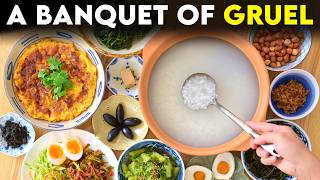
This video explores the culinary and cultural significance of plain rice gruel, known as 'mue' in Chaozhou, China, and 'khao tom kui' in Thailand. The host shares his personal journey from skepticism to appreciation, explaining how this simple, unseasoned dish serves as a palate cleanser and comfort food, especially in hot weather. The video also provides detailed recipes for a complete mue meal, including accompaniments like pickles, an omelette, stir-fried vegetables, and a Thai wing bean salad.
Gruel is defined as a simmered cereal grain in water, likely predating agriculture. It is similar to porridge but thinner and drinkable. In the West, it's often associated with poverty and the premodern era, but the host argues it may be a culinary loss.
In the Fujian and Chaozhou regions of China, a thin, unseasoned rice gruel called 'xifan' or 'mue' is a staple, served alongside salty/umami dishes. It acts as a palate cleanser, balancing strong flavors.
The host finally appreciated mue during a hot season in Bangkok, where it is known as 'khao tom kui'. The room-temperature, hydrating nature of the gruel made it the perfect side starch in muggy weather, punctuating strong flavors and refreshing the palate.
Chaozhou immigrants significantly shaped Bangkok's food culture. Many Thai-Chinese restaurants serve dishes that are essentially old-school or localized Chaozhou cuisine, including mue/khao tom kui.
For a milky mue, use starchy short-grain rice (e.g., Northeast Chinese or Japanese style). Wash 80g of rice, bring 1.6L (20 parts) of water to a boil, add rice and a spoon. The spoon helps jostle the rice, creating a milkier texture. Simmer for 20 minutes with a lid crack to prevent overflow.
Mue can be eaten hot in winter or cooled down in summer. It's often served room temperature, which is refreshing in hot weather. The host recommends making it first and letting it cool while preparing other dishes.
Classic accompaniments include fried peanuts, Chinese olives (ganlan), ganlancai (preserved mustard greens with olives), preserved radish (caipu) fried with lard and sugar, fermented bean curd (furu), and salted eggs. The host prefers eating pickles and mue in a 'one-two punch' to avoid 'mue pollution'.
A classic Chaozhou home dish. Mince 20g preserved radish and one garlic clove, fry in lard until fragrant, then mix with four beaten eggs seasoned with MSG and white pepper. Cook as an omelette, flipping when 80% set.
Classic vegetables include jute leaves or sweet potato leaves, but water spinach (ong choy) is a good substitute. Snap off fibrous ends, wash thoroughly, and stir-fry with lard, garlic, and 2 tbsp of puning doujiang (fermented soybean sauce). Season with sugar and MSG.
A Bangkok expat favorite. The key ingredients are wing beans (or substitutes like celery), Thai chili paste (nam phrik phao), and evaporated milk. Blanch sliced wing beans, mix with cooked minced pork, chili paste, sugar, MSG, fish sauce, lime juice, chili, onion, and evaporated milk. Garnish with cabbage, carrot, and a boiled egg.
In the Chashan area, a variation uses sweet potato to stretch scarce rice. Mince sweet potato and boil with a little rice to create a filling gruel.
Plain rice gruel (mue) is a versatile and comforting dish that shines as a palate cleanser and hydrating side, especially in hot climates. By pairing it with salty, umami-rich accompaniments, it becomes a genius culinary concept worth embracing.
What is gruel definitionally?
A simmered cereal grain in water, so simple it likely predated agriculture.
00:26
What is the difference between gruel and porridge?
Gruel is liquid and drinkable, while porridge is thicker.
00:39
What is 'mue' in Chaozhou?
A thin, unseasoned rice gruel served as a staple starch alongside salty/umami dishes.
01:28
Why did the host finally appreciate mue?
During a hot season in Bangkok, the room-temperature, hydrating nature of mue balanced strong flavors and was comfortable in muggy weather.
03:48
What is the water-to-rice ratio for mue?
20 parts water to 1 part rice (e.g., 1.6L water for 80g rice).
08:27
Why add a spoon to the pot when cooking mue?
The spoon jiggles and jostles the rice, helping to break down the exterior and create a milkier texture.
08:44
What is 'ganlancai'?
Preserved mustard greens cooked with Chinese olives and jarred up.
10:52
What is the key ingredient in the Thai wing bean salad?
Nam Phrik Phao (Thai chili paste) and evaporated milk.
17:30
What is the sweet potato mue variation?
Mince sweet potato and boil with a little rice to create a filling gruel, used when rice was scarce.
19:22
The Epiphany in Bangkok
This personal story illustrates how context (hot weather) can transform one's perception of a simple dish.
03:48The Spoon Trick
A practical cooking technique that uses a spoon to jostle rice, creating a milkier texture without constant stirring.
08:44Avoiding Mue Pollution
The host's method of eating pickles and mue in a 'one-two punch' highlights the cultural etiquette of preserving the gruel's purity.
11:33Critical Ingredient: Nam Phrik Phao
Emphasizes the importance of Thai chili paste in the wing bean salad, showing how a single ingredient can define a dish.
17:30Sweet Potato Mue
A historical variation that shows resourcefulness during rice scarcity, adding depth to the understanding of mue.
19:22[00:00] So I think when I say the word gruel, for a lot of you your mind's going to be jumping to something like… “you're serving us gruel?!?”. That is, it's slop, pig feed, poor people food… the mush that
[00:12] you'd get at the orphanage, the workhouse, but the association above all, I think, is with the premodern. And maybe in fairness, I mean, gruel it definitely is an old, old food: I mean,
[00:26] by some measures it's the original food. What it is definitionally is some sort of simmered cereal grain in with water - it is so simple that it probably predated agriculture. Now gruel, it
[00:39] should be said, is similar to but different from a porridge: a gruel is liquid and it's drinkable and porridge? I mean, we still have porridge for breakfast. But gruel, in the west I think,
[00:52] I think it's fair to say that it's starting to get to be a bit of an endangered species. But like, is that actually a culinary loss? Now, by the end of this video, I'm going to leave that up to you.
[01:04] But over here in China, at least, if you're familiar with Chinese food, you probably know about rice porridge, aka congee, aka Juk, aka Zhou. Now, we've covered Cantonese congee on
[01:16] this channel before, but from there, if you kind of move up the coast north a little bit to the greater Min area of Fujian and Chaozhou, you can find something that's a little bit interesting.
[01:28] There, their staple is something called Xifan or Mue, and it looks a lot like a congee, but it's a lot thinner. And it's unseasoned. And it's drinkable. What you're looking at is a rice gruel.
[01:47] Now, I should probably warn you guys that this stuff, it uh it really is quite bland. I mean, there's a reason why travelers to China usually don't come back home raving about the unseasoned
[02:00] rice gruel of Fujian and Chaozhou. And for the longest time, I didn't really get it either. But trust me that this stuff, it is actually genius. And these days, it's one of my go-to ways of eating rice. So now the way to think about this is that in that region, this is traditionally
[02:19] their equivalent of a bowl of white rice, the staple starch that you'll have next to your meal practically every single day. Now, you can find that kind of practice in pockets around the country. But for me, living practically my entire adult life in Guangdong,
[02:36] it's most synonymous with here, the city of Chaozhou, where it's called mue. So what you'll do in Chaozhou is you'll serve your mue alongside some salty/umami
[02:48] snacks and dishes... and you could kind of almost think of the plain gruel as a pallette cleanser. So like you've got something like this. These are ganlan or Chinese olives, and they're actually a pretty intense ingredient. But what you can do is you can eat them next to and interspersed with the
[03:04] mue: ditto with stuff like preserved daikon, fried peanuts, salty omelets, fish cooked in seawater (very traditionally)… stuff that is a little strong, a little salty and these days in Chaozhou,
[03:18] they'll even have these entire banquet concepts that are centered around that simple idea. So that's the context. But even then, for most of my years here in China, it never really clicked. Like
[03:30] I still loved Chaozhou food. I mean, their Loshui Master Stock is probably my personal favorite variant, and we do still need to really, really cover their Guorou. But this specific aspect of it, it was never really my thing. And so it wasn't until the first year that we lived down in Bangkok
[03:48] in the depths of my very first hot season that the puzzle pieces finally started to come together. Because this stuff in hot, muggy weather, this is the most comfortable side starch
[04:00] that you can possibly have. Now, before I get into why, I suppose I should back up and explain real quick why there is unseasoned Chaozhou style rice gruel in Bangkok of all places. So,
[04:17] simply put, Chazhou is to Thailand what Sicily or Naples is to New York City. Immigrants from Chaozhou really helped forge what we know of today as Bangkok. So, if you went to Bangkok's Chinatown
[04:31] and you got some Thai Chinese food, what you'd be greeted by is stuff that is pretty much old school Chaozhou dishes or localized Chaozhou dishes, that kind of thing. But then even outside of Chinatown,
[04:44] there's a lot of restaurants in Bangkok that are run by Chaozhou descendants and they can serve up a real mix. So you might be able to find some olive pork that wouldn't be too too out of place in Chaozhou next to some Thai Chinese stuff like Chinese sausage yam,
[05:00] all together with things that might be a lot more synonymous with central Thailand like Tom Kha Kai or deep fried shrimp cakes. And at a lot of these restaurants, they'll also have mue or as it's called in Thai, called them Khao Tom Kui. And so it's here at this patio at our neighborhood
[05:19] restaurant in Dindang called Jae Lek that I was eating a central Thai wing bean salad...and mue finally clicked for me. So how to explain this first? Often the mue it's served room temperature.
[05:34] So on a hot day, it's just really nice and hydrating, but also importantly, like we were talking about before, it also really helps balance a meal that has strong flavors. And like I don't know about you, but when it is muggy as hell, when I'm sweating bullets,
[05:49] it's often not all that comfortable to really load up on rich dishes or salty dishes or spicy dishes. But the plain me kind of punctuates those flavors, clears the mouth, lets you go on fresh.
[06:03] Now, you'll definitely need to try this yourself, but I just think it's really nice in the context of a hot summer meal. And so, given that we have a super El Nino barreling down on us,
[06:16] and given that this summer is hot, and given that nevertheless it is going to be the coldest summer for the rest of your life, I do think it's time to teach you the genius of Mue. So,
[06:30] mue together with how to assemble the pickle spread as you'd see it in Chaozhou. Then, we'll show you a basic preserved daikon omelette and a Chaozhou style fried vegetable
[06:44] so that you can make a full proper mue meal just like you'd see it in Chaozhou. But then lastly, I also wanted to do something a little bit weird. Because that wing bean salad was such an
[06:56] important dish for me in my mue journey, I really wanted to show you that one too. Now, years ago, uh, we asked Jae Lek how they made theirs, and they invited us back into the kitchen. We got some
[07:09] basic cell phone footage that I've been sitting on for a while... and I do really like the thing with Mue. Now, I should say that in an actual Thai context, I think most people would point to dishes like omelets or the aforementioned olive pork to go along with their Khao Tom Kui. So,
[07:26] this is a little bit me out on my own limb, but if you're still iffy on this whole unseasoned rice gruel concept, definitely try it with a mix of Chaozhou and Bangkok flavors,
[07:39] preferably in the dead heat of summer, because that is really what it ended up converting me. So, to make our mue then first, let's talk rice. So, for a nice and milky mue, what you're going to
[07:52] want is some sort of starchier short grain rice. Today we're using the rice from the northeast of China, which is probably the most common move in Chaozhou today, of which Japanese style rice would be an extremely close match. Now, down in Thailand, they'll obviously use their Thai
[08:09] jasmine rice, so to split the difference starch-wise, often they'll add a little bit of sticky rice into their mix, and you could totally do that too if you wanted. So, then just wash your rice. This was 80g worth for two people. Then bring 1.6 L. that is 20 parts water to a boil
[08:27] and then toss that in together with a spoon. Now, I should say that the spoon thing, it's kind of a little bit more of a Cantonese thing than a Chaozhou thing. So, you could definitely consider optional, but there's a pretty cool reason for the trick. And that's because in Chaozhou, they often
[08:44] really really emphasize stirring the rice as it's cooking. What'll happen is that when stirring, the very exterior of the rice is going to slightly break down a touch and leave you with a milkier
[08:57] end result. We've even seen one dude that insists on 365 stirs. But with the spoon, what's going to happen is that it'll kind of jiggle around when it's boiling and then it'll
[09:09] functionally sort of jostle the rice for you. Now, we'll still need to stir it a bit, but definitely not 365 times. So then let it come up to a heavy simmer. But definitely do remember to leave a big
[09:23] crack on the lid. Gruels, congees like this are infamous for overflowing into a kitchen disaster. And again, you are still going to need to stir this thing occasionally, maybe once every 4 to 5
[09:36] minutes or so. But no matter what, do not leave the room. Watch that thing like a hawk to make sure that it's not overflowing. If you do see it overflowing, don't panic. Just kind of open it up,
[09:48] stir it vigorously, put it back down. But no matter what, let that simmer for 20 minutes in all. Then heat off. And then you've got two ways that you can eat this. First, if it is
[10:00] winter and you do want something hot, you can eat the thing straight away. But if it's summer, again, it can be a really nice idea to let that thing cool down. So, what you can do when you're cooking is make your mue first, then you can set that aside, let it cool down
[10:15] while you're making everything else. Now, to eat this, we did make a couple dishes today, but I did want to talk about the pickles first. So, this was our spread. Here we've got some
[10:27] fried peanuts, which I know aren't exactly a pickle, but they are pretty classic here. Then, we have the aforementioned Chinese olive, which is a pickle. And while they're not actually related,
[10:39] I do think that some nice briny western olives would also be really nice in this context, too. Then there's this stuff, ganlancai, which is an awesome ingredient - definitely my favorite of
[10:52] the spread. What it is is some preserved mustard greens cooked together with that Chinese olive and then jarred up. I really suggest this one. Then we have some preserved radish, caipu as it's called in Chaozhou. This guy, it was fried in with a little bit of lard and seasoned
[11:09] with some sugar - recipe for that is down in the description box if you want it. Then we'll also have some furu fermented bean curd and of course a couple of salted eggs. Now, there's a couple ways
[11:21] that you can do this. I've seen some people just kind of load stuff up into their bowl, but for me personally, I kind of like avoiding mue pollution. So, the way I was taught to avoid it was this.
[11:33] First you have your olive vegetable in one hand. Then you'll immediately (ish) gulp the mue. So… Now that kind of one two punch I'll usually just do with the pickles. With proper dishes I'll just
[11:50] kind of eat them a little bit more relaxed and normally… and so speaking of which, let's show you this omelette. So this guy, Caipu Jiandan, it's probably one of the most classic home cooking
[12:02] dishes in Chaozhou because most people sort of like the world over, they'll have some eggs lying around their kitchen. But in Chaozhou, they'll practically equally also have some Caipu,
[12:14] so it's pretty straightforward to just smash the two together. So to make it, first just mince 20g of your preserved radish together with one clove of garlic. Set those aside. And then to a hot wok,
[12:26] toss in a half tablespoon of lard and give it a good swirl. Fry your garlic over medium until it's fragrant, about 15 seconds. Then toss in the caipu. Then fry that all together until the caipu
[12:38] is toasted with some light brown bits. And set that aside to cool down. Then crack four eggs to a bowl. And then to that, toss in an eighth teaspoon each MSG and white pepper. Whisk that super well,
[12:52] really beating the snot out of it. until no stray strands of egg white remain. Then mix in the fried caipu and garlic mixture… and now we can make an omelette. So to a hot wok, swirl in a tablespoon
[13:05] half of lard and give that a good swirl to get a nice non-stick surface. Then flame on medium high now, pour in your thoroughly whisked egg. Then begin to give it all a bit of a scramble. Once
[13:17] it's about 80% set strings, give or take, evenly spread the thing out and let it fry. If you're on a round bottom wok like us periodically turn it to make sure that everything is cooking evenly, then
[13:32] once it's no longer runny, about 3 to 4 minutes, flip. Let the other side brown for about 2 minutes or so for the sake of good-looking... then out and garnish with a little bit of cilantro.
[13:47] Then for a vegetable, for me at least, I'd consider the two most classic vegetables to go along with a Chaozhou Mue to be first, maye or hemp leaves [jute, actually], then second fanshuye or sweet potato leaves. Neither of which are available where we live in Yunnan,
[14:05] unfortunately. So instead, we're going to be using water spinach, aka Ong Choy. Now, if you haven't worked with Ong Choy before, a little bit like asparagus, they kind of have these fibrous ends. So, just like asparagus, find the point where the fibrousness begins,
[14:22] snap it there, and then you can discard that or alternatively save it for stews and other dishes. Then take the remainder and then snap them into two inch sections and set them aside. Now,
[14:36] Ong Choy, it loves to hide a whole bunch of little dirt and schmutz inside of it. So, do really make sure to do a bang-up job washing that and then let it drain.
[14:48] Then the flavor profile for this vegetable, it really is dead simple. It leans on this stuff, puning doujiang, and not really all that much else. Now, this bottle, it should be available
[15:02] at most Chinese supermarkets, but you might see it under the name Dao Jiew or Taucho, which is what it's called in and around Southeast Asia. What it is is a sort of lightly fermented soybean sauce… and we'll be using 2 tbsp worth to fry our vegetable. Now, to do so, to a hot wok, just
[15:19] swirl in two tbsp of lard. And over a medium low flame, fry two cloves worth of minced garlic until it's fragrant, about 30 seconds. Then add in the doujiang and fry those together for about a minute
[15:31] to sort of make a sauce of those two things. Then up the flame to high and add in the vegetable. Mix and fry to let that wilt about 1 minute or so. Then sprinkle in a teaspoon of sugar.
[15:43] Mix and then fry that for another 30 seconds. Then an 1/8 teaspoon of MSG and a final mix. And then with that, you've got yourself a Chaozhou style stir-fried veg… perfect to down some mue.
[15:59] Then last up, wingbean salad. Now, this dish is an expat favorite in Thailand, and I think with one bite, you'll definitely see why. The thing, it just tastes like Bangkok. But we should probably
[16:11] talk about sourcing first because I'm sure you might be a little bit curious about the titular wingbean. Now, wingbeans, they are bean. They also look pretty cool and they importantly have this
[16:24] really nice satisfying snap to them. They are a tropical plant, so you're probably not going to be able to find these. If you can find them in a Southeast Asian supermarket or something, that's awesome. But if not, the always excellent Pailin recommends substituting them with green beans.
[16:42] Now, I definitely don't want to go toe-to-toe with Pailin. She has undeniably forgotten more about Thai cuisines than I've ever learned. But for me at least, I just think that green beans,
[16:55] they kind of lack that snap of the wing bean. So instead, our substitute was going to be something a little bit more speculative. We tried celery - personally, I think it does really work here,
[17:11] and if you want a full recipe for that one, that's also down in the description if you want it. But besides the wingbean, the other important sourcing bit is going to be this guy. Nam Phrik Phao aka Thai chili paste. Now, this one, there's no way around it. It's absolutely critical
[17:30] for this flavor - this and evaporated milk is going to be the foundation of our profile here. It is pretty widely available online, though. So no matter what, just beg borrow steel your way
[17:43] to 45 grams worth and then set that aside. Then for the wingbean, the only thing to really worry about is the string. Sometimes on the older beans, you can get a little bit of a string,
[17:58] like a string bean. So if you can find one, just pull it away and set it aside. But then just slice 150g of the bean on a bias into about 1 cm sections. Then we'll quickly blanch those in
[18:11] boiling water for about 20 seconds. Then remove, shock, with cool water and then drain. Then also boil 60g of minced pork in the same water until it's cooked through and also let that one drain.
[18:25] Then for the final mix to a large bowl just toss in your Nam Phrik Phao Thai chili paste, 5g of granulated sugar and 2g of MSG. 10g worth of a solid fish sauce, another 10 grams or about
[18:39] two-thirds of a lime's worth of lime juice. Mix, mix, mix… then toss in one sliced spicy chili, a quarter of a small onion, also sliced, the pork, the beans, and I almost forgot my evaporated milk,
[18:52] 20g worth, and then mix that super well. And for the full Bangkok restaurant effect, just like Jae Lek, we'll garnish our plate with a bit of sliced cabbage and carrot. Then, toss on our salad.
[19:06] Nestle in a sliced boiled egg, preferably with a yolk on the gooey-er side. And then with that, the Thai wing bean salad is also good to go. So, uh, mue or white mue has another very classic
[19:22] variation around the Chashan area, which is with sweet potato. Where it came from, it was during the time where rice is very rare and you cannot even afford to use uh rice to make a thin gruel.
[19:35] And what you will do is that you will grab some sweet potato and mince it very small and boil it together with a little bit of rice and it will end up having a similar consistency with the gruel
[19:47] that also fills you up. So right, check out the recipe in description box. A big thank you for everyone that's supporting us on Patreon and of course subscribe for more Chinese cooking videos.


⚡ Saved you 0h 20m reading this? Transcribe any YouTube video for free — no signup needed.