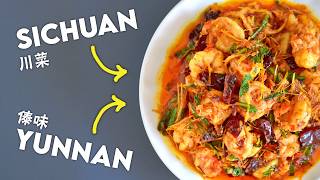

The Yunnan-Thai Fusion Mystery
34sExplains the unexpected fusion of Dai and Sichuan cuisines, sparking curiosity about cultural exchange.
▶ Play Clip"The title accurately describes the dish's fusion nature, matching the transcript's content."
Youqiang (油呛) is a spicy, herbaceous stir-fry from Jinghong, Yunnan, that uniquely blends Dai (Southeast Asian) flavors with Sichuan heat. The dish combines a pounded paste of lemongrass, chili, ginger, and garlic with dried chilies and Sichuan peppercorns, fried in generous oil. This video explains the cultural fusion behind Youqiang and demonstrates how to make it with tripe or shrimp.
Youqiang is a stir-fry from Jinghong, Xishuangbanna, mixing Dai (Southeast Asian) aromatics with Sichuan peppercorns and dried chilies.
The Dai paste is pounded in a mortar from lemongrass, fresh chili, ginger, and garlic. The Sichuan part uses dried chilies and Sichuan peppercorns.
The dish likely emerged from the intersection of Chinese and Southeast Asian cooking in Jinghong, though its exact origin is unknown.
Two versions: tripe (blanched 10 seconds) and shrimp (Cantonese-style prepped with soda water, then butterflied and marinated).
The stir-fry process: fry Sichuan chilies and peppercorns in oil, add pounded Dai paste, then the protein, then sauce (soy, oyster sauce), finish with cilantro.
What is Youqiang (油呛)?
A stir-fry technique from Jinghong, Yunnan, that blends Dai (Thai-like) aromatics with Sichuan peppercorns and dried chilies.
What are the four core ingredients in the Dai pounded paste for Youqiang?
Lemongrass, fresh spicy chili, ginger, and garlic.
0:20
What are the Sichuan-style components in Youqiang?
Dried chilies, Sichuan peppercorns, and a red chili powder like Kashmiri or gochugaru (optional).
3:22
What does Yunnan Youqiang use instead of fish sauce and blachan (shrimp paste) typically found in Thai cuisine?
Soy sauce and oyster sauce.
4:50
How do you prepare tripe for Youqiang?
Tripe should be blanched in boiling water for 10 seconds, then rinsed in cool water.
5:15
What is the Cantonese-style shrimp preparation (hako) mentioned for Youqiang shrimp?
Butterfly the shrimp, remove digestive tract, then marinate with salt, sugar, white pepper, and Shaoxing wine.
5:45
Pounding method
Explains the traditional Dai technique of pounding the aromatics in a mortar, which is key to the dish's flavor.
0:28[00:00] Throughout Yunnan today you can find a herbaceous
[00:07] Youqiang tribe, Youqiang marrow, Youqiang shrimp, Youqiang heart,
[00:14] the city of Jinghong right at the heart of the
[00:20] what it is, it's a mix of lemongrass, spicy fresh
[00:28] very traditional Dai way. Then put together
[00:34] Sichuan peppercorns over some really strong flame.
[00:40] Dai food or its cousins down in Thailand, you
[00:46] lean on that much oil. They will stir fry it, but
[00:53] common than grilling, deep frying, boiling, and
[01:00] chilies and Sichuan peppercorns in a stir fry. That
[01:08] cooking level. Now, there have been waves of
[01:14] and among them, there are such people. Some came
[01:21] of them end up just becoming die. Then after 49
[01:28] cash crop plantation industry and over time some
[01:35] and opening basically from the 80s until today
[01:42] Jing Hong following the city's development from
[01:48] day status as the Chinese Honolulu. But this is a
[01:56] why does it use basically the Thai holy trinity?
[02:04] Southeast Asian cooking style. Well, we don't
[02:09] chefs or restaurants who first started to Yo
[02:15] sits geographically and demographically at
[02:22] and Southeast Asian cooking systems. So probably
[02:29] this great cuisines together and yo it's tasty. So
[02:37] tribe is one of the most classic yoang dishes but
[02:44] basically yo anything. So, we'll also show you how
[02:52] shrimp preparation hako. It's really good in a
[02:59] the zoo flavor. And personally, I do hope some in
[03:08] I do think it will be a hit. Anyway, now I'll
[03:14] the process of yo chang. So, right, two core legs
[03:22] The latter is pretty dead easy on the sourcing
[03:28] guys were sichron argental, but cayenne, guajillo,
[03:35] together with one teaspoon of cichron peppercorns.
[03:41] actually not too bad. We will be finishing our
[03:47] herb also seen in viet Thai and Mexican cooking.
[03:53] cilantro. But the important part, the base of
[03:59] roughly chopped, 10 g of fresh spicy chilies, also
[04:05] also roughly chopped. Then we've also got 40 g
[04:12] also the harder, more fibrous tops. This dish is
[04:19] tops. But if your lemongrass is already topless,
[04:25] pound those, tossing that dye mix into a mortar
[04:32] I do think that a food processor might work.
[04:37] something about like this in the end, which
[04:43] the last thing before yo changing anything is a
[04:50] kind of interesting to me in that compared
[04:55] they seem to swap the fish sauce for soy sauce
[05:02] apparently do matter for something. So, right, two
[05:09] shrimp and we've got tripe. The stirfry process
[05:15] prep those for the tripe, we've got about 300 g
[05:22] and then quickly quickly blanched in boiling
[05:28] dump it in some cool water and rinse that well
[05:33] because tripe does cook in a flash. So then just
[05:40] Then for the shrimp, I should probably say at
[05:45] fry is definitely kind of anal. Um, I'm going to
[05:51] shrimp. This prep is the one Canney style that
[05:57] delicious shrimp video. The long and short of it
[06:03] and let it soak with a teaspoon of sodium
[06:08] about 5 to 10 minutes. Then you take that, rinse
[06:13] trickle of running water for another 5 or 10,
[06:19] and then toss it on a towel and wrap everything
[06:24] dry. Then you take those, about 300 g worth at
[06:31] back, opening them up like a book, and removing
[06:36] those, then marinate them with an eighth teaspoon
[06:41] and shaing wine. mix. Then toss in a gug of
[06:48] definitely prep your shrimp how you want to prep
[06:54] ready to fry. So to do so, to a hot walk, swirl in
[07:01] toss in your Sichuan leg. Fry those until the
[07:07] Then optionally color that oil with a teaspoon
[07:12] gochugaru. Once it's stained about 15 seconds or
[07:19] up your flame to maximum. Fry that all until you
[07:24] 1 minute. Then go in with your ingredient, tripe
[07:31] cooked, about 30 seconds. Tripe only needs about
[07:38] seconds or so. Then heat off cilantro or cilantro
[07:46] up a yo- ch. So, right. How to enjoy this thing?
[07:54] organ meat is very classic in a yo chang. Well,
[08:00] and crannies for the flavors to get into. So if
[08:07] tofu steak or some kind of deep fried tofu will be
[08:14] in Yunan, you will sometimes be able to find some
[08:20] really good. And if you are organizing a meal
[08:27] a d or a northern Thailand meal which we actually
[08:33] I do think Yo Chang will be easier to be placed
[08:42] central Yunan or a satry meal. So, right, as
[08:49] will have full recipes for both the shrimp and
[08:55] you for everyone that's supporting us on Patreon.
[09:03] [music]
[09:06] I say I'm fine.
[09:16] [music]
[09:17] [music]
[09:17] [music]

⚡ Saved you 0h 09m reading this? Transcribe any YouTube video for free — no signup needed.