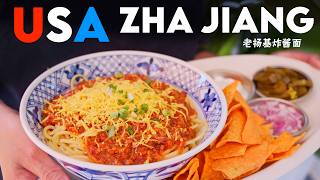

Inventing American Zha Jiang Mian
45sIntroduces a bold fusion concept that sparks curiosity about cultural adaptation of a classic Chinese dish.
▶ Play Clip"The title accurately describes the content: an American-style meat sauce noodle dish inspired by Chinese Zha Jiang Mian."
The video explores creating an American version of Zha Jiang Mian, a Chinese noodle dish with fried meat sauce. The creator adapts the core technique—frying minced pork belly and a thick fermented sauce—using American ingredients like bacon and a homemade barbecue sauce.
Zha Jiang Mian is a Chinese noodle dish with a fried meat sauce, but it's more of an adaptable idea than a single dish, with variations across China and Korea.
The creator aims to invent an American version using local flavors, starting with a mix of ground pork belly and bacon.
The difficult part is finding a thick fermented sauce; the creator decides on a homemade barbecue sauce with tomato base, fermented components, and American flavors.
The pork and bacon are rendered, then combined with a sauce made from crushed tomatoes, beer, stock, brown sugar, and spices, simmered until thick.
The sauce is served over pasta with base seasonings, and optional toppings like pickled jalapenos, sour cream, cheddar cheese, and Doritos.
The dish is deemed a success, and the creator suggests it could be adapted further, e.g., served with cornbread, fries, or on a hot dog.
The American Zha Jiang Mian successfully blends Chinese technique with American flavors, proving the dish's adaptability and potential for further creative variations.
What is the fundamental technique of Zha Jiang Mian?
Fry minced pork belly, then use the rendered lard to fry a thick fermented sauce.
0:25
What fermented sauce does the original Old Beijing Zha Jiang Mian use?
Gan Huang Jiang.
0:45
What is the Korean version of Zha Jiang Mian called, and what sauce does it use?
Jajangmyeon, using Korean chunjang.
0:50
What ingredient did the creator use as the American 'Jiang'?
A homemade barbecue sauce inspired by Kansas City style.
4:49
What is the purpose of adding garlic when chopping chilies?
Garlic acts as an emulsifier, helping the mixture come together into a paste.
6:30
Why did the creator switch to a clay pot for cooking the sauce?
To avoid acidic tomatoes ruining the wok seasoning.
8:19
What base seasoning did the creator use per bowl for the noodles?
1/8 tsp each of salt, MSG, sugar, soy sauce, Worcestershire sauce, and black pepper.
10:48
Name three optional toppings suggested for the American Zha Jiang Mian.
Pickled jalapenos, sour cream, cheddar cheese (or chopped green chilies, chopped onion, Doritos).
11:26
Zha Jiang as an adaptable idea
Explains that the dish is not fixed but a technique adapted across regions, setting up the creative challenge.
0:25American Jiang = barbecue sauce
Key creative leap: using a homemade barbecue sauce as the American equivalent of fermented Chinese sauces.
4:49Garlic as emulsifier for chili paste
Practical cooking tip that garlic helps bind chili and salt into a smooth paste without a food processor.
6:30Clay pot to protect wok seasoning
Shows attention to cookware maintenance when using acidic ingredients.
8:19Taste test success and adaptability
Confirms the dish works and suggests further variations (cornbread, fries, hot dog), emphasizing versatility.
12:09[00:00] Here in China, one of the most popular
[00:05] noodles” - basically, noodles in with a delicious
[00:12] inventing an American version of the dish...
[00:18] Chinese term “Zhajiang”, it's a dish, but it's
[00:25] that's been relentlessly adapted all throughout
[00:30] out a bit of minced pork belly, then use that lard
[00:38] giving it the name deep fried sauce. The most
[00:45] the Old Beijing Zha Jiang Mian, which uses a
[00:50] most famous is the Korean Jajangmyeon, which uses
[00:56] idea again almost everywhere. Like, where we live
[01:03] its own local fermented sauce. A few days back,
[01:09] Cantonese Minsi paste. And after that, we taught
[01:14] up Pixian Doubanjiang. Which all for me? It does
[01:22] I'm an America. And if this technique is used
[01:28] Myanmar border, what's stopping us from making our
[01:36] frying things in lard. Even the most maladjusted
[01:41] Jiang Mian. For a dish with so many variations
[01:47] why not an American one? So that's the challenge
[01:54] Mian with American flavors, which for the pork
[02:03] obviously, we're going to be using some American
[02:10] it would definitely be a little bit too bacony? I
[02:15] think something like a ragu. So, this here is
[02:22] or about five strips of bacon. Now, just like the
[02:28] going to be a coarser grind. So, you might want to
[02:34] you. But if that is impossible or really expensive
[02:41] that you can find. So then I'm just going to slice
[02:48] consistency… and then this here is going to be a
[02:54] us to the difficult part of the exercise, which
[03:01] don't think we really have in America. I mean,
[03:06] we do liquor pretty well. We've got some nice
[03:12] cheese, and sauerkraut, but nothing that really
[03:18] me, I kind of put fermented things into a couple
[03:25] there's sour ferments, there's what I think
[03:29] heavily fermented protein ferments, and then
[03:35] and fish sauce. Now, our cuisines, we've got these
[03:43] but we don't traditionally have anything
[03:49] which I'd imagine is why the cheffy types have
[03:55] they first got their hands on it. So, like maybe
[04:04] flavors here. So, maybe we can take a step
[04:09] this category in the form of mushroom ketchup,
[04:15] that around when we collectively fell in love
[04:22] the tomato has functionally filled this void for
[04:29] this is where my head's at. The American Jiang, it
[04:36] something recognizably an American flavor.
[04:42] and four, ideally have some kind of fermented
[04:49] problem for way too long, the American Jiang… it's
[04:56] really a Jiang, but it is undeniably us. Now, I'm
[05:05] but I'm getting an inkling that it might kind
[05:11] little bit more… homemade barbecue sauce inspired.
[05:19] Kansas City, but I also don't really want to use
[05:27] going with canned tomatoes, tomato paste, and a
[05:34] Which then brings us to the last thing before we
[05:41] they both include some kind of spicy sauce in
[05:46] felt like a good idea. So, I was thinking maybe
[05:55] as mayonnaise is? So, I don't know. I was thinking
[06:02] but I just decided to keep things simple. And last
[06:08] boiled water... and today, we'll turn that into
[06:14] give them a little chop, and you could totally use
[06:19] trick that I taught you a couple of weeks ago,
[06:25] I'll sprinkle on a 1/4 teaspoon of salt,
[06:30] together with the chilies. Because garlic's
[06:35] chopping, that's all going to come together into
[06:42] we've got our chili paste. So now let's go outside
[06:48] here is to start with about a tablespoon of
[06:53] over a medium/medium high flame, begin to slowly
[06:59] a hot second… so I'm going to quickly run inside
[07:04] soften up some onions - try to make everything
[07:10] mix in a 1/4 teaspoon of salt in with a half a
[07:16] oil and then enough water to just barely cover
[07:22] for about as long as our pork needs: we're just
[07:28] try to remember to give this a stir every couple
[07:33] So, now we'll run back to the pork. And after
[07:38] be nice and loosened up a bit like this… just
[07:44] it'll start to reach the “I'm being annoying
[07:50] being patient with it. Scrape off anything
[07:53] you can also add in a little bit more
[07:58] it's going to start to render out its lard...
[08:02] nurse things quite as hard. After 10 more
[08:07] looking for the pork to be nice and golden brown,
[08:13] or too crispy because remember, we do want
[08:19] now I just remembered I'm going to swap this to a
[08:24] to be ruining my wok seasoning… so once that's in,
[08:32] So, this is what I'm looking at now. It's
[08:37] for another minute or two and then toss that
[08:45] now over a medium flame... the classic Zha Jiang
[08:50] oil in with your sauce and then mix that really
[08:57] sauce a bit gentler, because sometimes
[09:00] things can sometimes scorch on you. So then just
[09:05] same move then with about a tablespoon of tomato
[09:10] that's fragrant, we'll toss in a tablespoon of
[09:16] fry it a bit to make sure that the oil stained
[09:21] crushed tomatoes. Then we'll toss in 200 ml
[09:28] and then start to bring this up to a light boil,
[09:33] powder, 2 tbsp dark brown sugar, 1 tbsp of soy
[09:39] and a good crack of black pepper. Then we'll
[09:45] about 20 minutes to evaporate off all that
[09:50] to break down the onions. After that time,
[09:55] to have kind of reached its lava bubbling
[10:04] Then we'll drizzle in a slurry of a half
[10:08] water bit by bit. And once that's stirred in,
[10:14] more MSG and brown sugar. Another generous crack
[10:20] which today I'm going to be starting with about a
[10:25] bit more sour, you could maybe add in a little
[10:30] little bit more barbecue saucy, maybe a bit of
[10:36] tastes pretty good to me… so, we can just run
[10:42] here was going to be to do a ganban mixed noodle
[10:48] bowl some base seasoning at first. So, let's do
[10:54] Worcestershire sauce, and then a good crack of
[11:00] take it a touch past al dente, then out, jiggle it
[11:06] do the move of a tablespoon of the pasta water.
[11:13] give this a quick mix first and then we'll smother
[11:20] famously comes with like a mountain of optional
[11:26] fun to do the same thing here. Now, I admittedly
[11:32] we can have a bit of pickled jalapenos on the
[11:37] spicy, some chopped green chilies, a little less
[11:43] a bit of chopped onion. Then for the sides,
[11:49] of anything more American than Doritos. So, we'll
[11:56] being American, I think we have to add in a bit of
[12:01] and this is looking pretty good I think. So,
[12:09] See how I did. Steph, do you wanna? Here you go.
[12:21] Pretty good. Feel like tortilla
[12:27] I definitely consider this one a success. Um,
[12:33] but I do also think that this can also be adapted.
[12:40] served with wanton noodles in wanton shops. Or if
[12:47] alkaline noodles and it's often in soup, which
[12:53] So, I think we can also take this base and adapt
[13:01] you could also take this, serve it with cornbread,
[13:07] Why not? So, yeah, originally we were all going to
[13:13] but um after thinking on it, we did really want
[13:20] We were originally just going to cut this, but
[13:25] with it. So, huge, huge thank you to everybody
[13:31] a written recipe for all three of the Zha
[13:37] of course, subscribe for more Chinese


⚡ Saved you 0h 13m reading this? Transcribe any YouTube video for free — no signup needed.