
Sichuan's 24 Flavor Profiles Explained
42sReveals a surprising fact about Sichuan cuisine having 24 distinct flavors, instantly hooking foodies and curious viewers.
▶ Play Clip"The title accurately describes the content: the video teaches the homestyle flavor profile and demonstrates three recipes."
Sichuan cuisine boasts 24 distinct flavor profiles, but many are too intense for everyday cooking. The homestyle flavor (jiachang wei) simplifies this with a base of Pixian doubanjiang and soy sauce, making authentic Sichuan dishes accessible to home cooks. This video demonstrates three variations of this base: a soupy braise for ribs, a saucy braise for green beans, and a dry stir-fry for pork.
Sichuan has 24 flavor profiles, but homestyle is the most practical for home cooks.
Homestyle flavor base: Pixian doubanjiang (Sichuan chili bean paste) and soy sauce.
Three consistencies: soupy braise (ribs), saucy braise (beans), dry stir-fry (pork).
Use only Sichuan-style red oil Pixian doubanjiang; not Cantonese or Taiwanese versions.
Ribs: 650g, inch pieces, fried golden, then braised with doubanjiang, soy sauce, water, ginger, scallion, Sichuan peppercorns for 1 hour, then add daikon for 30 min.
Beans: stir-fry with optional pork belly, add doubanjiang, soy sauce, water, braise 15 min, thicken with starch slurry.
Pork: 400g loin, 3mm slices, marinated with starch, white pepper, dark soy, Shaoxing wine; stir-fry in 4 tbsp oil, then toss with doubanjiang, soy sauce, green garlic.
Some Sichuan cooks fry their own doubanjiang at home, adding aromatics, different aged pastes, or umami boosters like dried shrimp.
What are the two key ingredients in the Sichuan homestyle flavor base?
Pixian doubanjiang (Sichuan chili bean paste) and soy sauce.
00:29
How many distinct flavor profiles does Sichuan cuisine have?
24.
What type of doubanjiang is required for authentic homestyle recipes?
Sichuan style (red oil Pixian doubanjiang).
01:24
How much rib meat is used in the homestyle ribs recipe, and how is it cut?
650 grams, cleaved into inch-size pieces.
02:03
What is the total braising time for the homestyle ribs?
One hour covered over medium flame, then add daikon and simmer another 30 minutes.
02:57
What type of bean is recommended for the homestyle green bean dish?
A Chinese flat romano bean (or Italian romano).
04:35
How long do the green beans braise after adding the liquid?
15 minutes.
05:20
What cut and thickness of pork is used for the dry stir-fry?
400 grams of pork loin, cut into 3-millimeter sheets.
06:14
How much oil is used to stir-fry the pork in the dry stir-fry recipe?
Four tablespoons of oil (not a typo).
06:44
What vegetable is added at the end of the dry stir-fry?
Green garlic (or scallion if necessary).
07:11
Homestyle flavor base
Reveals that authentic Sichuan homestyle cooking relies on just two key ingredients, making it accessible to home cooks.
00:29Three consistency variations
Demonstrates how the same flavor profile can be adapted to soupy, saucy, or dry dishes, showing versatility.
01:09Doubanjiang authenticity
Emphasizes that only Sichuan-style red oil Pixian doubanjiang works; other regional versions are not substitutes.
01:24Homemade doubanjiang
Explains that some Sichuan cooks fry their own doubanjiang at home, adding aromatics or umami boosters, which is a deeper level of customization.
07:40[00:00] So, Sichuan flavor. It's not just one flavor, there's famously 24 distinct profiles, from sweet and sour to their, admittedly, kind of, strange, strange flavor.
[00:13] But from this list here, frankly speaking, some of these they can get a little rare or a little intense, basically a bit more of a restaurant or a banquet thing. But luckily, for us home cooks, there is also the home style flavor, which consists of a
[00:29] base of pixie and doubanjiang, Sichuan chili bean paste, soy sauce, and honestly, not really all that much else. Because like, all throughout China, there really isn't anything more consistently home
[00:42] style than frying from a base of some kind of local seasoned savory sauce. So in this video today, we'll be teaching you that base. But at the same time, do remember that a flavor profile is just a flavor.
[00:56] The form it doesn't have to be fixed. So today, we'll teach you three home style consistencies, a soupy braised home style dish and the form of home style ribs, a saucy, quicker braised home style dish in the form of
[01:09] home style beans, and finally a drier stir fry of home style pork. So first up, the soupy ribs. And to start with these ribs, we're going to need, of course, some pixie and doubanjiang.
[01:24] For all of these recipes today, there is no substitute for this. And you're going to need the Sichuan style, not the Cantonese, not the Taiwanese. This here is the standard red oil pixie and doubanjiang.
[01:37] If you've got no Chinese supermarket close, you can buy it on Amazon, we, Mala market, Yamabai, really, it's not rare today, I've got my VPN set to Sweden and I can equally
[01:49] find it there. So you can just take some of that, mince it up for a smooth consistency, set it aside, and then that's more or less it for the prep. So then for the braising, we are going to be using a clay pot today.
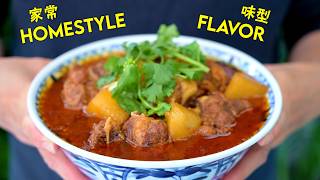
[02:03] You could also use a cast iron or even a wok. But either way, first toss in two tablespoons of oil. Then over a medium high flame, go in with your ribs. These were 650 grams worth, by the way, cleaved into inch size pieces and tossed those in.
[02:19] And just slowly fry those in the oil. And once they've changed color a bit, about five minutes, also toss in inch of smashed ginger. We'll be looking for these ribs to be good and golden brown, about three to five minutes
[02:32] more. Then toss in that minced pixie and doubanjiang, one tablespoon. Mix that very well to coat each of those pieces. Then add in one liter of hot boiled water from the kettle.
[02:44] Then bring that up to a boil. And then add in the second leg of our flavor profile today, two tablespoons of soy sauce. And for this specific dish to braise, we'll also toss in a scallion-type of knot, a half
[02:57] teaspoon of citron peppercorns, both of which optional but recommended, together with a half teaspoon salt and a quarter teaspoon of sugar. Then just let that go over a medium flame, covered for about one hour.
[03:12] And after that time, things were looking pretty nice here. So we'll also go in with a bit of dicon. This was just 500 grams worth, peeled well, and then chopped into a similar sized one-inch pieces, and then dumped in with the ribs.
[03:26] Keeping that all submerged, cover it, and let that simmer for another 30 minutes. And then after that time, it's the final seasoning time. Season this to your taste. But today we add another eight teaspoon each chicken powder and MSG, and then thicken that
[03:42] with a slurry of two teaspoons of starch, together with an equal amount of water, preferably potato starch if you happen to have some. Then just transfer that over to a serving bowl, dicons, down at the bottom, and top it with
[03:55] a garnish of a bit of cilantro, home-style ribs, done like that. So then our home-style dish, number two, a saucy braised bean dish called Jaechang-sijido.
[04:07] Now for this sort of saucy home-style dish, I'll often see potato, and you could also do taro, but these beans might just be my personal favorite because they really are quite easy. With that said, though, in China, saying the words, sijido, is a lot like saying green
[04:23] bean in English, both refer to whole category of beans, and many of them do behave quite different. For this dish, most delicious I think is going to be a start to your braising bean.
[04:35] Today we're using a Chinese biblow romano bean, but I also think that Italian romanas would also work really well too. So to fry those up, first roll in two tablespoons of oil to a hot wok, and today we'll also
[04:48] be frying that together with a hundred grams of sliced pork belly, totally optional for any vegetarians in the room. Just fry the pork belly over a medium-high flame for about two minutes, or until it begins to brown and slightly release a bit of its lard, and then toss in your beans.
[05:04] Fry those for about a minute, until the beans of change color, then scooch that all to the side, swap the flame to low, and then go in with the same one tablespoon of minced pixi and dobanjian. Fry that for a minute until the oil stained all nice and red, then mix, swap the flame
[05:20] back to high, and swirl in our second leg of the flavor profile, one tablespoon of soy sauce. Mix it well, then toss in two cups of water, stock, or a combination thereof, cover it with
[05:33] a breathable lid, and over a medium flame let that braise for 15 minutes. After that time, season it with an eight teaspoon each MSG and white pepper, and then over a low-flamed thicken it with a half-table spoon starch mixed with an equal part of water.
[05:49] Once that's thickened you're liking, remove and then jacang-siddi-do done, which then brings us to the final application of the flavor, a drier stir fry, the most famous of which, being
[06:02] twice cooked pork. Now, we've covered that specific dish before, so this pork that you're looking at here today, it isn't cooked twice, it's just cooked once, just a basic stir fry of some bog-standard
[06:14] lean pork, because again, you can absolutely homestow anything. So this here was 400 grams of pork loin cut into the normal three-millimeter sheets, tossed in a bowl and then marinated with a teaspoon of starch, quarter teaspoon each white pepper,
[06:29] dark soy sauce, and sourcing wine, mix well, and then toss in two tablespoons of oil, swap that to a bigger bowl once you realize that your previous bowl is apparently comically small for this, mix that properly well, and then now we can fry.
[06:44] So to do so, swirl in four tablespoons of oil into a hot wok, that's not a typo, this is Sichuan food, if you're not the oil, and then add in the marinated pork.
[06:56] Then just stir fry that on high until it's basically cooked through about two to three minutes, then remove and then swap the flame to low. Toss in one tablespoon of your trusty pixan dobanjiang, fry that for a minute or so to stain the oil,
[07:11] then heat back on high and add back in the cooked pork. Give that a good mix, swirl in that same tablespoon of soy sauce, mix it well again, then add in four stalks of green garlic, preferably or scallion if you have to.
[07:25] Fry that for about 30 seconds to cook said green garlic, or just a quick mix for scallion, and then season the taste. We add another eight teaspoon MSG, and then out. Jatchang fried pork done.
[07:40] So in this video, we use this kind of doban red oil dobanjiang, hong you. The most famous brand for this is called Junchang pie, and if you look online, you will also find that Junchang pie also sells dobanjiang impacts.
[07:55] So if you get those kinds of packs of dobanjiang, good news is that it's actually a very good dobanjiang, but bad news is that the oil is doban, it's not a direct ingredients
[08:09] that you can just use directly in recipes like this that call for red oil doban, because in Sichuan, at markets, sometimes you will see vendors selling this kind of traditionally
[08:22] homemade dobanjiang, and people will bring it back home and fry it up their own dobanjiang according to their own taste. Frying up your own dobanjiang at home may be a little bit of a project, but it's very delicious,
[08:37] and you can make your dobanjiang according to your own flavor. So some people may add some aromatics and spices, some people will mix different ages of doban
[08:49] together, some may add a bit more of chili to make it spicier, and some may add dry shrimps or ham to amp up the umami. And soon, we will have a video covering all of this, demystifying the Sichuan chili bean
[09:06] paste. But in the meantime, as always, recipe in the description box, a big thank you for everyone supporting us on Patreon, and of course, subscribe for more Chinese cooking videos.


⚡ Saved you 0h 09m reading this? Transcribe any YouTube video for free — no signup needed.