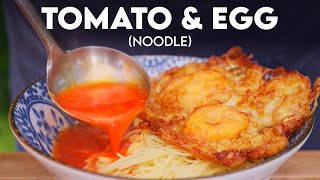

Tomato & Egg: China's Comfort Food Flag
45sThe emotional and cultural association with the national flag makes this clip highly shareable and curiosity-driving.
▶ Play Clip"The title accurately describes the recipe; the video delivers exactly what it promises with detailed instructions and cultural context."
This video presents a detailed recipe for Chengdu-style tomato and egg noodle soup, a beloved comfort food in China. It covers the history of the dish, ingredient options (fresh, canned, or mixed tomatoes), the importance of lard, and step-by-step cooking instructions.
Chengdu tomato and egg noodle soup is a delicious, comforting noodle dish with fried eggs and noodles in a rich tomato broth.
Tomato and egg is considered the definition of comfort food in China, found everywhere from home kitchens to restaurants and canteens.
In the early 2000s, a noodle shop called Hua Xing Jian Dan Mian in Chengdu popularized this combination, especially among club-goers as a midnight snack.
Three options: 1) Fresh tomatoes (650g) blended with water, salt, and Shaoxing wine; 2) Canned tomatoes (350g) crushed with water, salt, and Shaoxing wine; 3) A mix of fresh and canned. The mix is preferred.
Best shops use lard for frying the tomato soup base and eggs. The video shows how to render lard from fatty pork belly, using the crispy pork as a topping.
Fry aromatics (scallion, ginger, garlic) in lard, add tomato paste, optional chili powder, then the tomato mixture. Simmer with water/stock for at least 30 minutes.
Shallow-fry eggs in lard in a hot wok, keeping the yolk slightly hard. Pour egg into smoking oil, swirl, and baste with hot oil.
Mince fresh spicy chilies and garlic, fry in oil, add rice vinegar for a tangy topping.
Use Sichuan alkaline noodles (dried or fresh) or ramen. Assemble with fried egg, tomato soup, crispy pork, scallions, and chili topping.
This recipe provides a thorough guide to making authentic Chengdu tomato and egg noodles at home, with flexibility for ingredient substitutions and a focus on achieving rich flavor through proper techniques.
What is the historical origin of Chengdu tomato and egg noodles?
A noodle shop called Hua Xing Jian Dan Mian in the early 2000s near a clubbing district in Chengdu popularized the dish.
00:31
What are the three tomato options for the soup?
Fresh tomatoes blended, canned tomatoes crushed, or a mix of both.
03:25
Why is lard recommended for this dish?
It adds authentic flavor; the best shops in Chengdu use lard for frying the soup base and eggs.
04:37
What is the alternative to using store-bought lard?
Render lard from fatty pork belly and use the crispy pork as a topping.
04:54
How long should the tomato soup base simmer?
At least half an hour.
07:42
What is the preferred doneness for the fried egg yolk?
Slightly on the harder side.
08:28
What is the optional pickled chili topping made of?
Fresh spicy chilies and garlic, fried and finished with rice vinegar.
10:11
What type of noodles are recommended for this dish?
Sichuan-style alkaline noodles (dried or fresh), or Japanese ramen as a substitute.
10:58
Comfort Food Definition
Establishes the cultural significance of tomato and egg in China, setting the stage for the recipe's importance.
00:17Institution Among Locals
Highlights how the dish became a staple in Chengdu nightlife, adding historical context.
01:14Three Tomato Options
Provides practical flexibility for home cooks, catering to different ingredient availability and preferences.
03:25Lard Technique
Emphasizes a key flavor-enhancing technique used by the best shops, elevating the dish.
04:37Simmering Time
Indicates a crucial step for developing depth of flavor; patience is rewarded.
07:42Egg Yolk Doneness
Specific instruction to prevent overly runny yolk, ensuring the egg complements the soup.
08:28Optional Topping
Adds a customizable element; the pickled chili is a modern twist that enhances the dish.
09:57[00:00] This is Chengdu style tomato and egg noodle soup, it’s fried eggs and cooked noodles smothered in a rich tomato broth. While it’s not the most famous Sichuan noodle soup out there, frankly speaking, this recipe is probably one of the very
[00:17] most delicious we’ve shared on this channel. It’s just… really good, you have to try it. Because the combination of tomato and egg is the definition of comfort food in China.
[00:31] It’s a go-to for feeding kids, it’s at canteens, it’s a homecook’s staple, it’s at restaurants, you can find at all four corners of the country. And the color of the national flag of China? It’s
[00:45] sometimes even being referred to as tomato and egg. People just love it that much. Then in the early 00s in Chengdu, a noodle shop called Hua Xing Jian Dan Mian presented this
[00:57] combination at a particularly right time and right place. Just like a lot of Chinese cities, there was a clubbing district started to form in Chengdu in the early 00s. Famous local spots like “Empty bottles” started clustering around Yulin road,
[01:14] where the aforementioned noodle shop was also around the corner. And because when Sichuan people go out to drink, they love their midnight snacks. So when you have a comforting tomato and egg noodle soup together with a bunch of
[01:30] late into the night after a lot of alcohol… it’s no wonder that this soothing bowl of tomato and egg became an institution among that generation of Chengdu locals.
[01:45] Now, of course, over the years Chinese cities changed… and reportedly, Hua Xing Jian Dan Mian went downhill before reopening elsewhere, but in the meantime tomato and egg noodles in Chengdu caught on.
[01:59] These days, one of the best shops is called “Kangji Jiandan Mian”, which is what we based our version from. So now I’ll hand it off to Chris, who’ll show you how to make it.
[02:13] OK. So. To get started with our tomato and egg, we’re gunna need… some tomato. Which, unfortunately, is… the first thing that we’re gunna have to think about. Because while for
[02:26] this dish you don’t need the maximally in-season tomatoes grown on the volcanic slopes of Mt Vesuvius, it is going to help if your tomatoes actually kinda… taste like tomato. Like,
[02:40] for example in Chengdu something we’ve hear that the best noodle shops do is that they’ll go around and hunt for the best tomatoes that they can find, and when they find them, they’ll freeze them for this dish. Or for us here in Yunnan, we’re a little bit spoiled here with all the little
[02:58] micro-climates, we can generally get reasonable quality tomatoes pretty much year round. So I was thinking on this problem, and my American brain really started to churn…
[03:10] because in the US we usually crack that nut with canned tomatoes, and so I was thinking, I dunno, maybe that could also work here? So we tried it during testing and uh… yes. Absolutely,
[03:25] this totally does work too. So. We’ve got three tomato options for you today… first, if you are happy with your fresh tomato quality, what you can do is just grab 650 grams worth, cut a little x
[03:40] into them, boil them to peel them like always, and then toss in a blender together with a half cup water, quarter teaspoon salt, and a tablespoon of Shaoxing wine… blending it on the smoothie setting
[03:52] to a smoothie-like consistency… and setting it aside. But canned, I promise, is also really quite delicious. So you can also use 350 grams of canned tomato including its sauce obviously, crush the
[04:08] tomato with your hands and then mix it with a cup and a half of water, a quarter teaspoon salt, and tablespoon Shaoxing wine. And then finally, option three, what I actually liked the very best was a
[04:21] mix of fresh and canned tomatoes. So if you wanted to go that route you could use 450 grams or so of fresh tomato of any quality, mix that with, I dunno, like 175 grams or so of the canned tomato,
[04:37] and then blend that together with the water, salt, and Shaoxing quantities from option number one. Which brings us to the second thing we’re gunna need with this dish – and that’s lard. The very best shops in Chengdu what they’ll do is that they’ll fry their tomato soup base in lard,
[04:54] and then they’ll also end up frying their eggs also in lard. Now I do know that not everyone has a whole bunch of lard handy in their kitchen, and then also some brands of mass produced lard
[05:07] are definitely higher quality than others. So what we decided to do with our recipe today was this: start with fatty pork belly, from which we’ll render out the lard to use for the dish and
[05:19] then we’ll use the leftover crispy pork belly as a topping. Now to be crystal clear, we’ve never ever seen crispy pork belly like this as topping for this dish in Sichuan, but it really is
[05:33] pretty delicious and I don’t think that it would really feel out of place in Chengdu. My opinion. So we’ll just slice up 300 grams of fatty pork belly into thin strips, then toss that in a bowl and mix it with an eighth teaspoon salt,
[05:47] eighth teaspoon MSG, and a half teaspoon soy sauce. Then toss in a generous glug, or about three tablespoons of oil, mix that well, then add that all to a cool pot or wok.
[05:59] Then over a medium flame, slowly begin to render out that lard until the pork is brown and dry and crispy. This is gunna take a hot second, about 15 or maybe even 20 minutes or so… but once you’re at about this point with the pork, remove it,
[06:15] transfer it over to a paper towel lined plate, and of course reserve all that lard. We’re going to need four tablespoons worth for this soup. We’re using a claypot here today
[06:27] but a dutch oven or any braising vessel totally fine… and then, we’ll go in with our aromatics. This was just four scallions, white part removed and minced, an inch of ginger, also minced, four cloves garlic, also minced, and to get things really nice
[06:43] and pasty something that I personally like doing is taking a sprinkle or about an eighth teaspoon salt mixing it with the minced garlic and then chopping everything together for 2-3 minutes until it’s basically a totally uniform paste… but it’s completely up to you.
[07:01] Either way, just fry those over a medium flame until they’re fragrant, about one minute, then toss in a tablespoon of tomato paste – today I’m using an Italian tomato paste because I do kinda
[07:13] like Italian tomato paste plus I’m a sucker for the tube… but just let that fry to stain the oil, optionally toss in a teaspoon of a red fragrant chili powder like Kashmiri or Gochugaru, fry that
[07:26] to stain the oil… then go in with your tomato mixture. If you blended it like I did today, it is going to be kind of frothy, so I like to boil that on medium high flame to let that subside a bit… then add in 2 cups of water, or stock in an ideal world,
[07:42] or a combination – dealer’s choice… and the seasoning, up here on the screen… mix well, and let that all simmer together for at least a half an hour. And after that time, just season to taste… my tomatoes today were a little on the sour side
[07:58] so I also tossed in another ½ tsp sugar, and no matter what, finish it all with a good sprinkle of white pepper… and then now this is good for noodles and eggs.
[08:12] Now for the eggs, we’re gunna be frying our eggs like the noodle shops, which are basically shallow fried by any other name. So uh this is gunna be easiest if you have a round bottomed wok, so we’ll teach you how to fry them in this in just a second,
[08:28] but if you don’t feel like walking that mile that’s also completely fine, I totally get it, really any style of fried egg is gunna be pretty delicious here, just try to keep the yolk a little on the harder side. But if you do want to fry some eggs in this style,
[08:45] first just crack two eggs, being really careful not to break the yolk here, and then toss it in some sort of easy to pour container like a Pyrex. Then, get your wok piping hot, add a half a cup of your rendered lard to the wok. Then, flame on medium-high, heat up the oil until
[09:03] it’s smoking and then pour the egg in. It’s gunna aggressively and really satisfyingly puff and set, so gently swirl it around to allow everything to fry evenly… while also scooping a little bit of
[09:18] the hot oil over the yolk to let everything set. And when it’s set, flip it, and cook for another 20-30 seconds on the other side. Then flip that again to ensure perfect golden brown-ness,
[09:32] and then continue to fry it to your own liking. And then just scoop that to the side of the wok, letting all the excess oil drain out, and then transfer it to a paper towel lined plate.
[09:44] Then lastly, something that specifically Kangji Jiandan Mian serves with theirs is a bit of pickled chili oil – it’s optional, you can add it if you want, but both me and
[09:57] Steph really really like the addition. Now we have an entire proper recipe for this stuff in our “Every Sichuan Chili Oil” video, up here on the screen, but I did kinda think it’d be,
[10:11] I dunno, a little obnoxious to make you go chasing that recipe in order to make this one. So today, this is what we decided to do – we took fifteen grams fresh spicy chilis, Heaven Facing,
[10:23] Thai bird’s eye, that kinda thing… and together with three cloves of garlic finely finely mince those all together. Then, in a hot wok or pan, swirl in a tablespoon half of oil and then just fry those up over a medium flame. Fry them past fragrant or until they begin to kinda
[10:40] dry up a touch, about two minutes or so, then swirl in a half tablespoon of rice vinegar, or white vinegar if that’s all you have. Then just mix, remove, and then that is going to be our optional spicy-sour topping. Which then brings us to noodles. Today we’re
[10:58] using 100 grams per serving of a dried Sichuan-style alkaline noodle, but you could also use fresh noodles here, 150 grams worth in that case… and if you can’t find Chinese-style noodles I do think a nice thin Japanese-style ramen noodle would also be really good here.
[11:15] But either way, once those are cooked, lay those in a bowl, and then this is good to serve. So quantity of soup and everything today is gunna be good for three servings. So just take your fried egg and lay it over… and then smother the
[11:31] tomato soup all over everything. Toss in a generous handful of your crispy pork, a good sprinkle of those scallion greens, optionally some of our pickled chili oil sub or the real deal… and with that, now you’ve got some tomato and egg noodles.
[11:48] So when we make this kind of noodles, we’d usually make the base first, then prep all the toppings, and then cook the noodles at the end. And once the noodle’s done, we’ll just bring it to the table, so that everyone can just assemble their own bowls of noodles.
[12:04] So right, check out the recipes in the description box, a big thank you for everyone that’s supporting us on Patreon, and of course, subscribe for more Chinese cooking videos.

⚡ Saved you 0h 12m reading this? Transcribe any YouTube video for free — no signup needed.