
Why Your 1:3 RR Trade Still Loses Money
43sExposes a shocking truth that a supposedly profitable trade can actually be a loss, challenging common trading assumptions.
▶ Play Clip"The title promises a warning against scalping, and the video delivers a concrete fee analysis, though it's padded with a platform promo at the end."
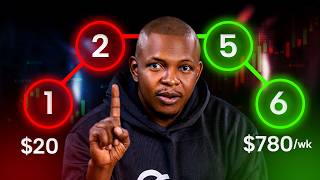
The video compares two trades with identical 1:3 risk-reward ratios—one a scalp on the 1-minute chart and one a day trade on the 30-minute chart—to reveal how exchange fees disproportionately erode scalping profits. It demonstrates that despite the same nominal risk-reward, the scalp trade's tighter stop-loss increases position size and fees, turning a supposedly profitable setup into a net loss.
Two trades both hit take profit with a 1:3 risk-reward ratio, but one leads to a loss due to fees.
A buy BTC trade on the 30-minute timeframe with a 1:3 risk-reward ratio. With $100 risk, position size is $9,460, and total fees are $10.4, reducing profit to $289.43 and loss to $110.4.
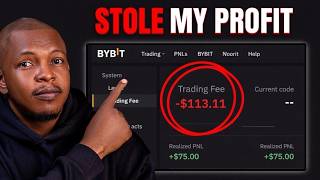
A short trade on the 1-minute timeframe with a tight stop-loss, causing position size to jump to $12,000. Total fees are $113, exceeding the risk amount, so profit is $186 and loss is $213.
The scalp trade's effective risk-reward ratio becomes 1:0.87, meaning you risk more than you can make. Over 10 trades, a 60% win rate is needed just to break even, while the day trader profits with a 30% win rate.
If the risk-reward ratio is 1:2, even a 70% win rate results in a loss, highlighting the impact of fees on tight-stop strategies.
CopyMeCrypto automatically detects and blocks scalp trades from being copied, allowing only day trades. Users can join the waitlist at copymcrypto.com.
Exchange fees can silently destroy the profitability of scalping strategies, even when the nominal risk-reward ratio looks favorable. Traders should favor day trading over scalping to preserve profits, or use platforms that filter out high-fee scalp trades.
What is the nominal risk-reward ratio of both trades in the video?
1:3
00:03
What is the total fee for the day trade example?
$10.4
01:17
What is the total fee for the scalp trade example?
$113
02:18
What is the effective risk-reward ratio for the scalp trade after fees?
1:0.87
02:46
What win rate is needed for the scalp trade to break even over 10 trades?
At least 60%
02:58
What win rate makes the day trader profitable?
30%
03:12
What happens to profitability if the risk-reward ratio is 1:2?
Even a 70% win rate results in a loss.
03:27
What does CopyMeCrypto do with scalp trades?
It automatically detects and blocks them from being copied.
03:42
Identical Risk-Reward, Different Outcomes
Challenges the assumption that a 1:3 risk-reward ratio guarantees profit, showing fees can flip the result.
00:03Scalp Trade True Risk-Reward
Reveals that fees can make a scalp trade's actual risk-reward worse than 1:1, a critical fact for traders.
02:46Win Rate Thresholds
Provides concrete win rate numbers (60% for scalp, 30% for day trade) that quantify the fee impact.
03:12Platform Filtering
Introduces a practical solution to avoid scalp fees, though it's promotional.
03:42[00:03] trader. Look at these two trades. They both hit take profit with a riskreward both hit take profit with a riskreward ratio of one is to three each. You'll ratio of one is to three each. You'll expect that if you put $100 into this
[00:17] trade, you will make $300. But that is not what happened. One of them will actually lead you [music] to a loss. Look at the chart again. You will observe that one is a scalp trade on the 1 minute time frame and the other is a
[00:34] day trade on the 30 minutes time frame. For the day trade, these are the actual values. So it is a buy BTC trade. This is the entry, the stop loss, [music] the is the entry, the stop loss, [music] the takerit. And like I said, it is a 1 to3
[00:48] takerit. And like I said, it is a 1 to3 riskreward [music] ratio. If I risk $100 on this trade, my position size is $9,460. And here I use the FS crypto calculator to calculate this. This is how the
[01:05] exchange charges you. If I took this trade on buy bit, that means I will pay trade on buy bit, that means I will pay $5.2 to open [music] this trade and $5.2
[01:17] to close this trade. a total fee of $10.4. $10.4. If I win, I don't keep $300. I keep If I win, I don't keep $300. I keep $289.43.
[01:36] If I lose, I don't lose $100. I lose $110.4. to $2.62. This is not [music] a bad trade. This is
[01:49] actually a trade I can grow my account with. But I cannot say the same thing for the scalp trade. This is the actual signal for the scalp trade. In this case, we are going short.
[02:01] This is [music] entry. The stop loss. Again, the risk-to-reward ratio is 1 is to3. Now, because the stop loss is very tight, the position size jumps [music] tight, the position size jumps [music] to $12,000.
[02:18] risk-to-reward ratio as the day trade, my total fee to open and close this trade is $113. So, the fee is higher than the actual
[02:30] So, the fee is higher than the actual rigged amount, which means that if I win this trade, I'm not taking home $300, but $186. but $186. And a loss is not $100, but $213,
[02:46] And a loss is not $100, but $213, making the true riskreward ratio 1 is to If you trade like this, you are literally risking more than you stand to
[02:58] make and your account will go to zero because over 10 trades, you will need at because over 10 trades, you will need at least 60% win rate to even come close to least 60% win rate to even come close to profit. While the day trader is being
[03:12] profit. While the day trader is being profitable from the 30% win rate, it even gets worse if your risk-to-reward ratio is 1 is to two, which is what [music] most traders aim for. In this case, you will still be at loss at 70%
[03:27] win rate. And these charges applies to whatever you're trading, be it forex, crypto, indices, whatever you're trading. So would you rather be a day trading. So would you rather be a day trader than a scalper? And in copy me
[03:42] trader than a scalper? And in copy me crypto we have this imbu the pro trader whose trade you can copy cannot take scalp trade. The system automatically scalp trade. The system automatically detects a scalp trade based on entry
[03:56] detects a scalp trade based on entry stop-loss and risk and simply won't allow it to [music] be copied. You can go to copymcrypto.com and join the go to copymcrypto.com and join the weight list for free access at launch.
⚡ Saved you 0h 04m reading this? Transcribe any YouTube video for free — no signup needed.