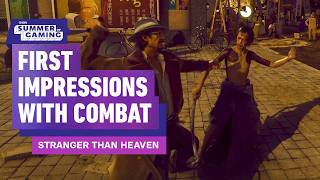

Yakuza's New Combat is NOT Button Mashing
55sShows a radical departure from classic Yakuza brawling to a deliberate, limb-based combat system that challenges player expectations.
▶ Play Clip"The title accurately reflects the combat's Soulslike difficulty and the Yakuza connection, but the comparison is slightly exaggerated as the game is not a full Souls clone."
IGN's Michael provides hands-on impressions of 'Stranger Than Heaven' from Summer Game Fest, highlighting its unique combat system and Soulslike difficulty. The demo focused entirely on combat, revealing a slower, more deliberate action style that differs from previous RGG Studio games.
Combat uses bumpers and triggers to control each limb (right bumper = right fist, right trigger = right foot, etc.), requiring deliberate combos and spatial awareness.
Combat is slower and more thoughtful than previous RGG games; not a button masher. Players must be deliberate with actions.
No lock-on; uses magnetic targeting. Can be confusing in crowds but allows flexibility.
Perfect timed dodges create slow motion and openings for more damage. Blocking and dodging are essential.
A stagger meter in the bottom left; when enemies stagger you, you fall and must wait or dodge ground attacks.
Command grabs: pull both triggers to grab, throw enemy to ground, then perform ground attacks.
The final part of the demo was a 1v1 boss fight that took 5-6 tries. The boss has a second phase with a one-hit-kill attack.
The game spans five different cities in five different time periods in Japan's history.
The story follows a half-Japanese, half-American man escaping persecution and searching for a home, with music as a central theme.
Tupac is included in the game, approved by his estate. Snoop Dogg was involved in the selection process. The inclusion is tied to music and the bridge between Japan and America.
How do the bumpers and triggers control the main character's limbs in Stranger Than Heaven?
The right bumper controls the right fist, the right trigger controls the right foot, and similarly for the left side.
0:34
Does Stranger Than Heaven have a lock-on targeting system?
No, there is no lock-on; it uses a magnetic targeting system.
1:26
What is the benefit of a perfect timed dodge in Stranger Than Heaven?
Perfect timed dodges create slow motion and an opening for more damage.
2:01
Where is the stagger meter located on the screen?
The stagger meter is located in the bottom left of the screen.
2:09
How do you perform a command grab in Stranger Than Heaven?
You pull both triggers to enter a grab mode, throw the enemy to the ground, then perform ground attacks.
2:43
How many tries did it take Michael to defeat the boss in the demo?
It took five or six tries to defeat the boss.
3:30
How many cities and time periods does Stranger Than Heaven span?
The game takes place across five different cities in five different time periods in Japan's history.
5:12
What is the background of the main character in Stranger Than Heaven?
The main character is a half-Japanese, half-American man escaping persecution in the United States and struggling to find a home in Japan.
5:32
Who was involved in the selection process for the Tupac character?
Snoop Dogg was part of the selection process for the Tupac character.
7:46
What time period does Stranger Than Heaven cover?
The game is set between the early 1900s and 1960s.
8:01
Unique Limb-Based Controls
Introduces a novel control scheme where each limb is mapped to a bumper/trigger, requiring deliberate inputs.
0:34Deliberate, Slower Combat
Combat is slower and more thoughtful than previous RGG games, not a button masher.
1:03Soulslike Boss Difficulty
The 1v1 boss fight is extremely difficult, with a one-hit-kill second phase, reminiscent of Dark Souls.
3:03Five Cities, Five Time Periods
The game spans five Japanese cities across different historical eras, offering a rich setting.
5:12Tupac Inclusion Raises Questions
The inclusion of Tupac in a historical setting is controversial, but tied to music and cultural themes.
7:38[00:00] Michael here with IGN and I am at Summer
[00:02] GameFest and I just played the game I've
[00:04] been looking forward to since it was
[00:06] announced, Stranger Than Heaven. I got
[00:08] to play a three-part demo and you know
[00:10] what? It's not quite what I expected.
[00:18] So, to kick things off, combat works
[00:20] very different from any of the other RG
[00:22] games you may have played. Yakuza, Like
[00:24] a Dragon, Judgment, any of those. This
[00:26] is very different. Yes, they have gone
[00:28] back to action combat, but it controls
[00:30] so differently from the action brawlers
[00:32] you may have played in the past. So, the
[00:34] way this works, the bumpers and the
[00:36] triggers control each limb of the main
[00:38] character. So, the right bumper is a
[00:40] right fist, the right trigger is the
[00:42] right foot, and the same for the left
[00:44] side. And you have to create these
[00:46] combos with each trigger pull and kind
[00:48] of be aware of the spatial area in which
[00:50] you are fighting all these enemies. and
[00:52] you can do some crazy things with it
[00:54] where you can hold one enemy to the
[00:55] side, be punching another guy to the
[00:57] left side. It's a lot more complex than
[01:00] what RGG has done in the past, but the
[01:02] combat is also a lot more deliberate.
[01:03] It's a lot slower, and I wouldn't call
[01:05] it sluggish necessarily, but you do need
[01:08] to be a lot more thoughtful about the
[01:09] actions you take in combat. You can't
[01:11] just button mash. This is not a button
[01:13] masher at all. So, the first part of the
[01:15] demo was pretty simple. I ran into a
[01:17] group of goons in the middle of the
[01:18] street and I got to get my feet wet with
[01:21] how all of the different controls work.
[01:23] So, it's a little tough when you're
[01:24] working with crowds though. If you're
[01:26] fighting like four or five different
[01:27] enemies because there isn't really a
[01:28] lock on. It's more of like a magnetic
[01:30] targeting. It's a little hard to kind of
[01:32] get your head around who you're actually
[01:34] attacking when you press any of the
[01:36] inputs. But I think it allows for a lot
[01:38] more flexibility. You are in control of
[01:40] each attack and you kind of need to
[01:42] think ahead of how you're going to
[01:44] control the character. And the thing
[01:45] about it being a little slower is that
[01:47] you can get locked into frame
[01:48] animations. And so the thing I'm getting
[01:50] my head around is what the frame timing
[01:52] is because you also have a dodge and you
[01:54] also have a block. And those you
[01:56] absolutely need to know how to use. So
[01:58] you really need to wrap your head around
[01:59] how those things work. And you can get
[02:01] perfect timed dodges to create a slow
[02:04] motion and an opening in which you can
[02:06] really do some more damage. Or you can
[02:07] just rely on a block. But you also have
[02:09] a stagger meter that you need to worry
[02:11] about in the bottom left of the screen.
[02:12] And when enemies stagger you, you fall
[02:14] to the ground and then it becomes a
[02:16] whole different thing where you just
[02:16] need to like wait it out or dodge their
[02:18] ground attacks. So there's a lot of ways
[02:20] in which you are vulnerable in a way you
[02:22] just haven't been in other action games
[02:24] from RGG Studio. So it's a very short
[02:26] demo, so I had very little time to
[02:27] actually get to grips with it. But once
[02:29] I got my head around directional dodges,
[02:31] that's the thing that you really need to
[02:33] learn. You can't just back away. You
[02:34] can't just dodge roll out of the way.
[02:36] You need to be a little bit more
[02:37] aggressive and you need to dodge around
[02:38] characters so you can get the opening
[02:40] that you need to actually knock them
[02:41] out. And the way you also have command
[02:43] grabs works really well where you pull
[02:44] both triggers and then the character
[02:46] will go into a grab mode, throw them to
[02:48] the ground, and then you can do your own
[02:49] ground attacks. And this is happening
[02:51] while you're fighting a big group of
[02:53] guys. And again, like I said, you need
[02:55] to think about what your moves are
[02:57] because again, you can get locked in
[02:59] these animations and you're vulnerable
[03:00] often. So, the last part of the demo was
[03:03] really difficult. It was a 1v one boss
[03:05] fight with what's ostensibly a super
[03:07] boss. And this is where I started to
[03:09] think to myself, is RGG doing Dark Souls
[03:12] style combat? Now, by no means are they
[03:14] trying to do a Dark Souls game? That's
[03:16] not what this is, and that's not what
[03:17] I'm saying. But it is this 1v one boss
[03:20] fight where you take a lot of damage.
[03:22] They have a lot of health and you kind
[03:24] of have to really be on top of your game
[03:26] lest you die in the middle of the fight.
[03:29] So, I'm not going to lie to y'all, it
[03:30] took me like five or six tries to defeat
[03:32] this guy. And maybe like Mr. shakedown
[03:34] from Yakuza Zero. That that's a tough
[03:36] boss in that game, right? But he doesn't
[03:39] compare to this. After my fourth or
[03:40] fifth try, I got him down to like a
[03:42] sliver of health and then there's
[03:44] another phase in which he has a onehit
[03:46] attack essentially knocks you to the
[03:48] ground and stabs you and you're done. So
[03:50] that speaks to the difficulty that is
[03:51] part of Stranger Than Heaven. Now again,
[03:53] they were dropping us in the middle of
[03:54] the game. So after 10 minutes, it's
[03:56] like, well, guess what? You're going to
[03:57] have to learn how to fight one of the
[03:58] hardest bosses in the game. So, I do
[04:00] think there will be a ramp up so you can
[04:02] hold your own against these kinds of
[04:03] bosses, but you also have to account for
[04:04] other things like the weapons that you
[04:06] have. So, you don't just have fists. You
[04:08] have a crowbar, you have knives, and the
[04:10] way you cycle through those weapons to
[04:12] create openings can be an interesting
[04:13] aspect of the combat. So, the demo I
[04:15] played here at SGF again was all combat.
[04:18] There was no story. But I think that was
[04:19] the number one question I had going into
[04:21] this game. Of course, the showcases we
[04:22] saw before gave a deep dive into the
[04:24] kind of story that they're trying to
[04:26] tell. But this was the one question I
[04:27] had was how combat was going to be
[04:29] because they had stressed that they're
[04:31] going more in-depth. And yes, they are.
[04:33] The thing is, I respect the approach.
[04:36] I'm not sure if I'm entirely on board
[04:38] yet. So, difficulty is one thing, and I
[04:40] kind of like that RG is focusing in on
[04:42] making their games a little bit more
[04:44] deeper when it comes to combat and
[04:45] challenging you a little bit more. I'm
[04:47] sure with time I can figure out deeper
[04:48] combos and how to get around these
[04:50] enemies. But for now, I'm focused on how
[04:52] movement works in this game because I
[04:54] think that's the part I'm getting hung
[04:55] up on. As someone who plays a lot of
[04:57] fighting games, who has played all of
[04:58] RG's action games, I think being nimble
[05:00] was a thing I liked a lot about those
[05:02] games, but this is very different and I
[05:04] just need to see more of it. So, there
[05:06] was no story in this demo, but I did get
[05:09] to see what the rest of that world looks
[05:10] like. This is a game that takes place
[05:12] across five different cities in five
[05:14] different time periods in Japan's
[05:16] history. So to see all these different
[05:18] cities alive in a way that Kamaroo is in
[05:21] the old Yakuza games was really nice to
[05:23] see and it feels like a generational
[05:24] jump in that regard. And if you haven't
[05:26] paid attention to any of the story that
[05:28] has been shown in showcases, this is one
[05:30] of RGG's boldest stories that they're
[05:32] going to tell. It's about a half
[05:34] Japanese, half American man who is
[05:36] escaping persecution in the United
[05:38] States, going back to Japan, but also
[05:40] struggling with the idea of finding a
[05:42] home. And this is such an interesting
[05:44] thing because if you've seen any of
[05:45] those demos or showcases, this is a game
[05:47] that focuses on music. And I think
[05:49] that's one of the most interesting
[05:50] aspects of it. Now, I didn't get to hear
[05:52] much of the soundtrack, but I think it's
[05:53] also a story theme where this is how he
[05:56] finds his connection with people in
[05:57] Japan and people in America. So,
[05:59] Stranger Than Heaven is working with a
[06:01] lot of interesting ideas, including the
[06:02] fact that it is tied to the rest of the
[06:04] Yakuza games. The Tojo clan is part of
[06:06] this story and it is tied to that, but
[06:08] it's not exactly a prequel and it's not
[06:10] exactly a direct relation to the Yakuza
[06:13] games, but it is sort of an origin story
[06:15] of how people push to the sides of
[06:18] society, how they find a living, how
[06:20] they survive in those streets, and the
[06:22] things that they resort to. kind of
[06:23] tells you what the underground criminal
[06:26] organizations of Japan at the time were
[06:28] like and the reasons why those things
[06:30] exist. And that was part of the
[06:32] conversation I had with Masayoshi
[06:34] Yokoyama, the director of this game when
[06:36] I did an interview. So I also asked them
[06:37] about the historical context in which
[06:39] they're working with because this is a
[06:40] tumultuous time in the world and
[06:42] especially with Japan with World War II,
[06:44] Imperial Japan. And I asked about how
[06:46] that's going to impact the rest of the
[06:47] story or how that's going to inform the
[06:49] things that happen to our main
[06:50] character. Of course, he said that we're
[06:52] going to have to wait for the game, but
[06:53] he also spoke to again what I mentioned
[06:55] about criminal organizations and the
[06:58] reasons why people resort to them in
[07:00] trying times. And that is kind of the
[07:02] ethos of the Yakuza series, right? You
[07:04] see a lot of characters who are
[07:05] desperate, who have to resort to these
[07:07] things and the emotional stories that
[07:09] are attached to that. That's kind of the
[07:10] expectation going into Stranger Than
[07:12] Heaven. But also, I think the bar is
[07:13] higher now because it is a game that
[07:15] takes itself more seriously. and he
[07:16] said, "Yes, there is a serious side of
[07:18] Yakuza, but it's also like a goofy game
[07:19] that has a lot of levity, but Stranger
[07:21] Than Heaven is trying to go for that
[07:23] more serious tone." And I think it kind
[07:25] of has to because it is working with
[07:26] more serious elements here, especially
[07:28] when you consider the history in which
[07:30] this game is taking place. There are a
[07:31] lot of elements they're working with
[07:32] there that I need to see for myself when
[07:35] this full game comes out. Now, there's
[07:37] no ignoring the fact that Tupac is in
[07:39] this game. Rest in peace to a legend,
[07:40] but he's been gone for 30 years, and I
[07:42] do think it's a little awkward to
[07:43] include him here. Yokoyama did mention
[07:46] that Snoop Dogg was part of the
[07:47] selection process for who this character
[07:49] was going to be. So maybe it's going to
[07:52] work. He did mention that there was a
[07:54] reason why they brought him in because
[07:55] there's a theme of music in this game
[07:58] and the bridge between Japan and America
[08:00] and how that's a binding factor. But in
[08:01] a game that takes place between the
[08:03] early 1900s to 1960s, not sure what
[08:06] they're trying to do here. And
[08:07] regardless of the fact that they said
[08:09] that they went to Tupac's estate and
[08:11] actually got approval for it and
[08:13] everyone involved was excited about this
[08:15] inclusion, there's no denying the fact
[08:17] that someone who's been gone for 30
[08:19] years is included in this. And I guess
[08:22] you'll just have to see for yourself. I
[08:24] am excited about the casting they have
[08:26] in this game. They have Tory Kelly, they
[08:27] have Otto, they have Snoop Dogg, who
[08:29] seems like a really interesting
[08:30] character who is going to be important
[08:32] to the story. And I still think RGG has
[08:34] it in them. They've been great
[08:35] storytellers in the past and they've
[08:37] told emotional stories that I still
[08:39] remember to this day. But I hope they're
[08:40] not out of their depth with this. And
[08:42] again, this was just a gameplay and
[08:44] combat demo, but we'll see when the game
[08:46] comes out in January next year. We've
[08:48] seen so much more at Summer GameFest, so
[08:50] for all of that, stick with IGN.
⚡ Saved you 0h 08m reading this? Transcribe any YouTube video for free — no signup needed.