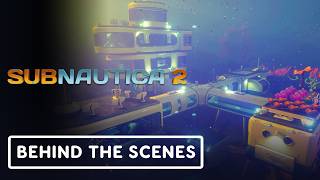
[00:04]
areas, I've intentionally built some areas where I'm like, I know whatever much cooler than I can. And I want to see what they think this little setup is or this little shrine thing is. I want them to give their own meaning to the
[00:19]
story and give them that unique experience. >> My name is Miho and I am the director of Subnautica 2. I'm Ben Kelly. I'm the
[00:34]
world art lead on Subnautica 2. >> My name is Dra Christopher. I'm a senior level designer on Subnautica 2. >> My name is Zachbatzik. I am the world >> The most successful environments are when the player can come into the space
[00:48]
and understand a little bit of the story just by looking at the set dressing. So before they have to read a PDA entry or spend time learning the law of the space, they should be able to understand just by the placement of props. And
[01:00]
[music] quite suggestive and gentle. Other times we can be a lot more explicit. The world is telling a story of a civilization that is gone that the player is experiencing. It's the same
[01:12]
with the colonists. There's more lore to discover than just an alien planet. It was a home for many. [music]
[01:25]
have to think about is what the player is going to experience. >> The purpose of gray boxing is just to make sure the level plays good. We get timings [music] between locations, narrative beats, how far is A from B or
[01:38]
>> We really want to make sure that we understand what the space is, how it going to interact with it, or if there is a big leviathan, where are they going to hide or not hide? So when a new area comes to us from level design, it comes
[01:53]
to us in blockout form. And this means that level design have placed primitive [music] they tend to just have a very basic grid material. However, the working with them long before this to figure out what's the ground made of,
[02:06]
what does the color palette for the biome, what are the types of foliage that's going to be in the space. They'll continue to test the space and they'll together to make sure that we [music] continue to maintain the intent they
[02:20]
have when they block the level out as we're arting up the space. Really boils down to making a game that makes you feel something. Now you feel terrified and now you feel the the beauty and the wonder of this place and now you feel
[02:33]
like you've seen something new. >> When you are designing on any level, you really have to think about creating these landmarks and almost like lines of >> contrast and consequence. So, you need to have contrast in the world that
[02:47]
player to look at and get them to feel like, I want to go over there and there needs to be some sort of consequence for you going there. That might be positive because you discover a new resource that might be like scary
[02:59]
haven't seen before. >> We really go all out hiding small areas crannies, these caves, these little hidden jackpots of things. >> I like using landmark shapes, um, leading lines. Lighting is also a great
[03:15]
way to kind of get the player interested in certain areas without just having a source. >> Lighting helps us to convey motion to the player. It's so important for visibility. So, how far the player can
[03:27]
then the color palette is really important as well. So, in safer areas or they can rest or [music] maybe a good place to build a base, we might use a dangerous, then we might go for cooler
[03:42]
bleak. So very prevalence in the areas where we have blight. Then we want to kind of strip some of that color palette back out until you've remedied it and again. >> The new region in EA2 obviously has a
[03:54]
bigger sense of scale. It provides a better stage for the collector that can shine more and there is a [music] lot more to explore space-wise with new >> It's not just like a new chunk of the world. It's [music] it's a new creature.
[04:07]
It's a new way to explore Axim and it's a new vehicle as well. Like that's the a new vehicle as well. Like that's the coolest thing. Always
[04:19]
is is like a dream come true for level designers cuz you add a massive new tool to build more [music] interesting spaces, do more interesting puzzles and add just another layer of depth to our world. One example would be hiding a
[04:34]
little pocket of goodies in in a cave and you actually have to scale up the wall to be able to grab the nodes [music] and also new ways to interact have done before. >> Here we're really tipping the scales
[04:46]
where the deeper you go, the more of a you'll be able to understand, see, and explore. Learning about them, exploring their spaces, learning how different they are, and also learning how similar they are. All this stuff I I think
[04:59]
excites me a lot for the future. I think we'll be able to make something very we'll be able to make something very cool here. >> I think I'm good. >> Ready?