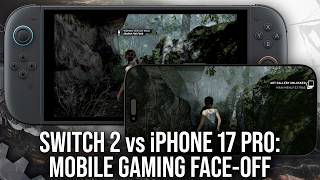

iPhone 17 Pro vs Switch 2: The Ultimate Showdown
45sDirectly compares two highly anticipated devices, sparking curiosity and debate among gamers and tech enthusiasts.
▶ Play Clip"The title accurately reflects the content, delivering a detailed comparison without exaggeration."
This video compares the gaming performance of the iPhone 17 Pro and the Nintendo Switch 2 across four AAA titles, analyzing visual quality, frame rates, and overall experience.
The iPhone 17 Pro achieves a stable 60fps in Grid Legends, while the Switch 2 dips to 40-50fps in busy scenes, but the Switch 2 supports extra effects like confetti and car mist.
The Switch 2 version of Resident Evil 7 closely matches the PS4 release with advanced effects and DLSS, while the iPhone version is a more traditional mobile port with reduced effects and blurrier textures.
In Tomb Raider, the iPhone achieves a consistent 60fps, but the Switch 2 offers TressFX hair and improved shadows, though it struggles to maintain 60fps.
Red Dead Redemption runs at a crisp 60fps on Switch 2 with DLSS, while the iPhone targets 40fps and uses post-process AA, resulting in a blurrier image.
The Switch 2 often delivers superior visuals and performance in these comparisons, but the iPhone 17 Pro shows potential when developers optimize for it. The future of mobile gaming on Apple devices depends on better utilization of its hardware.
Hardware Differences
Explains the fundamental hardware advantages of each device.
12:07Upscaling Techniques
Highlights the impact of DLSS vs. TAA on image quality.
05:49Thermal Throttling
Notes that iPhones throttle fast when pushed hard, affecting performance.
13:04[00:00] Apple's mobile hardware is renowned for its gaming power. Modern iPhones can choose through advanced rendering challenges, delivering stable renditions of sophisticated AAA software.
[00:14] In prior testing, we've established that newer iPhones can generally beat the original Switch, with higher-end features and smoother performance. But Nintendo has a new challenger on the market, the Switch 2, which should be able to square
[00:26] off more convincingly against Apple's mobile chips. So how do the Switch 2 and iPhone 17 Pro compare? Can a dedicated handheld be Apple's most advanced phone hardware?
[00:46] Our first game is Grid Legends. This 2022 racing title has had an iPhone version for a while and has an excellent Switch 2 version as well. The tech here is a little last gen, but the game still holds up visually and should be
[00:59] a decent fit for modern mobile hardware. Both iPhone and Switch 2 in handheld configuration have a performance mode, which targets 60 frames per second on both platforms. These mostly look similar in terms of visual settings.
[01:13] Both lack screen space reflections in typical gameplay, for instance. Both have static environmental shadows, and both appear to have reduced rate cubemap updates. But Switch 2 supports the game's confetti particles and bombs mode, plus car mist and
[01:28] sparks, while the iPhone version has none of these features. Conversely though, the iPhone version retains high-quality volumetric lighting, which is conspicuously missing from this Moscow track on Switch 2.
[01:40] Image quality is pretty similar here as well. I logged the Switch's typical threads at about 684p to 828p, typically, in my testing earlier this year. while iPhone hits 747p according to the Metal Overlay.
[01:56] But because the iPhone has an ultra-wide 19.69 aspect ratio that extends the horizontal axis, the Foley is rendering more pixels on the Switch 2, somewhere around 20% more based on my counts.
[02:12] Performance can suffer a little on Switch 2 in more intense racing sequences, but the game appears to support VRR, so actual moment-to-moment feel isn't compromised. Busy scenes take the game into the 40s and 50s, but in my experience it can be hard to
[02:27] notice, especially if you're playing with motion blur. The iPhone hits a stable 60fps conversely, but the upgrade isn't hugely tangible in typical play. In graphics mode, the iPhone version takes a more commanding visual lead in some key
[02:41] respects. Both versions look similar, but iPhone has environmental shadows that properly update in real time, and also has high quality volumetric lighting. of the game's advanced effects like the mist and car sparks are retained, but for some
[02:55] reason the iPhone is tragically confetti-less, even though we have confetti turned on in settings. I logged Switch 2 graphics mode resolutions at 0792p to 1080p while iPhone 17 Pro runs
[03:09] at 808p, at the lower end of the Switch 2 resolution range in nominal terms, but closer to the middle of the range in overall pixel count. The Switch 2 is substantially sharper, however, with clearer imagery and practice.
[03:22] Frame rates on Switch 2 hit a consistent 30 FPS, but iPhone aims for a higher 40 FPS and manages to hit it reliably That upgraded frame rate makes the game feel much smoother and more playable on 17 Pro devices I think Grid does a good job of illustrating the relative power of the two devices and the iPhone overall rigor in shops and advanced games Both platforms
[03:45] use TAA, neutralizing any AI-upstream differences, and both deliver broadly similar visual settings. There are some curious differences. The emission of logarithmic lighting in all of Switch 2's handheld modes is interesting, given that it doesn't seem to bother the iPhone, for
[04:00] instance. This comparison probably undersells the iPhone a little bit, though, because the iPhone code doesn't seem to take unique advantage of the iPhone 17 Pro's A19 Pro chip.
[04:12] The game's last iPhone update reportedly shipped a year ago and predated the launch of the latest iPhone models. That means the configuration here is built from the capabilities of the 16 Pro, with with no apparent enhancements for 17 Pro models.
[04:26] Frame rates may be more stable on 17 Pro models, however, because they can run the game's 16 Pro configuration with less strain. Next up is Resident Evil 7. This Capcom classic is another good workout for iPhones and Switches alike, posing an
[04:41] 8th gen rendering challenge to mobile hardware. But this isn't an especially close contest. The Switch 2 version aims for broad console parity, generally matching individual outcomes
[04:53] from the PS4 release. Some things differ, but broadly speaking, Switch 2 is delivering a home console-like experience. That also holds true for the game's handheld configuration, which basically looks like
[05:05] a blurrier version of the PS4 game. The iPhone version feels like a more traditional mobile port. Advanced lighting effects like SSR and volumetric lighting are cut back or absent, foliage is simplified, and channel maps are blurrier. Plus, texture resolutions appear
[05:21] vastly pared back, with blurry and unsophisticated artwork. These may be the right concessions for a mobile game, and they do stand out less obviously on the iPhone's small screen, but compared to Switch 2, there's not really much contest.
[05:35] Plus, image quality isn't great either. I've set a full 2556x1179 resolution in the game settings, but that doesn't reflect the internal resolution, which is about 720p.
[05:49] That would be perfectly fine with temporal upscaling, of course, but the game appears to use RE Engine's TAA instead of little effects, which produces a blurry and unstable picture. That compares unfavorably against Switch, which runs from a lower resolution of about
[06:03] 432p, but uprises pretty nicely with temporal upscaling, likely DLSS. I'm testing the game in its performance mode configuration here in order to keep permanent parity with Switch 2, and it does generally reach and hold 60 FPS.
[06:19] I'm just testing the game's opening, but RE7 tends to be constrained in scope throughout, so this seems representative. The game also has balanced and graphics-more configurations, which do enhance visual settings,
[06:31] and make use of higher-quality, no-FX up-sealing, but they target lower framerates than Switch 2, and so make for looser comparison points with Nintendo's hybrid. This is unfortunately another game where the visuals were calibrated against earlier iPhone
[06:45] hardware, as the game's last update came a year ago, according to the App Store listing. Advanced AAA titles are often released on iPhone and then more or less left alone, because they're mostly one-and-done affairs that don't demand constant patching and content cycles
[07:02] like live games All those caveats aside the iPhone version of Resident Evil 7 is a good port it just calibrates the needs of mobile devices I noted in DF coverage a couple years ago that the game was well behaved on my iPhone
[07:15] 15 Pro, without turning off key system functions like the flashlight in order to preserve the phone's thermal state, which was a serious issue in many games on that device. A good looking, but obviously degraded iPhone version that doesn't hammer battery life
[07:31] for device temperatures is probably a well-tuned configuration for most players.
[07:44] Next up is Tomb Raider, the 2013 reboot of the classic adventure series. Before we start on the iPhone version, though, we need to recap the game's controversial Switch to release. Compared to the game's PS4 outing, lighting detail was pared back, including a removal
[08:00] as many shadows, and it had somewhat degraded or removed ambient occlusion. Foliage and geometric density was reduced as well. Plus, the game's Tress Effect, Strandhair, was removed, giving Lara simpler locks that
[08:13] moved as one whole. Even compared to PS3, Switch 2 wasn't a clear winner because shadow-detailing presence on PS3 was sometimes absent on Switch 2. Fortunately as of the latest patch, some of these issues have been resolved.
[08:27] Notably, press effects have been added so Laura's hair moves more realistically. Some extra shadow detail is now present, and shadows that weren't previously drawn have been added. It's still pretty far from true PS4 parody though, with simpler foliage, low quality
[08:44] shadows, lower detail models, and no depth of field shared gameplay. It's better than it was before, but for a 13 year old game, I think it still doesn't quite meet expectations. So this updated Switch 2 version is what we're comparing against the iPhone.
[08:58] Unfortunately, the iPhone code is visibly simplified, with obvious foliage reductions compared to Switch. Trust effects doesn't make the cut on Apple's platform either. Colors are also a bit faded in my iPhone capture, though this is a bit trickier to judge because
[09:13] iPhones can have some complications in the capture process. The iPhone version also proves a bit blurrier than Switch 2, with less defined visuals. Internally, the game runs at 904p in performance mode, which is a slightly lower overall pixel
[09:28] count than the Switch 2's Canopy. iPhone does hit a consistent 60fps, however, logging a flat 60 in the game's opening segments. Switch 2 doesn't quite get there without its sub-60 performance.
[09:41] And you really feel it too because the game doesn't appear to support VRR. I recall Switch 2 performance being more consistent at launch, though I don't have any footage of the launch version in handheld mode.
[09:54] Perhaps some of the new TressFX videos have suppressed performance. This is the case where there's a genuine split. The Switch 2 is doing something that's probably more impressive technically, but iPhone delivers the performance goods.
[10:06] I do think that within reason developers should prioritize consistent performance over visual thrill, so the SFX is perhaps not the right call. Finally we have Red Dead Redemption.
[10:18] The first 2010 open world action adventure was originally released on Xbox 360 and PS3, but the Switch 2 version of the game delivers crisp visuals and a stable 60fps. Internally the game renders at roughly 540p, but it upscales to a convincingly high res
[10:34] output using DLSS. Visually speaking this title is nothing special by modern standards but it does offer a clean and smooth output on the Switch too The iPhone version is somewhat more compromised Firstly it doesn run at 60fps instead aiming for a 40fps target in its performance
[10:51] mode. It seems to have no issues hitting 40fps, but I think 60fps is the baseline expectation here for such an aged title. It also doesn't reveal itself as any temporal anti-aliasing or temporal up-healing, instead
[11:06] using Post Process AA. The game's internal resolution of about 700p isn't sufficient here to produce a clean or especially crisp image, even though the game is technically pushing more raw pixels than Switch 2. Drive instances seem pretty similar to Switch 2
[11:22] at least, and the underlying visual settings appear similar enough. This doesn't seem like a particularly strong iPhone port, though it does hold up well enough as a mobile experience. The iPhone 15 Pro version counted at the same 700p resolution
[11:36] with the same 40fps cap the last time I tested it, suggesting that the game may not take any advantage of the iPhone 17 Pro's chip. But the game was released after the 17 Pro's launch, so it really should have a graphics configuration tailored to the faster chip.
[11:51] I think the iPhone and Switch 2 comparison is intriguing. The Switch 2 has certain unique strengths, more targeted developer attention, a bespoke and proprietary graphics API, active fan cooling, and a wider, more power-hungry chip that can be pushed harder, but the iPhone
[12:07] has a more modern 3nm chip, which is several generations more recent than the Switch 2's dated 8-10nm NVIDIA processor. Plus, the iPhone is no slouch in feature terms either, supporting mesh shading, ray tracing,
[12:22] and AI upscaling just like the Switch. On balance, I think these two approaches can yield competitive results, which Grid Legends illustrates. A well-balanced phone release can square up just fine against Nintendo's latest console,
[12:35] if developers are aiming to maximize the hardware. But that's not the only consideration for mobile ports. High-end games complete phone batteries rapidly, reducing all-day longevity to just a few hours, and can cause thermal issues that make phones difficult to use or actively uncomfortable.
[12:51] Some developers make the choice to prioritize battery life and device stability over absolute rendering fidelity, which can be a sensible move. And few developers ship game configurations that fully saturate newer iPhones, because
[13:04] iPhones will throttle fast if pushed too hard. Plus, iPhone hardware is always evolving, so older games don't always make effective use of the latest iPhones. A game like Resident Evil 7 is left with a graphics configuration that suits 2023 and
[13:19] the 2004 era phones well, but it's probably a little light for an iPhone 17 Pro, and some newer games ship without an excessive configuration on the latest iPhones, with few upgrades over older models.
[13:31] We could derive insights about modern iPhones generally in these pedals, but less so about the 17 Pro specifically. In the future, I hope to find other mobile heavy hitters on Switch, games like Assassin's Mirage or Death Stranding, which have pushed out the frontier on iPhone, in addition to
[13:47] of the modern Resident Evil titles that haven't already appeared on Nintendo's platform. These games might provide a bit more context to understand Nintendo's aged T239 chip, and how it may hold up over time as the mobile frontier advances.
[14:02] If you enjoyed this video, please like, subscribe, and press the bell for YouTube notifications. Check out the Patreon at patreon.com slash digitalsummary for exclusive and early access content, and to get in touch, use social media.


⚡ Saved you 0h 14m reading this? Transcribe any YouTube video for free — no signup needed.