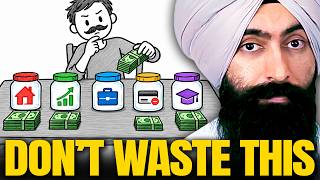

Where Your $4.5 Million Goes
45sShocking statistic about median income and career earnings compels viewers to watch.
▶ Play Clip"Delivers a solid 5-step framework, but padded with personal anecdotes and a sponsor segment; could be more concise."
This video presents a five-step financial framework designed to help viewers manage their paychecks effectively and build long-term wealth. The speaker emphasizes the importance of auditing expenses, escaping the 'financial danger zone,' systematizing savings and investments, increasing income, and protecting assets.
The median US income is $63,000/year, totaling $4.7 million over a career with 3% raises. Most people won't retire with $5 million; they'll have closer to $13,000 because money is spent little by little each paycheck.
The first step is to audit your finances by tracking all income and expenses, similar to a business P&L. This helps identify unused subscriptions and unnecessary spending, providing 'free money' and a clearer picture of your financial habits.
Reframe purchases in terms of time worked. A $3,000 scarf for someone earning $30/hour actually costs 115-120 hours of work after taxes and sales tax, making it easier to evaluate if a purchase is worth your time.
Save $2,000 for emergencies as fast as possible, then pay off all credit card debt. This moves you out of the 'financial danger zone' where any small expense or job loss could break you financially.
If you lack $2,000 in savings or have credit card debt, you're in the danger zone. This requires aggressive sacrifices: no eating out, vacations, brand-name clothes, or Netflix, and using time to earn more money instead of watching TV.
The median household with credit card debt owes about $8,000 at an average APR of 22%. This is the same return that makes credit card companies rich, so paying off this debt is like earning a guaranteed 22% return.
To get out faster: 1) Cut expenses (e.g., sell car, cook at home), 2) Cancel unused subscriptions, 3) Negotiate bills lower (be nice, mention competitors, ask for manager), 4) Earn more money (side hustle, extra hours).
Once out of the danger zone, implement the 75/15/10 rule: spend a maximum of 75% of income, invest at least 15%, and save at least 10%. Use three separate bank accounts with automatic transfers to enforce these allocations.
Savings are for emergencies, not wealth building, as they lose value to inflation. Keep 3-12 months of expenses in a liquid, high-yield savings account, depending on personal circumstances like age, family, and job stability.
Invest in proven asset classes like the stock market and real estate for long-term growth. Keep speculative investments (crypto, collectibles) as a smaller part of the portfolio. Once savings goals are met, redirect the 10% to investments.
Earning more money is important, but only after systematizing your finances. Without a system, extra income often leads to lifestyle inflation and increased debt. With a system, higher income fuels more saving and investing.
As wealth grows, protect it with a good accountant, legal advice, and appropriate insurance. Avoid whole life insurance in favor of term life, and consider estate planning to ensure your assets are distributed as you wish.
Building wealth takes a 'decade of sacrifice'—spending less, earning more, and investing aggressively. This long-term approach is more reliable than shortcuts, which often lead to disappointment and setbacks.
The video concludes that financial security comes from a disciplined, systematic approach: audit, build a foundation, systematize, earn more, and protect assets. It emphasizes that the 'long and hard path' of sacrifice is the most reliable route to wealth.
Time-Based Spending
Reframing purchases in terms of hours worked makes the true cost of luxury items tangible and helps curb impulse buying.
05:06Credit Card Debt as Negative Investment
Paying off 22% APR debt is equivalent to earning a guaranteed 22% return, a powerful motivator to prioritize debt elimination.
12:28The 75/15/10 Rule
A simple, actionable budgeting framework that automates saving and investing, reducing reliance on willpower.
16:47Systematize Before Earning More
Highlights the common mistake of increasing income without a system, which often leads to lifestyle inflation and more debt.
23:40The Decade of Sacrifice
Sets realistic expectations that wealth building requires long-term discipline, countering the allure of shortcuts.
34:36[00:01] The median income in the United States is $63,000 a year. That means the median is $63,000 a year. That means the median worker will earn 4.7 million dollars over their working career assuming that you get a 3% raise
[00:15] paycheck like most people, you're not going to retire with $5 million or $1 million or even $100,000, but closer to $13,000 in the bank. So, where's the other $4.5 million going? Because it's not all
[00:30] going to taxes. It's being spent away little by little every paycheck for 45 years. This is why many people do not have an income problem, they have a "Oh, Justin, if I just made an extra $1,000 a month, it'd be so much easier."
[00:45] Yes, but only if you know what to do with your money first. So, in this things you need to do with your paycheck every single time you get paid. So, please stick with me through this video that way you can be smarter with your
[00:58] money and take the money that you're going to earn and actually keep it to make you wealthy instead of making everybody else rich. Step number one, you to audit your money. I don't care how good you are with money. If you
[01:11] don't have a visualization of where your money is going, you are never going to be able to improve your money. This was a mistake that I made just recently. I'm pretty good with money. I do a monthly audit for my personal finances, and I
[01:24] used to do a monthly audit for my business finances, but I fell off doing the monthly audit for my company's finances. Why? Because we started hiring stuff. We started getting really busy inside of the business that I just
[01:37] audit. And then I hired an operations person, and one of the first thing that he did was, "Let's audit the finances. Let's take a look at the P&Ls and just see what's going on with the money." And what he found was thousands, not
[01:49] exaggerating, thousands of dollars of subscriptions every single month that were not being used. We immediately turned that off. If you don't keep a running audit of your money, it is so easy. I don't care who
[02:03] you are. This happened to me. It doesn't matter who you are. If you don't have a going, it is going to be so impossible for you to improve your money, and it's for you to improve your money, and it's such a simple way to find extra money
[02:16] let me show you what you need to do. You can do an app if you want to spend piece of paper, or just do a simple here's how it's going to work. On the top is you're going to write your
[02:30] are all the different sources of income that you have? I have my job income. I I have my investment income. So, write all your different sources of income right here. Then, you're going to write the total of how much money you made
[02:44] over the last month. Then, what you're going to do below this expenses. [clears throat] Notice how you were treating your finances like a business. In business, we call this a P&L, a profit and loss
[02:57] minus your expenses. I want you to do the exact same thing here. Now, when you I want you to do this right. So, grab your credit card statements, grab your card statements, because I want you to write down every penny. Where did the
[03:14] categorizing them. It's going to make it a lot easier. And if you have ChatGPT, to make it so much simpler for you to do this as well. You can just talk to ChatGPT or Claude and help you organize this money as well.
[03:28] of your expenses, all of the eating out that you did, all of your housing costs, gas bills, all of your whatever costs that you have. And then, you're going to have how much money is
[03:42] left. And then, once you have how much money is left, What did you do with the money that was left? How much money did you give to charity, if any? How much money did you put in a savings account? How much money
[03:57] did you invest? You must allocate that here, and every dollar must have a job, have done a true audit of your money, and now you have a tracking spreadsheet tracking spreadsheet, two things are going to happen that I can guarantee for
[04:13] you. Number one is you're going to find expenses you didn't know that you have. And that's kind of like free money, because now you can cancel some expenses you didn't know that you were spending money on. So, you just got some free
[04:27] going to do is you're probably going to realize, "Oh my god, I'm spending so Maybe I should not be going to Benihana's so often." And now you can your money, and I don't even have to tell you anything, because as soon as
[04:41] you start to see where your money is going, it's like you just graded yourself. And now you're going to start to feel like, "Oh my god, I work so hard to make this money. Where am I spending it? Is my time worth it?" See, the thing
[04:53] about money is that the way that you get rich fast is by not taking a shortcut, shortcut, you're never going to see the success that you want, and you're going shortcut, and you're never going to get there. But if you go the long path, you
[05:06] to get there. And the thing that I want you to start thinking about money, because if you make $30 an hour, and now you walk into amazing purse, you see that amazing scarf, and it's listed for a cheap
[05:21] little $3,000. Oh my god, $3,000 for this ugly little scarf, I got to have it. Well, the thing that I want you to remember is the cost of that scarf is not $3,000. The cost of that scarf is 100 hours of
[05:38] But truly, it's actually a little bit more than that, because you have to factor in the taxes you pay on this money, because you don't actually keep the $30 an hour that you make. Then you have to factor in the sales tax that you
[05:50] have to pay on top of that. So, truly it's closer to like 115 or 120 hours of your time to be able to buy that $3,000 scarf. Now, I don't care if you buy Gucci or Louis Vuitton. If you like that stuff, fine. Just make sure it is worth
[06:04] your time. But, in order for you to become financially successful, you have thinking about how you're using your money and whether or not you can become wealthy because if you don't believe that you can become wealthy, you will
[06:19] never become wealthy. And I'm telling you this because I used to guest teach in Detroit public schools. And I remember this so vividly cuz I used to kids, hard-working kids. Most of these kids had jobs.
[06:32] But, none of them thought that they could become successful. car?" Because I wanted to get them excited about this idea of becoming And they're high school kids and they would say things like a Dodge Challenger
[06:46] or a Ford Focus. And I said, "Well, why not something bigger like a Rolls-Royce or a Bugatti?" And they would say that because somebody like me in my situation, with my circumstances, I can't ever become that successful. And
[06:59] when you put that imaginary box over where you are, I can guarantee you ceiling. So, if you want to become wealthy, the first thing you have to do, you got to audit your money.
[07:12] that you think about money. You have to know that you will become money is a tool. You can use that tool to make yourself rich, or you can use When you go to Gucci and you spend the $3,000, you are making Gucci rich. And
[07:28] don't have because you finance it on your Amex or your Visa, well, now not only are you making Gucci rich, but you're also making Amex and Visa rich. single day not just to pay that money back to Gucci, but to pay them interest
[07:43] to Amex and Visa. And this is where what I want you to do and understand you have to have money left over in order for you to become wealthy because if you spend all of your money, and I get it's hard when there's
[07:57] all of your money, you never have a chance to become wealthy. And the way wealthy, I have a very specific definition of that. I'm going to show you. When I say wealthy, that means that wealthy people have enough assets. They
[08:11] own these investments that are paying them money every single month that they don't have to work anymore. The average person has to work because I have to work to afford the things that I want. Have to work to pay for my bills.
[08:24] Have to work to pay for my house. Wealthy people don't have to work. They work if they want to. They own the assets. Those assets pay them money whether or not they work. That money then pays their lifestyle. The only way
[08:40] that you can get there is if you have money left over to buy those assets. And that starts with controlling the expenses right here. And you can't control or manage those expenses unless you do that audit. Once
[08:53] I want you to do is lay your financial foundation. And when I say lay your financial foundation, what I mean is the first thing that you have to do is you first thing that you have to do is you must save $2,000 for an emergency as
[09:05] fast as humanly possible. And then once you save this $2,000, the next thing that I want you to do is get rid of your credit card debt. And you have
[09:17] thing, when I talk about saving this $2,000, is because the average person in $2,000, is because the average person in America right now does not have a $1,000 saved up to protect them from an emergency. If you had a $1,000 [snorts]
[09:31] unexpected expense because your car breaks down, the AC stops working, or the fridge breaks, most people statistically would then have to take that expense and finance it on their credit card because they don't have a
[09:43] have to keep putting these little expenses that keep happening on your get ahead because you're always taking one step forward, two steps backward. One step forward, two steps backward. And you're always going to be playing
[09:57] catch-up. So, to stop that, I want you to save $2,000 as fast as possible. And card debt. And this is what I call the financial danger zone. If you don't have
[10:10] these two things done, if you don't have $2,000, if you don't have your credit card debt paid off, you were in the financial danger zone because any small expense could break you financially. If you lost your job, you lost a paycheck,
[10:25] it could break you financially. And you have to get out of this financial danger now you're stuck. And what that means is right now, if you are in this situation,
[10:38] no more eating out at restaurants. No more going on vacation. No brand name clothes and no more Netflix. And you're going to say, "John Smith, why no Netflix? It's only $15 a month." It's not about the $15 a month. The average
[10:52] American is watching more than two hours of television a day. It's about the time you are wasting just sitting there scrolling through Netflix when you could be using that time to go and drive for Uber. You could be using that time to
[11:05] time to learn something how you can make more money. You could be using that time to find other ways to make more money. This is the time that if you are in this financial danger zone, you should not be sleeping so comfortably.
[11:19] You got to get out of this situation. And I say this so firmly because if you are in this situation, it is so easy for companies to prey on you
[11:31] and to unfortunately screw you over. Let me show you what I mean. Let's assume that you could find $8,000 right now, and you took this $8,000 and you invested it into this asset. And this asset pays you 22%
[11:45] a year, and you never invest another penny. You only invest this $8,000 one time, and you never invest another dollar again. You spend every other dollar that you earn, but this money is growing by 22% a year, and you do this
[11:58] for the next 40 years. Do you know how much this $8,000 is going to grow to? It's not going to grow to $100,000, or half a million dollars, or 1 million dollars, or 5 million dollars, or 10 million dollars, or 20 million dollars.
[12:11] million dollars, or 20 million dollars. It's going to grow to more than 22 "Jeff, that sounds pretty good. I can find that $8,000. Sign me up. What do I do?" Well, here's the reality. You probably are not going to get those 22%
[12:28] returns. But do you want to know who is? Amex, Visa, MasterCard, Discover. those 22% returns? You are. When you have credit card debt, because the median household with credit card debt has about $8,000 of credit
[12:43] card debt, and the average APR on that credit card debt is right around 22%. So, if you wonder why those credit card companies are so rich with those huge buildings all across the world with private jets, it's because the majority
[12:58] of people are working so hard to let them be so rich, because they are the what I want you to do is get out of the situation, stop making them rich, that we have the ability to make yourself rich. So, if you are in this financial
[13:13] danger zone, you don't have $2,000, or you have credit card debt, or both, how do you get out of the financial danger zone faster? Four things. Number one, find ways to cut back on your expenses. Maybe you can sell your car and get a
[13:26] apartment. Maybe just stop going out to eat every single week and you start cooking at home. Find ways to spend less money. Number two, cancel some subscriptions. You're going to find some unused subscriptions through this audit.
[13:39] subscriptions that you can cut back on. Find ways to stop spending money so you have more money for yourself. Number three, negotiate your bills lower. your cell phone bills, they're all going
[13:54] to be trying to raise the prices. And a lot of times they don't even tell you. a way so you don't actually hear about it. But what you can do now is you can work to negotiate those bills lower because
[14:06] the worst they're going to say is no. I love doing this strategy because I really don't like seeing my phone bill getting more expensive. I hate it when my internet bill gets more expensive. So here's what you do. Number one, call
[14:19] them. But here's the key. Be nice. Those customer support people are getting yelled at. They're getting cussed out every single day. And if you're nice to them, they are more likely to be nice to
[14:32] your wallet. So you're going to call them and you're going to be nice. And then you're going to say, "Hey, uh I've been a customer with your company for 3 years and I really like your service, but I noticed that over the years that
[14:45] and I don't know if I can keep paying this price. Can you tell me what's going on here?" Then they're going to give you some explanation and they might already something." And if they don't, here's what you do. "Oh, okay. Well, thank you
[14:58] for letting me know. Um I was actually looking at your competitor and they're something that you can do to beat that price? I don't want to leave, but I just can't keep affording this price." And
[15:11] they can come close, but maybe they can't beat it. And that's when you say, with me and bringing the bill down by $25 a month, but I really need it down by $40 a month. Could you please talk to a manager or bring a manager in that way
[15:26] I could talk to them. I don't want to leave, but if I have to, I will. And now the manager often times has the ability to lower the price a little bit more. whatever bills that you have, all of your insurance companies, all of your
[15:40] phone bills, all of your utility bills, all of your internet bills, and see if You don't have to sacrifice anything, but you'll find ways to negotiate your bills lower and have some money without getting rid of anything. And then the
[15:53] some more money. Whether that's driving for Uber, whether that's earning more hours, a side hustle, doing a second job, finding a way to make some more money, just so you can get out of this financial danger zone faster, because
[16:06] until you get out of here, you can't start making yourself wealthy, because all of your extra money is going to make everybody else rich. Now, this is where to start systematizing your money once you get out of the financial danger
[16:18] on your money, and every month you're going to see where your money is going, things that you're not using. And then what you're going to do is you're going have a little bit of a savings cushion of $2,000, and then you're going to pay
[16:31] finally have some breathing room, and now we can talk about building a system wealthy person does is they give their dollars a job before that money hits are about to do right now. And one of the simplest systems that you can create
[16:47] is what I call 75 15 15 10. And what the 75 15 10 rule states is for every dollar that you earn from here on out, 75 cents is the maximum that you
[17:02] on out, 75 cents is the maximum that you can spend, 15 cents is the minimum that you invest, 10 cents is the minimum that you save. So, whether you make $10,000 a year, $100,000 a year, or a million dollars a year, you're always working to
[17:16] money, but there's a way to do this right and there's a way to do this wrong. The way you do this wrong is now your money hits your bank account and made a thousand dollars. I'm going to only spend $750 out of this thousand
[17:32] dollars and I'm going to invest some and save some money." The problem with that money in one bank account, it's very easy to forget or make a mistake or accidentally now spend your investment
[17:46] money on a TV when Amazon is having a sale. So, instead, the way that I want you to do this is I also want you to create three different bank accounts. And now what's going to happen is money gets
[17:59] direct deposited into your bank account right here. You go to work, you get here. Now, you're going to create automatic withdrawals and deposits, which means 15% of this money is automatically going to go right here and
[18:15] 10% of this money is automatically going to go right here into this different is you've created walls around your money. That way, you can visualize and see, "This is my spending money. This is the most money that I have to spend.
[18:29] to invest. This is the money that I'm going to save for emergencies." And now what you've done is you've created a system where you're also protecting yourself from your own stupidity. Because I got to do the same
[18:44] thing from me. I don't want to say this to be mean, but the reality is sometimes not too long ago. We were walking down the streets of New York and we passed this store and they had this like life-size action figure from a Dragon
[18:57] those of you that like Dragon Ball Z. I love Vegeta. And I was like, "Oh, that that." So, I walked in the store, I look at the action figure and it was like $8,000. I was like, "Oh, let me buy this." And my wife was like, "Well, are
[19:11] you going to put it?" I was like, "I'll put it in my office somewhere." And she and that. Sometimes you need a check. In that instance, my wife was my check that stopped me from making that impulse
[19:23] purchase. Now, realistically, I probably will end up actually just wanted something a little bit bigger, but I didn't end up buying it at that time because my wife was my check that I almost just made this
[19:35] impulse purchase. And I get it. I just I like Dragon Ball Z, okay? like Dragon Ball Z, okay? But in this case, I had the money to spend. But if you don't have the money to spend, your check will be the amount
[19:48] of money in your account. In that instance, it was my wife. check of saying, "Do I have this money to spend or do I not? This is the money that must be invested. This is the money that must be saved." Now, let's talk
[20:01] about savings for just a minute. Your savings are not there to make you wealthy. Your savings are there to protect you against an emergency. Hear this very carefully because your savings are losing value to inflation.
[20:16] I'm talking about having money to protect you in case you lose your job, in case you get sick, or in case something really bad happens. And against those disasters, you don't want to have to start scrambling for
[20:29] You want to have some cash to fall back on. And you don't want to take the because what ends up happening a lot of times is a disaster happens in the economy and you have an emergency situation.
[20:43] So, a disaster happens in the economy and the stock market falls by 35% your job. your job. Now, your portfolio is down 35%
[20:56] and you need your savings. And now you thought you had $100,000, but you only have $65,000. That's the problem with having your savings in the stock market or any sort of
[21:08] liquid, easy to access, like a high-yield savings account. So, the savings wants to be in a savings account, not to make you wealthy, but to protect you against an emergency. You want to have somewhere between 3 to 12
[21:22] months worth of savings put aside. It's a big range because, well, personal 25-years-old, you don't have kids, you don't have a spouse, you might only need 45-years-old, you got kids, you got a spouse that relies on you, you also take
[21:35] care of your parents, you might want a 12-month savings cushion to be able to feel comfortable knowing that, "Hey, if I lost my job tomorrow, I'm not going to fall back on. We can continue to live our lives while
[21:48] I get back on my feet." So, that's why you need 3 to 12 months worth of savings. Once you have that savings goal hit, you're not going to take this money and put it here. So, now it becomes 75/25
[22:01] goal. Now, your investments, this is where wealth is going to be built. You can invest this money in the stock market, estate, you can invest this money into courses, you can invest this money into
[22:15] The idea here is you're going to invest this money with the goal of making more very risky with this money, at least with most of it. Spend most of it on Those are the two asset classes that have been proven to build more wealth
[22:29] years, outside of building your own business, but that's not for everybody. can be passive, and it's a great way to build wealth over the long term. And speculative, have some more fun stuff like crypto or collectibles or other
[22:44] things like that, make that a smaller piece of your investment portfolio. going to be going. Now, for those of you up-to-date on what's happening in the financial news, my team at Briefs
[22:57] Finance publishes a free daily newsletter called Market Briefs, where the economy, housing, stocks, crypto, and global markets into a free 5-minute newsletter. It's very fun to read. If you are not reading yet, I highly
[23:12] of thousands of investors that read Market Briefs every single morning. So, that link for you down in the description below. Now, there's a lot of not going to go into all of those ways in this video. I have a lot of videos
[23:27] investing strategies. I will link some of those for you down in the description if you want to learn more. And this is the money that you can spend. Once you move on to number four, earning more money. Now, notice how I included
[23:40] earning more money after you systematize it, because the mistake that I see a lot of people make is they say, "I'm in a financial tough situation. I got to sense. But the problem is, if you have no idea
[23:53] when you start to make that extra $10,000 a year, is now your bank says, "Ooh, you are more creditworthy. How about you upgrade the Toyota Camry to a nice BMW 4 Series? We'll be happy to give you that financing." Or you start
[24:07] to see the nicer apartments. Or you start to see those vacations at Cancun happening to a lot of people, and I'm telling you this from experience, again and again, is [snorts] you start making an extra $1,000 a month,
[24:21] than you were before. Because as you make more money, you become more That's what banks like to call it. Because if you make more money, they And as you become more creditworthy, your credit lines increase. People start
[24:36] because now all of a sudden you thought that extra $10,000 a year, that extra your financial mess, because you're going to take this money and spend it smartly. But then all of a sudden, you just start spending some more money and
[24:49] to more debt, and now you're in a bigger financial hole than you were in in the first place, which is why I want you to systematize your money, and then I want you to earn more money because now what happens if you go from $50,000 a year to
[25:03] have more money to spend, but you're also investing more and you're saving more because you're following 75/15/10. For every dollar that you earn, 75 cents is the maximum that you can spend, 15 cents is the minimum that you invest, 10
[25:17] cents is the minimum that you save. If you go from $75,000 a year to $750,000 You're still going to be spending more money, but you're also going to be there's a lot of ways to earn more money. You can go out and get a
[25:30] certificate to get a new career. You can go and get another degree if that's what you want to do. You can go out and just go and get a new job if that's what you hustle. You can start a business. It doesn't matter. I know there's a lot of
[25:42] this stuff going around that a job is bad. Well, things have changed throughout time. I actually had a really good talk about this with my good friend, one of my early business partners. When we were
[25:55] college, most people didn't want to start a business, right? We didn't have people that wanted to start a business were a very special kind of weirdos. Like it was like the true entrepreneurs where it was in your DNA where you're
[26:09] like, I need to start a business. It just wasn't like the normal thing to do. And now everybody feels like I should be a business owner making an insane amount of money. The first thing is starting a business is very hard, and you got to be
[26:23] insane. The second thing is starting a business that makes a lot of money and makes you a lot of money is now a whole separate layer of difficult. that's the only way to become successful. Well, no, that's not true.
[26:40] job. You have to know what's right for you. I love entrepreneurship. I love entrepreneurs. I mean, when I was starting off my business journey, I wish that I had more support or more people that were doing it, but the reality is
[26:54] most people cannot and they won't because it is very hard. Because when you talk about you're going to have to sacrifice sleep, you're going to have to fact, you're going to have to make a whole lot less money for years before
[27:09] you can see any real reward. If you just got a job, you'd have less stress, you'd make more money, you'd work less hours, and you'd have the probably health insurance, too. Plus you get time off.
[27:22] people. Because when you start a business, guess what? When you have a kid, you don't get paternal leave or maternal leave because you are the supplier of your own income. You got to work.
[27:35] When your parents get sick or your grandparents get sick, you don't get especially if you're in the early stages. Whereas when you were an employee, you can request time off. You might even get
[27:50] paid time off. When you were a business owner in the early stages, there's no working and you're making money or to get to the point where your business can make money without you working.
[28:04] So, I'm not trying to discourage you from starting a business. In fact, I love encouraging people to be an entrepreneur, but I want to make it clear that there's many ways to make more money. Not everybody needs to or
[28:16] should be a business owner. I love entrepreneurs. I love entrepreneurship. I'm 100% a supporter and a promoter of it. the delusion that comes with it if you want to become successful.
[28:29] but the reason why I want you to earn more money is so you can fuel your wealth because the way that you become wealthy is by being an asset owner. Your assets are right here. These assets can be stocks, they can be real estate, they
[28:42] But [snorts] you You have to build a business to become wealthy. The idea is you just have to be an asset owner if you want to become wealthy. Then this assets. As a licensed attorney, who's not your attorney, what I can tell you
[28:57] is [snorts] as you start to have more wealth, and you definitely will once you will try to take some of it out of your pocket for themselves. And this is where you want to make sure you are protecting your wealth by having the right shields
[29:10] in place. The first step is get yourself a good accountant. I have worked with accountants. A good accountant is going to cost you more money up front, but they will probably save you a lot of money in taxes overall, which will end
[29:24] up actually saving you money because now you have an accountant that actually understands the tax laws. Here's the reality. Taxes are always changing. Don't overpay in taxes if you don't have to. Pay what your taxes are,
[29:37] but don't overpay in taxes. And many people, especially as you start to build wealth, are overpaying in taxes. So, if you can get a good accountant that can get yourself a good accountant. Number two, you need to get yourself some good
[29:52] need a lot of different business attorneys, but get yourself at least a you as to what type of legal protection that you need. You will then also need insurances. Maybe you need your health insurance,
[30:06] your car insurance. Maybe you want some life insurance to be able to protect you wealth. There's two types of insurance for life insurance. There's whole life and term life insurance. I'm not a fan of whole life insurance. I think that
[30:20] life insurance is kind of like a a investment account there to protect you. the term of your life insurance, like if you get a 20-year policy, if you die
[30:33] going to get a big payout. If you die on year 21, your family gets zero dollars. because if you know how to invest your money, your family doesn't have to rely on life insurance to be able to
[30:49] fund their lives. And the second reason is that term life insurance is a whole Because the way the whole life insurance works is your money has to be invested. the profits. I mean, they life insurance company has to make some money off of
[31:03] well. That's how they're going to pay the brokers. That's how they get rich as money, take a piece of it, and then give you the rest. Versus if you know how to invest your money, get a term life insurance policy, you have all the
[31:16] remaining money left over, and you can invest it yourself and keep the returns you want to learn how to invest your money. So, and then you also want to think about getting an estate planning attorney. An
[31:29] build a will, might help you build a trust, they might help you build other things to protect your assets. Because the last thing that you want to happen is you pass away, and then the government decides where your money
[31:41] You don't want that to happen. But, the ultimate goal here is that now as you optional. Because now you have the assets. As we're building here, you have the assets that are worth enough or paying you
[31:56] enough cash flow that you have enough money coming in to live your life, go on that you want to do without worrying about money because your assets are paying for it. That's the way wealthy people think, but
[32:12] your paycheck. When I first started learning about money management, I thought that credit cards are bad and evil. And then when I realized that I knew how to spend my money, and I wasn't going to spend money I didn't have for
[32:25] credit card perks and points, I realized that I could earn more cash back, I doing nothing except making the transactions that I would normally make anyways with a the card instead of a debit card. And that's why I partnered
[32:38] together an article of some of my favorite credit cards. Now, here's the caveat. If you don't know how to manage your money, don't use a credit card. But card, in this article with my sponsor FinanceBuzz, I go over some of my top
[32:51] credit cards based off of different types of tiers. If you have credit card debt and you want to pay it off faster, I go over some of the top 0% APR credit cards. This will give you an opportunity to attack the credit card debt faster
[33:03] while not accruing any interest during the 0% APR period. I go over some of my can earn more points and cash back while you spend on your normal transactions. I go over some of my favorite travel cards
[33:16] often and earning more income. And then I go over some of my favorite business how to manage your money and you're comfortable using a credit card, you can see some of my top credit cards right now in the free article that I have for
[33:29] talked about in this video is the first thing you need to do is you got to audit happening with your money, where your money is going, you got to get it under Once you audit your money, number two is you [snorts] got to build your financial
[33:43] $2,000 and you have to pay off the out of the financial danger zone. This is the time where you have to make the most sacrifices because you don't want to be in that financial
[33:56] danger zone a day longer than you need to be. systematize your money. Something like 75 15 10. So, for every dollar that you earn from here on out, it has a job. Some money is always going to be saved
[34:10] money. Then you're going to work earn more money that way you can fuel the system. That way you have money to save, invest, and spend. And then you're going to work to protect your assets. Now, depending on where you are, this might
[34:22] But like what I said a little bit earlier, remember, the best way to get it's to take the long and hard path because it will actually get you there versus the shortcuts are going to get you excited and then disappoint you.
[34:36] going to disappoint you and this is going to set you back time and time again. I [snorts] call this a decade of sacrifice. It's not very attractive, but the reality is a decade of sacrifice of
[34:49] spending less, earning more to invest like crazy can put you in a completely different financial situation where now you can actually become wealthy instead become wealthy with all the shortcuts that are out there.
[35:02] best thank you is a referral. So, if you could, please share this video with a fellow investor. That way we can continue to spread this type of financial education. Thank you. I was just in New York and somebody stopped me
[35:15] and said, "Jaspreet, I have $10,000 in the bank. What should I do with it? market right now? What happens if the stock market crashes? Or should I slowly put this money into the stock market? Or should I do something more risky that
[35:28] can give me better returns like pre-IPO stocks?" That's what I'm going to break stocks?" That's what I'm going to break down step-by-step



⚡ Saved you 0h 35m reading this? Transcribe any YouTube video for free — no signup needed.