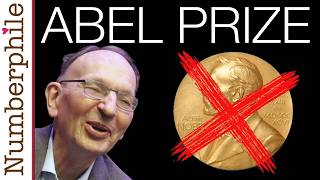

The Nobel Prize of Math?
40sControversial comparison between Abel Prize and Nobel Prize sparks debate about mathematics recognition.
▶ Play Clip"The title accurately reflects the content—a behind-the-scenes look at the Abel Prize ceremony, including the 'not Nobel' distinction."
The video takes viewers behind the scenes at the 2026 Abel Prize ceremony in Oslo, Norway. It covers the event's pomp, the laureate Gerd Faltings, and includes interviews that critique the prize system. The video also features a lighthearted souvenir theft of Faltings' name tag.
The Abel Prize is nearly 25 years old and is often called the 'Nobel Prize of mathematics'.
The winner was Gerd Faltings, known for cracking Mordell's conjecture.
The Crown Prince of Norway handed over the prize.
Faltings gave a humble, witty speech.
The host stole Faltings' name tag as a souvenir.
Faltings said the least liked part was the many interviews.
Faltings criticized the prize system as unfair, concentrating on few people.
Committee chair Helga Holden said they never use 'Nobel Prize of mathematics'.
Holden explained the selection process involves scanning the landscape and seeking overlooked mathematicians.
Holden noted top mathematicians are individualistic and independent thinkers.
What is the Abel Prize often called?
The Abel Prize is often called the 'Nobel Prize of mathematics' and has been awarded for nearly 25 years.
0:14
Who won the 2026 Abel Prize and for what work?
Gerd Faltings won the 2026 Abel Prize for his work on Mordell's conjecture.
1:33
Who handed over the Abel Prize to the laureate?
The Crown Prince of Norway handed over the prize.
2:30
What did Faltings say was the least liked part of the festivities?
Faltings said the least liked part was the many interviews he had to give.
4:10
How did Faltings describe the prize system in mathematics?
Faltings described the prize system as not fair because prizes go to few people who already have prestige, creating a self-reinforcing cycle.
4:33
What did the committee chair say about the phrase 'Nobel Prize of mathematics'?
The committee chair said they never use the phrase 'Nobel Prize of mathematics' because it is a banned phrase.
5:55
How does the Abel Prize committee select winners?
The committee scans the mathematical landscape, collects nominations, and gathers letters of recommendation from experts worldwide.
8:27
What is the cash prize for the Abel Prize?
The cash prize is 7.5 million Norwegian kroner.
9:02
What common traits do top mathematicians share according to the committee chair?
Top mathematicians are very individualistic, independent thinkers, and have succeeded against the odds.
9:21
Abel Prize as Nobel of Mathematics
Establishes the prize's reputation and context for the video.
0:14Faltings on Prize System Unfairness
Provides a candid, critical perspective from a laureate on the prize circuit.
4:33Committee Chair Rejects 'Nobel' Label
Reveals the official stance and the reasoning behind avoiding the comparison.
5:55Selection Process Explained
Details the deliberate, non-linear process to avoid a narrow prize circuit.
8:27Traits of Top Mathematicians
Offers a humanizing perspective on what makes these individuals exceptional.
9:21[00:01] Join me for a journey behind the scenes
[00:03] at the 2026 Arbell Prize. I'm heading to
[00:07] Oslo in Norway for this.
[00:12] For those unfamiliar with the Arbell
[00:14] Prize, it's been around for nearly 25
[00:16] years and has carved out a niche as the
[00:19] kind of Nobel Prize of mathematics.
[00:22] We'll talk more about that later. And
[00:25] hang around because later you'll see how
[00:27] I sneakily steal something from the
[00:30] prize winner himself.
[00:36] Now I arrived in Oslo on a Monday night,
[00:38] meaning I missed the traditional wreath
[00:40] laying ceremony at the statue of Neil's
[00:43] Henrik Arbell. He's the famed Norwegian
[00:46] mathematician after whom the prize is
[00:48] named, of course. And I did have time on
[00:51] Tuesday morning to go and pay my own
[00:53] respects.
[00:58] The wreath you can see was still there.
[01:01] I'm sure in the UK some scallywag would
[01:03] have pinched that by now, but there you
[01:04] go. Blowing in the wind. Now, I don't
[01:07] know if you've heard of Arbel, but if
[01:09] you're a math person, you've probably
[01:10] heard the term Arbillion. That comes
[01:13] from Arbell, so his name's everywhere.
[01:16] Now, next it was off to this very fancy
[01:18] hall for the prize ceremony. These
[01:21] murals were painted by Edward Monk,
[01:24] another famous Norwegian.
[01:26] Now, the winner of the prize was no
[01:28] surprise. It had been announced a few
[01:30] months earlier and it was the German Ger
[01:33] Falting.
[01:34] >> Our board has decided to award the Able
[01:37] Prize to G Fings.
[01:40] >> I won't go deep into his mathematics
[01:42] here. Suffice to say, he's a big deal in
[01:44] mathematics, and he cracks something
[01:46] called Mordell's conjecture. If I had a
[01:48] dollar for every time I heard the word
[01:50] Mell during this week, I'd almost be
[01:52] able to afford a beer in Oslo.
[02:07] Now, there was lots of singing and
[02:09] music.
[02:10] Fings by all accounts is a big music
[02:12] fan. So he probably quite enjoyed this.
[02:21] >> Your royal highness a laurate, ladies
[02:24] and gentlemen.
[02:25] >> And after a suitable amount of pomp and
[02:27] a very classily made intro video, the
[02:30] crown prince of Norway handed over the
[02:33] prize.
[02:35] Despite having a few issues with the
[02:36] trophy's orientation, Faultings then
[02:38] gave a really nice speech. He's quite a
[02:41] softly spoken and humble man, but I also
[02:43] found him quite funny. He's a dry wit.
[02:50] We then left the hall and I couldn't
[02:52] help noticing the trophy was left up
[02:54] there on stage. I hope someone picks
[02:56] that up later. And next, everyone got
[02:59] properly overdressed and we headed to
[03:01] the castle. More wine, of course. There
[03:04] was no shortage of that. And we all
[03:06] shook hands with this government
[03:08] minister and faultings himself.
[03:10] >> Congratulations.
[03:12] >> That's a lot of handshakes, more music
[03:14] and speeches. And it was actually quite
[03:16] a fun evening. I met some really
[03:18] interesting people at my table.
[03:28] But then leaving the banquet hall, I
[03:30] couldn't help noticing Falting had left
[03:32] his name tag on his table. He was gone
[03:34] and rather than having it tossed in the
[03:36] bin, I decided to keep it as a souvenir.
[03:39] Hey, at least I didn't steal that
[03:40] wreath, right? The next day, we were off
[03:42] to the university for lectures. Falting
[03:44] himself and three experts giving more
[03:46] technical talks. I have to admit, as a
[03:48] non-mathematician, some were a little
[03:50] over my head. This was definitely for
[03:52] the hardcore,
[03:54] but Falting sat through them. And as his
[03:57] reward, he was thrown under the bus for
[03:59] yet another interview. This time with
[04:01] me. What part of the festivities that
[04:04] we've seen so far did do you most like
[04:07] and what do you least like if you will
[04:08] tell me as well about it all.
[04:10] >> Least like are the many interviews I
[04:13] have to give
[04:16] and most like
[04:18] the prize ceremony ceremony was nice.
[04:21] >> Tell me about prizes. You've received a
[04:24] few obviously. What role do they play in
[04:26] mathematics? Do you see them as an
[04:28] important thing or trivial? How do you
[04:30] feel about prizes in general?
[04:33] >> Well, I mean it's when I was young, I
[04:36] didn't think about prizes
[04:39] and uh now I suddenly get them and uh I
[04:44] thought I mean they seem to concentrate
[04:46] on few people and not and I decided
[04:51] there mechanism going on. I mean the
[04:56] prize giver giver gains him prestige if
[05:00] the prize winner has prestige and the
[05:03] prize winner has prestige if the prize
[05:06] giver has prestige and so the prize
[05:09] giver looks for people who have prestige
[05:12] and how do they find them? they have to
[05:15] have gotten other prizes
[05:18] and so it comes that sort of prizes go
[05:21] to few people and there are many people
[05:24] who would deserve some recognition who
[05:27] don't get it so it's not a fair system
[05:31] but I'm profiting from it
[05:33] >> the full interview can be found over at
[05:34] number file 2 see the links below and I
[05:36] did show professor faultings his stolen
[05:38] name tag and he autographed it for me
[05:43] another party this time at the Norwegian
[05:45] Academy of Sciences which essentially
[05:47] runs the prize on behalf of the
[05:49] government. Helga Holden chaired the
[05:51] committee which decided the winner. So I
[05:54] spoke to him too.
[05:55] >> Let me say a phrase to you which I don't
[05:56] know if it's a band phrase or not.
[05:59] >> The Nobel Prize of mathematics.
[06:01] >> Yeah, this is a band. This is the band
[06:03] phrase. I I never use it. I never use
[06:06] it.
[06:06] >> But other people do use it and I don't
[06:08] mind if they use it.
[06:09] >> Okay.
[06:10] >> But I don't we don't the the academy
[06:12] will never use that. Yeah, I can
[06:15] understand why Alfred Nobel died now.
[06:18] But do you think he missed a trick by
[06:19] not having mathematics?
[06:20] >> Oh yes, he did a big mistake. A big
[06:22] mistake. Yes. I mean this was on the
[06:24] mission and I mean all these stories
[06:26] about why there is no Nobel Prize in
[06:28] mathematics and I think the closest one
[06:30] is that he didn't see the practical
[06:31] importance of mathematics because the
[06:34] original uh plan for the Nobel Prize in
[06:36] physics was to recognize the biggest
[06:38] discovery of the previous year. that
[06:41] does not make much sense these days at
[06:43] all and the first years it was given for
[06:45] practical inventions
[06:47] and he couldn't see any practical uh use
[06:50] of mathematics and of course now we know
[06:52] that this is not true and also we know
[06:55] that invent or discoveries in physics
[06:57] takes more than a year so the plan was
[07:00] great but he missed out something I was
[07:03] speaking to uh fings today and he was
[07:06] full of happiness and praise about his
[07:08] prize
[07:08] >> but he did raise an interesting point
[07:10] and I have read it elsewhere as well
[07:12] that the mathematical prizes can become
[07:15] bit of a like a circuit and the same
[07:17] people the same people win them you know
[07:19] if he won a fields medal then you win
[07:21] this then you win that and the same the
[07:23] same
[07:24] >> and I wonder how you respond to that
[07:26] because it's it seems kind of inevitable
[07:28] but I don't know how you get around
[07:29] >> it is this is an issue and we discuss
[07:32] this in the committee and we try to
[07:33] avoid you know making the circle smaller
[07:36] and smaller and some people get all the
[07:38] prices now I I mean there are a few
[07:41] people who stand out and they deserve
[07:44] all almost all the prices and they will
[07:46] get them eventually but we do make a
[07:49] serious search and look for names that
[07:51] have not necessarily been recognized and
[07:53] who deserve it. So so it is an issue. I
[07:56] I think it's a very valid point and uh
[07:59] has to be taken seriously. So when the
[08:02] committee sits and decides who the
[08:03] winner is going to be, it's not just a
[08:05] pure meritocracy and okay, all the best
[08:08] mathematicians except that one's got it
[08:09] and you're like working down a list.
[08:11] >> To put it uh in very simple words, when
[08:13] I took over the the chairmanship, I
[08:16] didn't get a list from my my predecessor
[08:19] with a list and I just had to cross out
[08:21] the next four names on his list. That's
[08:23] not how it works. So, so we try to scan
[08:27] the mathematical landscape and see if
[08:29] some people have been forgotten, some
[08:31] areas have been forgotten.
[08:34] We look for nominations and we collect
[08:37] letters of references, letter of
[08:39] recommendations from experts, real
[08:41] expert worldwide. Again, a full
[08:43] interview over at number file 2. And by
[08:45] the way, I asked around and I found
[08:48] this. Falting's prize was here in
[08:50] storage, presumably to be sent to him a
[08:52] bit later. Look at this lovely box.
[08:54] >> I have to admit, it feels kind of
[08:56] plastic. I wish it had been like crystal
[08:58] or glass or something. Maybe some silver
[09:00] and gold bits on it. But there you go.
[09:02] With a cash prize of 7.5 million
[09:05] Norwegian crowns, I'm sure the laurates
[09:07] can afford to jazz it up later if they
[09:09] want. Having seen multiple prize winners
[09:12] and these top people, is there anything
[09:14] you've noticed that you think, "Ah,
[09:15] that's that's why these best men and
[09:18] women, they've got something in common
[09:19] or something about them?" Yeah, I have
[09:21] the the privilege of having seen all of
[09:24] them since 2003
[09:27] and I have to say they stand out in some
[09:29] way. It's hard to describe but they
[09:31] really stand out from the crowd. I mean
[09:34] they are very individualistic.
[09:37] They are very independent thinkers. They
[09:40] do what they think they they want to do
[09:43] because they know they have been
[09:45] successful in doing that throughout
[09:47] their career. They have done things that
[09:48] people have said you nobody can do this
[09:50] and they have done it. So they stand out
[09:53] and overall they are extremely
[09:55] impressive from the professional point
[09:57] of view. When you look at other aspects
[10:01] you know I mean they are more like
[10:03] regular people when it comes outside
[10:04] their special field but in their special
[10:07] field I mean they are stars. That was it
[10:09] for me. Unfortunately, I couldn't attend
[10:11] some of the other events held in Arbell
[10:13] Week, including celebrations for younger
[10:15] students and teachers, but they all
[10:16] looked great. And maybe they'll invite
[10:19] me back next year. Or perhaps not when
[10:21] they find out about that stolen name
[10:23] tag.
⚡ Saved you 0h 10m reading this? Transcribe any YouTube video for free — no signup needed.