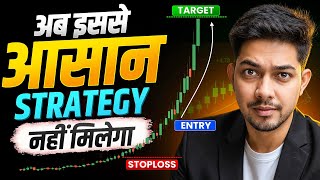

Price Action Traders Have No Place in Hell?
57sThe shocking opening line grabs attention and immediately challenges viewers to test their trading skills.
▶ Play Clip"Reveals a genuine pattern nuance but padded with repetitive prompting and program promotion."
This video reveals a nuanced mistake many traders make when trading classic price action patterns like double tops and double bottoms. The speaker challenges viewers to spot a key difference between two visually similar patterns, then explains how checking whether price crossed a previous high/low can separate profitable trades from losing ones. He also criticizes overcomplicating charts with indicators and emphasizes understanding time, price, and market psychology.
The speaker presents two patterns: a double top (M pattern) and a double bottom (Blue pattern), asking viewers to identify the difference between them before he explains.
If the neckline breaks, you enter, place a stop above/below, and set a target. This is the standard approach most traders know.
The major difference is that in the first M pattern, the high was not crossed during the second peak, while in the second pattern, the high was crossed. This changes the trade's validity.
One pattern formed a breakout, the other only a retracement. Recognizing whether price breaks out or merely retraces is critical for pattern validity.
Beginners only see the shape (M or W) and ignore the internal price behavior, which is why they fail even when trading textbook patterns.
Many traders add moving averages, Bollinger Bands, and divergence to 'enhance' price action, but this creates a messy chart and distracts from the core price story.
Any chart is built from two components: time and price. Understanding the momentum and story within these dimensions enables low-risk, high-probability trades.
Most people don't know how a candle is formed or that each candle tells a 'cash story'. Price action trading is fundamentally different from indicator-based trading.
The speaker advises against paying ₹40,000 for price action courses, stating that trading skill comes from experience, not just learning transactions or patterns.
To anticipate operator (institutional) moves, you must first understand retail trader behavior. Recognizing where the crowd enters and exits lets you trade against them.
Either master and follow basic rules using just one indicator, or deeply learn every chart detail. Both can work, but half-hearted attempts fail.
If you show 10 charts to 10 people, 9 will notice the same obvious thing. You should train yourself to see what those 9 miss to plan better trades.
Successful price action trading isn't about memorizing pattern shapes; it's about scrutinizing the internal structure—such as whether highs/lows are crossed—and understanding the psychology of other market participants. Simplify your approach, respect the fundamentals of time and price, and either follow strict rules or commit to deep learning.
What are the two components of any price chart according to the video?
Time and price.
04:13
What was the major difference between the two M patterns shown?
In the first pattern, the high was not crossed; in the second, the high was crossed.
01:55
What should you do when the neckline breaks in a double top/bottom pattern?
Enter the trade, place a stop, and set a target.
00:58
What does the speaker say about paying ₹40,000 for price action courses?
Do not pay it; you cannot become a trader just by learning transactions.
05:26
What must you catch before catching the operator's move?
The retailer's (retail trader's) move.
06:19
What are the two simple ways to make money in the market?
Either follow basic rules strictly with one indicator, or learn every detail deeply without shortcuts.
07:04
Out of 10 people shown the same chart, how many will see the obvious thing?
9 out of 10.
07:18
The High-Crossing Nuance
This is the core 'secret' of the video—a simple but often-overlooked detail that can invalidate a textbook pattern.
01:55Time and Price Are the Foundation
Reduces price action to its fundamental components, clarifying that everything else is just noise.
03:59Don't Overpay for Courses
Practical financial advice that saves viewers from common scams in the trading education space.
05:26Catch Retail Behavior First
A contrarian framework for understanding market moves by tracking the crowd before the operators.
06:19Two Paths to Profit
Gives viewers a clear binary choice: master simplicity or master depth—both valid, but not both at once.
07:04[00:01] not practicing price action trading, you wo n't even find a place in hell. Many YouTubers and Instagrammers who make YouTube videos of people making rails truth there is in this, I'll reveal to you in this video. I'll
[00:17] and how you can take it to an advanced level and make money. Look, I'm going to ask you a question. If you've answer this question. I'll show you two patterns,
[00:30] and then I'll show you two patterns. You'll have to comment and tell me the difference between the two patterns. This will help you understand your perspective. I wo n't tell you, but you'll know what you're seeing. Let's start.
[00:42] First, we're going to look at the price action here: double top and double bottom. One M pattern, and another is the double bottom, which we call the Blue pattern. Whatever your normal rule is, if this nick line breaks, enter here, place a stop plus
[00:58] here, place a target here, that's a matter of death. Now, simply tell me what difference you see between pattern A and pattern B. There is a difference, a very major difference. After seeing this, comment. Pause the video and comment. Then I will
[01:13] tell you what the difference is and what mistakes you make in price action trading, how you can take level further, how not to make a mess. I am going to make very clear points, but first, pause the video and comment and tell me what
[01:26] difference you see in this pattern. You have to write in detail. Okay, I have commented. After that, look at the same pattern here as well. Okay, this pattern in blue. What difference do you see between this pattern and this pattern? Pattern A and Pattern B. I will tell you how to comment. In the blue pattern, there is
[01:41] Or in the M pattern, there is this difference between the A pattern and the B pattern. I hope you have commented on this. Look. This applies to intraday stocks. this video, this applies to everyone. I have commented. Now, let me tell you,
[01:55] you see that the momentum has come down a little bit. This is not a major thing to look at. The major thing, I will tell you, is that the first time this M pattern was formed, its high, I mean, this high has not crossed.
[02:09] Okay, and the second time this pattern was formed, its high has crossed here. lot is going to happen here. When this pattern was forming and this
[02:21] pattern was forming, I will tell you the difference between the two. What is the difference between this pattern, if you look from here, I will give you the color of the betel leaf. From here, till the time it went up, it came down. When it went up, it must have gone up till here. When this pattern was forming, a breakout pattern was
[02:36] formed here, but a breakout pattern was not formed here. There was a retracement here, but there was a breakout here, what does it mean? It had a breakout here. It had a breakout here. breakout here. It had a breakout here. This means that the new bars that came in, the new
[02:49] A beginner doesn't understand these details. He simply sees what he saw. This M pattern also happened, this M pattern happened, this Blue pattern also happened, but there's a
[03:01] happened, this Blue pattern also happened, but there's a telling you, just like all the people who have started creating patterns, like the Rising Head and Shoulders, Cup and Handle, Pollen Flag, Sar pattern, a
[03:15] lot of other things have formed before they formed, after that, that thing gets formed. So, in the market, you only understand the patterns. People buy books, people buy charts, people like the seeing that, you'll think in the market that I should make an entry and take a trade. After
[03:30] If I implement it further, you'll still make a profit. But the problem is that people will add a little M spice to it. We'll apply a few moving averages, mix in a few inner bands, add a little divergence, and
[03:45] create a recipe that will make the chart look so messy. By trading on that chart, a guy calls himself a price centimeter. So, to become a price action trader, it's centimeter. So, to become a price action trader, it's
[03:59] pattern, Cobra, is. After all, you've heard a lot about price action. Look at how any chart is formed. It's made up of two things: time and price. Okay, here, consider this is a State Bank chart. If this is a one-day chart, then 11 am,
[04:13] If this is a one-day chart, then 11 am, 12:00 pm, 1:00 pm, 2:00 pm, 3 pm, this is the timing. And here, consider 400, 420, 450, of this type. If the price has such a momentum, if you analyze the momentum of this price, then the
[04:29] you analyze the momentum of this price, then the If you can understand that story by looking at this action, you can make a low-risk trade based on that. You
[04:44] identify one, the reward. You identify it where you see that there is a reward. You define a high probability trade where the probability is very high and you trade that thing by doing this
[04:58] action of this price. So you are a price and you are doing price action trading, but price action trading is not something to be kept. Price action trading is people do not know the basic thing about
[05:12] how a candle is formed. People do not know that a candle tells a cash story. People do not know that indicator trading and price expression are two different things. So if someone is teaching you price action trading and saying that just
[05:26] by learning price action trading you will become a trader, in return they are charging a lot. They are telling you that this is the fee for learning prices. Do not pay ₹40,000. You cannot become a trading center just by transactions. You can learn to see things through trading, but what to see,
[05:38] when to take the plunge, when to enter, when to exit, those are the main things. Coming with experience is a different thing and this thing is a different thing. Analyzing is a different thing and building a picture of the market based on the analysis, taking trades based on that,
[05:51] following your rules according to the trade, understanding what story the market is telling, that thing is a different thing, so what is the solution, is price action or not, like I told my students about price action in my mantra program,
[06:05] I said I am teaching you rules because if you do n't know the rules, how will you break the rules, you don't know what is happening in the game, so you don't know what is happening in the game, so
[06:19] want to catch the operator's move, then first you have to catch the retailer's move, before the operator you have to focus on the retailer, the spelling may be wrong, I apologize for that, I am not paying that much attention to this thing either, that is, what is the biggest mass behavior of the people, that is, the mother, doing, when will
[06:32] you know that thing, then you will be able to go against it, when will you know when those people You are going to get trapped when the market is going to trap those people, when you will be able to find out the behavior of the message of the money invested, when you will be able to find out when you will know
[06:49] seeing entry, where he is seeing exit, until you are able to find out that, you will you do not have to move ahead from the operator, you have to work with the operator, but before that you will have to be aware of every aspect of the trailer, I will tell you one thing, if
[07:04] you want to make money in the market, there are two simple ways, one thing is very simple, hold on to the basic things, follow the rules so fast that then you will get results from just one indicator, after that you will not have to use your brain much, and if you want to learn, then leave no stone unturned in learning,
[07:18] and if you want to learn, then leave no stone unturned in learning, detail, every minute thing that you are seeing after looking at the chart, if I show 10 charts to 10 people, then out of those 10 people, 9 people will understand one thing. Watch and you should
[07:32] see what the other nine people are watching. That will come when you play at their level one by one and understand their behavior and you can plan your trade accordingly because the last phone will definitely be there. So I hope that
[07:45] If you did not understand, I agree that the video was a bit advanced, then not learnt this thing in advance, then you can join and the rest of the program will be available in some next rest of the program will be available in some next important video. Till then, bye.
⚡ Saved you 0h 07m reading this? Transcribe any YouTube video for free — no signup needed.