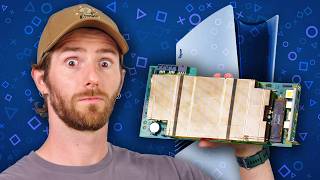

The Thermal Nightmare of Overclocked PS5 Boards
59sShowcases the extreme and risky nature of hardware mods with dramatic temperature spikesفق, which is both educational and entertaining.
▶ Play Clip"Delivers exactly what the title promises: a detailed, honest look at repurposing mining boards into gaming rigs, with benchmarks and caveats."
This video explores the BC250, a blade-style system-on-a-board originally created to salvage semi-functional PlayStation 5 processors for cryptocurrency mining. Now that mining is no longer profitable, these boards can be purchased for around $200 and repurposed into budget gaming rigs. The video details the hardware specifications, performance benchmarks, community modifications, and the trade-offs involved in using this unconventional hardware.
The BC250 was created in 2021 to salvage PS5 chips that didn't meet Sony's strict requirements, originally for large-scale crypto mining.
The BC250 can be found for around $200 and includes a 6-core AMD CPU, a 1080p-class GPU with ray tracing support, and 16GB of GDDR6 memory.
The BC250 lacks Sony's proprietary software and hardware encoding/decoding. The CPU is reduced from 8 to 6 Zen 2 cores, and the GPU from 36 to 24 compute units.
Cyberpunk runs at 50-100 FPS at 1080p, Batman Arkham City runs smoothly at 1440p, but Fortnite is unplayable due to kernel-level anti-cheat requiring Windows.
A dedicated community provides 3D-printed enclosures, power adapters, software patches, and guides to improve performance and ease setup on Linux.
Installing a modified BIOS unlocks additional parameters, allowing for better fan control, memory allocation tuning, and potentially unlocking disabled CPU/GPU cores.
The presenter unlocked the GPU to 40 compute units (more than a PS5) and increased frequency to 2GHz, achieving solid 60 FPS at 1440p medium in Cyberpunk.
Unlocking cores leads to high temperatures and noise; the 3D-printed enclosure caused temperatures to spike, requiring frequency reduction or exotic cooling solutions.
A full setup (BC250 + $60 SSD + power supply) costs around $300, and since there's no Windows support, no Windows license cost, making it exceptional value.
Issues include high idle power consumption, lack of hardware encoding/decoding (making streaming impractical), no onboard analog audio, and reliance on buggy DisplayPort audio.
These boards were run hard during mining, risking GPU memory degradation. Some newer games require hardware features not supported, causing compatibility issues with Proton.
Community development is rapidly improving performance and compatibility, but prices are rising (from ~$50 to $200), so interested buyers should act soon.
What was the original purpose of the BC250?
To salvage semi-functional PS5 processors for large-scale cryptocurrency mining.
00:14
How much does a BC250 typically cost now?
Around 200 US dollars.
00:38
What are the key specs of the BC250?
6-core AMD CPU, 1080p-class GPU with ray tracing, 16GB GDDR6 memory.
00:38
How many compute units does the BC250 GPU have compared to the PS5?
24 compute units vs 36 in the PS5.
01:58
Why can't Fortnite run on the BC250?
Its kernel-level anti-cheat requires Windows, which the BC250 cannot run.
02:42
What is the recommended memory allocation setting for the GPU?
Set it to 512 megabytes, aiming for around 7GB maximum VRAM usage.
04:08
What performance was achieved after unlocking the GPU?
40 compute units (more than a PS5) and 2GHz frequency, achieving 60 FPS at 1440p medium in Cyberpunk.
04:49
What is a major drawback regarding streaming on the BC250?
Lack of hardware encoding/decoding makes streaming and remote play impractical.
07:25
What is the total cost of a full BC250 setup?
Around $300 including SSD and power supply, with no Windows license cost.
06:41
Salvaging PS5 chips
Explains the origin of the BC250 as a repurposing of defective PS5 chips for mining.
00:14Unlocking GPU to 40 CUs
Demonstrates that disabled cores can be unlocked, exceeding PS5 specs.
04:49Untouchable value
Highlights the exceptional performance-per-dollar ratio of the BC250.
06:41Reliability concerns
Warns about the risks of buying hardware that was run hard in mining.
08:35Rising prices
Notes that community improvements drive up prices, urging timely purchase.
09:20[00:00] Okay, picture this. It's 2021. It's the height of the pandemic crypto boom. Computer silicon is worth more than gold. And AMD is just gonna throw away thousands of PlayStation 5 chips that
[00:14] don't meet Sony's strict requirements for performance and power consumption? I don't think so. And thus, the BC250 was born. This blade-style system on a board was originally
[00:26] created as a way to salvage semi-functional PS5 processors for large-scale cryptocurrency mining. But, now that that's no longer profitable, these cast-off machines can be found easily
[00:38] for around 200 US dollars. And for that low price, you get just about everything you need for a fully functioning gaming rig. Basic ION cooling, a 6-core AMD CPU, a decent 1080p-class GPU with support for hardware
[00:55] ray tracing, and, perhaps most importantly, 16 gigs of GDDR6 memory. Just add a fan, storage, and a decent power supply, and you're gaming, bud! What's the catch, Linus?
[01:07] Well, I don't know. She's Linus, what's the catch? I'm not the... What are you saying? I'm saying, Bayonetta is a catch, and I'll tell you. After the segue. That's all there.
[01:19] War Thunder. Take command of over 2,500 different tanks, planes, ships, and helicopters from 10 nations throughout history and present day. Play War Thunder for free on PC, console, or mobile
[01:32] using our links in the description. Probably the most important distinction is that while the BC-250 uses PS5 silicon, it is not a PS5. Sony's proprietary technology, including their system
[01:46] software and their hardware video encoding and decoding are non-functional. Even the core system specs are actually substantially lower. I already mentioned a reduction from 8 Zen 2 CPU cores to
[01:58] just 6, but the GPU is cut down as well, from 36 compute units in the PS5 to just 24 in the V6050. But remember guys, the PS5 targets upscaled 4K, so if we set our sights a little lower,
[02:13] There's a whole world of games that can run on this thing at 1080p high, or, for older and lighter titles, even higher resolution. Cyberpunk, for instance, manages around 50 to nearly 100 FPS, depending on the exact detail levels and whether you enable ray tracing,
[02:30] and Batman Arkham City was butter smooth for me at 1440p, absolutely cranky. As for Fortnite, what? Zero FPS? Fortnite's not that demanding, is it?
[02:42] No it not But its implementation of kernel easy does demand that you run Windows something the BC250 cannot do That going to be gotcha number two But there good news
[02:57] There is a glowing community around these little machines that is dedicated to making everything easier, from creating 3D-printed enclosures and convenient power adapters to help spread the load across multiple connectors, to creating software patches that improve performance and even writing
[03:13] detailed guides that help new users get started on the Linux distro of their choice. A more recent development is these convenient scripts that make the setup process a lot less intimidating and, maybe more importantly, make it easier to keep your operating system
[03:28] up to date without breaking any of the modifications that you might want to install. Modifications, you say? Yes, I do say. First up is the hackery to first boot your VCC50 that is, in my opinion, necessary, like
[03:41] installing the modified BIOS that unlocks many additional parameters, and then setting your less obnoxious fan control curve and fine-tuning your memory allocations. Just like the PS5, the BC250 has a single pool of RAM that is split between the CPU
[03:56] and the GPU. There are settings to fine-tune this split, but it's a little more complicated than just set and forget. Each setting indicates the minimum amount of RAM that is dedicated to the GPU, and then
[04:08] And out of what remains, Linux, by default, can borrow up to half of that for the GPU as well. If all that sounds complicated, just set it to 512 megabytes, and then aim for around
[04:20] 7-ish gigabytes maximum VRAM usage in your games. That'll give you about a gig of buffer room before your system will crash. Then you get into the fun stuff. Remember earlier when I said the CPU and GPU were cut down?
[04:33] What I really meant was, lockdown, and it turns out that in some cases, these cores can be unlocked to meaningfully enhance performance. We managed to not only increase the operating frequency of our chip to 2 GHz, but we also
[04:49] managed to get the full 40 CPUs of our GPU working. That's even more than a PlayStation 5. Let's game. Ah, the sweet sound of value.
[05:01] 40 FPS, not the most I've ever seen in Cyberpunk, but like, holy crap. This board is 200 bucks. Okay, let's go to a more reasonable 1080p. Man, with the unlock, this thing is fly.
[05:17] Here she is. 1440p, medium, little bit of upscaling. Solid 60 FPS. That is pretty freaking cool.
[05:30] As cool as that was it worth noting that silicon is usually discarded or repurposed for a reason And even if you do manage to unlock your chip like you did or some folks also get the missing CPU cores activated
[05:43] there are likely to be consequences. We were lucky enough on both of our units that most of our consequences were thermal related. You probably noticed while I was gaming that our system is a little noisy.
[05:57] These two powerful, not-too-industrial fans were necessary to keep the string at barely safe temperatures. And that was outside of our cute little 3D printed enclosure here. As soon as we put this on it, those safe temperatures went absolutely wild.
[06:12] Now backing off our frequency below 2 GHz would likely resolve this, but some enterprising users have gone the other route, frankensteining power coolers or even water coolers onto their decency 50s.
[06:25] Which raises the obvious question, is any of this worth the effort? I mean, there's no question the performance per dollar is there. A BC250 plus a $60 SSD and a doorstop power supply can be had for around $300 plus the cost of an operating system.
[06:41] But, wait a minute, no Windows support means no Windows cost. So, for about $300. That is untouchable value right there. But there are some issues, and I'm going to start with the smaller ones.
[06:54] The form factor? Not the most convenient thing ever. I touched on 3D printed chassis options, but some folks just mount them in computer cases, and then will either solder a front power button onto the rear one, or just give their PC the ol' reach around when they're
[07:09] trying to turn it on and off. Either of them takes a little bit of Redneck ingenuity, but is not a big deal. Same goes for the lousy idle power consumption. Depending on which Linux this one is kind of solved, but these boards were not designed to sit around doing nothing,
[07:25] which could contribute to your power bill. The lack of hardware encoding and decoding is a bigger deal to me. This makes BC250s basically completely impractical for streaming and remote play using applications like sunlight
[07:38] and moonlight. It's really a shame, because otherwise these would be very versatile and affordable thin clients. And another annoyance is that while standard USB means that you
[07:50] can counter plug anything you want into it, as long as it's supported on your Linux distro, there's no onboard analog audio, so you're reliant on the audio stream that comes over DisplayPort, which would be fine if it wasn't kind of buggy on these. Remember guys, these
[08:05] were compute boards, so high fidelity audio output wasn't exactly a priority. That means that depending on the cable you choose to plug in here, you might run into issues with the audio stream that coming over the play port The one surefire fix is a USB DAC but there only so many ports on this thing and I don recommend using USB DACs on a hub or splitter Bringing us finally to the big issue First is that these machines were almost certainly run hard and hot for their entire
[08:35] profitable lifespan. I mean, they were explicitly manufactured for crypto mining, a use case that is notoriously hard on every element of the system, especially the GP memory. And the other big one, and this is the one that might doom BC250s to the hobbyist shadow realm forever,
[08:51] is game compatibility. Some newer games require hardware features that this clunky, sort of a PS5 chip doesn't support properly, and I encountered multiple instances of games that should work with Proton on Linux that just didn't.
[09:08] At least, not for me anyway. But, with that said, the community hasn't fully given up on those. In recent months, community development around these has moved at a rapid pace, and it wouldn't
[09:20] surprise me to see them become more performant, more compatible, and more stable over time. The only thing to watch out for is that, when things get easier, the price tends to go up. These used to be like around $50 or something worth it, like $70, $50, $70 or something
[09:36] like that. Now they're up to $200. So, if you've got this fair cash, and this looks and sounds like a fun little project, I can wholeheartedly recommend BC250 modding. I mean, Lord knows, but brand new hardware marketing
[09:48] looks exciting from obvious right now. What is exciting, though, is telling you about our sponsor. Warthunder. Take command of over 2,500 tanks, planes, helicopters, and ships of 10 major nations in one of the most comprehensive vehicle combat games.
[10:03] So if you ever wanted to know what it's like to get behind a wheel of a 1920s fighter jet, now you don't need to take out that second mortgage. Because War Thunder is free on PC, consoles, mobile, as well as Mac and Linux. Immerse yourself in intense PvP battles where the war machines you control
[10:18] are modeled after the real-world counterparts, right down to the vroom-vroom sound the engines make. You're not going to have a hard clutter with hit-point boxes, because War Thunder's combat is focused around piece-by-piece damage
[10:30] you're doing to enemy vehicles. The X-Ray View allows you to see the intricate details of combat, like where your shells penetrated other tanks and ships, and what was damaged as a result. There's over 95 million players on War Thunder
[10:44] with a range of skills and game modes. So play War Thunder for free on PC, PlayStation, Xbox, and mobile using the links below. And new to the game or returning after six months, you'll get a massive bonus pack on PC and consoles
[10:56] packed with vehicles, boosters, and more. Claim your bonus and start playing today. You guys enjoyed this video? You might like the one we did recently or are about to do where we unlocked 56 gigabytes of hidden secret memory on another mining GPU.
[11:12] That was pretty cool.




⚡ Saved you 0h 11m reading this? Transcribe any YouTube video for free — no signup needed.