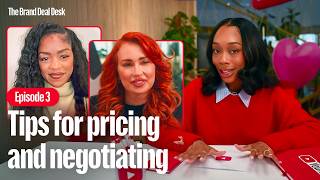

When Should Creators Bring Up Money?
39sThis raw, relatable moment about money anxiety hooks creators who struggle with pricing themselves.
▶ Play Clip"Delivers solid, actionable advice on pricing and negotiation, though host banter and a fragmented structure add some padding."
A panel of YouTube creators and industry experts break down how to price brand deals with confidence, covering pricing models, usage rights, contract terms, and negotiation tactics.
Ask brands for a paragraph explaining deliverables, usage, and proposed budget before quoting a price. This helps you gauge fit and whether you're in the right ballpark.
Deals can be structured as a flat fee, a fee based on expected views, or a performance-based commission. Choose based on whether the brand wants trust, reach, or sales.
If brands want to use content beyond your channel—in ads, on their site, across socials—that's added value and should mean additional money for you.
Creators often underpricing themselves by focusing on vanity metrics. Instead, figure out what you offer beyond those numbers to get a fair deal.
Long-form, short-form, and live content each have distinct value and should be priced differently, because they deliver different things to brands.
Offer tiered packages: bronze is the minimum you'll do for the rate, silver is more, and gold is the premium dream. Be willing to walk away if they don't bite.
Flat fees are straightforward—scope, usage, done. Hybrid deals include commission and work best when you have a proven ROI and know you can sell.
Look for indemnity clauses—always ask for joint indemnity. Check whether repurposing is global and if they'll dub you in other languages, and be aware that laws differ by country.
Charging the same for shorts and long-form is a common mistake. Set different starting prices for each in YouTube Creator Partnerships from day one, because they do different things.
Bundle a long-form video with an accompanying short to make the deal more complete for the brand and justify a higher fee. Always explore whether a longer-term deal is possible.
Define exactly what you're delivering, deadlines, and feedback stages. Watch for kill fees and payment terms before work starts, especially for international projects with tax, time zones, currency, and contract law complexities.
Pricing brand deals is about knowing your value, understanding what different content formats are worth, and negotiating beyond the headline fee with usage rights, add-ons, and long-term opportunities.
What are the three pricing models mentioned for brand deals?
Flat fee, fee based on expected views, and performance-based (commission) deals.
01:18
What should a creator ask a brand for before quoting a price?
A paragraph explaining the deliverables, usage, and proposed budget.
00:53
Why should creators price shorts and long-form differently?
Because each format has different value and does different things for the brand.
06:23
What is the bronze, silver, and gold negotiation tactic?
Offer tiered packages: bronze is the minimum you'll do for the rate, silver is more, and gold is the premium dream package. Be willing to walk away.
03:25
What are some usage rights that add value to a brand deal?
Using the content in ads, on the brand's site, across socials, on billboards, or in supermarkets.
01:43
What is the recommended clause regarding indemnity in creator contracts?
Ask for joint indemnity.
05:16
What is a common mistake creators make when pricing content?
Charging the same for shorts and long-form.
06:23
What does a 'hybrid' deal mean?
A flat fee plus some sort of commission; it works best if you have proven ROI.
04:21
What should be included in a contract before work starts?
Deliverables, due dates, feedback stages, kill fees, and payment terms.
08:14
What international factors complicate creator contracts?
Tax, time zones, currency, and contract law.
08:29
What is a key piece of advice for new creators trying to break through?
Be original and true to yourself.
05:41
What role do stats play in negotiation?
Stats are king; you cannot argue with the figures. Know your numbers and stick to your value.
05:57
Get the brief before the quote
Asking for deliverables, usage, and budget upfront prevents undervaluing and saves time.
00:53Usage rights are a revenue lever
Many creators forget to charge for usage beyond their channel, leaving money on the table.
01:43Tiered pricing anchors negotiations
Bronze/silver/gold gives creators flexibility and upsell opportunities.
03:25Rate cards: one size does not fit all
Separating short-form and long-form rates is a simple, impactful correction to a common mistake.
06:23Bundling and long-term deals win
Combining formats and pursuing recurring partnerships boosts both revenue and brand relationships.
07:45[00:06] variety of videos. One of those being when I technically became the richest would think that would make me the perfect person to talk about money because I'm British. I find that very vulgar. So luckily, I have two fantastic
[00:20] co-hosts who eat business for breakfast. >> I'm Erin White and I'm a business YouTuber. >> I'm [music] Max Fosh and I'm a YouTuber >> I'm Grace Andrews and I'm a creator entrepreneur.
[00:39] very beginning? >> I was so nervous. I actually wrote out a this, I'll be very happy." >> You've got to charge something that you work. >> At what point do you all bring up money?
[00:53] >> If [music] you can get a paragraph that explains what the deliverables are, what the usage is, and what their proposed budget is because then I can give a very within my ballpark and whether I'm interested in doing it. And within the
[01:06] video. You can start, you know, stacking video, a long-form video, community post, live. >> we should get into the weeds here. Like, how do we actually go about pricing
[01:18] >> Don't worry, guys. I got this. >> [laughter] >> I'm learning counting hacks. >> Now, when you're pricing a deal, there are a few ways you can do it. [music] A flat fee, a fee based on expected views,
[01:30] makes sense depends on what the brand actually wants. Is it trust, [music] reach, sales? You know, sales-based deals sometimes have a commission >> And don't forget usage rights. If they want to use your content beyond your own
[01:43] channel, in ads, on their site, across socials, that has added value. Know your numbers. Know your value and price like you mean it. And if you're not sure, talk to other creators because we are all learning this stuff together.
[02:04] marketing agency and a creator, I feel like you are going to know negotiation with you guys. >> Why do you think creators find it so hard to price themselves? >> They tend to immediately look at their
[02:20] vanity metrics. It's really about figuring out what you can offer beyond really get a fair price and a fair deal. has countered, that's a good thing. The worst thing is when you pitch a fee and
[02:32] >> [laughter] >> I definitely should have gone in higher. >> I don't struggle with the fee so much. What I really do struggle with is like everything else around it. >> Understanding your audience and really
[02:44] understanding that, looking at the metrics so that you can weight the that you're offering accordingly. >> Now, on YouTube you've got various different like forms of content. You've got long-form, short-form, live.
[02:57] >> They do need to be priced differently because they do each have different value associated to it. >> Crazy insights. Thank you. >> Here comes Sarah. >> Oh my gosh, I need a private word with
[03:11] >> Oh, thank you. >> Bye, Jade. your top negotiation tips, what would they be? they're like, "Actually, I've got less money." Then you want to go back and
[03:25] is how much I can do for the rate and that's the bronze tier. So, it's going originally discussed, right? And then your silver will probably be more originally want. And then for the gold, you can just sell them the dream. Stand
[03:39] walk away. >> it comes to negotiating contracts, what are those negotiables that you recommend creators zero in on? >> Really look at the whole library of features that are available on YouTube
[03:54] and utilize those to upsell. >> love everything you said. >> love everything you said. >> Thanks for having me.
[04:08] hey. Hannah, we are so glad you are here. For >> My name is Hannah Holland. I own a talent management company called HL D Talent. We manage some of the top creators in the country.
[04:21] deal? >> So, a flat [music] fee is like a this is what you have to do for it, this is the usage, easy. If it's hybrid, that means there's maybe some sort of commission with it. That
[04:35] deal only works if you know you sell. So, if you have a great ROI, that is kinds of deals. You have to understand what you bring to the table. business side of all of these conversations challenging?
[04:48] and they also sometimes struggle to know their worth or can overvalue their front? >> need to know the terms of the deal. What you also want to go through the usage. Is [music] it out of home? Are you on
[05:03] billboards? Are you in supermarkets? That adds to the fee, and then also know your payment terms. >> When creators open a contract, what are attention to? >> Indemnities. A lot of people don't even
[05:16] sued for if this doesn't go well. You should always have and say you want a joint indemnity. Repurposing. So, is it a global repurpose? If so, are they dubbing you in a different language? And also, the laws and regulations are
[05:28] different in different countries. >> Oh, I've missed everything, haven't I? mistake you often see new creators do. >> Thinking that what works for that one
[05:41] >> How do you creators who are starting now break through to become one of people's core ingredient? >> Originality. And I know it's a really really true to yourself. >> How do you get better at negotiating?
[05:57] >> Stats are king. You cannot argue with the figures. If you know I can sell this, you know your value, stick [music] to it. Your first negotiation is always going to feel a bit rocky. There's no harm in saying, "What is the budget that
[06:10] you're looking for?" >> Guys, this is great stuff. She's good. >> Let's break it down for those who slept in the back of class, Max. When it comes to pricing, one of the biggest mistakes creators make is
[06:23] charging the same for shorts and long-form. Don't. Inside YouTube Creator Partnerships, you can actually set your rate card directly in the platform. And you should be giving brands different starting prices for shorts and long-form
[06:38] from day one, because [music] they do different things and brands know that. >> And there isn't one magic formula, either. Some creators charge flat fees, engagement. And a lot of the time, people will use a mix of those things
[06:50] depending on the job, the brand, or what's actually being asked of them. The starting point for negotiation, not a fixed law carved in stone. [music] If a brand wants to put paid ad spend behind your video or puts your
[07:04] video on another platform, that's additional value for them. So therefore should mean additional money for you. Your creator partnership's rate card gets the conversation started. And the add-ons are where you make sure the deal
[07:16] actually reflects what they're getting. >> A lot of the real negotiation happens beyond the headline fee. Things like exclusivity, usage rights, extra social carefully about how you want to use them. You could charge extra, or they
[07:32] in with a brand you love. >> And one of YouTube's big strengths is that you can offer long-form and shorts on the same platform. So rather than think about how you can bundle them together to give the brand a stronger
[07:45] >> A long-form video as well as an accompanying short can make the deal a bit more complete for a brand, as well as justifying a higher fee for you. And always worth exploring whether there could be a longer-term deal [music] in
[07:59] the works, rather just a one-off. >> Now, once the money side is agreed, make you sign it. What exactly are you delivering? When is [music] it due? What halfway through? You also want to look out for things like kill fees,
[08:14] payment terms. Whether it's [music] a flat fee or a performance-based deal, work starts. professionally. Clear brief, clear deadline, clear feedback stages. And
[08:29] that matters even more if you're working internationally, where things like tax, time zones, currency, contract law can all make things a little bit more exciting than you might have hoped. >> I don't know about you, but I will not
[08:42] way. >> Kelvin, how much would you charge YouTube [music] for a five-part creator series? series? >> Um
[08:54] >> Hannah. >> Coming up, we go looking for the elusive brand deal sweet spot, [music] where brands and creators are totally aligned.
⚡ Saved you 0h 09m reading this? Transcribe any YouTube video for free — no signup needed.