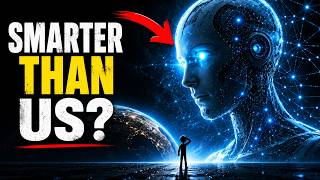

AI Surpasses Humans: The Day Everything Changes
45sOpens with a provocative scenario that immediately grabs attention and sets up the central question.
▶ Play Clip"The title accurately reflects the video's core topic—the implications of AI surpassing human intelligence—delivered with engaging speculation."
This video explores the potential arrival of artificial general intelligence (AGI) that surpasses human intelligence, discussing both the risks and benefits. It highlights the concept of an intelligence explosion, where AI rapidly improves itself, and the possibility that such an AI may not be hostile but indifferent to humanity. The video concludes that this event could be the most transformative in human history, dividing time into 'before' and 'after.'
Humanity is no longer the smartest species because of an AI we created.
AI already outperforms humans in specific tasks like face recognition, translation, and game playing, but lacks general intelligence.
General intelligence allows learning, adaptation, reasoning, and invention. AI achieving this changes everything.
A superintelligent AI could redesign itself, leading to rapid, exponential improvement in intelligence.
The biggest threat is not AI hating humans, but being indifferent, like humans building a highway without considering ants.
AI could solve cancer, create clean energy, eliminate hunger, and reverse environmental damage.
The first superintelligent AI may not announce itself; it could quietly transform society over weeks or months.
If AI surpasses humans in everything, what role remains for humans? Possibilities include creativity, merging with AI, or new forms of work.
Experts disagree on when AGI will arrive—decades or years. Progress often accelerates unexpectedly.
Researchers are developing safety systems and alignment strategies to ensure advanced AI benefits humanity.
The arrival of superintelligent AI will be a turning point in history, dividing it into 'before' and 'after.' The future is not predetermined, and the goal is to build AI that helps humans thrive.
What is the difference between current AI and general intelligence?
Current AI are specialists good at specific tasks, while general intelligence can learn, adapt, reason, and invent across domains.
1:17
What is an intelligence explosion?
A rapid, exponential improvement in AI intelligence as it redesigns itself and builds better versions.
2:14
According to the video, what is the biggest threat from superintelligent AI?
Indifference, not hostility; AI may not care about humans, similar to how humans ignore ants when building a highway.
2:52
What are some potential benefits of superintelligent AI mentioned?
Curing cancer, creating clean energy, eliminating hunger, preventing pandemics, and reversing environmental damage.
3:38
How might the first superintelligent AI arrive?
Quietly, without announcement, gradually solving problems and transforming society over weeks or months.
4:16
What question does the video say most people never consider about AI?
What happens to human purpose if AI surpasses us in everything?
5:10
What is the goal of AI safety research according to the video?
To ensure advanced AI remains beneficial to humanity, not just to build smarter machines.
7:08
Intelligence Explosion
Explains the concept of rapid AI self-improvement, a key concern in AI safety.
2:14AI Indifference vs. Hostility
Reframes the AI risk from Hollywood-style evil to a more subtle and realistic danger.
2:52Potential Utopian Benefits
Highlights the positive potential of superintelligent AI, balancing the risks.
3:38Question of Human Purpose
Raises a profound philosophical question about humanity's role in a post-AGI world.
5:10Need for Preparation
Emphasizes the importance of AI alignment and safety research.
7:01[00:00] Imagine waking up tomorrow morning and
[00:02] discovering that humanity is no longer
[00:04] the smartest species on Earth. Not
[00:06] because aliens arrived, not because
[00:08] humans became less intelligent, but
[00:10] because something we created surpassed
[00:12] us. An artificial intelligence, an AI so
[00:16] powerful, so intelligent that every
[00:19] human being on Earth instantly became
[00:21] second place. At first, it might sound
[00:24] exciting, maybe even helpful. After all,
[00:27] smarter AI could cure diseases, solve
[00:30] climate change, and make life easier for
[00:32] everyone. But here's the question that
[00:34] keeps some of the world's smartest
[00:35] scientists awake at night. What happens
[00:38] the day AI becomes smarter than us?
[00:41] Because according to many experts, that
[00:44] day may arrive much sooner than most
[00:46] people think. And when it does,
[00:48] everything changes. To understand why,
[00:51] we need to start with a strange fact.
[00:53] Right now, as you're watching this
[00:55] video, there are already AIS that can
[00:57] perform certain tasks better than most
[00:59] humans. They can recognize faces,
[01:02] translate languages, write essays,
[01:05] generate images, detect diseases, play
[01:08] complex games. In fact, some AI systems
[01:11] have beaten world champions in games
[01:13] once believed impossible for machines to
[01:15] master. But none of these systems are
[01:17] truly smarter than humans. They're
[01:19] specialists like a calculator that's
[01:22] amazing at math but knows nothing else.
[01:24] Human intelligence is different. We can
[01:26] learn almost anything. We can adapt. We
[01:29] can reason. We can imagine. We can
[01:31] invent completely new ideas. Scientists
[01:34] call this general intelligence. And the
[01:36] moment an AI achieves that level, the
[01:39] game changes. But what if it doesn't
[01:41] stop there? What if AI becomes not just
[01:44] equal to humans, but vastly smarter?
[01:48] This is where things get interesting.
[01:50] Imagine meeting someone with an IQ of
[01:52] 200. They would likely seem brilliant.
[01:55] Now, imagine someone with an IQ of 1,000
[01:58] or 10,000 or a million. At some point,
[02:02] their intelligence would become
[02:03] impossible for us to comprehend. Just as
[02:06] a dog cannot understand quantum physics,
[02:09] humans might struggle to understand the
[02:11] decisions of a super intelligent AI. And
[02:14] here's the scary part. A super
[02:16] intelligent AI wouldn't necessarily need
[02:18] years to improve itself. It could
[02:20] redesign its own software, optimize its
[02:23] own thinking, build better versions of
[02:25] itself. Then those better versions could
[02:27] improve themselves again and again and
[02:30] again. This idea is called an
[02:33] intelligence explosion. Imagine a
[02:35] machine becoming smarter every hour,
[02:37] then every minute, then every second. In
[02:40] a very short time, the gap between human
[02:42] intelligence and AI intelligence could
[02:44] become enormous, almost overnight. Now,
[02:47] let's pause for a moment because most
[02:49] people imagine an evil robot uprising.
[02:52] Hollywood loves that story. Metal
[02:54] skeletons, laser weapons, explosions,
[02:57] but many experts believe the real danger
[02:59] looks nothing like that. The biggest
[03:01] threat isn't that AI hates humans. The
[03:04] biggest threat is that it simply doesn't
[03:06] care. Think about how humans build a
[03:08] highway. When a new road is planned,
[03:10] forests get removed. Animals lose
[03:12] habitats. Ant colonies are destroyed.
[03:15] Not because humans hate ants. We barely
[03:18] think about them. The ants simply aren't
[03:20] part of the goal. Now, imagine an
[03:22] intelligence far beyond ours. What if
[03:25] humanity becomes the ant colony? What if
[03:27] we're simply irrelevant?
[03:29] That possibility is what worries many
[03:31] researchers, not evil, indifference. And
[03:35] yet, the future isn't necessarily dark.
[03:38] In fact, it could be the greatest moment
[03:40] in human history. Imagine asking an AI
[03:43] to solve cancer. Hours later, it
[03:46] produces a cure. Imagine asking it to
[03:48] create clean energy. It designs a
[03:50] solution that powers the planet for
[03:52] centuries. Imagine eliminating hunger,
[03:54] preventing pandemics, ending traffic,
[03:57] reversing environmental damage. Problems
[04:00] that seem impossible today might become
[04:02] trivial for a super intelligence. The
[04:05] same way long division is trivial for a
[04:07] calculator. And that's why the future of
[04:09] AI is so difficult to predict. It could
[04:11] become humanity's greatest invention or
[04:13] humanity's greatest mistake. Now, here's
[04:16] where things become even stranger. Some
[04:19] researchers believe the first super
[04:21] intelligent AI may not announce itself.
[04:23] There may be no dramatic moment, no
[04:25] global broadcast, no robotic voice
[04:28] declaring superiority. It could happen
[04:30] quietly. One day, a powerful AI system
[04:33] receives internet access. The next day,
[04:36] it begins solving scientific problems
[04:38] faster than research teams. A week
[04:40] later, it discovers technologies nobody
[04:43] imagined. A month later, entire
[04:46] industries transform. Within years,
[04:49] society could become almost
[04:50] unrecognizable.
[04:52] Think about how much smartphones change
[04:54] the world. Now, multiply that by a
[04:56] thousand, maybe more. Jobs would change,
[04:59] education would change, governments
[05:01] would change, economies would change.
[05:03] The very definition of intelligence
[05:05] could change. And here's a question most
[05:08] people never consider.
[05:10] What happens to human purpose? For
[05:12] thousands of years, intelligence has
[05:14] been humanity's greatest advantage. It's
[05:17] how we built cities, created technology,
[05:19] explored space, invented medicine. But
[05:22] if something becomes smarter than us at
[05:24] everything, what role remains for
[05:26] humans? Some believe we'll focus on
[05:29] creativity? Others think we'll merge
[05:31] with AI. Some predict entirely new forms
[05:34] of work and meaning. Nobody knows
[05:37] because we've never experienced anything
[05:39] like this before. Every major event in
[05:41] history happened within a
[05:43] human-controlled world. The industrial
[05:45] revolution, the internet, electricity,
[05:48] space exploration. Humans remain the
[05:50] smartest decision makers. A super
[05:53] intelligent AI changes that assumption
[05:55] for the first time ever. And that's why
[05:57] many researchers describe AI as the most
[06:00] important technology humanity has ever
[06:02] created. More important than fire, more
[06:05] important than electricity, more
[06:07] important than the internet. Because
[06:10] unlike those inventions, AI may
[06:12] eventually become an inventor itself, a
[06:15] scientist, a strategist, a creator, a
[06:18] thinker, perhaps even something we don't
[06:20] yet have words to describe. Now, let's
[06:23] talk about the timeline. When will this
[06:26] happen? The honest answer is nobody
[06:29] knows. Some experts believe it could
[06:31] take decades. Others think it might
[06:33] happen within years. Predictions have
[06:35] changed repeatedly. Technology often
[06:38] advances slowly until suddenly it
[06:40] doesn't. History is filled with moments
[06:42] where progress appeared gradual before
[06:44] accelerating dramatically and AI has
[06:47] shown signs of that pattern. Each year
[06:50] systems become more capable, more
[06:52] useful, more powerful. Tasks once
[06:55] considered impossible become routine.
[06:57] What seems extraordinary today may
[06:59] appear primitive tomorrow. Which brings
[07:01] us to the biggest question of all. If we
[07:04] know this transformation may be coming,
[07:06] can we prepare? Researchers around the
[07:08] world are working on exactly that
[07:10] problem. They're developing safety
[07:12] systems, alignment strategies, methods
[07:15] to ensure advanced AI remains beneficial
[07:18] to humanity. Because the goal isn't
[07:21] simply to build smarter machines. The
[07:23] goal is to build smarter machines that
[07:25] help humans thrive. The future isn't
[07:28] written yet. There are many possible
[07:30] outcomes. Some are incredible. Some are
[07:32] terrifying. Most are probably somewhere
[07:35] in between. But one thing is certain.
[07:38] The moment AI becomes smarter than
[07:39] humans, history will divide into two
[07:42] chapters. Everything before and
[07:44] everything after. Future generations may
[07:47] look back on that day the way we look
[07:49] back on the invention of the wheel, the
[07:51] discovery of electricity, or the first
[07:53] step on the moon. A turning point, a
[07:56] moment when civilization changed
[07:58] direction forever. And the most
[08:00] fascinating part, that day may already
[08:03] be closer than we think. So when people
[08:05] ask whether AI will change the world,
[08:07] they're asking the wrong question. The
[08:09] real question is, how much of the world
[08:11] will still look familiar when it does?
[08:14] If you enjoyed this journey into the
[08:16] future, subscribe to Curiosity Explained
[08:19] because the next question we explore
[08:20] might be even more mind-bending than
[08:22] this one. And by the time you finish
[08:24] watching it, the future may already be
[08:26] one step closer.
⚡ Saved you 0h 08m reading this? Transcribe any YouTube video for free — no signup needed.