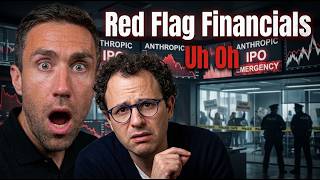

Anthropic's Shocking 2025 Losses Revealed
45sThe dramatic revelation of massive financial losses in a high-profile AI company sparks curiosity and debate.
▶ Play Clip"Delivers a solid breakdown of Anthropic's financials with useful context, though the 'canary in the coal mine' framing is a bit hyperbolic."
Anthropic's 2025 financials reveal a $4.59 billion revenue against $12.6 billion in operating expenses, resulting in an $8.06 billion loss, with a $42 billion derivative-related loss. The video breaks down these numbers, explains why 2025 data is standard for an IPO filing, and projects 2026 performance, highlighting concerns about growth stagnation and the company's $518 billion cloud compute obligations.
Anthropic reported 2025 revenue of $4.59 billion, operating expenses of $12.6 billion, and a net loss of $8.06 billion. A $42 billion loss is attributed to derivative value changes, likely from options given to investors.
IPOs require audited financials for the prior year, typically due April 30th. Companies often supplement with recent quarterly data, but 2025 figures are normal for an IPO prospectus, not deceptive.
Anthropic's annualized run rate is estimated at $65 billion, about 12x 2025 revenue. However, the company spent $12.6 billion to make $4.5 billion, leading to an $8 billion loss.
Anthropic has $518 billion in cloud compute and infrastructure obligations over the next decade, equating to roughly 10 gigawatts of compute.
Dividing by 100,000: revenue $45,900, spending $126,000, loss $80,000, with a promise to spend $5 million over a decade, while being valued at $20 million—illustrating circular investing.
Reports of operating profit in 2026 strip out stock-based compensation, revenue shared with partners like Amazon, and training costs—making the claim misleading.
OpenAI's ARR is $50 billion, but Anthropic's ARR appears to be flatlining, which could explain the urgency to IPO now before growth comparisons worsen.
IPO in Q3/Q4 2026 would show 10x growth vs. 2025, but lapping the Claude Code peak in Q2 2026 would drop growth to ~4x, and by Q4 2027 could stagnate to 30% or less, alarming investors.
Seven co-founders will hold 50.1% voting power via Class F stock in a separate LLC, shielding them from profit-focused lawsuits, allowing a safety-first narrative. Ben Bernanke is a trustee, Reed Hastings a board member.
Profitability and growth numbers for Q2-Q4 2027 are critical to determine if the AI bubble pops, not the IPO or early numbers.
Anthropic's 2025 losses are expected, but the real concern is ARR stagnation and massive future obligations. The IPO timing may be strategic to lock in favorable comparisons before growth slows, and the AI bubble's fate hinges on 2027 growth metrics.
Anthropic as Economic Canary
Highlights systemic risk: if Anthropic fails, AI funding and the broader economy could collapse.
00:45Revenue vs. Loss Disparity
Shows the scale of spending relative to revenue, illustrating the need for continuous investment.
03:10Misleading Profitability
Exposes how adjusted metrics can mask true financial health, a key lesson for investors.
06:29IPO Timing Strategy
Explains why companies may rush to IPO before growth comparisons worsen.
10:41Governance Structure
Shows how founders can retain control and prioritize safety over profits, a novel approach.
13:14[00:00] Little piggy, little piggy, come on home, holy smokes, we just got our first look at Antropix Financials, thank you Reuters, and man some people are really pissed off, these
[00:18] numbers are not making people very happy at all, the losses are way too big, and so what we're going to do in this video is we're going to break down exactly what these numbers represent, because a lot of these numbers represent 2025.
[00:33] So what we're going to try to do is get estimates for what's going on in 2026 and try to understand how impactful the numbers that just came out for Anthropic actually are,
[00:45] especially because Anthropic is not carrying the coal mine. If Anthropic gets sick, the entire economy dies. I know that sounds a little parabolic, but it's pretty much what I believe.
[00:59] it's anthropic and open AI rollover and all of a sudden you don't have the funding of the sort of circular investiture investiture, that's a good one, into chips that's like a combination
[01:11] of investment and divestiture if you don't have a circular investment into chips from a company like Anthropic who then of course in a circular nature gets investments from some of the very GPU
[01:23] manufacturers funding them the entire economy might not be spending this much money on AI. You could see a real big oopsie-doopsie. So, let's go through some of what actually just came out, because a lot of people are freaking out about
[01:35] this. Anthropic reported 2025 numbers, and one of the first things that I'd like to clarify here is some people think that that is, you know, designed to be deceptive or sussy-bocko or whatever, having a little bit of insight into how this stuff actually works. This is
[01:51] not actually Anthropic quote-unquote refusing to give 2026 numbers. That is not how that works, this is simply how IPOs work. You go to IPO, you do something known as file your audited
[02:04] financials, which are typically due April 30th of every year for the year before that. So, for example, my startup, that is PCAOB Audited, one of the most stringent auditing standards that
[02:16] exists. Actually, I think it's the most stringent auditing standard. When we have to file for, if we want to file for an IPO, we would use, or even a fundraise, we would use our audited financials and staple that basically to the fundraise or IPO or whatever you're doing.
[02:30] But that represents the prior year, right? And so usually what companies do is they'll report like, hey, well, the last six months were this, or the quarterly revenue was this. We're still going to get that kind of stuff from Anthropic.
[02:42] So it's really normal that an IPO prospect is going to give you 2025 numbers, because again, the 26 numbers aren't going to be available for a full year and audited until April of next year.
[02:54] So what do we have? Well, if you just briefly look at some of the things that are circulating online, you see some things that are a little confusing. So, for example, we'll put this together here, which indicates that revenue was about $4.6 billion, which is $4.59 billion in 2025.
[03:10] Currently, we expect the annualized run rate for Anthropic to be somewhere around $65 billion, which is close to around 12x where they were in 2025. However, with those 2025 numbers, they do show an $8.06 billion loss.
[03:25] And that is unfortunately because they spent $12.6 billion in operating expenses. So in other words, you made $4.5, you spent $12.6, and then you lost $8.
[03:37] That does show up, though, as a negative $42 billion loss due to the change in value of some derivatives. These to me sound like options that they basically gave to other companies or investors who invested in Anthropic And because Anthropic stock went up in value those options cost the company more basically Try to simplify this as much as possible
[04:00] It gets really funky. There's also talk that they had $20 billion of cash on hand at the end of last year. We don't know how that looks after, like, the METO training, Fable training, all that
[04:12] other good stuff, but we do know that they're expected to have $518 billion of cloud compute and infrastructure obligations over the next decade. So that's a lot.
[04:24] That could equate to around 10 gigawatts of compute. It's quite a bit. Now, these numbers do seem a little scary, and so some people are quick to react when I make this analogy,
[04:37] but this is a good analogy for 2025. It does not necessarily mean it is bad for 2026. We'll go through 2026 in just a moment and some of the real red flags that exist. this is just a way to scale the numbers that we just got for 2025.
[04:54] So let's say your name is Anthropic. All I did with these numbers is divide by 100,000. So when they say we have revenue of $4.59 billion, I just divide it by $100,000 to try to make it relative.
[05:07] So if I divide by 100K, I get to, let's say your name is Anthropic. You make $45,900 per year. you'd spend $126,000 per year, which means you lost about $80,000 a year.
[05:21] Then you made a promise that over the next decade, you were somehow going to spend $5 million. And some people say you are worth $2 trillion in the case of entropics, or in your case, $20 million.
[05:33] Which, this works because rich people keep investing in you so you can keep spending on their product. Yes, that is called circular investing. Some people get a little pissy, and they get their little panties tied up in a knot
[05:47] when I make that analogy, because they're like, oh, and this is like so an AI response. But then this, quote, very bullish guy, not biased at all. Fun analogy, but it runs on last year's paycheck. Blah, blah, blah, blah, blah.
[05:59] Okay. So the guy's obviously got his little cute AI that needs to reply, because that's apparently what very bullish people do, is they have AI replies to people. So anyway, this knucklehead does not realize that when this company says they actually turned an operating profit,
[06:17] that they did not actually turn an operating profit in 2026. So that person apparently missed the story, which we covered on this channel right here. But watch how they calculate an operating profit for 2026.
[06:29] So anybody who's telling you that, oh, well, the company's doing a lot better in 2026, just know this is what they're saying. The headline is, Financial Times, Anthropic tells investors it will be profitable for a second straight quarter.
[06:41] Good old Chris, quote-unquote very bullish guy, just read the title. But what do you expect? The guy's literally tweet-replying to people with AI summaries. That's sad enough.
[06:53] But anyway, if you actually look at the details, it says the company has told a small group of shareholders that its adjusted operating income will be positive for a second quarter. But the measure strips out stock-based compensation
[07:07] it also strips out the revenue that is shared with distribution partners including Amazon and the cost of training in other words what got us here all the people and the talent we just paid for
[07:20] yeah we're going to just pretend that doesn't apply then we're going to strip out all of the cost of training our models and then we're going to strip out all of our AWS you know related fees
[07:33] or at least some of them for distribution and then we'll call ourselves profitable. Yeah, that's too gazy, okay? I like to consider myself realistically bullish that we not at the end of the bubble yet but I know that if this canary croaks the whole thing is over So I like to be pretty clear about
[07:56] that. That's why I say low debt, because this canary croaks, and you've got knuckleheads out there like this Chris guy, who are like, oh no, no, no, man, but they're profitable, they're profitable, bro. It's like, no, no, they're not, Chris. They're not. And they're not going to be
[08:14] in 2026 either. And that's where things get really, really fascinating. Because the 2026 numbers actually provide some cause for concern. Like, actually. So first of all, I'm going to show you
[08:29] opening eye. Opening eye according to ticker trends. And then we got to talk about the whole founder non-profit thing that they got going on. Boy, oh boy, we gotta talk about that. Opening on has an annualized recurring run rate of about $50 billion.
[08:43] It's based on current estimates. You can see this growth trajectory is pretty solid. Now, before I show you Anthropix, which is just a couple clicks away over here, and I have it up, I apologize. I got a roll of that, baby. If you or your channel spent years
[08:59] growing up on social media and experienced serious mental health struggles. You should hear this. Recently, a jury ordered Meta and YouTube to pay millions for their role in designing and promoting addictive platforms. They knew their apps could contribute to anxiety,
[09:15] depression, and body image issues, but did not share those risks while prioritizing profits. The recent historic verdict underscores the consequences of those decisions. Now, Morgan & Morgan is stepping up to hold these platforms accountable for the harm they caused.
[09:31] Click the link in my bio to take a short quiz, and you may be entitled to a potential recovery of over $1,000. It's quite easy to do. Go to the link in the description, fill out the form for yourself or a loved one.
[09:44] It's quick, easy, and you could recover a potential recovery of over $1,000. This is Anthropix, and this is a little bit more concerning,
[09:58] because if this is accurate, which we do not know that it is accurate, it totally makes sense why Anthropic wants to IPO now. Think about it. If you were Anthropic and you're like, hey, you know what?
[10:13] Do we want to IPO now or next year? If your annualized recurring run rate is flatlining, in other words, you're not getting more growth because people are cutting back on tokens or they're using open weight models or whatever, that's problematic.
[10:27] But not only that, as you go into next year, the desirability of your comparisons are going to look a lot worse. Watch this. Let's say you IPO in the third or fourth quarter here in 2026.
[10:41] If you compare to last year, it's going to look like your growth is up massively compared to last year, right? You know, you're going to compare to Q3 2025 or Q4 2025.
[10:55] your revenue is literally going to be up 10x, which will look like 900%, because your revenue in that quarter will be like $21 billion. You compare that to 2 then, that's 10x. That's great.
[11:07] But if you lap the Claude Code and Claude's co-work moment of Q2 2026 right here, where you had $7.5 billion of revenue, all of a sudden it's going to look like you're closer to 4x.
[11:21] That's still good. but that growth rate is starting to plummet. And I'm not saying that's bad. The company's doing well. I'm just saying you have a desire to IPO here when you're comparing to those
[11:33] peak moments. Ignore the fact that here it says 1,300% because that's comparing to like really really tiny numbers of you know a few hundred million dollars before that The point is these are pretty big numbers and the percentages are pretty big But those percentages start getting teeny tiny tiny tiny once you start lapping this
[11:52] Now, does that matter? No, because it's still good. But you know where it matters? What happens if you get to Q4 2027, and your growth rate has potentially started to stagnate, and instead of growing at 4x, you're growing at 30%?
[12:08] or worse, you're barely growing quarter over quarter, or sequential quarter after sequential quarter, because of that stagnating annual recurring revenue, that's when investors get nervous.
[12:20] Because as long as you're growing, investors are like, okay, cool, yeah, you guys will get through the loss, you guys will make it, you'll be all right. But as soon as you stop growing, that's when people stop funding the AI build-out. And we've talked about it all day long.
[12:33] You need to fund the AI build-out. The big red flag is when the AI funding stops, you're cooked. Okay. That's really important to know. So, yes, we want to know what's going on with the ARRs.
[12:47] Very, very important. Now, the $518 billion of commitments that they have, yeah, that's about $50 billion a year per, sorry, $50 billion per gigawatt that works out to about 10 gigawatts of spend, essentially, over the next few years to decade.
[13:01] We're not entirely sure. Reuters screwed up the first version of the article, and then try to fix it. Whatever, fine. Point of all this is that the company's going to go public. This is their release,
[13:14] and there's this thing called a new founder LLC. They're positioning this to serve the common good. It's the seven co-founders, basically, are going to be able to hold 50.1% of the voting power of the stock with a class F stock.
[13:26] And because they're in a separate LLC, they'll be essentially guarded from lawsuits that force them to focus on profits so that they can argue that they're focusing on safety first
[13:38] and that's why they're forestalling profits. Make it that what you want. Ben Bernanke is now a trustee of all this stuff. Reed Hastings is a board member. Like, he got some big names in this. The company's, like, they do have a very good product.
[13:51] I'm going to give them that. I think they have a fantastic product. Claude's probably one of my favorites. I don't have any exposure to Claude. I kind of wish I did because it'd be way up if they were going to IPO for $2,000. But I don't know.
[14:03] I mean, I haven't seen the whole document yet, but do I really want to invest in this right now? I don't know. Is it really going to depend on that AR? We don't actually have profitability numbers, though, for really any of the quarters that I think matter or growth rate numbers.
[14:18] And so this is why I say what matters so much for Claude or the company, Ethel Roberts, what matters so much is what happens to this company on a Q2-27 to Q3 basis, Q3 to Q4,
[14:32] and how are things evolving and changing up, that's when you know if this AI bubble is going to pop. Not because of the IPO. Not because of these early numbers. It's way too soon for this,
[14:44] and I still hang my hat on this idea that we're going to end up getting an Iran deal and the market will have a glorious euphoric rally once we get that. Obviously, still have some work to do to get there.
[14:57] So that's my take on these anthropic numbers. Sorry to some of these knuckleheads that seem to have blinded perspectives on the Internet.
[15:09] But I think this is a useful perspective to share. And we'll see how it goes. Anyway, thanks for being here. Have a great night. If you like that video, shake this around. I think you're going to love it. I don't know about advertising. These things are incredible to see.
[15:22] I feel like nobody else knows about this. We'll try a little advertising and see how it goes. Congratulations, man. You've done so much. People love you. People look up to you. Kevin Passer, finance analyst. and YouTube up neat Kevin always great to get your take



⚡ Saved you 0h 15m reading this? Transcribe any YouTube video for free — no signup needed.